
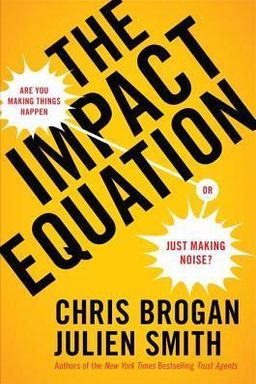
The Impact Equation cover

The Impact Equation

by Chris Brogan and Julien Smith

The Impact Equation offers a fresh perspective on making your brand unforgettable. By mastering the art of communication and leveraging a unique formula, you can ensure your product not only hits the market with impact but remains relevant and trusted by your audience over time.

Turning Ideas into Real Impact

Have you ever felt that your ideas, work, or brand make noise—but not a real difference? Chris Brogan and Julien Smith’s The Impact Equation asks this provocative question at the heart of modern creative and business life: are you making things happen, or just making noise? In our era of endless tweets, updates, and self-promotion, the authors argue that real influence and lasting success come not from louder messages but from more resonant ones—from ideas designed to create genuine human impact.

Brogan and Smith don’t just explore social media; they use it as a lens to understand how people spread ideas and connect in a digital world. As they put it, calling their book one about Facebook or Twitter would be like saying Moby-Dick is about boats. The real subject is you—the creator—and how you project meaning into the world. The book introduces a practical framework called the Impact Equation: Impact = C × (R + E + A + T + E). Each letter represents a key attribute of influence and creativity: Contrast, Reach, Exposure, Articulation, Trust, and Echo.

The Core Argument: Creation Outweighs Noise

At the center of the book is the belief that technology has democratized ideas. Anyone with an internet connection is simultaneously a media consumer, creator, and even a media owner. This is revolutionary—but it also means the marketplace of ideas is crowded, chaotic, and unforgiving. To thrive, you must learn how to make your idea stand out (Contrast), reach people effectively (Reach and Exposure), and connect emotionally and credibly (Articulation, Trust, and Echo).

The authors show that impact begins not with a platform but with a purposeful idea. They challenge readers to think like entrepreneurs and adventurers—people who act first, experiment constantly, and build communities around what they care about. Brett Rogers, one of the book’s early examples, epitomizes this spirit. Disillusioned by the tourist-choked town of Jasper, Canada, Rogers started documenting his rafting journeys down wild rivers, eventually letting supporters fund his next expeditions. His success didn’t come from permission or pedigree; he “picked himself.” In today’s world, Brogan and Smith suggest, that’s what all real creators must do.

Why the Equation Matters

The six attributes form a system for assessing and improving any message or idea. Each one adds a dimension of human relevance:

  • Contrast: The art of standing out by being meaningfully different. Without it, your message disappears into the crowd.
  • Reach: How far your ideas actually travel—your audience size and network.
  • Exposure: How often people encounter your message in ways that reinforce their trust and familiarity.
  • Articulation: How clearly and simply you express what you do and why it matters (“Tell it to me like I’m six years old,” as one business professor advised).
  • Trust: The credibility, reliability, and sincerity that make people believe in you beyond surface impressions.
  • Echo: The emotional resonance your ideas create—the sense that “I see myself in this.”

Brogan and Smith organize their guidance around building and blending these forces—first through ideas, then through platforms, and finally through human connection. This progression—from the inner creativity to outer communication and social engagement—reflects how influence grows from the inside out.

Why This Matters to You

The Impact Equation redefines success in the digital age. Old media relied on gatekeepers—magazines, producers, editors—but today’s world rewards those who can combine creativity with authenticity. You don’t need permission to publish, launch, or promote your ideas. But you do need contrast and clarity in a world drowning in content. Whether you’re a freelancer, business leader, or artist, the question remains: how do you make sure your story doesn’t vanish in the noise?

Throughout the book, Brogan and Smith share examples—from adventurers like Rogers to musicians like Adele and entrepreneurs like the founders of Dollar Shave Club—showing that impact can emerge anywhere creativity meets care. They also remind readers that social tools are temporary; people and stories are timeless. If you focus on connecting authentically rather than simply broadcasting, you’ll not only amplify your reach—you’ll deepen your influence.

Ultimately, The Impact Equation challenges you to measure success not by followers or clicks, but by the emotional, cognitive, and human footprint you leave behind. It’s about transformation over transaction. The authors’ message is simple yet profound: everyone can have impact—but only if their ideas are built to connect.


Contrast: Standing Out in a Crowded World

Brogan and Smith devote one of their deepest explorations to Contrast, the starting multiplier of their equation. Without it, they say, your work is invisible. In a marketplace flooded with posts, products, and pitches, people notice only what diverges meaningfully from everything else. As entrepreneur Brett Rogers demonstrated, being “an adventurer who sails down rivers without burning a drop of oil” is an idea that instantly separates him from hundreds of generic filmmakers.

Understand How Ideas Compete

Every idea, like a species, competes in an ecosystem for survival. Drawing on The Selfish Gene by Richard Dawkins, the authors describe ideas as memes that replicate or die depending on how well they fit the environment. A well-shaped idea is like a baseball designed for a glove—it catches attention. A misshapen idea bounces away. Malcolm Gladwell’s terms such as “tipping point” succeeded because they were clear and memorable enough to travel between people. You can do the same by shaping your ideas around emotional relevance, not jargon.

Patterns and Bravery

Humans are pattern-seeking creatures. We tune out sameness, which is why authentic divergence matters. The authors identify three ways to test Contrast: incremental (small variations that don’t offend), radical (drastic shifts that may repel), and moderate (balanced innovation). The courage to be distinct fuels the third path—the art of brave differentiation. They tell the story of Dan Carney, a minimalist project manager who simplified an overcomplicated corporate system into ten daily items and ten-minute meetings. Many dismissed it as “too simplistic.” Yet bravery often means pruning complexity to create clarity.

“Bravery is not the absence of fear—it’s boldness despite it.”

The authors remind you that daring ideas often look foolish before they look brilliant. Simplicity, in this sense, is courage.

Emotional Contrast and Connection

Contrast is not just aesthetic; it’s emotional. To evoke attention, you must spark feeling. When Chrysler launched its “Imported from Detroit” campaign featuring Eminem, it didn’t sell cars—it sold pride, authenticity, and grit. Emotional contrast makes messages stick because it breaks monotony in a sea of functional marketing. Even humor and surprise—like YouTube adding a “vuvuzela” button during the World Cup—create memorable dissonance that draws people close.

Creating Stronger Contrasts

  • Map your audience’s “default world” and design something different enough to provoke curiosity but not alienation.
  • Simplify jargon—speak like a human, not a corporation.
  • Decide what to eliminate. As Cirque du Soleil did when cutting animals from the circus, subtraction can create powerful uniqueness.
  • Anchor your contrast with emotion—fear, pride, joy, nostalgia—so people feel the distinction, not just see it.

When Contrast is designed intentionally and courageously, impact multiplies. In Brogan and Smith’s words, “If your offering looks like everything else, no one cares. But if it’s you—authentic, brave, and distinct—your audience will.”


Articulation: Clarity that Cuts Through Fog

Once you’ve created a distinct idea, you must explain it so clearly that anyone can grasp it instantly. That’s the essence of Articulation. As business instructor Kenneth Hadge famously said, “Tell it to me like I’m six years old.” Brogan and Smith emphasize that big words and clever phrasing don’t build impact—clarity does. Complex explanations confuse; simple ones convert.

Simplicity Over Sophistication

Simplicity isn’t childish—it’s strategic. Nike’s “Just Do It” conveys a global psychology of action in three words. Chipotle’s menu boards—“Order,” “With,” “Salsas,” “Extras”—demonstrate how clean labeling invites immediate understanding. In contrast, verbose mission statements dilute meaning. Brogan and Smith challenge you to strip down every sentence until only the essentials remain. An articulate idea is a sword, not a fog machine.

The Fierce Editor

Writing, the authors argue, is now a fundamental twenty-first-century skill. To cut through information overload, you must edit relentlessly. They suggest reviewing every email, blog post, or speech for brevity: could it fit in two sentences? Tools like two.sentenc.es encourage disciplined communication. Brevity forces you to lead with essence—not decoration. (Compare this to William Zinsser’s On Writing Well, which also sees clarity as a moral duty in communication.)

“Use small words for big ideas.”

Brogan and Smith insist that even the smartest audiences crave simplicity; it shows respect, not condescension.

Connecting the Dots

Great articulation stitches ideas together like constellations. The authors build on Howard Gardner’s concept of synthesis: connecting varied insights into one cohesive picture. Whether crafting blog posts or business pitch decks, clarity depends on linking parts into an intelligible whole. The difference between random notes and symphonies is organization. Think of Stephen Hawking’s A Brief History of Time, which translated astrophysics into human-scale ideas. Articulation turns complexity into revelation.

Speaking the Audience’s Language

Finally, Articulation means meeting audiences where they are. Speak their vernacular, not yours. Whether talking to scientists or designers, echo their familiar references while introducing new patterns—just as Adele speaks to heartbreak without lofty metaphors, making universal emotions feel personal. When Stephen Hawking turned “black holes” into visual metaphors, he built bridges between experts and laypeople. To articulate well, translate—not impress.

Brogan and Smith’s challenge is simple but demanding: respect attention by making comprehension effortless. A well-articulated idea doesn’t need repetition—it spreads itself. And in a noisy age, clarity is not just elegance—it’s survival.


Reach: Extending Your Voice Across Networks

After you create and clarify an idea, you must ensure people can find it. Reach measures how far your influence travels. It’s not about vanity metrics like followers or views; it’s about real connection across meaningful networks. Brogan and Smith argue that technology has made Reach more possible—and more misunderstood—than ever before.

Building Platforms, Not Just Audiences

In the past, media Reach belonged to gatekeepers—TV networks, newspapers, radio. Now anyone can build a multimedia platform. Lucas Cruikshank’s “Fred” videos on YouTube and Amanda Hocking’s self-published novels demonstrate that with low-cost tools, creativity can outpace corporations. The authors urge you to think like a media owner, not merely a participant. Every tweet, blog, or email list expands your footprint if used intentionally.

From Audience Building to Influence

Reach grows gradually, like Louis C.K.’s comedy career or Paulo Coelho’s global following. It’s cumulative patience. One reader becomes ten, ten become one hundred, and soon the network reinforces itself—a “rich-get-richer” cycle of visibility. But Brogan and Smith warn that faking reach (buying followers or email lists) creates hollow influence. Instead, Reach thrives through repeated authenticity and engagement. Your message must travel through trust, not tricks.

Selecting the Right Channels

Reach depends on channel strategy. A blog nurtures depth; Twitter spreads speed; LinkedIn builds credibility; YouTube offers emotion and tone. Whichever mix you choose, Brogan and Smith stress consistency over volume. Brett Rogers reached people through documentaries and personal storytelling long before crowdfunding existed. The goal isn’t ubiquity—it’s presence where your audience already gathers.

Why Bigger Isn’t Always Better

Reach doesn’t guarantee impact; intimacy magnifies meaning. The authors advise focusing on networks that care, not crowds that skim. Rachel Hawkins, a young-adult author, grew loyal readers not through mass advertising but through friendly Twitter exchanges and behind-the-scenes storytelling. A smaller, attentive audience can generate more influence than passive millions. Size matters only when paired with depth.

The takeaway? Reach is not a race for numbers. It’s a long-term architecture of connection, trust, and relevance. Build intentionally, communicate consistently, and let your voice ripple outward through relationships—not algorithms.


Exposure: Staying Visible Without Becoming Noise

Exposure is how often your message appears—and how well repetition builds trust instead of fatigue. Brogan and Smith contrast sustainable visibility with hype. Hype flares then dies; exposure compounds and strengthens. The authors show how consistent, purposeful presence creates a “default status” in your audience’s mind, much like Saturday Night Live occupying Saturday nights without needing perfection.

The Bell Curve vs. the Climb

Advertising spikes attention like a bell curve: brief peak, fast decline. Owned platforms—blogs, podcasts, communities—build exposure through steady accumulation. Each connection reinforces memory and reliability. When Wikipedia runs a donation drive annually, its exposure succeeds because people interact with it year-round. High Trust plus timely requests equals lasting impact.

Frequency Done Right

So how often should you blog, tweet, or post? The answer: as often as you can deliver quality people care about. Chris Brogan experimented with daily versus weekly blogging. He found daily posts attract subscribers but don’t ensure deeper engagement; conversations matter most. Julien Smith discovered weekly posts could sustain quality and enthusiasm while avoiding burnout. The frequency sweet spot, they say, depends on consistent engagement rather than mere output.

Avoiding the “Look at Me” Trap

Exposure isn’t about demanding attention—it’s about earning it. The authors call excessive self-promotion the “Look at Me” problem, where creators shout louder instead of serving audiences. True exposure arises from helpful persistence. Jeremiah Owyang, for example, gained credibility by freely curating competitors’ products, making his site a go-to resource. Transparency builds comfort; hard-sell tactics erode trust.

Staying Fresh in the Saturation Era

Information overload makes exposure tricky—people drown in updates. Brogan and Smith recommend purposeful content (only share what’s useful or entertaining), brevity (design for mobile attention spans), and channel diversity (customize posts per platform instead of duplicating). A steady voice amid chaos earns respect. They remind you that, paradoxically, silence can sometimes enhance exposure; absence builds anticipation.

To manage exposure elegantly, be rhythmic, relevant, and real. When your audience thinks of your subject, you should naturally come to mind. That’s how repetition transcends noise—and transforms attention into loyalty.


Trust: The Invisible Currency of Influence

If exposure keeps attention, Trust keeps belief. In the formula, it bridges performance and perception—what people expect versus what you deliver. Brogan and Smith revisit concepts from their earlier book Trust Agents, merging human psychology with business science through the Trust Equation: Credibility × Reliability × Intimacy ÷ Self-interest. They argue that trust, more than any other factor, determines whether ideas grow or die.

Four Pillars of Trust

  • Credibility: You must prove competence. Awards, testimonials, and affiliations signal skill—but long-term credibility rests on consistency. As Seth Godin says, “People trust you when you’re trusted by others.”
  • Reliability: Deliver repeatedly. Many online creators vanish after enthusiasm fades; reliability distinguishes amateurs from professionals. Editorial calendars and daily habits cultivate trust through rhythm.
  • Intimacy: Show warmth and empathy. In the authors’ view, intimacy outweighs credentials; people prefer connection to perfection. Rachel Hawkins’ conversational tweets and thank-you replies make readers feel known—a quiet but potent intimacy.
  • Low Self-interest: When people sense you’re genuinely helpful—not hustling—they relax and reciprocate. Generosity signals abundance; greed signals danger.

The Human Factor

The authors highlight how humor and humility humanize brands. During the 2010 World Cup, YouTube added a “vuvuzela” button that playfully annoyed millions. It was absurd—but it made users laugh, revealing a company conscious of shared culture. Audiences crave humanity, not automation. As they write, “In a world of bots and press releases, acting human is revolutionary.”

Building Trust Over Time

Trust has no shortcuts. Like small-town reputations, it grows through time and transparency. The authors encourage long-term reliability: meet commitments, show up, and admit mistakes publicly. They reference Barry Moltz and Becky McCray’s Small Town Rules, which parallels online communities with rural ones where everyone knows who keeps promises. In digital life, every post is a public record; credibility accumulates or erodes daily.

“Trust isn’t built by perfection—it’s built by reliability under pressure.”

Mistakes owned publicly deepen credibility more than flawless façades.

Every comment, email, and tweet is a microtransaction of trust. Treat them that way. If you respond, keep promises, and act sincerely, you’ll compound influence in ways data can’t measure. Trust, ultimately, is slow—but exponential.


Echo: Resonance and Emotional Connection

Echo—the final element of the Impact Equation—is the heartbeat of influence. It measures how deeply your ideas reflect your audience’s identity and emotions. When people say, “That’s exactly how I feel,” echo happens. Without it, communication is mechanical. With it, it’s transformative.

Empathy and Identification

Echo relies on empathy, not expertise. The authors illustrate this through Adele’s concert at Royal Albert Hall, where her intimacy with fans produced a universal connection. She wasn’t performing at them—she was talking with them. Authentic moments (“I hate being the sober friend dealing with drunk friends”) bridge celebrity divides. Audiences see themselves in her stories, creating emotional mirrors.

When Echo Goes Wrong

Misused empathy backfires. Celebrities who join protests in designer jeans trigger dissonance—they claim solidarity but signal separation. The authors caution that false familiarity breeds cynicism. Echo requires lived or shared emotion, not borrowed sentiment. Speak from experience, not simulation.

Human Resonance in Practice

Echo manifests in many ways: answering fan messages, understanding everyday struggles, or sharing personal quirks. Deadmau5 (Joel Zimmerman) connects with fans through casual livestreams, jokes, and authenticity—he never calls them “fans.” Paulo Coelho builds echo by turning his Twitter background into a mosaic of his readers. Both amplify connection by decentralizing ego; they make others co-creators of meaning.

Creating Lasting Echo

  • Share emotions openly—vulnerability generates trust.
  • Use your audience’s language—cultural references, humor, or analogies—to validate understanding.
  • Package yourself—quirks like a love of Batman or Dungeons & Dragons personalize leadership.
  • Reply sincerely—simple responses demonstrate respect and human presence in the digital noise.

“If people see themselves in your story, they’ll carry it forward as their own.”

Echo transforms audiences into advocates; resonance fuels ripples.

Echo isn’t manufactured; it’s earned through genuine recognition of others. When your work reflects their dreams, fears, and humanity, they echo it willingly. That’s not marketing—it’s belonging.


From Ideas to Human Impact

The closing sections of The Impact Equation remind you that success isn’t about metrics but meaning. Influence without humanity is hollow. Brogan and Smith argue that the future belongs to those who anchor technology in empathy. As billions join the global conversation, the only ideas that will matter are those that connect hearts, not just networks.

Untangling the Social Mirror

In the concluding chapters, the authors warn against getting lost in external judgment—the “social mirror.” Likes, shares, expectations, and critics can distort purpose. Real impact demands inner clarity: serve others, but measure yourself by values, not vanity. Obligation kills creativity; authenticity restores it.

You Are the Hero of Your Story

Every person is the protagonist of their own narrative. Your actions touch others, even in small, unseen ways. Recognizing this mutual influence deepens empathy—the foundation of all six CREATE attributes. The authors encourage reflection: in daily life, who are you quietly impacting, and how intentionally?

The Future of Connection

Brogan and Smith envision a world where technology erases barriers and links every solution to its seeker—“Google your problem, find your helper instantly.” Until that day, creators must hustle, design with care, and keep the human element alive. Algorithms will eventually optimize communication, but empathy will always remain the differentiator.

Their final message blends realism with hope: all of us are part of history’s most connected generation. The responsibility—and opportunity—is to use that connection for genuine impact. When you CREATE—Contrast, Reach, Exposure, Articulation, Trust, and Echo—you’re not just spreading ideas. You’re shaping how humanity communicates. That is the true equation of influence.

Dig Deeper

Get personalized prompts to apply these lessons to your life and deepen your understanding.

Go Deeper

Get the Full Experience

Download Insight Books for AI-powered reflections, quizzes, and more.