
Idea 1
The Lost Sacrament of Immortality
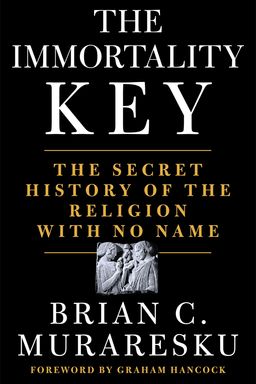
What if the secret to humanity’s oldest spiritual longing—the desire to defeat death—was once found in a cup? The Immortality Key argues that ancient ceremonies, from the Greek Mysteries at Eleusis to early Christian Eucharists, used psychoactive sacramental beverages to induce mystical visions so profound that initiates came away convinced of immortality. Author Brian C. Muraresku weaves together archaeology, chemistry, theology, and modern neuroscience to trace this forgotten lineage of visionary communion.
The book begins with a puzzle: for over two thousand years, Eleusis promised its initiates an answer to death through a ritual climax known only to those who partook of the kukeon, a mysterious barley-based potion. From there, Muraresku explores whether that potion contained psychoactive substances like ergot or other entheogens that opened the way to divine revelation. He then follows that thread through Greek, Roman, and early Christian traditions, suggesting that the sacramental power of the Eucharist originally lay in experiential, not symbolic, transformation.
The Psychedelic and the Divine
Modern clinical research on psilocybin at institutions like Johns Hopkins and NYU reveals experiences of ego dissolution, timelessness, and unity with the divine—phenomena indistinguishable from mystical ecstasy described by saints and prophets. Muraresku juxtaposes these laboratory results with the testimonies of ancient initiates, arguing they share a common human capacity for transcendence. The book’s thesis suggests that religion’s origins were not in belief but in experience: ingesting sacred substances that allowed initiates to encounter the divine directly.
From Eleusis to Early Christianity
The Eleusinian Mysteries provide the historical backbone. At Eleusis, initiates entered the telesterion and drank the kukeon in secret before witnessing a revelation so transformative that Plato, Pindar, and Sophocles spoke of it as the key to conquering mortality. The rite was violently suppressed by Christian emperors in the fourth century AD—but Muraresku shows how its imagery and ritual form resurfaced, disguised, in early Christianity. The Gospel of John’s Eucharistic language mirrors Dionysian wine miracles, while Gnostic sects preserved female-led, visionary practices long after the Church sought to domesticate them into symbolic rituals.
Women, Knowledge, and Suppression
Women—priestesses, herbalists, healers—were the forgotten engineers of these earliest sacraments. From the priestesses of Demeter to Mary Magdalene and the Gnostics, women safeguarded pharmacological expertise and the authority to mix the sacred cup. When institutional Christianity replaced the mystical experience with hierarchical control, women’s roles were demonized, paving the way for accusations of witchcraft and the Inquisition’s destruction of female-led ritual lineages.
Modern Science and the Revival of the Mysteries
The return of psychedelic research resurrects this lost sacramental technology in a regulated, ethical form. Clinical trials show that under controlled conditions, people undergo visionary experiences almost identical to historical mysticism. For Muraresku, this suggests humanity is neurologically wired for transcendence—and that drugs were once sacred catalysts for the beatific vision, not threats to moral order. The book closes with a call to test ancient chalices using modern archaeochemistry, challenging institutions like the Vatican to reconsider the literal chemistry of their origins.
The book’s central insight
Mystical revelation, the experience of union with the divine, may not be metaphorical. It could be the result of a reproducible human-chemical interface, a sacrament concealed by millennia of political and religious suppression—and potentially recoverable through modern science.
As you move through the evidence—from the barley fields of Eleusis to sealed Pompeian vats and Tuscan Inquisition files—you’re asked to reconsider religion’s deep structure: not as belief in miracles but as the organized cultivation of them.