
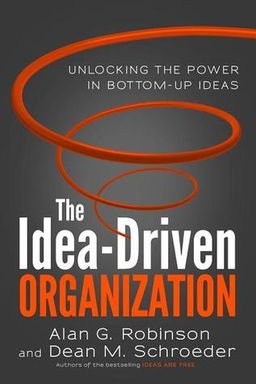
The Idea-Driven Organization cover

The Idea-Driven Organization

by Alan G Robinson and Dean M Schroeder

The Idea-Driven Organization reveals how businesses can achieve long-term success by harnessing bottom-up innovation. By empowering employees to share ideas, companies can enhance creativity, streamline operations, and maintain a competitive edge. Learn practical methods to foster a culture where every idea counts.

Building an Idea-Driven Organization

Have you ever wondered why some organizations bristle with energy, creativity, and constant improvement—while others feel slow, rigid, and uninspired? In The Idea-Driven Organization, Alan G. Robinson and Dean M. Schroeder argue that the most powerful driver of performance and innovation isn’t a brilliant executive plan or a big new technology—it’s the collective intelligence of the people on the front lines.

The authors contend that roughly 80 percent of all performance improvement potential lies in everyday employee ideas—not in strategic initiatives pushed from the top. Front-line employees, after all, see problems and opportunities that managers never notice. Yet most companies, by design, suppress this insight through outdated, top-down leadership models and bureaucratic systems that discourage participation.

Robinson and Schroeder make a compelling case for a new kind of management: one that is top-directed but bottom-driven. Senior leaders set the direction, but improvement flows upward from employees empowered to act on their knowledge. At the core of this approach is what they call the idea-driven organization—a company that’s intentionally structured to seek, evaluate, and implement large volumes of front-line ideas. The results, they show through global case studies, are faster problem-solving, stronger innovation, higher engagement, and sustained profitability.

Why This Shift Matters

For many organizations today, the challenge isn't generating more strategic plans—it’s execution. Cutting costs, increasing efficiency, and innovating rapidly are demands that traditional management methods can't meet. As the authors warn, “We have been doing more with less for so long that we’ve reached a point where further demands can no longer be met by simply tweaking the system.”

The premise of the book aligns with what thinkers like Peter Drucker and Jim Collins (in Good to Great) observed: sustainable success comes from disciplined, humble leadership that taps the organization’s full brainpower. Front-line workers are the forgotten strategists—they know where costs hide, where service falters, and how systems fail customers. When given permission and support, their suggestions build resilience and innovation capacity far beyond top-down fixes.

The Book's Core Framework

The book unfolds around a multi-layered framework for creating an idea-driven culture. It describes how leaders can recognize the hidden value in employee ideas, shift from command-and-control to collaborative management, and realign their organization’s structure and policies to support idea flow. Robinson and Schroeder describe a progression from awareness to systemization: first, understanding why front-line ideas matter; second, dismantling barriers like hierarchy and power distance; and finally, embedding idea processes into operations, culture, and rewards.

They weave in dozens of vivid stories—from the Clarion-Stockholm hotel’s bartenders refining customer service to Brasilata’s factory workers submitting 150,000 ideas a year—to show how ordinary people can create extraordinary results when the system enables them. At Coca-Cola Stockholm, for instance, line workers solved a chronic production flaw that stumped two elite Six Sigma teams. Their idea may have been simple—tilting a guide rail—but its impact was profound, saving thousands of dollars and hours of downtime.

From Philosophy to Practice

To make an idea-driven culture real, the book explores how organizations can tackle leadership blind spots, power dynamics, and structural misalignments. It discusses the pitfalls of excessive hierarchy, opaque feedback, and misguided incentive systems that punish instead of inspire idea sharing. The solution isn’t token suggestion boxes or casual brainstorming but a disciplined management system where ideas are aligned with strategy, supported by managers, and rapidly implemented.

Robinson and Schroeder’s central contention is that ideas are free—but only if leaders know how to listen. They show how to build structures that both empower and hold accountable: managers who are evaluated by the number of ideas they support, processes designed around collaboration, and continual feedback loops that connect ideas to measurable outcomes. Over time, this system effectively transforms a slow, rules-heavy organization into what the authors call “a self-improving organism.”

Why It Matters to You

For anyone leading a team—or simply trying to make their workplace more dynamic—this book offers both philosophy and blueprint. You’ll learn not just how to recognize good ideas but how to build trust, humility, and shared purpose around them. Whether you manage a coffee shop, a hospital, or a global enterprise, an idea-driven mindset helps you unlock the latent creativity that already exists within your people. And as organizations face the accelerating pressures of automation and competition, this shift from control to collaboration may be your most powerful competitive advantage.

In the chapters that follow, Robinson and Schroeder dive into how to rewire leadership habits, align management systems, create high-performing idea processes, and sustain continuous improvement. The result is not just a set of tactics but a transformation—a move toward organizations where everyone, not just “management,” becomes an agent of innovation.


Why Front-Line Ideas Matter

If you want to know where your organization’s best ideas are hiding, the answer isn’t in the boardroom—it’s on the front line. Robinson and Schroeder call this overlooked source the 80/20 Principle of Improvement: roughly 80 percent of your improvement potential lies in employees’ small daily ideas, not management’s big strategic projects. Managers focus on the visible 20 percent, but the silent majority of opportunities come from people closest to problems and customers.

The Power of Small Ideas

At Coca-Cola Stockholm, the bottling line once suffered frequent stoppages as bottles jammed on a curved conveyor. Two Six Sigma teams tried to solve it using complex analysis, but failed. Then a worker added a simple washer to reduce surface friction—a tiny fix with huge payoff, eliminating downtime and saving thousands annually. In one year, Coca-Cola Stockholm implemented over 1,700 frontline ideas—far more than its management-led projects combined. The employees produced 76 percent of total improvement savings, confirming that simple ideas often yield the most leverage.

Contrast this with top-down campaigns that ignore front-line input, like the New England utility company that imposed inventory limits on transformers. On paper, it looked efficient. In practice, crews ran out of parts, wasted hours improvising repairs, and spent thousands replacing cheap equipment with costly alternatives. The problem wasn’t employee resistance—it was management blindness to operational reality. Leaders often see aggregate data, not situational knowledge. Employees, by contrast, live within the system daily and can spot where inefficiencies and customer pain points truly occur.

Compounding Impact

Small ideas compound remarkably over time. At the Clarion-Stockholm hotel, bartenders generate about fifty implemented ideas per employee per year. Most are small tweaks, from reshelving glasses closer to the counter to informing staff when VIP guests arrive. Yet collectively, these ideas improved service, raised satisfaction, and created an elegant working culture where staff felt ownership of the guest experience. By aggregating hundreds of micro-improvements, the hotel achieved consistently high occupancy and profitability while keeping costs competitive—a perfect illustration of systemic efficiency through small wins.

Brasilata, a steel can manufacturer in Brazil, took this approach to extraordinary heights. With nearly 1,000 “inventors” on staff, it processes around 150,000 ideas per year. Ninety percent get implemented, not because they’re revolutionary, but because the company’s structure supports rapid evaluation, decentralized decision-making, and employee pride in improvement. Each accepted idea strengthens the business and deepens trust.

Why Leaders Overlook This Potential

Traditional leaders often fall into what Friedrich Hayek called the trap of “aggregate knowledge”—believing that high-level data tells the full story. But front-line employees possess “knowledge of particular circumstances of time and place.” They see the excess steps, double handling, and customer frustrations that never make it onto management dashboards. The humility to recognize this asymmetry is essential for leaders who wish to harness the other 80 percent of improvement capability.

Jay Reardon at Hickory Chair, for example, rescued his furniture company not through restructuring but by listening. When he discovered that factory bathrooms were neglected while executives enjoyed privileges, he saw how deeply employee trust had eroded. By cleaning bathrooms, removing abusive managers, and inviting workers’ ideas, he reinvigorated the business. In four years, Hickory Chair cut work-in-process inventory by 90 percent, slashed lead times from 16 weeks to 1.5, doubled custom options, and boosted profitability—all powered by front-line innovation.

(Note: Reardon’s humility echoes what Jim Collins later described as the hallmark of “Level 5 leaders”—those who combine fierce resolve with genuine modesty.)

“The people who do the work know the work.” — Alan G. Robinson

An idea-driven organization isn’t a suggestion box. It’s a management shift that treats staff wisdom as a strategic asset. Once leaders begin capturing, honoring, and implementing front-line contributions, they rediscover how much untapped intelligence already exists within their walls. This mindset not only improves operations—it transforms culture, replacing cynicism with ownership and creating the continuous motion that defines every truly innovative company.


The Psychology of Power and Listening

If great ideas live on the front lines, why do so few leaders hear them? Robinson and Schroeder trace the problem to a natural distortion that occurs as people rise in rank: the intoxicating effects of power. As managers gain authority and privilege, they are constantly reinforced with symbols of superiority—corner offices, higher pay, deference, suits—that quietly erode humility. Over time, they begin believing their own myth of knowing best.

When Status Silences Ideas

The authors open with striking examples. At a European port, executives had reserved covered parking spots under a bright blue awning—while employees trudged through storms from the far lot. This daily reminder of rank created a physical and psychological barrier between leaders and workers. Not surprisingly, the company’s employee idea system was failing: only a handful of suggestions trickled in. The leaders thought the problem was the process, but the real barrier was cultural—who would offer ideas to someone who literally parked under a canopy of privilege?

In another case, county supervisors in California secretly upgraded the toilet paper in executives’ bathrooms from two-ply to four-ply while cutting employee pay by 10%. When the story broke as “Bathroom Tissue Gate,” public outrage forced a reversal. Absurd as these stories sound, they reveal how small symbolic separations corrode trust and idea flow.

The Cognitive Costs of Power

Building on research by Philip Zimbardo's infamous Stanford Prison Experiment and subsequent studies by Adam Galinsky and colleagues, the authors show that power literally changes how people think. It reduces complexity of thought, shortens listening, and increases self-absorption. People in power listen less carefully, overestimate their understanding, and become less accurate in reading others’ emotions—a fatal combination for leaders who rely on employee input.

A case in point: a pharmaceutical CEO demanded 30% annual growth without analyzing if it was physically possible. He mocked environmental rules, bragged about bribing garbage collectors, and lost the respect of his leadership team. Though considered “successful” in traditional corporate terms—sales were growing on inertia—he embodied everything Robinson and Schroeder warn against: arrogance, ignorance, and isolation. His company’s ideas dried up because no one trusted him.

By contrast, organizations like Inditex (the parent of Zara) and Hickory Chair deliberately recruit humble managers who naturally listen and credit others. Inditex’s founder, Amancio Ortega, learned this lesson at 12, when his manager at a clothing shop ignored his improvement ideas. Decades later, he built the world’s largest fashion company by ensuring everyone—from store clerks to designers—could share insights freely. Zara’s twice-weekly calls with store staff capture constant customer data, feeding rapid product decisions that redefine “fast fashion.”

“Humility is not a weakness—it is a strength.” — Jay Reardon, Hickory Chair

Keeping Leaders Grounded

Idea-driven organizations actively counteract the distortions of power. The book highlights General Martin Dempsey’s introduction of 360-degree evaluations for military generals—groundbreaking for an institution fixated on rank. By inviting feedback from subordinates and peers, the U.S. Army began evaluating not just competence but character. Similarly, Toyota’s tradition of “going to gemba”—visiting the actual place where work happens—ensures that even senior executives remain connected to reality. At ThedaCare, a Wisconsin health system, leaders spend hours each week shadowing nurses and doctors as part of their “leader standard work,” learning firsthand about patient care and improvement opportunities.

Power, in short, leads you away from the truth unless you deliberately walk back toward it. By dismantling privileges, fostering humility, and embedding daily engagement with front-line work, leaders can rebuild trust, sharpen understanding, and reignite the flow of ideas that power real innovation.


Structuring for Ideas

A brilliant idea process can’t survive inside a misaligned organization. Robinson and Schroeder argue that most companies require structural redesign before they can become truly idea driven. Traditional hierarchies—built for control, not creativity—smother the agile, cross-functional collaboration that ideas demand. The solution: align structure, goals, and culture so every employee’s suggestions propel the organization’s strategic direction.

Vertical and Horizontal Alignment

Vertical alignment ensures that front-line ideas connect to overall strategy. Leaders often assume their mission is clear, but reality says otherwise. At an electronics retailer, a test revealed that none of the executives’ top three goals matched the CEO’s. Without shared direction, employees’ ideas were “scattershot.” The fix was translating big ambitions—like “increase market share”—into actionable shop-floor indicators such as on-time shipment percentage or order accuracy. Once employees understood how their daily improvements fed corporate outcomes, idea quality soared.

Horizontal alignment tackles cross-department conflict. A small insurance firm’s IT group rejected a customer service idea because coding help wasn’t “in their budget.” The company lost efficiency because departmental goals weren’t unified. Aligning incentives—so departments shared responsibility for idea success rather than guarding their turf—turned friction into collaboration. Graniterock, Toyota, and Fresh Ventilation demonstrate this principle: they design processes, not silos, enabling ideas to flow across boundaries quickly.

Removing Bureaucratic Barriers

True alignment often requires confronting control systems that leaders once considered lifesaving. One retailer, after years of chaos, installed tight purchasing and approval rules that prevented fraud—but also delayed even basic improvements like buying a marker. During idea system pilots, temporary waivers showed how freeing up authority unleashed creativity. Gradually, the company loosened policies and learned that trust and transparency deliver better control than endless sign-offs.

Zara: A Structure Built for Flow

Zara, Inditex’s flagship brand, exemplifies structure designed for ideas. Its three-person product teams—designer, production coordinator, and country manager—sit in open studios and decide collectively. Changes from store feedback materialize within weeks. Designers review daily information from front-line clerks who observe customer behavior. Manufacturing remains local to speed experimentation. Every layer, from ergonomics to authority distribution, supports fast information flow and quick action. This is not just alignment—it’s architectural empathy for ideas.

When structure and strategy reinforce idea flow, improvement becomes organic. As the authors put it, “People cannot be expected to offer their ideas if every day the organization’s structure tells them those ideas are not welcome.” Alignment transforms managerial intent into daily reality, enabling employees to turn purpose into progress.


Designing Effective Idea Systems

How can you handle hundreds or thousands of employee ideas without drowning in paperwork? Robinson and Schroeder devote significant focus to creating high-performing idea systems—frameworks that process ideas efficiently, respect employees’ ownership, and lead to rapid action. Unlike traditional suggestion boxes that collect dust, these systems institutionalize collaboration and continuous improvement.

Three Proven Models

The authors describe three archetypes:

  • Kaizen Teian (Japan): A mature idea culture where individuals constantly submit and implement small ideas. Brasilata’s factory in Brazil mirrors this model, processing over 150 ideas per worker annually with near-total implementation rates.
  • Idea Meetings: Regular team sessions where each member brings one opportunity for improvement. Actions are assigned, tracked, and executed collaboratively.
  • Idea Boards: Visual management tools that display problems, priorities, and progress. They turn ideas into public commitments and foster accountability.

Boardroom Inc., for instance, skyrocketed from occasional suggestions to over 100 implemented ideas per employee per year after shifting authority downward. CEO Martin Edelston realized that decisions should be made by those most familiar with the work. Once he stopped bottlenecking approvals, productivity and morale exploded.

From Problem to Solution

High-performance systems encourage teams to submit problems—not just ideas. At Springfield Technical Community College, a suggestion to advertise online portals seemed minor until team discussion revealed the real problem: students weren’t trained to use the system. The fix—self-help kiosks staffed by peers—saved 700 staff hours yearly. By separating the problem from the proposed fix, teams open space for creative group solutions.

Facilitation and Escalation

Well-run meetings depend on skilled facilitators who draw out quieter voices, prioritize effectively, and connect small issues to big goals. Equally vital is a transparent escalation process: when teams can’t decide or need cross-department resources, ideas move upward without disappearing. At Scania, a Swedish truck maker, visible tracking boards ensure no idea “dies in committee.” Managers’ follow-through is public, holding them accountable to their teams.

In contrast, electronic suggestion boxes often fail because they automate bureaucracy—routing ideas up a slow, risk-averse chain. It’s digital lipstick on a broken process. Real idea systems, the authors insist, distribute authority, speed, and feedback so employees see progress and impact.

“You can put lipstick on a pig—but it’s still a pig.” — Robinson & Schroeder, on electronic suggestion boxes

A functioning idea system doesn’t just collect input—it cultivates engagement, learning, and shared problem-solving. When designed well, it becomes part of the organization’s nervous system, transmitting signals and driving adaptive responses faster than any memo from above ever could.


Implementing and Sustaining Idea Systems

After a century of management models built for compliance, installing a truly idea-driven system requires strategic patience. Robinson and Schroeder outline a nine-step roadmap for sustainable implementation—from leadership commitment to continuous improvement. Each step forces both structural and cultural change.

Step 1: Lead with Commitment

An idea system cannot outpace its champions. Alpha Natural Resources, a U.S. mining firm, proved this after acquiring another company notorious for safety failures. Alpha’s executives—all former miners—shut down operations for training, signaling that safety and employee ideas mattered most. Their “Running Right” idea program, driven by miners themselves, cut accidents dramatically and turned a cultural liability into a competitive strength. Leaders must demonstrate that ideas aren’t optional—they’re the organization’s lifeblood.

Step 2–5: Design with Integration

Form a credible cross-level design team, as Health New England did, mixing executives, middle managers, and front-line staff. Assess misalignments—policies, measurement systems, or bottlenecks that block ideas—and integrate the new system into existing routines. The authors stress “minimal intervention”: adapt what already works rather than layering new bureaucracy. For example, idea meetings can be embedded into existing team sessions, and recognition tied to current performance reviews.

Step 6–9: Pilot, Roll Out, Improve

Start small but learn fast. Effective pilots identify practical problems early—training gaps, IT backlogs, slow purchasing—and solve them before scaling. Robinson and Schroeder describe pilots where simple measures like empowering departments to spend $250 per idea unlocked dozens of improvements. Quantitative dashboards and qualitative coaching help track adoption. Once momentum builds, phased rollouts ensure each new area benefits from the last’s experience.

Even mature systems must evolve. At Pyromation, after noticing that only one or two team members implemented most ideas, leaders redesigned processes so everyone managed at least one idea at a time. Continuous self-improvement keeps the system alive and culturally relevant. As the authors remind us, “A system for improvement should itself continuously improve.”

Ultimately, sustaining a high-performing idea system demands discipline: accountability, transparency, and leadership humility. It’s not a project; it’s a new way to run the organization.


The Link Between Ideas and Innovation

A frequent misconception is that front-line ideas produce only incremental changes, while innovation requires genius breakthroughs. Robinson and Schroeder debunk this divide, showing how everyday ideas fuel and sustain big innovations. In fact, they argue, most breakthrough innovations depend on small ideas to work effectively.

Small Ideas Make Big Ideas Possible

At Subaru Indiana Automotive, a novel idea to recycle toxic paint solvent through vacuum distillation initially came from a vendor. When the vendor failed, front-line maintenance crews stepped in, refining the system through hundreds of micro-ideas—adjusting components, changing processes, inventing tools—until it functioned flawlessly. Later, workers proposed new uses for the residual waste, turning it into recyclable materials. Without their ideas, the “green innovation” would have collapsed in theory or cost.

Building Innovation Capabilities

Front-line participation doesn’t just improve performance—it develops organizational muscles for innovation: problem-finding, experimentation, and cross-functional learning. Allianz China’s revolutionary “Super Fit” life insurance, customizable to each client, emerged because prior idea systems had built flexibility into every process. By engaging employees early, CEO Wilf Blackburn created a culture capable of launching a complex product competitors couldn’t replicate.

From Routine to Breakthrough

Firefighting-equipment company Task Force Tips illustrates this synergy beautifully. A casual brainstorming dinner about adding a pressure gauge to water cannons evolved, through collective ideation, into a radically safer product that automatically shut off when unanchored. Subsequent team input— twenty-one enhancements from legs to coatings—turned a routine tool into an award-winning innovation. By embedding idea collaboration in its design process, TFT made innovation continuous, not episodic.

Whirlpool’s turnaround confirms the same pattern on a global scale. Once trapped in a commoditized appliance market, it transformed into a top innovator by embedding idea generation throughout all levels. Front-line workers contributed ideas like rubber-top mats and storage-drawer pedestals for washers—simple but lucrative additions that helped triple average sale value. Creativity democratization, not R&D supremacy, restored its competitive edge.

Removing Barriers to Innovate

High-performing idea systems also force organizations to confront bureaucratic drag that blocks innovation. Software firm HCSS discovered that its product development process bogged down because departments lacked a unified method to capture and prioritize improvements. Implementing an idea system exposed this misalignment, leading to a holistic redesign. The newfound clarity allowed a part-time programmer’s idea—automated software testing—to save weeks per release and eventually redefine HCSS’s development cycle.

ThedaCare’s transformation in healthcare perhaps best captures the endgame: a culture where everyone—from doctors to nurses to janitors—identifies problems and contributes improvements daily. Their combination of lean methods, value-stream mapping, and front-line ideas cut surgical mortality, saved millions, and made collaboration routine. The conclusion? Innovation thrives not from creative chaos but from organized, collective intelligence.


Keeping Ideas Flowing

Even the best idea systems stagnate unless leaders nourish ongoing creativity. The final chapters explain how to keep the well of ideas from drying up by teaching problem sensitivity—training people to notice problems they once ignored. When employees see “problems” as opportunities, the organization never stops improving.

Training Problem Finders

Subaru Indiana Automotive reached zero landfill two years early by using “idea activators”—short training modules that helped workers spot environmental opportunities. The Three Rs (Reduce, Reuse, Recycle) sparked ideas to reuse packing foam, eliminate box lids, and connect compressed air lines to save energy. Dumpster-diving exercises turned waste analysis into creative discovery sessions. These simple interventions reshaped how employees perceived their work: every inefficiency became a solvable challenge.

Other organizations use idea mining—digging deeper into existing ideas to unearth new perspectives. At a pet insurance call center, a confusing Yellow Pages ad led to the broader insight: every time a customer is confused, it’s a clue to improve communication. Similarly, the Clarion-Stockholm staff mined service interactions to invent features like reading-glasses boxes or spare laptop chargers for guests. The skill isn’t brainstorming—it’s listening differently.

Institutionalizing Feedback

Graniterock’s “short-pay” policy—letting customers withhold payment if unsatisfied—turned feedback into gold. Instead of debating refunds, the company studied each complaint and fixed root causes. This led to innovations from better concrete coloring to improved dispatching. By intentionally breaking “defensive crusts,” the company made errors visible and transformed them into learning fuel. Today, its defect rate is below 0.2% and it enjoys premium customer loyalty.

In idea-driven cultures, every complaint, delay, or glitch is a ticket for improvement. When curiosity replaces blame, idea flow becomes endless. The best organizations, the authors remind us, don’t wait for epiphanies—they train everyone to see the next small step forward.

Dig Deeper

Get personalized prompts to apply these lessons to your life and deepen your understanding.

Go Deeper

Get the Full Experience

Download Insight Books for AI-powered reflections, quizzes, and more.