
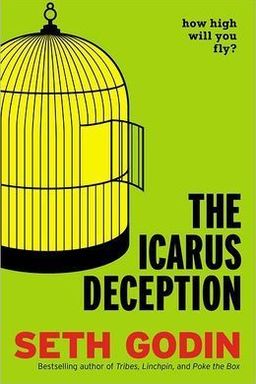
The Icarus Deception cover

The Icarus Deception

by Seth Godin

The Icarus Deception challenges traditional myths about success, urging readers to embrace creativity in the face of an evolving economy. Seth Godin argues that aiming high and breaking free from societal norms are key to thriving in a world where automation is replacing conventional jobs. This compelling read inspires readers to redefine their approach to work and life.

Flying Higher: The Central Message of The Icarus Deception

How high are you willing to fly? Seth Godin’s The Icarus Deception poses this provocative challenge, shattering the myth that safety lies in keeping your head down and following instructions. We’ve long been taught that success means obedience, compliance, and fitting neatly inside an industrial system designed to reward conformity. But Godin contends that this worldview—the one that shaped much of modern work and education—has collapsed. In its place, a new era has arrived: the connection economy, where creativity, emotional labor, and genuine human connection matter more than productivity and efficiency.

The book’s title—and its central metaphor—comes from the ancient Greek myth of Icarus. As the story goes, Daedalus warns his son not to fly too high lest the sun melt the wax in his wings. But the part most people forget is that Daedalus also cautioned Icarus not to fly too low, where the sea’s damp mist would weigh down his wings. Industrial society, Godin argues, focused only on that first warning—don’t fly too high. Hubris became the ultimate sin, and ambition was considered dangerous. We built a culture that punished risk-taking and rewarded safe mediocrity. The tragic irony is that, by discouraging people from flying too high, we’ve taught entire generations to fly far too low.

The End of the Industrial Safety Zone

For most of the twentieth century, your career depended on how well you could follow the rules. Schools trained children to memorize, conform, and obey. Factories rewarded punctuality and diligence. The system needed reliable cogs, not creative artists. This system worked for a while—it built enormous institutions and powered middle-class prosperity—but now it’s dying. Automation, globalization, and digital networks have dismantled that predictable world. The places we used to call safe—corporate hierarchies, nine-to-five jobs, prestigious degrees—are no longer secure. “The safety zone has moved,” Godin warns, “but your comfort zone has not.” What feels safe today may actually be the most dangerous place to stay.

Art as the Human Act of Connection

In this new world, art becomes your only real defense. Not art in the narrow sense of painting or music, but art as Godin defines it: “the human act of creating something new that matters to another person.” Art is expressive, generous, and risky. It doesn’t follow a manual—it connects people through courage and emotion. The connection economy rewards those who build bridges, not those who merely follow processes. This means you are called not just to do your job, but to perform your art—to bring vulnerability, insight, and originality to whatever you create.

A New Kind of Risk: Vulnerability as Strength

Flying high means embracing vulnerability. Art demands courage—the willingness to create without guarantee, to give without knowing how you’ll be received. This is terrifying because it exposes you to shame, criticism, and self-doubt. Yet in the connection economy, such vulnerability is your superpower. As Brené Brown (another thinker Godin acknowledges) writes, “Courage is telling our story—not being immune to criticism.” You don’t need permission. You simply must begin. Godin repeatedly encourages readers to “pick yourself”—to stop waiting for gatekeepers and start connecting directly with people who care.

The Revolution of Connection

We are living through a revolution, one where competence and capital are cheap but emotional labor—caring, risk-taking, generosity—is priceless. The Internet stripped away the old gatekeepers; now anyone can publish, compose, or create. Success is no longer about getting picked by Oprah or a CEO; it’s about picking yourself and giving your gift to the world. A blogger, a teacher, a nurse, a coder—anyone can be an artist by choosing to connect. The reward isn’t applause but impact: changing how people feel, think, or see the world.

“The doors are open,” Godin writes. “You don’t need a map—you need to dance with the fear.”

Why These Ideas Matter

Why should this matter to you? Because the fence is gone—the enclosure that trapped workers in predictable safety has disappeared. If you cling to comfort, you’ll sink. If you embrace art, you might soar. The Icarus Deception isn’t only about economics or culture; it’s about identity. It insists that you are not your career, your title, or your résumé. You are an artist whose work can move others. The moment you stop hiding your creative power, you stop deceiving yourself—and finally begin to fly higher.

Across the chapters, Godin explores myths, propaganda, and the psychological barriers that keep people small. He examines shame, grit, connection, and commitment. He offers strategies for creating art, surviving criticism, and thriving in vulnerability. In sum, the book serves both as manifesto and manual—a call to reject fear and reclaim your human capacity for creativity, risk, and generosity. The question is simple but urgent: Now that the fence is gone, will you stay grounded or learn to fly?


The Connection Economy and the End of Compliance

Godin argues that the most dramatic shift of our time is the rise of the connection economy. Where the industrial economy rewarded obedience, the connection economy prizes creativity, innovation, and relationships. In his words: “Competence is no longer scarce—what’s scarce is trust, connection, and surprise.”

From Factories to Connections

During the industrial age, people were interchangeable parts of a vast machine. We learned to measure success through productivity and efficiency. Following instructions led to stability; fitting in ensured survival. A secure job was a bargain—you gave up individuality for predictable pay. But now the conditions that made that bargain possible have vanished. Digital networks have demolished scarcity and amplified choice. Automation and outsourcing have made it easy to find good workers anywhere. What matters now isn’t what you produce but how you connect.

In today’s economy, the most valuable skills are emotional ones: empathy, trust-building, generosity, and the courage to lead. You might build software or bake bread or design games—none of that matters unless your work forges genuine connection. As Godin writes, “If your factory burns down but you have loyal customers, you’ll be fine.”

Six New Economic Assets

To thrive, you must cultivate six core assets—qualities that machines and standardized systems can’t replicate:

  • Trust and Permission: In a world flooded with messages, people pay attention only to those they trust. Permission marketing, the concept Godin first popularized, remains key—earning attention rather than grabbing it.
  • Remarkability: Nobody talks about the boring and the safe. To be shared, your work must be bold, fresh, and worth remarking on.
  • Leadership: Unlike management, which seeks compliance, leadership is about risking vulnerability and stepping forward without a map.
  • Stories: Data may inform, but stories move people. Spread narratives that spark emotion.
  • Humanity: In a world of automation, being deeply human—caring, connecting, showing empathy—is revolutionary.
  • Generosity: Give first. Offer gifts, ideas, and insight—art is an act of generosity that creates imbalance and sparks connection.

Emotional Labor as the New Advantage

In industrial systems, physical labor created value. But now emotional labor—the work of caring, communicating, and creating—is what scales. It’s harder, riskier, and more draining, but it’s also irreplaceable. Every blog post, performance, teaching session, or startup pitch that reveals part of your humanity adds to your art. Machines can’t care; that’s your competitive edge.

The Fall of the Gatekeepers

The connection economy demolishes traditional authority. You don’t need a TV producer, CEO, or publisher to say “yes.” YouTube, Kickstarter, and social media let artists pick themselves. Louis C.K. released a stand-up special directly to fans and earned millions while preserving creative control. Amanda Palmer crowdfunded her album and built a thriving career by connecting directly with supporters. These examples embody Godin’s mantra: No one is going to pick you. Pick yourself.

“The connection economy doesn’t care how famous your boss is—it cares how human you are.”

Thriving in the New Economy

Adapting doesn’t mean learning another tactic or buzzword—it requires rewiring your sense of safety. Stop asking for maps and start embracing exploration. As Godin puts it, “Seek out questions, not answers.” When you trade comfort for discovery, vulnerability becomes your strength. The fence is gone; you can fly. But the real challenge isn’t technical—it’s emotional. You must believe that creating art and connecting people isn’t indulgent. It’s the new safety zone.

This is the essence of Godin’s revolution: success now belongs to those who lead with humanity. The people who matter most—teachers, caregivers, creators, leaders, entrepreneurs—won’t be those who simply produce efficiently, but those who connect authentically. The world doesn’t need more efficient cogs; it needs bold, vulnerable artists who can bridge the distance between machines and meaning.


The Icarus Myth and Human Fear

At the heart of The Icarus Deception lies a reinterpretation of the famous Greek myth. For centuries, the story of Icarus has been told as a warning against pride—fly too close to the sun and you’ll fall. But Godin insists that this interpretation is incomplete and dangerously misleading. The real tragedy isn’t that Icarus flew too high; it’s that we’ve spent generations flying too low.

Reclaiming the Forgotten Half of the Myth

Daedalus didn’t just warn Icarus to avoid the sun; he warned him not to fly too close to the sea, where the damp air would destroy his wings. Society conveniently erased this half of the lesson. Industrial propaganda trained us to fear standing out, to equate ambition with hubris, to keep our wings low and unthreatening. The phrase “Don’t get too big for your britches” is the modern echo of the Icarus deception—the lie that humility requires invisibility.

Godin argues that this myth has permeated everything: education, religion, corporate life, even family dynamics. Schools punish risk and reward compliance. Companies ask employees to “be realistic.” We’ve internalized the message that failure is shameful, that taking initiative without permission is reckless. Yet, as he reminds us, flying too low near the waves is more dangerous than flying high—because it feels safe while slowly killing your spirit.

The Fear Industry

Godin compares modern society to the myth’s sea—humid, heavy with manufactured fear. He calls out the “fear industry,” a system sustained by advertising, bureaucracy, and authority figures who benefit from our compliance. Fear of criticism keeps you silent in meetings. Fear of instability keeps you in jobs that drain you. Fear of vulnerability keeps your art locked away. To stay safe, you dim your own light.

“Flying too low, too close to the waves, guarantees mediocrity—not safety.”

Kamiwaza: Acting Like the Gods

Godin introduces the Japanese concept of kamiwaza, meaning “godlike performance.” Unlike arrogance, kamiwaza isn’t about ego—it’s the purity of doing something with complete commitment and authenticity, as the gods would. To live with kamiwaza is to embrace uncertainty boldly and to act from creative generosity rather than fear. The irony, he points out, is that being “godlike” makes us more human, not less. When you strip away doubt and artifice, what remains is courage—the essence of art.

Hubris Reconsidered

Why is hubris vilified? Because it threatens the status quo. The industrial world needed obedient workers, not visionaries flying toward the sun. Those who dared to disobey—the “tall poppies,” the rule breakers—were cut down. The myth served as propaganda for control, not wisdom. But now, flying higher isn’t hubris—it’s survival. When everything safe becomes obsolete, risk becomes the new security.

In fact, courage isn’t an act of rebellion against the gods—it’s a homage to them. To be human is to create, to imagine, to risk connection. Fear of hubris keeps artists silent and innovators small. Yet, as Joseph Campbell once wrote (and Godin echoes), “Myths aren’t about gods—they’re about us.” The real myth isn’t that we shouldn’t reach for the sun—it’s that we were never allowed to realize how high we could go.

In the end, Godin’s reinterpretation of Icarus becomes both a metaphor and a manifesto. The deception isn’t that ambition kills you; the deception is that safety saves you. You were born with wings—now fly.


Vulnerability, Shame, and Creative Courage

Art requires risk, and risk exposes you. Seth Godin spends much of the book unpacking this emotional terrain—why we hide, how shame controls us, and what it means to be vulnerable. It’s impossible to make art without stepping into uncertainty, because art is a mirror of humanity itself. To create something new that matters to others, you must show yourself, and in doing so, you invite judgment. Vulnerability is the gateway to authentic connection; shame is its prison.

Why Shame Persists

Shame has long been the industrialist’s weapon. It enforces conformity by punishing difference. Children learn early not to raise their hands “too much,” not to show off, not to fail publicly. As adults, we fear embarrassment, so we don’t innovate or speak up. Bosses use shame to suppress dissent—“Who do you think you are?”—and social media amplifies the fear of exposure. Godin calls shame “the soul-killer,” a force that keeps us hidden long after the need for obedience has vanished.

Shameless Art

To overcome shame, Godin advocates for a radical stance: be shameless. Not selfishly, not arrogantly—but courageously. A shameless artist refuses to internalize criticism. She listens, learns, but doesn’t let fear define her. To stand onstage, to write a book, to launch a product, you must be willing to say “This is me” and mean it. The shame that might follow is neither inevitable nor permanent—it can exist only if you accept it. “We can’t make you feel shame without your cooperation,” he writes.

“Vulnerability without shame is courage. Vulnerability with shame is paralysis.”

Armor and Authenticity

The metaphor of armor runs throughout the book. Your job title, credentials, social media persona—these are forms of armor that keep you safe. They protect you from criticism but also prevent connection. When Godin forgets his suit jacket before a keynote talk, he recognizes it as symbolic: without his physical armor, he feels naked but alive. Art doesn’t emerge from protection—it emerges from exposure. To create is to risk being seen. When you remove your armor and declare, “Here’s what I made,” you allow others to connect with your humanity.

Choosing Your Audience

Not everyone deserves that vulnerability. If your audience shames rather than engages, they’re not your audience. True connection requires reciprocity—a mutual offering of dignity. Brené Brown’s research (which Godin cites) parallels this idea: not everyone has earned the right to hear your story. Artists must shun the nonbelievers. You cannot make art for everyone; you can make it for someone—a human connection that matters.

By redefining vulnerability as a strength instead of a weakness, Godin turns fear on its head. Every trembling moment before you press “publish” or take the stage is proof that you’re alive and doing real work. Feeling exposed is not an error—it’s a sign that you’re creating art with your whole self. Shame demands silence; vulnerability invites connection. Between those two lies courage—the beating heart of all art.


Grit and the Art of Persistence

What sustains an artist once the initial spark fades? For Seth Godin, the answer is grit—the determination to keep showing up, the resilience to endure failure, and the patience to keep doing meaningful work even when it’s hard. Art is not a one-time performance; it’s a lifelong discipline.

Defining Grit

Industrial systems despise grit. Machines require smoothness; grit clogs the gears. But in human terms, grit is essential. It’s the grain of resistance that makes life interesting and growth possible. Godin references psychologist Angela Duckworth’s definition: grit combines perseverance, hardiness, resilience, ambition, commitment, and flow. It means you keep going not because someone orders you to, but because your inner compass demands it.

The Grind Is the Work

Most people try to escape the grind—they see hard work as the enemy. But the artist knows the grind is the work. It’s not separate from art—it’s the foundation. If you’re waiting for inspiration or external motivation, you’ll never ship. “Relentlessly remove external control, motivation, and approval,” Godin advises. True grit means you act even when you’re tired, even when your previous project flopped. Grit is a posture of commitment: not part-time, not when conditions are perfect, but always.

Resilience Over Perfection

In Godin’s framework, success doesn’t come from never failing—it comes from refusing to let failure define you. The resistance—the voice in your head saying “This might not work”—isn’t the enemy; it’s a signal that you’re doing something worthwhile. Steve Pressfield called this “The War of Art”; Godin reframes it as partnership. The resistance never goes away, but each act of creation teaches you to dance with it instead of fight it.

“When the lizard brain screams, it’s proof you’re making art that matters.”

Practice as Transformation

Grit transforms the artist’s identity from tourist to inhabitant. Doing the work daily—even when no one notices—builds creative muscle. Every painting, every blog post, every code prototype moves you closer to mastery. It’s not the applause that matters; it’s the discipline that keeps you dancing even when the music stops. This mirrors the philosophy of kaizen (continuous improvement) and echoes other thinkers like Cal Newport (Deep Work) and Carol Dweck (Mindset): excellence is the result of sustained effort, not flashes of genius.

Godin reminds us that grit means choosing the infinite game—playing not to win but to keep playing. The goal isn’t perfection; it’s persistence. The creative life doesn’t promise comfort; it promises meaning. When you embrace the grind as your art, every setback becomes a step toward the work that truly matters.


Art as a Generous Human Act

Throughout The Icarus Deception, Seth Godin returns to the idea that art is not selfish—it’s generous. True art creates connection, and connection is always a gift. “Art isn’t made as part of an even exchange,” he writes. “It’s your chance to create imbalance, which leads to connection.” The paradox of generosity is that giving freely actually increases your influence and impact.

Art as a Gift Economy

Industrial economies run on transactions—equal exchange, measured value, predictable output. Art runs on gifts. When you perform generously, you unsettle the balance. The recipient feels gratitude, obligation, or inspiration, and the cycle of connection continues. This idea draws from Lewis Hyde’s The Gift, another book Godin celebrates, which argues that artistic creation thrives in a gift economy rather than a market economy. Each act of creativity—whether a song, a blog post, or a product launch—is a kind of gift that invites participation.

Generosity Creates Trust

In a marketplace flooded with options, people choose connection over efficiency. They trust those who give without manipulation. This generosity doesn’t mean giving away everything for free—it means leading with service. A thoughtful design, a meaningful message, or an act of empathy counts as artistic generosity. As Godin explains, every human transaction can become a moment of art: the doctor who calls after surgery to check how a patient feels, or the customer service rep who creates an honest connection instead of repeating scripts.

Embracing Impermanence

Godin evokes the Japanese idea of mono no aware—the beauty of impermanence. Art, like life, fades. A song ends, a painting cracks, an app loses users. But this evanescence is what gives art its magic: it allows for renewal. The artist’s job isn’t to preserve art—it’s to keep gifting it. Creation is ephemeral, and that’s why every moment of giving matters. Rather than cling to permanence, Godin urges us to dance “on the edge of finished,” knowing there’s always one more opportunity to give.

“To make art is to give. To give is to connect. Connection is the only safety we have.”

In the end, generosity is what separates an artist from a worker. The worker trades time for money; the artist gives meaning for connection. In the connection economy, such gifts don’t disappear—they multiply. Each act of generosity, done well, expands your tribe and strengthens the network that keeps culture alive. Art, then, becomes more than creation—it becomes contribution.


Choosing to Pick Yourself

Godin’s recurring refrain—“Pick yourself.”—is perhaps his most empowering message. In an age when gatekeepers are vanishing, waiting for permission is artistic suicide. If you want to lead, start. If you want to create, make. If you want to connect, reach out. The door to contribution has never been wider, yet most people still wait outside, hoping someone will notice them.

The Myth of External Authority

Industrial systems conditioned us to rely on bosses, publishers, producers, and professors to validate our worth. The promise was simple: work hard, follow the rules, get chosen. But now, the gatekeepers are gone. Oprah isn’t picking new authors; Dick Clark isn’t picking new musicians. The Internet picked everyone. YouTube, Kickstarter, Substack, and social media allow you to publish and perform instantly. Still, many people remain trapped in the illusion that they need permission.

Self-Selection and Responsibility

Picking yourself is liberating—but also terrifying—because it means accepting full responsibility. When you launch your own podcast or pitch your new idea, you can no longer blame “the system.” As Godin puts it, “How much responsibility are you willing to take before it’s given to you?” The self-selected artist owns every failure and every success. That accountability is both burden and gift, because it sets you free from waiting.

Sarah’s Story: Performing for the Wrong Audience

To illustrate this idea, Godin tells the story of Sarah, a musical theater performer obsessed with being picked. She spent 98 percent of her time chasing casting calls and pleasing directors instead of performing. One day, she realized that her joy wasn’t in being chosen—it was in dancing. So she began performing in unconventional venues: classrooms, prisons, small community spaces. In choosing herself and her audience, Sarah rediscovered agency and fulfillment. The applause didn’t matter as much as the connection.

The Math of Self-Picked Success

The economic evidence supports this shift. Before the revolution, only a fraction of musicians earned royalties through record labels. After digital disintermediation, any artist can upload to iTunes, sell a few songs, and make more than they would through traditional contracts. Godin cites Jeff Price of TuneCore: selling two copies of an independent song online can earn more profit than a CD sold through a major label. The same rule applies across industries—consultants, creators, teachers, and entrepreneurs. Picking yourself scales.

“No one is going to pick you. That’s the good news.”

In a system that once rewarded obedience, initiative is revolutionary. Picking yourself isn’t just a career strategy—it’s a moral stance. It declares that your art matters enough to risk exposure. It may not guarantee success, but it guarantees movement, and movement itself is the essence of being alive. Stop waiting for permission. Stand up, speak up, ship your work, and connect. Because in the connection economy, the only person who can pick you—is you.

Dig Deeper

Get personalized prompts to apply these lessons to your life and deepen your understanding.

Go Deeper

Get the Full Experience

Download Insight Books for AI-powered reflections, quizzes, and more.