
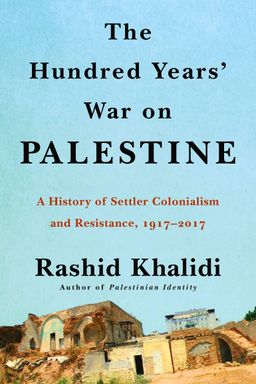
The Hundred Years'' War on Palestine cover

The Hundred Years'' War on Palestine

by Rashid Khalidi

The Hundred Years’ War on Palestine by Rashid Khalidi provides a detailed Palestinian perspective on the complex history of the region. From British colonialism to the rise of militant movements, this book explores the resilience and struggles of a people seeking justice and peace.

The Hundred Years’ War on Palestine

How can you understand a century-long conflict that has continually reshaped the Middle East and world politics? In The Hundred Years’ War on Palestine, historian Rashid Khalidi argues that Zionism, supported by imperial powers and later by the United States, amounted to a sustained settler-colonial project that systematically displaced, marginalized, and fragmented the Palestinian people. You should not see this simply as a clash of two national movements but as a structured, asymmetric struggle—one between colonizers with state and imperial backing and an indigenous society struggling to assert its existence and rights.

Khalidi frames his narrative as both historical chronicle and family memoir: generations of the Khalidi family intersect repeatedly with milestones from Ottoman decline to the 21st century Gaza wars. This personal dimension highlights a central claim: that Palestinians have always been active participants in their own history, not passive victims or latecomers to modern politics.

Colonial Structures and Early Zionism

The book opens by situating Zionism within the broader framework of European settler colonialism. Like other movements from the same era, its leaders—from Theodor Herzl to Ze’ev Jabotinsky—conceived of colonization as a civilizing mission and were prepared to use legal, financial, and military tools to dominate the land and its indigenous population. Khalidi contrasts the Zionist rhetoric of modernization and progress with the reality of dispossession and exclusion experienced by Palestinian communities. The exchanges between Herzl and Ottoman intellectual Yusuf Diya al‑Khalidi reveal that conflict in embryo: appeals for coexistence met by paternalistic promises of improvement that conveniently denied Palestinian political agency.

Empire, Mandate, and the Alliance of Power

From 1917 onward, Palestine became the site of a unique imperial compact. The Balfour Declaration and later the League of Nations Mandate institutionalized Zionist goals under British supervision. Khalidi exposes these arrangements as structurally biased: where the Jewish Agency received quasi‑state privileges, the Arab majority was reduced to religious and civil rights without political recognition. Britain’s “triple bind” forced Palestinians to face an empire that was both ruler and patron of their colonizers. Khalidi’s meticulous reconstruction of legal texts, diplomatic archives, and correspondence underscores that the de-nationalization of the Palestinians was not accidental but baked into the Mandate system’s design.

Nationhood from Below

Parallel to these imperial designs, Palestinian society underwent modernization and identity formation. New newspapers, schools, and merchants tied Jaffa, Haifa, and Jerusalem to global markets. Khalidi challenges the myth that Palestinians had no national consciousness before 1948; instead, he shows how a modern, secular patriotism emerged in direct response to colonial encroachment. Journals such as Filastin and al‑Karmil articulated an imaginative geography of Palestine as a single homeland and critiqued Zionist practices. By highlighting early Palestinian organizing—petitions, congresses, and local mobilization—Khalidi reclaims a narrative of agency and self-awareness that colonial discourses deliberately erased.

Resistance and Repression

The trajectory from the 1936–1939 Great Revolt to the 1948 Nakba exemplifies how repression and settler militarization combined to destroy indigenous political structures. Britain’s counterinsurgency campaigns devastated Palestinian leadership just as Zionist institutions consolidated state functions. When Israel emerged in 1948, it did so not by miracle but by mastery of organizational power and global legitimacy. Khalidi documents massacres, expulsions, and property seizures through both archival and personal testimony, arguing that these acts fulfilled long-articulated settler logics of demographic dominance (a parallel to transformations seen in Algeria or Australia).

From Occupation to Diplomacy

Subsequent decades—1967, 1982, 1987, 1993, and the Gaza wars—form what Khalidi calls successive “wars” in a continuous colonial campaign. The 1967 war’s military triumph redrew maps but reignited Palestinian nationalism by bringing millions of Palestinians under direct occupation. The rise of the PLO, the trauma of Beirut in 1982, and the grassroots First Intifada all reaffirmed the persistence of resistance even under extreme fragmentation. Yet each phase also witnessed co‑optation: whether through U.S. diplomacy after Madrid, the Palestinian Authority’s security obligations under Oslo, or factional splits between Fatah and Hamas.

Equality as the Future Horizon

Khalidi closes by rejecting the illusion that partition or incremental statehood can resolve a fundamentally unequal order. Framing Israel‑Palestine as a settler‑colonial system means that only equality—of citizenship, rights, and sovereignty—offers a sustainable foundation for justice. He calls for a reorientation of Palestinian strategy toward grassroots unity, rights‑based diplomacy, and international alliances beyond the orbit of American mediation. Throughout, he reminds you that history is not fate: understanding the colonial underpinnings of the conflict opens the possibility of reimagining liberation not as return to old formulas but as the realization of universal equality in the land both peoples call home.


Imperial Foundations of the Conflict

Khalidi demonstrates that the roots of the modern conflict lie in empire’s legal and political design. British and international frameworks transformed Zionist aspirations into enforceable power while stripping Palestinians of national rights. You are urged to see the Balfour Declaration not as a sentimental act of sympathy for Jews but as an instrument of British strategy in the Middle East—a way to secure imperial routes, counter French influence, and gain support in wartime diplomacy.

Balfour and the Hierarchy of Peoples

Balfour’s own memo of 1919 candidly subordinates Arab will to European designs, assuming that the “desires of 700,000 Arabs” matter less than Zionist success. This line encapsulates the racial and cultural hierarchies underlying British policy. Under the Mandate, articles privileging Jewish immigration and recognizing the Jewish Agency as a public body legitimized a dual system: Zionists enjoyed quasi‑state prerogatives while Palestinians were confined to local administration under colonial control.

Institutionalizing Inequality

Legal mechanisms reinforced political exclusion. Land transfer laws facilitated dispossession; “public security” measures criminalized assembly and press freedom. British divide‑and‑rule tactics—promoting rival religious offices, curbing congresses, and outlawing parties—eroded Palestinian unity. Khalidi situates this within a continuum of colonial governance resembling India or Kenya, where administrative fiat and legal dualism manufactured control without full annexation.

Key lesson

Empire provided the scaffolding for settler power: it created the bureaucratic, military, and diplomatic environment in which Zionism could flourish while foreclosing indigenous self-determination.

The Triple Bind

By the late 1920s, Palestinians faced an unbreakable triangle of constraint: British military supremacy, Zionist institutional modernization, and international law codified against them. Khalidi’s portrayal of this “triple bind” reveals why Palestinian appeals to justice, even when eloquent and legally precise, repeatedly met silence. In recognizing this architecture of inequality, you see how international law itself functioned as a colonial instrument, legitimizing conquest under the language of progress.


Palestinian Identity and Resistance

Contrary to claims that Palestinians lacked national consciousness, Khalidi details how modern Palestinian identity developed from social modernization and reaction to external threats. You follow the emergence of print capitalism, urban bourgeoisie, and educated elites who articulated Palestine as both a political and cultural homeland. This awareness predates partition or exile and reflects global patterns of nation formation.

Modernization and Social Fabric

Ottoman reforms expanded education, bureaucracy, and commerce. Towns like Jaffa became export hubs connecting peasants, merchants, and professionals. This socioeconomic evolution generated class awareness that transcended family or city loyalties. Khalidi positions Palestine within larger Middle Eastern transformations, where modernization fostered new political imaginaries even before formal colonialism arrived.

The Press and the Public Sphere

Newspapers became incubators of nationalism. Editors such as ‘Isa al‑‘Isa and Najib Nassar publicized land sales, criticized Zionist separatism, and introduced everyday readers to the concept of “Palestine” as a shared identity. English‑ and Arabic‑educated elites like Yusuf Diya al‑Khalidi bridged Ottoman cosmopolitanism with local patriotism. Public debates over education, women’s roles, and economic self‑sufficiency gave nationalist sentiment coherence and vocabulary.

Identity as Response and Assertion

For Khalidi, identity was both assertive and defensive: shaped by pride in homeland and resistance to encroachment. The early 20th‑century Arab congresses, petitions to Versailles, and collective strikes reveal that Palestinians did not merely “react” to Zionism but developed their own vision of self-rule. Recognizing these early movements corrects the persistent erasure that treats Palestinian nationhood as derivative rather than indigenous and modern.


Revolt, Nakba, and Exile

Khalidi traces the decades from 1936 to 1949 as the era in which Palestinian social cohesion was shattered and Zionist statehood crystallized. The Great Revolt epitomized mass resistance and British repression, while the Nakba institutionalized dispossession through armed conquest and demographic transformation.

The Great Revolt and Its Defeat

The 1936 general strike and revolt embodied unified national opposition to both British rule and Zionist expansion. Britain’s counterinsurgency—with aerial bombardments, executions, and deportations—decimated leadership and social structures. At the same time, Zionist militias trained under British protection, transforming the yishuv into a proto‑army. Khalidi calls this a crucible where colonial violence not only quenched rebellion but prepared the ground for a new state.

Partition and the Catastrophe

The UN Partition Plan of 1947 legitimized unequal realities. When war erupted, Plan Dalet operations expelled or terrorized civilian populations—a pattern Khalidi documents in Haifa, Jaffa, and hundreds of villages. The exodus of roughly 720,000 Palestinians produced the largest refugee crisis in the region’s modern history. He fuses family testimony with archival research to underscore that the Nakba was not a spontaneous byproduct of war but a culmination of settler-colonial logic.

Regional Reverberations

The refugee outcome reshaped adjacent states: Jordan’s annexation of the West Bank, Lebanon’s sectarian fears, Syria’s security anxieties. Khalidi argues that the Nakba inaugurated an open-ended process of structural displacement. Property confiscations, laws of absentee ownership, and the institutionalization of the Jewish National Fund ensured that erasure became permanent policy. Understanding this continuity helps you see 1948 not as an endpoint but a beginning—the foundation of an unresolved colonial relationship.


Occupation, Resistance, and Revival

The 1967 war and its aftermath mark a paradoxical transformation: Israel achieved overwhelming military victory yet reawakened Palestinian political identity. Khalidi charts how occupation both entrenched control and reignited mobilization, giving rise to the modern PLO and later the intifadas.

UNSC 242 and the Legal Vacuum

Resolution 242’s ambiguity—calling for withdrawal from “territories” not “the territories”—created a diplomatic loophole. More critically, it reduced Palestinians to a refugee issue, excluding them from political recognition. This omission institutionalized denial of agency, transforming diplomacy into a state‑centric conversation that marginalized the colonized population. Khalidi treats 242 as a structural turning point where language itself became an instrument of power.

The Rise of the PLO

After 1967, war refugees and activists regrouped in exile. The Battle of Karameh (1968) provided symbolic triumph; Yasser Arafat’s ascendancy made the PLO both guerrilla federation and diplomatic representative. The PLO’s later entanglement with Arab state politics—culminating in its 1982 expulsion from Beirut—revealed tension between autonomy and dependence. Each military confrontation (Jordan 1970, Lebanon 1982) forced Palestinians to rebuild amid exile and fragmentation.

1982 Beirut and Sabra‑Shatila

The Israeli invasion of Lebanon was intended to destroy the PLO’s military capacity. Instead, the sieges of Beirut and massacres at Sabra and Shatila exposed the human cost of international complicity. Khalidi’s eyewitness account conveys how global powers—particularly the U.S.—brokered withdrawals without guarantees, producing humanitarian catastrophe and birthing new actors like Hizballah. The episode symbolizes repeating patterns: external powers seeking control while civilians bear the consequences.


The First Intifada and Political Transformation

The First Intifada (1987–1993) becomes, in Khalidi’s reconstruction, both a mass awakening and an undoing. It was the first struggle fought primarily inside the Occupied Territories, organized from below, and broadcast globally. You see ordinary Palestinians transform resistance into civic life: strikes, boycotts, tax refusal, and the creation of self‑governing committees.

Grassroots Power and International Resonance

The uprising’s decentralized character enabled rapid spread across towns and camps. Its imagery—a child with stones facing soldiers—shifted international perceptions. Women assumed leadership as men were detained, forging gendered dimensions of struggle often ignored in earlier narratives. Intellectuals like Hanan Ashrawi and Haydar Abd al‑Shafi became global voices translating daily suffering into political language that resonated with human rights discourse.

Repression and its Ironies

Israel’s repression under Defense Minister Rabin—with directives to “break bones”—inflicted mass injury and imprisonment but failed to extinguish popular mobilization. International media coverage turned brutality into a moral liability for Israel, prompting Western governments to experiment with peace initiatives. The PLO, meanwhile, sought to reassert leadership over a movement that had surpassed it, revealing tensions between diaspora politics and local agency.

From Popular Resistance to Oslo Channels

By combining resilience and visibility, the Intifada achieved political recognition but also paved the way for elite negotiations. Khalidi stresses that this people’s movement was gradually co‑opted by leadership exiled in Tunis, whose isolation and misread of realities led them into flawed diplomacy. The Intifada thus marks both the high point of grassroots unity and the prelude to compromises that re‑embedded inequalities under the guise of peace.


From Oslo to Fragmentation

Oslo in 1993 redefined the conflict’s trajectory. Khalidi warns you to interpret it not as a peace breakthrough but as a restructuring of control. The PLO, weakened by exile and financial loss after backing Iraq in 1991, accepted U.S.‑brokered terms that privileged security over sovereignty. The resulting Palestinian Authority incorporated limited autonomy while preserving Israeli supremacy.

Recognition for Security

Through secret channels, mutual recognition was exchanged for cooperation in policing occupied populations. Israel acknowledged the PLO as representative but withheld recognition of a Palestinian state. Security coordination became the central pillar: Palestinians would govern fragments of land while ensuring Israeli safety. This arrangement shifted occupation’s administrative burden without altering its reality.

De Facto Bantustanization

Oslo II’s territorial divisions—Areas A, B, and C—entrenched fragmentation. Area C, rich in resources and sites for settlements, remained under full Israeli control. Khalidi compares this geographic partition to colonial “native reserves,” designed to contain populations rather than empower them. International donors misread aid and elections as state‑building, while real sovereignty stayed with the occupier.

Core Warning

A peace built on inequality can only institutionalize subjugation; Oslo transformed liberation into subcontracted governance.

Collapse of Legitimacy

The PLO’s misjudgment in aligning with Iraq alienated Gulf patrons and exhausted regional support, leaving it desperate for Western recognition. The ensuing donor dependency and security obligations destroyed popular trust. Khalidi interprets this era as the codification of defeat through diplomacy—a process that shaped the fractured landscape of Palestinian politics thereafter.


Hamas, Gaza, and Global Shifts

The rise of Hamas and repeated Gaza wars represent both a symptom and a consequence of the failures of Oslo-era politics. Khalidi describes how secular nationalism’s decline, combined with external manipulation, birthed new Islamist resistance that would dominate post‑2000 dynamics.

Origins and Election Shock

Founded in 1987 from the Muslim Brotherhood, Hamas initially thrived under tacit Israeli tolerance designed to weaken Fatah. When it won the 2006 legislative elections, Western powers refused acceptance unless it met political conditions—recognition of Israel, renunciation of violence—that no occupying power had reciprocally met. The boycott led to fiscal crisis and civil conflict culminating in Hamas’s control of Gaza and the geographic-political split of 2007.

The Siege Economy

Following Hamas’s takeover, Israel and Egypt imposed a comprehensive blockade, creating a humanitarian catastrophe. Gaza’s economy collapsed under restrictions on fuel, materials, and exports; youth unemployment surged beyond 50 percent. Khalidi emphasizes siege as a policy of collective punishment, designed to delegitimize Palestinian resistance through economic strangulation rather than concession.

Wars of Disproportion

From 2008 to 2014, Israel launched repeated assaults under the “Dahiya doctrine,” inflicting overwhelming firepower on dense urban zones. The asymmetry—thousands of Palestinians versus dozens of Israeli deaths—demonstrated continuation of colonial logic in modern form. Yet global perception began to shift: televised devastation of Shuja‘iyya and civilian suffering eroded unconditional support among Western audiences, especially younger Americans.

Changing Global Perceptions

While U.S. policy still armed and shielded Israel diplomatically, public opinion trends revealed cracks in consensus. Human rights frames, social media imagery, and activist movements introduced equality-based narratives challenging old paradigms. The Gaza crises, Khalidi notes, transformed moral perception even if not policy—proof that informational and ethical reconfigurations precede political change.


Equality and Decolonization as the Future

Khalidi concludes that you must reframe Palestine not as a bilateral “dispute” but as a colonial system demanding decolonization. From Herzl to the Nation‑State Law of 2018, policies have consistently enshrined ethno‑national hierarchy. The solution, he insists, lies in principles of equality and shared rights—not partition or conditional statehood.

Reframing the Conflict

Viewing Zionism through a colonial lens clarifies the persistence of inequality. Laws that determine land access, movement, and citizenship maintain a dual regime reminiscent of other settler systems. Acknowledging this structure connects Palestinian struggles to global decolonization frameworks—from South Africa’s anti‑apartheid movement to Indigenous rights campaigns worldwide.

Equality as a Non‑Negotiable Principle

The litmus test of justice becomes equality under law—civil, political, and national. Khalidi challenges the sustainability of a state that claims democracy while reserving self‑determination for one group. Demographic and territorial realities already produce a de facto single system; moral and political coherence demand transforming it from domination to equality.

Strategic Reorientation

Practically, Khalidi proposes shifting from U.S.‑centric mediation to broader international arenas, rebuilding Palestinian unity, and articulating a rights‑based agenda emphasizing return, citizenship, and justice. Only by confronting structural inequality rather than managing its symptoms can both peoples imagine coexistence not predicated on privilege but on universal rights. The war on Palestine, he concludes, can end only when the world chooses equality over empire.

Dig Deeper

Get personalized prompts to apply these lessons to your life and deepen your understanding.

Go Deeper

Get the Full Experience

Download Insight Books for AI-powered reflections, quizzes, and more.