
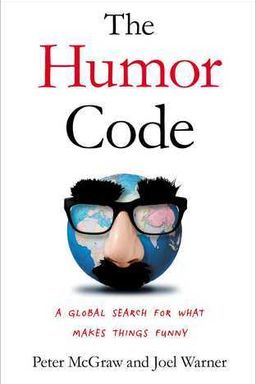
The Humor Code cover

The Humor Code

by Peter McGraw and Joel Warner

The Humor Code takes you on a global journey to uncover what makes us laugh. Authors Peter McGraw and Joel Warner explore humor''s cultural nuances, its psychological effects, and its role in human connection, offering valuable insights into the use of humor in everyday life.

The Science of What Makes Us Laugh

Why do you laugh—and why do some jokes leave you cold while others devastate you with hilarity? In The Humor Code, psychologist Peter McGraw and journalist Joel Warner team up to travel the globe hunting for the elusive formula of humor. Their quest is both scientific and personal: they want to uncover the principles that govern why something feels funny, while testing whether these truths can be proven through experiments, conversations with comedians, and even daring stand-up performances. At the heart of their inquiry lies one pivotal question: is there a code behind comedy, an equation that explains laughter across cultures?

McGraw contends that humor isn’t random or mystical—it follows psychological laws. His central argument, the benign violation theory, claims that we laugh when something feels wrong but simultaneously safe. It’s why we giggle at social blunders or political jokes but cringe at real tragedy. In essence, humor thrives at the intersection of danger and delight. To prove this, McGraw and Warner journey from Denver comedy clubs to Tanzanian villages struck by a mysterious laughter epidemic, from Japanese game shows to Israeli refugee camps, and finally to Montreal’s Just For Laughs festival. Each destination adds evidence to their theory that humor’s “sweet spot” arises when violation and safety collide.

The Quest for a Universal Theory

The book opens at the Squire Lounge in Denver, where McGraw bombs his first stand-up attempt, realizing firsthand that theory alone can’t substitute for timing and charm. This failure sparks his scientific crusade: maybe what comedians intuit can be expressed as psychological law. At his Humor Research Lab (HuRL), McGraw observes how subjects respond to absurd ads, painful mishaps, and edgy jokes. Through such experiments, he concludes that laughter comes not from cruelty or confusion alone, but from tension transformed into playfulness.

To test this, he embarks on a global journey that merges journalism with science. In the process, he discovers that humor is both biological—rooted in evolution as a signal of safety—and social—a tool for bonding, rebellion, and healing. Each chapter pushes the boundary of what counts as comedy: a failed altruistic campaign, a clown troupe curing trauma, or protest movements toppling dictators through laughter. You learn that humor performs vital functions in human life: it challenges authority, alleviates anxiety, and reveals truth where speech alone might falter.

Why Humor Matters

Warner’s storytelling adds emotional stakes to McGraw’s scientific pursuit. Behind their adventures lies a critique of modern seriousness. In a world burdened by conflict and stress, laughter becomes rebellion and relief. They argue that humor isn’t just decoration—it’s survival intelligence. From prisoners of war who used jokes to resist despair to social activists who weaponize satire, humor emerges as a universal language of resilience. This fusion of experimentation and empathy makes The Humor Code more than trivia about jokes—it’s a new lens on humanity itself.

Across continents, McGraw’s benign violation formula proves surprisingly elastic. Whether analyzing Louis C.K.’s brutal honesty, Japanese manzai duos, or Palestinian satire, McGraw finds that laughter depends on psychological distance: when tragedy feels too close, it’s painful; when it’s far enough, it’s funny. This insight bridges comedy and compassion—you can’t fully understand joy without recognizing suffering. Their journey ends where it began: back on stage. McGraw tests his theory by performing at the world’s biggest comedy festival in Montreal, proving that science can illuminate comedy but never replace its artistry. Humor, they conclude, is both experiment and improvisation—the world’s most human act of balance between chaos and comfort.

Ultimately, The Humor Code teaches that laughter is far more than entertainment. It’s a form of psychological recalibration, a social connector, and a window into what makes human experience bearable. You laugh not because life is easy, but because humor rewires hardship into harmony. By decoding comedy, McGraw and Warner reveal laughter as our most profound survival skill—a global proof that, even in tragedy, it’s possible to find something benign.


The Benign Violation Theory

Peter McGraw’s groundbreaking concept—the benign violation theory—serves as the linchpin for the entire book. According to this model, humor arises when what seems wrong (a violation) also feels harmless or acceptable (benign). This delicate balance explains everything from ticklish laughter to political satire. When a boundary is crossed but you recognize it’s safe, the tension releases as joy.

From Theory to Practice

McGraw’s experiments at the Humor Research Lab illustrate how this formula applies across cultures. He tested reactions to stories like rock star Keith Richards allegedly snorting his father’s ashes. Participants laughed only when they felt the act was simultaneously shocking yet somehow okay. If the violation was real or cruel, amusement vanished. Similarly, humorous ads failed whenever they insulted viewers instead of involving them in safe absurdity.

This dual structure—violation and safety—bridges decades of failed theories. Plato’s superiority model, Freud’s relief theory, and the incongruity approach each captured fragments of truth but overlooked interplay. McGraw shows that laughter isn’t mere release or surprise—it’s reconciliation. Jokes allow us to touch danger without harm, to feel edge without injury.

Real-World Proof

To explore whether humor has universal rules, McGraw tested live stand-up. At Denver’s Squire Lounge, his attempt to apply benign violations through stories about nicknames failed spectacularly—too benign, not enough edge. But across the world, his theory proved adaptive. Japanese manzai duos rely on a straight man correcting a fool’s benign errors, while Palestinian comedians transform oppression into laughable irony. Each case shows humor’s power to defuse tension by rebranding risk as play.

Key Principle

You laugh when your mind recognizes danger but your heart feels safe. That is the universal mechanism behind every joke that works—from pratfalls to parody.

McGraw’s insight connects psychology, linguistics, and comedy. It reveals humor as both shield and mirror: we laugh to process what frightens or frustrates us. By identifying and softening violations, anyone—from advertisers to therapists—can create humor that heals rather than hurts. This is the science behind every genuine giggle.


How Comedians Experiment Like Scientists

One of the book’s most surprising revelations is that professional comedians operate much like experimental researchers. They test hypotheses—jokes—by performing them, collect responses (laughter or silence), tweak variables (timing, tone, topic), and iterate until results improve. McGraw’s collaboration with comics from Los Angeles proves that comedy, like science, demands data and patience.

Stand-Up and the Laboratory

When McGraw interviewed Louis C.K., he discovered that veteran comics distrust simple formulas. “There’s no one explanation,” C.K. said, rejecting theoretical shortcuts. Instead, stand-up is empirical: comedians learn by failing. In clubs like Los Angeles’s Comedy Store, aspiring performers repeatedly test routines four nights a week. Managers and scouts—such as Sarah Klegman and Jeff Singer—observe not numbers but intangible patterns: confidence, timing, emotional rapport. The result is a profession where progress depends on trial, error, and resilience.

The Comedy Classroom

Greg Dean’s stand-up class in Santa Monica translates linguistic humor theory into step-by-step technique. He teaches “riffing,” the art of playful audience interaction, and diagrams jokes like scientific equations—connecting phrases to generate reinterpreted meanings. His example, “My wife is an excellent housekeeper; when we got a divorce, she kept the house,” demonstrates how structured reinterpretation creates laugh-worthy incongruity. Yet field research proves that academics alone can’t guarantee laughter without the messy chaos of real audiences.

McGraw calls comedians “applied scientists of emotion.” They gather feedback through laughter rhythms, crowd energy, and timing precision. When Aziz Ansari records each show to study audience reaction, he becomes a behavioral researcher testing humor under real-world conditions. Stand-up thus bridges art and analytics—the iterative process behind creativity itself.

You can use this insight to refine your own humor or creativity. Record reactions, note when people smile or disengage, adjust approach. Whether pitching ideas at work or telling stories with friends, you’re running mini-comedy experiments. As McGraw shows, empathy and experimentation turn ordinary communication into shared amusement.


Culture Shapes What We Find Funny

Why do jokes that kill in one country flop in another? Through journeys to Japan, Denmark, and Palestine, McGraw and Warner reveal that humor depends profoundly on culture. Every society defines what counts as benign or violating, shaping who laughs and who protests. The authors argue that understanding cultural humor is key to bridging differences worldwide.

The Japanese Puzzle

In Osaka, the authors encounter audiences transfixed by rakugo—traditional seated storytelling delivered with minimal gestures. Without translation, McGraw nearly dozes off, realizing that laughter here stems from rhythm, politeness, and shared cultural scripts. Comedy in Japan thrives on consensus and ritual, not confrontation. The Osakans’ compartmentalized humor—strictly confined to specific spaces like cafes, theaters, or television—embodies a restrained society where satire exits on cue. This contrasts with Western stand-up that breaks taboos to assert individuality.

Dangerous Cartoons in Denmark

The authors' deep dive into the 2005 Mohammad cartoon crisis exposes humor’s political volatility. Danish illustrators assumed freedom of speech as benign context; Muslim viewers saw blasphemous violation. The ensuing protests proved that humor fails when cultural distance collapses. As scholar Jytte Klausen notes, the problem wasn’t the drawings alone but missing context: jokes unmoored from shared understanding mutate into offense. McGraw uses this tragedy to show how timing, distance, and empathy decide whether violation stays benign or becomes destructive.

Laughter Under Occupation

In Palestine, comedy becomes catharsis. Satirical shows like Watan ala Watar lampoon both Israeli occupation and local corruption, offering emotional release amid despair. Here humor acts as political protest—a version of “laughtivism.” Yet even in conflict zones, laughter forges humanity. When Palestinians and Israeli police momentarily share jokes in Hebron, Warner and McGraw witness humor transcending politics. Across cultures, laughter marks boundaries yet builds bridges; it signals, as Father James Martin puts it, “the divine impulse that keeps humans sane.”

If you’ve ever explained a joke that fell flat abroad or among colleagues, you’ve felt this tension. The Humor Code teaches that joking well requires empathy—a willingness to grasp others’ moral maps and sensitivities. Humor divides when context disappears but unites when surprise feels safe. Within cultural collisions, comedy teaches compassion.


Laughter's Evolutionary and Emotional Roots

In Tanzania, McGraw and Warner investigate the mysterious 1962 “laughter epidemic,” where hundreds began laughing uncontrollably. Their exploration becomes a meditation on why humans evolved laughter at all. Through neuroscientist Robert Provine’s field studies and evolutionary biologist David Sloan Wilson’s work, they reveal laughter as a primal social code—a way our species signals safety and connection.

The Science of Social Spasms

Provine’s “sidewalk neuroscience” showed that only 20% of laughter occurs in response to deliberate jokes. Most happens during casual conversation—a sign that laughter functions as social punctuation rather than humor’s byproduct. People are thirty times more likely to laugh in company than alone. This research reframes comedy as communication. We laugh to confirm group bonds, synchronize attention, and announce emotional safety.

From Chimps to Humans

Evolutionary studies trace laughter to panting sounds heard during chimpanzee playfights—signals that combat is friendly. Over millennia, this panting morphed into human chuckles. Guillaume Duchenne’s 19th-century experiments shocking facial muscles revealed two distinct laughs: the genuine “Duchenne laugh” with smiling eyes and the polite “non-Duchenne” variety. Later scientists Matthew Gervais and David Sloan Wilson proposed that real laughter evolved as a marker of play and exploration, while fake laughter evolved as social strategy for manipulation or appeasement.

McGraw expands this idea using his benign violation lens: laughter’s evolutionary essence expresses the realization that danger has passed. When you laugh after surviving turbulence or embarrassment, you’re broadcasting relief—an ancient safety signal still embedded in human interaction.

Recognizing this helps you see humor’s physiological power. Laughter isn’t shallow; it resets anxiety systems, regulates breathing, and bonds communities. Whether in Tanzanian villages or corporate meetings, when people share laughter they’re reaffirming primal safety—that instinctive “we’re okay” that connects us all.


Humor Heals: The Medicine of Play

Can laughter cure pain? Traveling with Patch Adams’s clown brigade through the Peruvian Amazon, McGraw and Warner discover that humor doesn’t fix disease but profoundly aids healing. Their experiences redefine the cliché “laughter is the best medicine,” showing that humor’s value lies not in biological miracles but in emotional resilience and human connection.

The Power of Connection

Among Amazonian slums ravaged by floods, clowns use play to rekindle joy. A simple red nose transforms fear into freedom—children who rarely smile engage, adults rediscover dignity. Patch Adams insists, “I never said laughter is the best medicine; love is.” For him, clowning breaks societal walls by violating seriousness benignly, turning tragedy into intimacy. McGraw realizes that humor’s therapeutic power stems not from curing cells but curing isolation.

Scientific Skepticism and Emotional Truth

Early research into humor therapy produced conflicting results. Large-scale studies, like Norway’s HUNT-2, found no measurable link between sense of humor and physical health. Yet survivors and doctors observed its psychological effects—reducing stress, strengthening morale, building relationships. The paradox mirrors Cousins’s claim in Anatomy of an Illness: laughter helps because it shifts perception, not physiology. Humorous complaining, McGraw later proves, makes adversity lighter and people more likable. Humor doesn’t remove problems; it reframes them.

In scenes where clowns comfort patients with Parkinson’s or bring mirth to mental hospitals, Warner describes laughter as bravery disguised as play. Clowning, like empathy, is a rebellion against despair. Even grief softens through gentle jokes, as seen when McGraw jokes about scattering his mother’s ashes—humor as memorial healing.

Lesson from the Amazon

Physical cures may fail, but laughter restores meaning. It signals we still belong, that pain can coexist with play. Humor doesn’t eliminate hardship—it reminds us we’re still human within it.

Applied beyond hospitals, this insight empowers everyday resilience. Laugh at the absurdities of deadlines or traffic; joke in grief without guilt. As McGraw concludes, laughter is medicine—not the best, but irreplaceable.


Humor as Rebellion and Resilience

In war zones, dictatorships, and crises, laughter becomes a weapon. McGraw and Warner’s encounters in Palestine, Denmark, and Serbia show humor’s subversive potential, a defiance that comforts and challenges simultaneously. Whether it’s prisoners flipping off captors or satirists facing censorship, humor survives where logic collapses.

Laughtivism: Comedy as Revolution

The authors document the Serbian movement Otpor!, whose activists toppled Slobodan Milošević using pranks and parody. By painting his face on barrels and inviting citizens to beat it, they forced police into absurdity—arresting a barrel instead of a man. This strategy, called “laughtivism,” breaks fear barriers. As organizer Srđa Popović notes, “If you weren’t arrested, you couldn’t get laid.” Humor converts power into ridicule, shifting authority dynamics without violence.

Sacred and Political Boundaries

From Mohammad cartoons to Palestinian sketches, satire often dances near prohibitions. When jokes violate sanctity without empathy, chaos ensues—as in Denmark’s cartoon crisis. But when humor invites shared reflection, it empowers. In Ramallah’s Watan ala Watar, comedians mock corrupt leaders and extremists alike, making laughter common ground amid conflict. Even Holocaust survivors like Gizelle Cycowycz laughed under torment—a psychological rebellion asserting identity against dehumanization.

McGraw’s experiments, from hurricane tweets to POW histories, reveal humor’s timing principle: tragedy plus distance equals comedy. When disaster is fresh, jokes offend; as time passes, laughter heals. This curve reflects emotional resilience—the conversion of suffering into story. The authors show that humor doesn’t trivialize pain; it transforms it into shared humanity.

Each smile in a refugee camp or giggle in a conflict zone proves laughter’s endurance. In moments of restriction, humor restores freedom at least internally. When words fail, irony speaks. The Humor Code reminds you that mirth isn’t denial—it’s endurance with style.


The Art and Limits of Universal Comedy

The authors end their journey searching for humor’s universal denominator—the world’s most globally funny joke. Psychologist Richard Wiseman’s experiment collected two million online ratings to find it: a hunter misinterpreting instructions from emergency services. McGraw calls it “the color beige of jokes”—the least offensive, most broadly acceptable gag. Their takeaway: universal humor isn’t the funniest, just the safest.

Why Universal Isn’t Always Great

McGraw’s collaborations with improv groups like Upright Citizens Brigade refine Wiseman’s dull joke into hilarious variants without adding offense. By adjusting context and implication, they learn that humor’s reach grows through skill, not blandness. When danger feels implied but unseen—like off-screen chaos instead of graphic harm—audiences laugh without guilt. This demonstrates again the benign violation effect: serious violations can be funny if expertly framed.

Comedy’s Human Core

Ultimately, McGraw and Warner conclude that perfect formulas can’t capture comedy’s soul. Humor, like love or art, resists complete quantification. It thrives on spontaneity, empathy, and imperfection. At the Montreal festival, McGraw’s own closing stand-up proves this truth: some jokes click, others flop, but shared laughter always connects. Science can decode laughter’s triggers, but not replace the human spark that delivers them.

Final Message

You can study humor endlessly, but its heart lives in risk and vulnerability. The universal joke isn’t the blandest—it’s your willingness to laugh with, not at, the world.

By the book’s close, humor becomes symbol of life’s balance: between reason and chaos, tragedy and relief. Global comedy unites us not through sameness but through shared imperfection. That paradox—that laughter emerges from the mix of wrongness and safety—is the universal language McGraw finally decodes.

Dig Deeper

Get personalized prompts to apply these lessons to your life and deepen your understanding.

Go Deeper

Get the Full Experience

Download Insight Books for AI-powered reflections, quizzes, and more.