
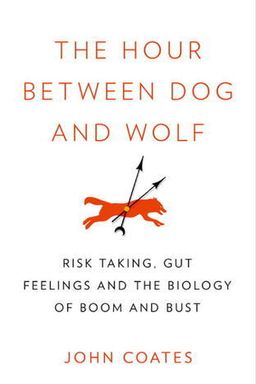
The Hour Between Dog and Wolf cover

The Hour Between Dog and Wolf

by John Coates

The Hour Between Dog and Wolf delves into the intricate relationship between human biology and financial markets. John Coates reveals how hormones like testosterone influence traders'' behavior, often leading to market volatility. By understanding these physiological impacts, readers can devise strategies to mitigate risks and leverage their body''s responses for improved trading outcomes.

The Biology of Risk and Decision

Why do market booms feel euphoric and crashes paralyzing? In The Hour Between Dog and Wolf, neuroscientist and former trader John Coates argues that financial markets are not just economic systems—they are biological theaters where hormones, neural circuits and institutional incentives interact to shape risk-taking. You never act as a detached rational calculator; when you trade or invest, your entire body joins the decision.

Coates’s central claim is simple but revolutionary: risk is a physiological event. Every market tick triggers physical responses—adrenaline and noradrenaline for immediate arousal, testosterone for confidence and reward, cortisol for threat and withdrawal. These substances, acting on brain and body, can make markets collectively manic or morose. Understanding this biological architecture explains why rational agents can produce irrational cycles.

Mind and body as one trader

Your decision-making circuits are fundamentally embodied. The locus ceruleus floods your brain with noradrenaline when novelty appears—a market surprise, a price break, a Fed announcement. That ‘alert’ state modifies heart rate, breathing, and muscle tone, and those bodily signals feed back through the vagus nerve to your brain, changing attention and judgement. This is the basis of gut feelings—the body’s feedback loop acting faster than conscious thought.

Coates describes traders sensing change before data hits the screens. Their bodies detect subtle environmental cues through preconscious mechanisms—the brainstem, amygdala and colliculus—long before conscious logic intervenes. You think you’re using instinct; physiologically, your whole system has prepared you for action.

Hormonal cycles and market cycles

During winning streaks, testosterone surges, increasing confidence and appetite for risk. That’s the winner effect: success alters physiology, fueling further daring until exuberance becomes recklessness. During loss streaks and crises, cortisol rises, promoting anxiety, pessimism and avoidance. Together they push markets into biological feedback loops—bulls become bubbles, bears become crashes.

Coates’s studies on London trading floors showed that morning testosterone predicted afternoon profits in male traders, while sustained cortisol correlated with poor risk control. The implication is profound: physiology shapes not only individual moods but collective price action. Bubbles and busts are partly hormonal epidemics.

Speed, intuition and embodied intelligence

Fast markets demand split-second reactions, and your biology delivers. Conscious thought takes hundreds of milliseconds to form; by then, the price has changed. Traders and athletes rely on automatic processes—pattern recognition and motor programmes trained by experience—to act before awareness catches up. The brain’s predictive circuits anticipate movement and prepare muscles milliseconds in advance. Conscious deliberation, useful for analysis, is too slow for execution.

Through examples of traders like Martin and Scott, Coates shows how embodied cognition operates under risk: physiological readiness combines with preconscious pattern detection to generate ‘gut’ trades that seem intuitive but are biologically grounded. When properly trained, these instincts can outperform strategy; when distorted by hormone excess, they fail catastrophically.

Institutions as biological amplifiers

Markets don’t magnify risk alone—organizations do. Banks that raise risk limits in booms, pay huge bonuses for short-term gains and cut capital after crises unwittingly reinforce hormonal surges. Biological cycles become systemic cycles. The feedback between body chemistry and incentive structures explains why the same economy can oscillate between irrational optimism and paralyzing fear without external shocks.

To stabilize markets, Coates proposes practical interventions: change compensation to reflect multi-year outcomes, encourage physiological recovery, design workplaces that manage stressors, and diversify biology—more women and older men—to temper testosterone-fueled extremes. His thesis ultimately reframes finance as a branch of behavioral physiology: managing risk means managing bodies as well as balance sheets.

Key insight

Markets move not only because of data but because of biology. To trade wisely, manage your physiology as carefully as your portfolio. Emotional control starts with hormonal awareness, and institutional design must account for the chemistry of risk-taking.

This integrative view—combining neuroscience, endocrinology and economics—makes Coates’s book one of the most original works on market behavior in the modern era. It teaches you that stability is physiological as much as financial, and that mastering risk begins with mastering yourself.


Hormones and Market Mood

Hormones set the emotional climate of markets. Testosterone drives confidence and aggression; cortisol drives caution and fear. Coates traces how these biological agents synchronize across traders, transforming rational price discovery into emotional contagion.

The winner effect and risk appetite

In victory, testosterone rises. It boosts red blood cell count, oxygen capacity and focus—enhancing performance. But repeated success compounds that effect, fostering overconfidence. Coates’s field studies found that traders with elevated morning testosterone earned more by afternoon, yet their risk exposure often ballooned dangerously. This feedback mechanism—win, surge, risk, win again—fuels market bubbles much as it fuels animal dominance displays.

The 1990s dot‑com mania and the housing boom showed the same pattern: male traders with sustained success drifted toward bravado and larger directional bets. Moderate testosterone sharpens instinct; excess dissolves caution. The book’s character Scott becomes emblematic—his escalating e‑mini positions mirror a hormonal spiral from competence to recklessness.

Cortisol and crash psychology

Cortisol mirrors the opposite phase. It rises under uncertainty and prolonged threat, helping short-term endurance but undermining long-term reasoning. Initially, it sharpens alertness; chronically, it shrinks hippocampal structures and strengthens amygdala fear circuits. On the trading floor, prolonged stress transforms vigilance into paralysis.

During the credit crisis, Coates found that traders with high cortisol levels became pessimistic and froze even when opportunities reappeared. When everyone’s hormones synchronize negatively, markets overshoot downward just as they do upward in exuberance. The body’s chemistry echoes across trading floors, creating collective mood.

Practical takeaway

Recognize your physiological phase. The same hormone that drives peak performance can trigger overconfidence or panic. Designing rest periods and multi-cycle incentives is not indulgence—it is essential risk management.

By mapping hormonal arcs onto market cycles, Coates turns economic booms and busts into human physiology writ large. The system doesn’t just misprice assets—it mismanages bodies. Awareness of these internal signals can help you act rationally when your chemistry isn’t.


Speed, Intuition and Embodied Intelligence

Fast-moving markets reward speed more than deliberation. Coates connects real-time trading to neuroscience of action: decisions often occur before conscious thought catches up. Understanding how your body and brain preempt awareness helps you use intuition effectively.

Pre-conscious detection

Signals travel through two neural routes: a rapid ‘low road’ from the thalamus to the amygdala for crude threat detection, and a slower ‘high road’ through cortex for evaluation. In volatile conditions, traders react through the low road—fast, reflexive, emotional. Your body often commits to a response milliseconds before you rationally decide.

Libet’s experiments confirm that actions are prepared unconsciously before reported intention. Coates’s narrative analogues—Martin executing a massive bond trade instantaneously—illustrate these mechanisms. Like an athlete catching a cricket ball without computation, skilled traders rely on trained automaticity, not analysis.

Training intuition

Gut feelings stem from accumulated experience and interoceptive sensitivity. Damasio’s Somatic Marker Hypothesis explains that past emotional outcomes tag decisions with bodily feelings. When similar cues recur, the body signals before reasoning can. In gambling and market experiments, physiological markers predict decision quality better than verbal reports.

To use gut feelings reliably, you must train them. Kahneman and Klein’s joint work on intuition shows that accurate instinct requires a regular domain with valid feedback. Trading floors can provide that if feedback is immediate and performance metrics are clear. Coates even proposes biomonitoring—heart rate, skin conductance—to quantify stress and detect when intuition is compromised.

Key insight

Your gut is a data stream. With practice, it becomes a rapid, informed predictor; without training, it’s noise. Managing physiological awareness turns instinct from superstition into skill.

Coates concludes that the best performers integrate automatic and analytical systems—fast embodiment for execution, slow reflection for strategy. You can’t think your way into speed, but you can train your body’s intelligence to think with you.


Institutions and Biological Feedback

Individual physiology becomes collective instability when amplified by incentives. Banks and hedge funds inadvertently turn hormones into macroeconomic variables. Coates demonstrates how reward systems and organizational design can either compound or contain human biology.

Incentive loops

Management often increases risk limits and bonuses in good times—precisely when testosterone and dopamine are rising. The combination creates runaway positive feedback: profits elevate hormones, hormones elevate risk-taking, profits spike again. When the cycle reverses, cortisol dominates, limits contract, and losses deepen. The firm mimics the body’s own instability.

Coates’s “Tortoise versus Hare” comparison shows structural peril: short-term stars earn enormous bonuses before eventual collapse, while steady performers contribute real value but earn modestly. Because incentives favor volatility, institutions prefer physiology aligned with immediate reward rather than sustained health.

Technology and ecology

High-frequency trading and algorithmic systems changed execution speed but not judgment. Machines handle milliseconds; humans handle minutes to months. Crises—from LTCM to 2007—revealed the continuing human center: when automated markets fail, physiology determines recovery capacity. Institutional ecology—who is empowered, how decisions occur—affects whether human biology stabilizes or destabilizes markets.

Implication

Economic stability demands biological design. Compensation, limit-setting, rest and diversity must align with how bodies actually handle risk and recovery.

Institutions thus act as biological amplifiers. Instead of imagining rational markets, Coates reframes them as ecosystems of embodied agents. To reform finance, reform the physiology of its incentives.


Building Resilient Traders

After diagnosing hormonal volatility, Coates turns to cultivation: you can train toughness. Physiological resilience—fast recovery, controlled arousal, balanced hormones—creates consistent decision performance under stress. Borrowing from sports science, he explains how traders can build the biology that sustains judgment.

Components of toughness

A resilient trader shows a high anabolic-to-catabolic ratio (testosterone and growth hormone outweigh cortisol), strong but brief adrenaline spikes, and high heart-rate variability—a marker of vagal tone. Such bodies react quickly to shocks, then reset, avoiding prolonged fear chemistry.

Neal Miller’s conditioning experiments revealed that intermittent stress builds resistance; unrelenting strain depletes it. Coates fuses this insight with athletic models: interval training, cold exposure, sauna contrast, and breathing exercises improve hormone regulation. Traders can adopt similar regimes to harden biological responses.

Training protocols

  • Alternate intense effort and recovery—both physical and cognitive—to teach your body adaptive stress cycling.
  • Use cold-water immersion or saunas to trigger controlled amine spikes and accelerate cortisol clearance.
  • Practice diaphragmatic breathing and mindfulness to strengthen vagal regulation.
  • Track heart-rate variability as an objective signal of stress load.

Key insight

Resilience isn’t mental toughness alone—it’s biochemical optimization. By tuning hormone responses, you make stress enhance, not erode, performance.

Coates’s “tough trader” embodies sports physiology applied to markets: short, intense activation followed by recovery, not endless endurance. Treat your body as trading infrastructure—your hormonal curve should be as well managed as your capital curve.


Designing Healthier Organizations

Beyond individuals, Coates outlines reforms for institutions themselves. Organizations can reduce chronic stress and hormonal instability through structural change: control, compensation, and wellness. These are managerial levers for physiological stability.

Restoring control and reducing uncertainty

Research from Whitehall and Karasek shows that autonomy protects health. In trading, uncertainty from management can be as harmful as market risk. Establish predictable processes, delegate routine execution, and clear legacy losses quickly. When people regain control, cortisol drops and cognitive flexibility returns.

Reengineering incentives

Replace short-term bonus volatility with multi-year or deferred schemes that reward stability over cycles. Encourage steady employment and longer evaluation horizons. Align personal physiology—longer-term planning and moderation—with institutional goals.

Institutional wellness and diversity

Physical health programs matter economically. Integrated gyms, stress monitoring, and social support lower absenteeism and medical claims. More important, biological diversity—gender and age—reduces systemic risk. Women’s lower testosterone and older men’s steadier profiles damp amplification. Diversity becomes not ideology but prudence.

Manager’s rule

Stable management and supportive environments are public health tools. Less cortisol means better judgment; calm physiology equals sustainable profit.

In summary, Coates turns corporate wellness into systemic risk prevention. Markets are human networks; to stabilize them, treat traders as biological assets. The next crisis may start with chemistry—so prevention must start with physiology.

Dig Deeper

Get personalized prompts to apply these lessons to your life and deepen your understanding.

Go Deeper

Get the Full Experience

Download Insight Books for AI-powered reflections, quizzes, and more.