
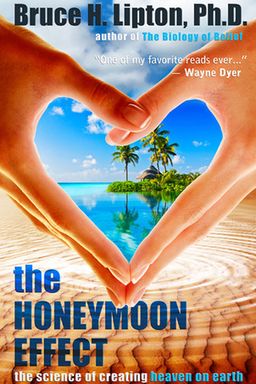
The Honeymoon Effect cover

The Honeymoon Effect

by Bruce H Lipton

The Honeymoon Effect explores how to maintain the euphoric state of early romance by utilizing insights from biology, quantum physics, and psychology. Learn to harness the power of your subconscious, align your energy, and understand the biochemistry of love to create enduring, passionate relationships.

Creating Heaven on Earth Through Love and Belief

Have you ever wondered why the first few months of a new relationship feel magical—like you’re living in a dream—and why that bliss so often fades away? In The Honeymoon Effect, Bruce H. Lipton, Ph.D., invites you to see that this exhilarating state isn’t accidental; instead, it’s a product of your beliefs, biology, and consciousness. Lipton argues that we can consciously extend that electrifying honeymoon feeling for a lifetime by understanding the science of love—right down to the cellular level.

Best known for his pioneering work in The Biology of Belief, Lipton blends quantum physics, cell biology, and psychology to show that love and connection are not mystical accidents but measurable, reproducible biological phenomena. According to Lipton, relationships—and indeed, the experience of Heaven on Earth—are built on more than chemistry. They rely on how your mind, conscious and subconscious, interacts with energy and programming. Once you learn to align your thoughts, beliefs, and biology, you can sustain the joy and vitality of love indefinitely.

From Cellular Communities to Human Bonding

Lipton starts by reminding us that we are not isolated entities; we are communities of 50 trillion cells living in harmony within a single body. Just as these cells thrive by working together, human beings are biologically designed to connect and bond. Evolution, writes Lipton, favors cooperation over competition. When we connect—emotionally, spiritually, and energetically—we bring out our biological potential for health, joy, and creativity. That drive to bond, built into every organism, provides the foundation for all relationships, from molecules to humans.

Energy: The Invisible Language of Attraction

Moving beyond conventional biology, Lipton taps into quantum physics to explain how love works as an energetic phenomenon. Every atom, molecule, and cell vibrates with energy. When two entities resonate in harmony—when their energies align—they experience what he calls “constructive interference”: a boost of energy and vitality that creates good feelings, attraction, and cooperation. Conversely, “destructive interference” generates bad vibes and resistance. Lipton equates these harmonious patterns with healthy relationships and the disharmonious ones with conflict or toxicity. This understanding reframes love not merely as emotion but as a scientific state of resonance between energy fields.

Love Potions and Biochemistry: The Chemistry of Connection

The Honeymoon Effect is not just mystical—it is biochemical. When we fall in love, our brain releases a cocktail of hormones and neurotransmitters—dopamine, oxytocin, and growth hormone—that flood the body with euphoria and well-being. Lipton explains that your mind is constantly mixing this biological paint. You can create bliss by how you perceive the world. When your thoughts focus on love and joy, your brain generates a life-affirming internal chemistry. When your mind is stressed, fearful, or angry, your biochemistry shifts into protection mode, stunting growth and health. Thus, the quality of your relationships mirrors the chemistry of your perceptions.

The Four Minds Behind Every Relationship

Perhaps Lipton’s most striking insight is that every couple isn’t just two minds working together—it’s four. Each person brings both a conscious mind, which dreams and creates, and a subconscious mind, which runs programmed behaviors absorbed from parents and culture. The honeymoon glow lasts only while the conscious minds are in charge; once daily stress diverts attention, the subconscious takes over—and that’s when old patterns sabotage harmony. The secret, Lipton says, is to reprogram the subconscious using mindfulness, energy psychology, and intentional awareness so that both minds are aligned in love rather than conflict.

Becoming “Noble Gases”: Relationships that Radiate Light

Lipton concludes with a metaphor from chemistry. Noble gases are atoms so balanced that they don’t need to bond to maintain stability—yet when they become excited, they produce radiant light. Balanced human beings, like noble gases, don’t cling to relationships out of need; they connect out of shared excitement and mutual wholeness. When two people who have integrated their subconscious and conscious minds unite, they create a luminous relationship that inspires others, much like the excimer lasers that emit coherent light. This, he writes, is how personal love can heal the planet—by spreading harmonious energy throughout humanity.

Why It Matters

Lipton’s vision redefines romantic love as a spiritual and biological partnership. It teaches that lasting joy comes not from finding “the one” but from becoming whole yourself—by aligning your beliefs, rewiring subconscious patterns, and cultivating positive energy. Once you transform your inner world, you’ll radiate the kind of love that can create Heaven on Earth for yourself, your partner, and, collectively, the planet. The Honeymoon Effect is both a scientific manual and a spiritual awakening: it offers tools to sustain the bliss that most people think is fleeting. Lipton’s message is simple but revolutionary—you have the power to change your biology, your relationships, and, ultimately, your world by changing your beliefs.


The Biological Drive to Bond

Lipton opens the scientific exploration of love by asking a deceptively simple question: why do humans persist in seeking connection, even after painful breakups and failed relationships? The answer, he says, lies in biology. Every organism, from bacteria to humans, is designed to bond. This is not just emotional instinct—it’s an evolutionary imperative embedded in our cellular structure. Your body itself is a living community of 50 trillion cooperative cells. The harmony among them mirrors the harmony humans crave in relationships.

Community and Cooperation in Nature

Drawing from cell biology, Lipton shows that our cells model perfect cooperation. Within the body, each cell performs its role so that the whole thrives—just like individuals in an ideal human community. He compares humanity’s challenge of managing seven billion people to the cellular challenge of organizing fifty trillion: if our bodies can sustain harmony at that scale, we can too. This connectedness is echoed in nature, where even bacteria communicate chemically and form communities. He uses examples like ants and horses to illustrate nature’s punishment for isolation: both species die when separated from their groups. Humans, though capable of surviving alone longer, often “go crazy in the process” because connection is a biological need.

Beyond Reproduction: The Human Twist

Contrary to popular perception, our drive to bond surpasses the drive to procreate. Lipton cites researchers like Robert Sapolsky, who highlight how uniquely human relationships are—they involve communication and emotional intimacy beyond sex. This makes love more than a matter of survival; it’s evolution into awareness. Our capacity for sustained, emotionally rich relationships signals humanity’s next stage of evolution—community driven not by instinct but by conscious choice.

Fractals and the Pattern of Cooperation

To illustrate how cooperation repeats throughout nature, Lipton introduces fractal geometry. Like Russian nesting dolls, fractals reveal patterns that recur at every level of creation—from tree branches to rivers to human lungs. The same principle applies socially: cooperative cellular behavior mirrors community organization at larger scales. This fractal symmetry proves that the drive to bond is not random—it is woven into the fabric of existence. When we emulate nature’s harmony, we align with a universal pattern of growth and connection.

Lipton’s Conclusion

“Whether we’re conscious of it or not, our biology pushes us to connect. When we bond harmoniously, we not only heal ourselves—we contribute to healing the planet.”

According to Lipton, learning to couple well is the groundwork for humanity’s next evolution—the formation of a cooperative global “superorganism.” In his words: “If ants can do it, so can we.” This perspective reframes relationships as a biological and spiritual duty. You’re not just loving another person; you’re participating in life’s grand evolutionary experiment, moving humanity toward unity.


Good Vibrations: The Physics of Love

Lipton believes that love is both a feeling and a frequency. In Chapter 2, he merges quantum physics with everyday experience to explain how relationships are formed through energy. Everything in the universe—from atoms to human thoughts—radiates electromagnetic vibrations. When two energies match harmonically, they amplify each other, producing high energy and joy: good vibes. When they clash, they cancel out—creating bad vibes. Recognizing and trusting this energetic feedback is key to creating lasting harmony.

Constructive vs. Destructive Interference

Lipton uses the analogy of ripples in a pond. Two stones dropped at the same time create waves that meet in harmony (constructive interference), magnifying energy. When dropped at different times, the waves cancel each other (destructive interference). Similarly, when your energy aligns with another person’s, your combined vibration rises—you feel excitement and connection. When discordant, energy dissipates, leaving tension and fatigue. These principles transform love from mystery into mechanics: resonance literally powers romance.

Reading and Broadcasting Energy

Every cell, atom, and thought radiates vibrations that you can perceive. Lipton recounts a story of ignoring his instinct about an untrustworthy neighbor—a predator whose energy “made his skin crawl.” His failure to heed that signal led to being deceived, proving that ignoring bad vibes has tangible consequences. Trusting your energetic intuition, he says, can protect you better than rationalizing with words. He even cites science: the brain produces electromagnetic fields measurable outside the skull (EEG and magnetoencephalography). Thoughts don’t just reside inside your head—they broadcast into the environment, influencing others.

Nonlocality and Quantum Entanglement

Entanglement, one of quantum physics’ strangest principles, supports the idea that connected minds can influence each other over distance. Lipton refers to research from the University of Mexico showing synchronized brain waves between meditating pairs in separate chambers. This “spooky action at a distance,” as Einstein called it, explains why lovers often feel each other’s emotions from miles away. The Law of Attraction and its lesser-known counterpart, the Law of Repulsion, operate at the same energetic level: what you think and feel draws or drives away corresponding experiences.

Thoughts as Tuning Forks

Lipton introduces a vivid metaphor: your brain is a tuning fork. Whatever emotion you hold resonates through the world, attracting experiences that match. Focusing on anger and betrayal brings destructive patterns; focusing on love and gratitude amplifies bliss. Even pretending—"faking it until you feel it”—works because your energetic broadcast shapes your reality. In relationships, this means you magnetize partners who reflect your inner frequency. When you heal your negative programs, you stop drawing toxic relationships and start “broadcasting Heaven on Earth.”

A Central Lesson

Lipton reminds us: “Live and enjoy the fact that you are a creator, not a victim of your life.” Once you see yourself as energy rather than matter, you realize you’re fundamentally connected to everything—and capable of shaping that connection consciously.

So, next time you sense those good or bad vibrations, don’t dismiss them. They’re the energetic language of love—the quantum signals that make relationships flourish or fail.


Love Potions: The Chemistry of Passion

In Chapter 3, Lipton explores love not just as energy but as biochemistry. When you fall in love, your mind triggers a flood of hormones and neurotransmitters that create euphoria, health, and vitality. This “Honeymoon cocktail” explains why you feel invincible early in relationships—and why heartbreak feels physiologically painful. Yet, Lipton insists, this chemistry is under your control. Your perceptions, not your genes, mix the brew.

Cells Respond to Environment, Not Fate

Drawing from his stem cell research, Lipton recounts how identical cells transformed into muscle, bone, or fat depending on their culture medium. It wasn’t genetic differences but environmental signals that determined their destiny. Similarly, your emotional environment—your thoughts and beliefs—shapes your cellular chemistry. When you perceive love, your brain releases dopamine, oxytocin, and growth hormone; when you perceive fear, it releases stress hormones like cortisol and adrenaline. Simplified, Lipton summarizes: “It’s the environment, stupid.”

The Cocktail of Emotion

Your brain is a paint-mixing machine capable of infinite biochemical shades. When you’re romantically infatuated, it mixes passion with dopamine (“pleasure and craving”), testosterone (“lust”), and oxytocin (“bonding”). Estrogen and testosterone spark attraction across sexes; dopamine reinforces pleasurable behavior; vasopressin drives territorial protection and partnership in males (as seen in prairie voles); and oxytocin cements trust and attachment through touch and affection. Lipton creatively calls this the “Color Palette of Love.”

Obsession and Serotonin

Lipton references Italian psychiatrist Donatella Marazziti’s finding that serotonin levels drop when people fall in love, resembling obsessive-compulsive disorder. That’s why lovers behave irrationally—that “can’t get you out of my head” quality is literally biochemical. While dopamine powers euphoria, serotonin regulates stability. Over time, with trust and attachment, chemistry evolves: from the jittery red of infatuation to the calm blue of long-term love.

Love Over Fear

Lipton ties it all back to belief. Your brain’s chemistry doesn’t act randomly—it matches your perceptions. A loving mindset opens your biology toward growth; a fearful one shuts it down for protection. Stress, he notes, is responsible for most illness because it chronically suppresses growth. But just as the placebo effect demonstrates belief can heal, choosing love changes your biology at the cellular level. You are your own biochemist, mixing potions with your mind.

So, when you experience heartbreak or bliss, remember Lipton’s insight: these feelings are real chemical states—but you, not fate, are behind the formula. By consciously cultivating love’s perceptions, you sustain the Honeymoon Effect indefinitely.


Four Minds in Every Relationship

Lipton’s concept of “four minds” reframes why even the most passionate relationships stumble. Every couple actually brings four minds into the mix: each person’s conscious and subconscious. The conscious mind is creative and desires joy; the subconscious mind is habitual, running programmed behaviors absorbed before age seven. Harmony depends on aligning both layers so your conscious dreams aren’t sabotaged by subconscious fears.

The Conscious Mind: The Dreamer

The conscious mind—centered in the prefrontal cortex—is slow but creative, capable of imagination and free will. This is where you form your ideals: “I want love, equality, respect.” Unfortunately, it operates only about 5% of the time. When occupied with planning or worry, it hands control to the subconscious. That’s why the loving, patient you from the honeymoon phase suddenly turns critical or defensive later—the autopilot has taken over.

The Subconscious Mind: The Programmer

The subconscious learns differently—it records patterns through repetition or hypnosis. As children, we are sponges. Before age six, our brains operate mostly in theta waves, a state equivalent to hypnosis. Parents’ behavior—loving or critical—becomes our operating software. Lipton notes that a simple phrase like “You don’t deserve that” can program lifelong feelings of unworthiness. These early records run 95% of adult behavior, making it crucial to rewrite limiting beliefs.

Reprogramming the Subconscious

Lipton offers tools for reprogramming: mindfulness (observe your thoughts and rewrite negative ones), hypnosis or subliminal learning, and energy psychology (such as PSYCH-K, which he personally used). These techniques create new subconscious habits aligned with conscious intent. The process takes patience and repetition, much like learning to drive—eventually it becomes automatic.

Aligning All Four Minds

Once both partners become conscious of their programming, communication transforms. Instead of arguing defensively, they can ask, “Did you mean that, or is that an old tape?” This breaks cycles of blame rooted in childhood conditioning. When both minds align in love, each partner expresses the same values consistently—no longer swinging between romance and resentment. For Lipton, this alignment creates enduring harmony: the perpetual Honeymoon Effect.

Transformation Lesson

“When all four minds are aligned,” he writes, “you and your partner become the same lovable people you were in the first days of your relationship.” The challenge isn’t finding love—it’s keeping the subconscious out of the driver’s seat.


Noble Gases: Love that Illuminates the World

In one of the book’s most creative chapters, Lipton compares enlightened humans to noble gases—elements that are perfectly balanced, needing nothing outside themselves to remain stable. This metaphor captures mature love: two whole individuals who come together not out of need, but mutual excitement, creating radiant energy that enriches everyone around them.

From Codependency to Coherence

Most human relationships, says Lipton, mimic chemical bonding between imbalanced atoms. Each partner compensates for the other’s “missing electrons,” creating codependent equilibrium. While this satisfies emotional needs, it leads to dysfunction and dependency. The noble gas, however, spins in balance alone. When “excited” by light (analogous to inspiration or consciousness), it joins another balanced atom to form an excimer—a bond that emits coherent light. Similarly, two self-aware partners can create a relationship that radiates healing energy.

Love as Planetary Healing

Lipton extends this metaphor globally. Just as clustered excimers form lasers of powerful, coherent light, human beings aligned in love can transform the planet. He cites real examples, from Bharat Mitra and Bhavani Lev’s ORGANIC INDIA, which uplifted thousands of struggling farmers through conscious business, to scientific models like the Gaia hypothesis that view Earth as a living organism. For Lipton, planetary crises—environmental, social, spiritual—signal humanity’s metamorphosis from caterpillar to butterfly, with “imaginal cells” leading the way toward a cooperative species.

Becoming the Light

The path to becoming a noble gas begins with personal balance: healing subconscious programming, aligning with integrity, and living love consciously. When enough individuals achieve this balance, their collective energy will heal humanity’s autoimmune condition—its self-destructive separateness. Lipton’s vision is not just romantic but revolutionary: when each of us becomes an excimer of love, the world itself glows like a laser.

A Planetary Message

“Every cell, every person, and every relationship is part of one living system. Love is not just personal—it’s evolutionary.”

Lipton’s chemistry lesson becomes a spiritual manifesto: create balance, excite others into awakening, and together, illuminate the planet.

Dig Deeper

Get personalized prompts to apply these lessons to your life and deepen your understanding.

Go Deeper

Get the Full Experience

Download Insight Books for AI-powered reflections, quizzes, and more.