
Idea 1
Why Humor is the Best Way to Face the Absurdity of Existence
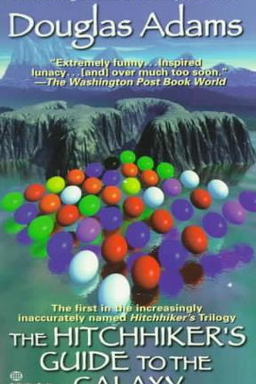
Have you ever felt that the universe is far too big, chaotic, and ridiculous to make sense of—and that maybe laughter is the only logical response? The Hitchhiker’s Guide to the Galaxy, first appearing as a radio play in 1978 and later as Douglas Adams’s seminal comic sci-fi novel, tackles exactly that. Adams proposes that life, the universe, and everything are inherently absurd—and humanity’s attempts to create meaning are equally ridiculous. Through the adventures of Arthur Dent, a painfully ordinary Earthman who survives the destruction of his planet, Adams constructs an intergalactic satire about bureaucracies, technology, and the search (or non-search) for purpose.
The Comic Absurdity of Existence
Adams opens with the banal bureaucracy of small-town England—the council wants to demolish Arthur’s house for a bypass—and then immediately escalates that absurdity to a cosmic scale: the Galactic government destroys Earth to make way for a hyperspatial express route. This jump from micro to macro absurdity sets the stage for the novel’s larger argument—that humanity’s self-importance is laughably misplaced in a vastly indifferent universe. The result is both thrilling and terrifying: we discover we’re just tiny specks in creation, but Adams invites us to laugh at our insignificance rather than despair.
Civilization as Comic Farce
Throughout the book, technological and bureaucratic systems mirror the ineptitude of human institutions. Vogons—bureaucratic aliens—destroy Earth with all the compassion of a city planner ticking off paperwork. The Hitchhiker's Guide itself (a cheap, unreliable, wildly popular electronic travel book) mocks scientific and cultural authorities. It has the reassuring words “Don’t Panic” on its cover—a kind of parody of human self-help slogans. Adams transforms global systems of power, government, and science into endless bureaucratic farce. In doing so, he echoes satirists like Kurt Vonnegut, who also used science fiction to lampoon human pride and institutional failure.
Meaninglessness as Freedom
If the universe is absurd, Adams argues, then trying to understand it is simultaneously futile and liberating. Through Arthur’s bewildered journey with Ford Prefect (his alien friend and researcher for the Guide), we explore philosophies of nihilism and humor. Arthur's Earthly concerns—his house, his tea—become comedic relics. Ford teaches him the secret of galactic hitchhiking, and together they learn to survive by abandoning all illusions of control. Adams presents humor not as avoidance, but as surrender to chaos. As Camus argued in The Myth of Sisyphus, embracing absurdity can be the beginning of freedom. Adams’s comedic twist makes that surrender joyful.
The Search for the Ultimate Question
The novel’s philosophical climax comes when a supercomputer named Deep Thought is asked to find the Answer to “Life, the Universe, and Everything.” After seven and a half million years, it reveals the answer is simply “42.” The punchline resonates far beyond comedy. Adams uses mathematics—the symbol of rational inquiry—to expose the emptiness of grand metaphysical questions. Yet in the sequel (and within this first installment’s closing), the search for the Question itself becomes the real quest. By reducing the mysteries of existence to a number, Adams playfully declares that the only rational response to such mysteries is laughter. The point isn’t to find meaning—it’s to enjoy the absurdity of the search itself.
Why It Matters
At its core, Adams’s novel is a philosophical self-help guide disguised as cosmic slapstick. Through humor and interstellar chaos, he teaches you how to respond to life’s meaninglessness with lightness. The world may feel incomprehensible, but rather than despair, Adams invites you to grab your towel—both a literal survival tool and a metaphor for preparedness—and face the absurdity with laughter and curiosity. For readers, it’s an antidote to both nihilism and seriousness: if life has no definitive Answer, then you might as well explore, enjoy, and never forget to “Don’t Panic.”