
Idea 1
Power, Person, and the American Presidency
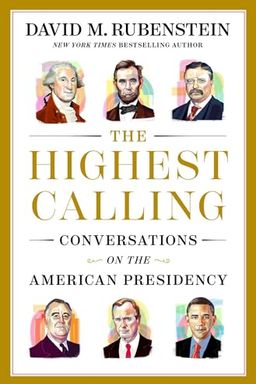
How can you judge a president in the moment, knowing history will revise the verdict? In this book of conversations and profiles, David Rubenstein argues that the modern presidency is a double-edged instrument: the office has grown into unmatched global power, yet its occupant is uniquely exposed to public scrutiny, personal strain, and historical reappraisal. He contends that you cannot understand the office unless you hold two ideas together: the presidency’s institutional might and the president’s individual character. Put differently, the job magnifies the person—and the person refracts the job.
Across portraits from George Washington to Joe Biden, you see how background, temperament, and health shape decision-making; how war, recession, and scandal define legacies; how staff and media amplify strengths or weakness; and how rules of the political game prewire incentives and outcomes. Rubenstein threads these themes to show why your civic choices—especially voting—carry unusually high stakes when a single leader can redirect the nation.
The arc of power—and its personal cost
Start with the office itself. Washington set key precedents—cabinet governance, civilian supremacy, the two-term norm—yet early presidents still walked to inaugurations and lived under the shadow of Congress. By Woodrow Wilson’s 1918 arrival in Paris and Franklin Roosevelt’s wartime leadership, the presidency had become a global colossus. Today, one person oversees a vast administrative state, nuclear weapons, and a sprawling alliance network. That centrality invites consequence and backlash: Lincoln bore the Civil War’s burden; Kennedy was assassinated; Lyndon Johnson was politically broken by Vietnam; Nixon resigned under Watergate; and Donald Trump faced two impeachments and criminal indictments.
Rubenstein’s thesis
“A president is just one person—but that one person can move an entire country.” The office’s expansion raises both the potential for major reforms and the risk of outsized mistakes.
Why the person matters
Rubenstein’s interviews teach you to read the president’s past to forecast the presidency. Washington’s estate management at Mount Vernon (a complex enterprise that produced 11,000 gallons of whiskey annually near the end of his life and relied on the labor of more than 540 enslaved people across his lifetime) mapped onto his public caution and institution-building. Jefferson’s plantation aristocracy and Enlightenment ideals produced both the Declaration and the moral contradictions of the Hemings relationship (DNA evidence supports that he fathered at least four of Sally Hemings’s children). Ulysses S. Grant’s battlefield decisiveness yielded victory for the Union and, later, a conflicted presidency reappraised for its enforcement of Reconstruction. Calvin Coolidge governed by restraint; Woodrow Wilson’s academic legalism inspired institutional ambition and hubris; Franklin D. Roosevelt’s polio forged empathy and iron resolve (Warm Springs as therapy and training ground for service).
Crises that reveal leadership
Moments of decision compress time and clarify character. Abraham Lincoln’s moral clarity preserved the Union; Grant fought the Ku Klux Klan through federal enforcement; James Garfield’s death was less about politics than medical failure; Wilson’s stroke crippled governance; John F. Kennedy’s learning curve from Bay of Pigs to the Cuban Missile Crisis illustrates growth through error and disciplined empathy. Later, Harry Truman’s unpopular choices (atomic bombs, NATO, firing MacArthur) were reassessed as foundational; Dwight Eisenhower’s quiet stewardship yielded the Interstate Highway System and Cold War stability; Richard Nixon’s China opening and SALT were eclipsed by Watergate’s abuses of power.
How staff, media, and rules shape outcomes
Presidents govern through teams and narratives. The quality of a chief of staff and the trust among senior aides determine coherence; leak-prone factions (as under Trump) often correlate with policy whiplash, while disciplined teams (as under Biden) enable steadier execution. Media is both mirror and megaphone: Obama functioned as a “Rorschach test” (Peter Baker’s phrase), while Trump’s Twitter feed rewired the pace and volatility of presidential communication. Structural incentives—Electoral College math, campaign finance rules (post–Citizens United), and polarized primaries—shape who gets to the Oval Office and how they behave once there.
Afterlives that redefine legacy
The presidency does not end at noon. Jimmy Carter’s Carter Center, George W. Bush’s PEPFAR (credited with saving ~25 million lives), Bill Clinton’s global development work, and even Bush’s veteran portraiture show you how former presidents extend policy and shape memory through philanthropy and cultural projects. Presidential libraries and centers curate stories and convene solutions (note Obama’s Chicago center and collaborative programs across libraries).
In sum, Rubenstein’s book equips you with a durable lens: weigh office and individual; examine crises, staff, and systems; and remember that history’s verdict is iterative. That is why your role as a citizen—especially voting, demanding transparency on health and finances, and backing sensible reforms—matters more than you might think. (Note: This framing echoes Robert Caro’s insistence on the “uses of power,” but Rubenstein spreads the inquiry across many voices, pairing biography with practical governance.)