
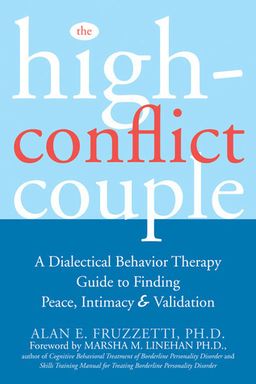
The High-Conflict Couple cover

The High-Conflict Couple

by Alan E Fruzzetti

The High-Conflict Couple provides a roadmap for navigating relationship challenges with mindfulness and effective communication. Through practical insights, Alan E. Fruzzetti empowers couples to transform conflict into connection, fostering deeper intimacy and mutual understanding.

Transforming High Conflict into Intimacy and Peace

Have you ever found yourself wondering how love can exist alongside anger? How two people deeply committed to each other can spiral into shouting matches over seemingly trivial matters? In The High-Conflict Couple: A Dialectical Behavior Therapy Guide to Finding Peace, Intimacy & Validation, Alan E. Fruzzetti asks these painful but vital questions and then provides answers rooted in both science and compassion. The book combines rigorous psychological research with the healing philosophy of mindfulness, arguing that emotional dysregulation—not incompatibility—is usually the root cause of chronic relationship turmoil.

Fruzzetti contends that couples don’t fight because they don’t love each other enough. They fight because they don’t yet know how to manage the powerful emotional storms that love brings. When emotions become dysregulated—too intense, too fast, and lingering too long—our ability to think clearly and act effectively collapses. At that moment, conversation devolves into survival instincts: escape, attack, or defend. The solution, Fruzzetti argues, lies in learning specific skills drawn from Dialectical Behavior Therapy (DBT), originally developed by Marsha Linehan. These skills teach couples how to balance acceptance and change: accepting both themselves and their partner as they are, while simultaneously committing to change behaviors that cause harm.

Understanding Why Conflict Persists

High-conflict couples, Fruzzetti explains, become stuck because their emotional responses spiral too quickly into judgments. Each partner longs for closeness but accidentally pushes the other away in moments of dysregulation. A critical comment elicits defensiveness; a defensive tone is interpreted as rejection; and soon, both partners are hurt, misunderstood, and angry. Most couples assume the conflict stems from the issue itself—money, chores, parenting—but Fruzzetti shows it’s the emotional process, not the content, that is broken.

His central claim—that emotion regulation governs communication efficacy—reshapes how we understand intimacy. When partners learn to regulate their emotions, they can vocalize needs precisely and receive validation accurately, creating a cycle of understanding that prevents escalation. Validation, then, is not simple agreement; it’s the act of communicating that understanding makes sense—“Of course you feel disappointed; anyone would.”

The Promise of DBT for Relationships

Dialectical Behavior Therapy was originally designed for individuals struggling with extreme emotional fluctuations, such as those with borderline personality disorder. Fruzzetti helped adapt DBT for couples and families, focusing on relationship dynamics where both people experience intense emotional arousal. DBT teaches four major skill sets that translate beautifully into couple’s work: mindfulness, emotion regulation, distress tolerance, and interpersonal effectiveness. Practicing these together builds a partnership that can withstand emotional storms with compassion and clarity.

Through mindfulness, you learn to observe your own emotions and your partner’s reactions without judgment. Through emotion regulation, you calm your physiological storms before speaking. Distress tolerance teaches you how to endure painful situations without making them worse. And interpersonal effectiveness helps you express what you want accurately while respecting your partner’s needs. The combination enables couples to “transform conflict into closeness” by replacing blame with curiosity and criticism with validation.

Why This Approach Works—and Why It Matters

Fruzzetti’s approach matters because it offers a genuine integration of rigorous research and personal compassion. He draws on decades of studies on stress, emotional arousal, and communication to demonstrate that moderate levels of emotional tension can enhance performance, but extreme arousal destroys reasoning (often known as the Yerkes-Dodson curve). In relationships, unregulated arousal is like a forest fire: even the smallest spark can ignite days of chaos. Fruzzetti reframes the problem: partners aren’t wrong for feeling deeply—they simply haven’t learned to cool the flame before speaking.

These ideas matter far beyond therapy sessions. Emotional dysregulation in families leads to depression, anxiety, substance use, and even difficulties in children’s emotional development. The book’s methods ripple outward, improving not only partnerships but the entire emotional climate of a home. By teaching individuals how to validate, Fruzzetti transforms validation into a bridge between personal healing and relational health.

What You'll Learn in This Summary

In the pages ahead, you’ll explore how Fruzzetti helps couples understand the internal mechanics of emotion, practice mindfulness of self and partner, stop destructive cycles before they begin, and rebuild intimacy through accurate expression and validation. You’ll see how he teaches partners to negotiate problems constructively rather than “win” arguments, and how acceptance—both of yourself and the person you love—can paradoxically bring the change you’ve long been seeking. By integrating science, mindfulness, and compassion, Fruzzetti offers not just a therapy method, but a map for creating relationships that feel like home again.


Understanding Emotion in Relationships

Fruzzetti begins with a deceptively simple question: Why do we say the nastiest things to the people we love most? His answer reshapes our view of emotional behavior. He argues that every outburst, every avoidance, every defensive remark is usually not about the situation itself but about physiological emotional dysregulation—the moment when our emotions overpower reason and focus solely on escaping discomfort.

How Emotions Work

You experience emotion as a complex process involving sensations, thoughts, memories, and biological reactions. External events (arguments, tone of voice) and internal events (past experiences, beliefs) interact with your attention system to create emotion. Fruzzetti compares emotions to actions like walking—they’re something we do, not something we have. When emotions are regulated, you can think clearly. When they’re dysregulated, your thinking narrows, and escape becomes the only goal.

Vulnerability Factors

Three elements make you vulnerable to intense reactions: sensitivity (how easily emotion is triggered), reactivity (how big and fast it grows), and time to equilibrium (how long it takes to calm down). Partners differ in all three, creating mismatched emotional rhythms. For example, one may recover from conflict in minutes while the other still replays it hours later. Recognizing these differences helps you time discussions more wisely and avoid escalating cycles.

Conflict Patterns

Fruzzetti identifies four typical relationship conflict patterns: constructive engagement, mutual avoidance, destructive engagement, and the engage-distance pattern. In constructive engagement, partners communicate calmly, describe rather than judge, and validate each other’s perspective. The other patterns—avoidance, hostility, or imbalance—stem from dysregulated emotion and lead to disconnection. Learning DBT skills helps couples move progressively toward constructive engagement, where conflict becomes an opportunity for learning rather than pain.

“Being upset isn’t the problem,” Fruzzetti writes. “Being dysregulated—out of control, focused on escape rather than connection—is.”

By conceptualizing emotions as dynamic processes and learning to manage sensitivity, reactivity, and arousal, couples gain the power to transform destructive conflict into understanding. Fruzzetti essentially reframes self-control not as repression, but as awareness—a concept parallel to Thich Nhat Hanh’s Buddhist mindfulness, which he cites as inspiration for DBT’s focus on acceptance and compassion.


Mindfulness and Acceptance of Self and Partner

Chapter two dives into acceptance and mindfulness—the heart of Fruzzetti’s approach. He likens relationships to a dance, where harmony depends on awareness of one’s own steps and the other’s rhythm. When couples step on each other’s toes, they stop dancing until they relearn how to move together. Fruzzetti teaches mindfulness practices that reorient partners toward connection rather than blame.

Three Aspects of Mindfulness

Mindfulness involves three kinds of awareness: of self, of partner, and of the relationship itself. Mindfulness of self means noticing your thoughts, emotions, and urges without judgment. Fruzzetti integrates Linehan’s three “states of mind”: emotion mind (impulsive feeling-driven), reasonable mind (logic and rule-driven), and wise mind (balance between the two). Acting from wise mind allows you to respond with clarity instead of reactivity.

Mindfulness of your partner means observing them nonjudgmentally—how they speak, their tone, posture, and facial expressions—without interpreting motives. This open curiosity builds empathy and prevents miscommunication. Finally, mindfulness of connection reminds you that your actions affect your partner; what you give returns to you. Treating your loved one harshly is poisoning your own nest.

Description vs. Judgment

Fruzzetti emphasizes describing over judging. Judgments (“he should be more attentive”) create shame and anger, fueling conflict. Description (“I notice I feel sad when he doesn’t ask how my day was”) calms arousal and promotes empathy. This distinction draws from Greenberg and Johnson’s emotion-focused therapy, yet here it’s embedded within DBT’s skill structure: being descriptive regulates emotion; judging amplifies it.

Practical Mindfulness Exercises

He suggests specific daily practices: noticing reactions in the shower or when breathing, observing voice tone changes during conversation, or asking yourself before speaking, “Will this make things better or worse?” These micro-mindful pauses anchor you to intention and long-term goals rather than the heat of emotional impulse. The result is a relationship driven by choice, not reflex.

Mindfulness is more than meditation—it’s a lifestyle of noticing. When practiced together, couples begin feeling emotionally synchronized. Like dancers who trust each other’s timing, partners who cultivate mindful awareness move in rhythm, turning everyday friction into opportunities for emotional closeness.


Stopping Destructive Cycles

Stopping the spiral of destruction—the pattern of mutual invalidation—is Fruzzetti’s third step. He teaches couples to make a commitment not just to love, but to effectiveness: acting in ways that move toward peace rather than suffering. Being ‘right’ is less important than being skillful. This reframing helps partners replace escalation with courageous restraint.

Commitment to Effectiveness

Commitment comes first. Fruzzetti compares emotional control to training for a marathon—it cannot rely on willpower alone but requires repeated practice until self-control becomes automatic. He dismantles cultural myths that equate not retaliating with weakness. Instead, stepping back during conflict is portrayed as a courageous act of self-respect and relational preservation.

Anticipating Triggers

Couples learn to anticipate emotional triggers—the predictable words or situations that ignite old arguments. By rehearsing alternative responses in advance, they recondition the cycle. For example, Edgar knows Selena will criticize his tone; instead of snapping, he plans to say, “I miss feeling close when we talk.” The preplanned response has power precisely because it’s intentional, not impulsive.

Managing Urges

Fruzzetti introduces three DBT techniques for managing destructive urges: visualize the negative consequences (imagine the aftermath of escalation), observe the urge without acting (see it as a wave that will pass), and visualize positive consequences of restraint (imagine peace instead of pain). These exercises convert self-control into emotional intelligence—shaping instinct into wisdom.

“Refusing to continue the fight,” Fruzzetti writes, “is not surrender. It is choosing life over destruction.”

By helping partners anticipate triggers and manage impulsive urges, Fruzzetti transforms reactivity from enemy to teacher. Every urge becomes a reminder: you can choose mindfulness and love over automatic retaliation. This is the turning point where self-control becomes true freedom, allowing partners to preserve both self-respect and connection.


Being Together When You Are Together

Once the chaos subsides, Fruzzetti helps couples re-learn togetherness. High-conflict partners often live emotionally apart—even while sitting on the same couch. ‘Being together when together’ means shifting attention from vigilance (watching for signs of attack) to presence (noticing that your partner is here, breathing beside you). The goal isn’t constant conversation; it’s shared existence.

Reconditioning Emotional Responses

After years of repetitive conflict, even neutral situations become emotionally charged. Fruzzetti suggests counter-conditioning—creating new positive associations through specific rituals like a ‘relationship spot’ (a room or corner dedicated to loving reflection) or a ‘relationship box’ filled with reminders of affection. These tools evoke calm and affection before difficult discussions, retraining your nervous system to expect love instead of attack.

Active vs. Passive Togetherness

Couples often share space passively, coexisting without emotional connection. Fruzzetti encourages turning passive presence into active togetherness through mindful attention—watching your partner pour coffee, noticing their posture, or exchanging brief smiles. This practice revives small joys and dissolves loneliness. It’s a counterintuitive truth: genuine intimacy begins with simple noticing.

Mindfulness When Apart

Fruzzetti also expands mindfulness beyond physical proximity. Thinking warmly of your partner when apart reinforces emotional continuity. Instead of fixating on frustrations, mentally recall affectionate scenes: a shared laugh, their hand on your shoulder. These moments rewire habitual thoughts from critique to appreciation.

Being together, both physically and emotionally, draws on mindfulness and conditioning principles. By intentionally associating presence with peace, you shift from hypervigilance to safety. In Fruzzetti’s words, this practice “reduces loneliness and soothes our emotions, leaving us less reactive when the next conversation begins.”


Reactivating Love and Connection

Once conflict stops dominating, the relationship must be reawakened. Fruzzetti guides couples to reactivate shared joy, affection, and purpose—the antidotes to chronic negativity. He emphasizes doing small, meaningful activities together to rebuild relational identity: seeing yourselves again as a team rather than adversaries.

Shared Activities and Family Identity

Couples heal by re-engaging with the world side by side. Fruzzetti encourages planning social outings, recreation, or simple shared tasks, defining yourselves publicly and privately as a partnership. Whether attending family gatherings or cooking together, you strengthen what he calls “coupleness”—a shared identity beyond arguments.

Intellectual and Spiritual Sharing

He reminds readers that intimacy deepens through shared ideas and values. Discuss what you’ve read, what you think about the news, what matters to your spirit. These exchanges reintroduce curiosity and respect. By exploring beliefs rather than debating them, couples reconnect on meaning as well as emotion. (Note: This mirrors John Gottman’s concept of “bids for connection” through everyday talk.)

Rekindling Sexual and Physical Intimacy

Fruzzetti addresses sexual reactivation candidly. Conflict erodes desire, but mindful affection rebuilds it. He redefines sexuality broadly—holding hands, gentle touch, lingering kisses. These small acts recondition desire and restore trust. Couples are advised to focus on feeling the moment rather than evaluating performance, turning intimacy into mindfulness practice.

Acts of Kindness Without Strings

Finally, Fruzzetti introduces unconditional consideration: doing small caring acts without expectation—like making coffee or leaving a note. These gestures, though tiny, shift the relational climate toward generosity. When done mindfully, they generate reciprocal goodwill naturally, making kindness self-perpetuating.

Reactivation is more than activity—it’s transformation through shared effort. Every outing, discussion, or kiss re-teaches both partners how to enjoy togetherness. Over time, resentment fades into laughter, and the relationship awakens not through grand gestures, but through mindful everyday tenderness.


Accurate Expression and Validation

In Fruzzetti’s model, communication hinges on what he calls the “couple two-step”: accurate expression followed by validating response. Many relationships fail because partners express secondary emotions (anger, blame) instead of primary ones (sadness, longing). Truth gets lost in translation. Learning to articulate genuine needs and validating each other’s experiences rebuilds emotional trust.

Accurate Expression

Accurate expression starts with self-regulation—lowering arousal before speaking. Fruzzetti even suggests using bathroom breaks to practice mindfulness and check your facial expression in the mirror. He distinguishes expression goals: emotional (seeking comfort), practical (seeking change), and relational (seeking closeness). Matching your words to your goals prevents crossed signals. For instance, if you want empathy, don’t open with criticism—clarify that you’re seeking support.

Validation

Validation is not agreement; it’s communicating understanding and acceptance. Fruzzetti defines validation as “the communication of understanding and acceptance,” mirroring Linehan’s principles. Validating responses soothe emotions, slow reactivity, and foster closeness. When you say, “Of course you feel hurt; that makes sense,” you calm your partner’s nervous system and invite cooperation instead of defense.

The Power of Reciprocal Vulnerability

One profound form of validation is reciprocal vulnerability—the simple honesty of saying “me too.” When your partner opens up, meet that openness rather than analyzing it. Fruzzetti illustrates this through Jasmine and Jared, whose mutual acknowledgment of sadness (“I miss you too”) transformed distance into tenderness instantly. Authentic emotion, when mirrored, dissolves resentment faster than logic ever could.

By mastering accurate expression and validation, couples relearn the lost language of empathy. Instead of accusation, they speak acknowledgment; instead of defense, they respond with curiosity. This “two-step” becomes a dance toward connection, turning conversation itself into an act of love.


From Invalidation to Repair and Emotional Growth

Even skilled communicators slip into invalidation—criticism, sarcasm, or dismissiveness. Fruzzetti devotes an entire chapter to recovering from these lapses. His strategy blends self-validation, self-soothing, and repair, showing that rebuilding trust after hurt is the essence of emotional maturity.

Self-Validation and Compassion

When attacked or criticized, instead of retaliating, Fruzzetti teaches partners to self-validate: recognize feelings of hurt or fear as legitimate. This stops the reflexive escalation and provides emotional grounding. Compassion toward self turns potential explosions into calm awareness. Invalidation, he notes, doesn’t wound merely because it’s unfair—it wounds because it violates the expectation of safety in love.

Breaking the Cycle

High-conflict couples develop habitual reactivity—attack begets counterattack. Fruzzetti replaces this pattern with the validation rule of three: if one partner manages to offer three consecutive validating responses amid hostility, the other person almost always calms down. This principle reflects DBT’s behavioral roots—shaping responses through consistency instead of punishment.

Repairing the Relationship

Repair involves acknowledging harm, describing its impact, and recommitting to change. Genuine repair communicates both empathy and accountability. When partners apologize mindfully—naming hurt and outlining future self-control plans—it rebuilds safety. Fruzzetti’s case of Charlie and Cameron demonstrates how vulnerability in repair (“I imagine it hurt you when I said that; I’ll take a break next time”) invites forgiveness more than explanations ever could.

Repair is not about erasing mistakes; it’s about affirming care after pain. Paradoxically, successful repair strengthens intimacy—proving the relationship can survive rupture. As Fruzzetti shows, healing conflict is less about avoiding damage and more about repairing with compassion.


Transforming Conflict into Closeness

In his concluding chapter, Fruzzetti synthesizes the entire approach into one truth: suffering in relationships stems from nonacceptance and nonchange. When partners cling to the idea that the other “should” be different, they remain trapped in frustration. Acceptance, paradoxically, brings the freedom to love and to change.

Acceptance vs. Suffering

Most couples oscillate between wanting change and refusing to accept reality. Fruzzetti reframes acceptance not as giving up, but as releasing attachment to how things “should” be. He encourages partners to pause their crusades to fix each other and instead observe what they have now. This behavioral tolerance—ceasing attempts to change—often reveals underlying tenderness previously masked by frustration.

Finding Meaning in Imperfection

Through case examples like Annie and Seth, who learned to embrace each other’s quirks (her forgetfulness, his bedtime play with their child), Fruzzetti shows how mindfulness transforms irritation into affection. Recontextualization—seeing troublesome behaviors as reflections of endearing traits—creates peace. Seth’s playfulness, once maddening, became evidence of love; Annie’s distraction became proof of generosity of attention.

Living in the Present

Ultimately, Fruzzetti urges couples to “mind the gaps,” focus more on what they have than what’s missing, and engage fully with each other. Acceptance makes space for change by removing tension. In this way, DBT’s dialectical philosophy—balancing acceptance and change—culminates in peace. Intimacy arises not from problem solving, but from being present together, imperfect and whole.

As Fruzzetti concludes, treating your partner as though your life depends on it is not hyperbole; in emotional terms, it does. Acceptance saves love from corrosion, restoring relationships to their natural state: connected, imperfect, and profoundly human.

Dig Deeper

Get personalized prompts to apply these lessons to your life and deepen your understanding.

Go Deeper

Get the Full Experience

Download Insight Books for AI-powered reflections, quizzes, and more.