
Idea 1
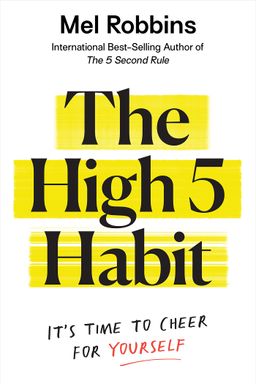
The High 5 Habit: Turning Self-Criticism into Self-Celebration
Have you ever caught your reflection and immediately thought, ugh? Mel Robbins asks this hauntingly familiar question at the opening of The High 5 Habit: Take Control of Your Life with One Simple Habit. The book’s central argument is deceptively simple: by learning to high-five yourself each morning, you can rewire your brain’s default setting from self-criticism to self-compassion. Robbins contends that the habit is not superficial or silly—it's grounded in neuroscience, psychology, and behavioral change. The act of celebrating yourself instead of condemning yourself triggers a cascade of emotional and cognitive shifts that change how you see yourself and how you show up in the world.
The High 5 Habit isn’t about motivational fluff—it’s about building a daily ritual that teaches your mind to see your worth, reinforces commitment, and quiets the relentless internal critic many of us live with. Robbins explains that your brain’s Reticular Activating System (RAS)—a neural filter determining what information gets through to your consciousness—pays attention to what it believes is important. If you constantly reinforce messages of failure, guilt, or inadequacy, the RAS filters the world through that lens. But when you start celebrating yourself, your RAS flips its script: it begins looking for opportunities, evidence of your competence, and reasons to keep going.
The Core Philosophy: A Daily Partnership with Yourself
Robbins roots her philosophy in one deceptively simple ritual: each morning, stand before the mirror and high-five your own reflection. Without words, this gesture communicates powerful, ancient messages of support: I believe in you. You can do this. Keep going. By redirecting the encouragement we freely give to others—friends, colleagues, teammates—toward ourselves, we start rebuilding a broken relationship: the one we have with our own reflection.
The book argues that our culture prizes relentless productivity and external validation while neglecting the self-support systems we need to sustain both. Robbins compares life to running a marathon—you don’t finish by berating yourself; you finish because you are cheered for every mile. A high five isn’t arrogance; it’s acknowledgment.
The Science Behind the Gesture
Robbins grounds this emotional habit in behavioral activation therapy, neuroscience, and psychology. She cites research showing that physical gestures and affirmations alter neural pathways through what Duke neuroscientist Lawrence Katz called neurobic exercises. When you perform a simple but unexpected action paired with an emotion (like high-fiving your reflection and feeling celebration), your brain produces new connections that make empowerment and positive thinking more automatic.
Studies are referenced, including one where children performing difficult tasks persisted longer when given a high five than when praised verbally (“You’re smart”). The high five, Robbins says, bypasses skepticism and taps into unity, trust, and recognition at a subconscious level. Neurochemically, it releases dopamine and reinforces the feeling of connection—both physically and emotionally. It’s a simple, repeatable way to teach your nervous system what encouragement feels like and to make it your default setting.
The Deeper Stakes: Why You Need This Habit
Robbins shows that most adults are their own worst critics. Decades of internalized comparison, cultural expectations, trauma, and guilt have built mental lint that clogs the filter of perception. You scroll through social media and interpret others’ success as evidence of your inadequacy. You downplay compliments, thinking they must be wrong. A daily high five breaks the cycle through physical reinforcement—it’s not thinking differently; it’s acting differently so your thinking follows. As she writes, you can’t think your way into a new life—you act your way there.
The High 5 Habit gradually transforms your subconscious patterns of self-rejection into self-acceptance. When you repeat it every morning, you start seeing yourself not as the problem but as the solution. Eventually, your self-talk softens; you make your bed for yourself, not out of obligation; you put on your workout clothes because you deserve movement. The ripple effect extends outward—you begin trusting your reflection, forgiving your past, and believing that your goals are achievable.
Why It Matters: Reclaiming the Relationship That Defines Every Other
The heart of Robbins’s message is that your relationship with yourself sets the tone for every other relationship and goal in your life. If you look in the mirror and don’t see someone worth celebrating, no job title, partner, or praise will fix that. She insists that self-love is not narcissism—it’s necessary. By greeting your reflection with kindness, you affirm the innate worth that has been buried under years of criticism and comparison. Throughout the book, Robbins offers tools—mirror routines, journaling practices, RAS training, and morning rituals—to build a foundation that supports lasting confidence rather than fleeting motivation.
The High 5 Habit is ultimately a manifesto for reclaiming your inner coach—the part of you that knows how to rise after failure, that forgives setbacks as lessons, and that cheers you toward your future. It’s practical, relatable, and scientific, but most of all, it’s radical in its simplicity: the one person who can give you permission to be proud of who you are is the person staring back at you in the mirror.