
Idea 1
The Hidden Brain and Human Behavior
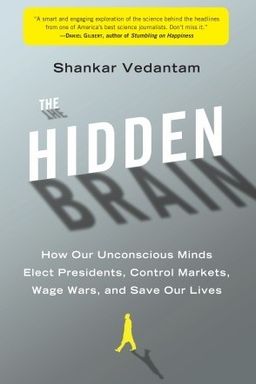
Why do you trust your own intentions so completely? Shankar Vedantam’s The Hidden Brain opens with a paradox: you believe you act deliberately, yet the evidence shows unconscious forces shape perception, memory, fairness, and even moral judgment. Vedantam calls this unseen architecture the hidden brain—the fast, efficient set of mental operations that work beneath awareness to help you navigate the world but also mislead you about your own motives.
You Don’t Act for the Reasons You Think
The book begins with Toni Gustus’s confident yet mistaken eyewitness identification of Eric Sarsfield—a case where certainty, emotion, and procedure combined into a wrongful conviction. Vedantam’s point is not that Gustus was malicious, but that everyone’s memories and perceptions are subtly rewritten by unconscious filters of attention and context. Your conscious brain offers rational stories for choices it did not truly make. Thus, much of human certainty is narrative construction after the fact.
The Function of the Hidden Brain
Vedantam characterizes the hidden brain as your mind’s automatic pilot. It runs heuristics—shortcuts that exchange accuracy for speed—and acts on subtle cues like faces, tone, or status. You depend on these rapid judgments, yet they make systematic mistakes. From office coffee payments increasing when an image of watching eyes is posted (Melissa Bateson’s study) to investors’ preference for pronounceable stock names (Adam Alter’s experiment), your hidden brain handles decisions before you know it has acted.
The Hidden Brain Shapes Society
These mechanisms scale up from individuals to entire societies. In gender and racial bias, for instance, small perceptual cues compound into vast structural inequalities. Madeline Heilman’s résumé studies show identical credentials rated differently depending on whether the applicant’s name is James or Andrea. Jennifer Eberhardt’s death-penalty work reveals that defendants with more “stereotypically Black” facial features are far more likely to receive death sentences when the victim is white. Vedantam argues these patterns are invisible because intention masks bias—most participants believe they are fair while acting otherwise.
Emotion and Identity Overrule Reason
The hidden brain shapes love and rivalry too. Abraham Tesser’s research shows how pride and jealousy coexist when someone close to you succeeds—an unconscious dual reaction that can undermine marriages or partnerships. John Trojanowski and Virginia Lee’s complementary roles in Alzheimer’s research illustrate that conscious structure can harness these unconscious motives by dividing labor and reinforcing shared credit.
When the Hidden Brain Malfunctions
Mental disorders such as frontotemporal dementia (FTD) expose the hidden brain’s contribution to morality. Patients like Wendy McNamara can describe social norms but don’t feel them. Vedantam invites you to rethink responsibility: moral sense isn’t just intellectual—it depends on unconscious emotional circuits that keep behavior within bounds. (Note: This parallels Antonio Damasio’s somatic-marker theory.)
Bias Across a Lifetime
From infants preferring familiar faces to seniors losing inhibitory control, Vedantam shows bias is learned and deepened through life. Preschoolers already absorb racial schemas from observation, and aging reduces the conscious suppression of prejudice. You cannot simply lecture people out of bias—you must alter environments and exposure patterns so the hidden brain re-learns inclusive associations.
Collective Paralysis and Group Psychology
The hidden brain also governs crowds. In tragedies like Deletha Word’s Detroit bridge assault or 9/11’s differing floor outcomes at Keefe, Bruyette & Woods, people followed group cues instead of personal judgment. Conformity brings social safety but can be lethal in crises. Vedantam warns that institutional drills and explicit hierarchies are required to counter the bystander effect.
Radicalization, Terror, and Moral Collapse
Extreme devotion—whether at Jonestown or within suicide cells—arises through ordinary mechanisms intensified inside small groups. Vedantam draws on Ariel Merari and Scott Atran’s studies to show how isolation, ritual, and honor systems close the “tunnel” of ideology, transforming rational people into instruments of violence. The hidden brain’s need for belonging and meaning, once monopolized by a group, overrides even self-preservation.
The Bias of Attention and Numbers
Another channel of error is emotional numeracy. Paul Slovic’s “telescope effect” explains why you can feel deep compassion for a single dog stranded at sea (the Hokget case) but numbness toward thousands dying in genocide. The hidden brain gravitates to identifiable victims, making mass suffering abstract. Policymakers must design feedback systems that translate statistics into human-scale stories while preserving proportional action.
Political Illusions and Campaign Ethics
Implicit association tests (IAT) prove you may unconsciously link race and Americanness, influencing elections like 2008. Vedantam closes with political strategists’ dilemma: should campaigns appeal to conscience explicitly or bypass bias with symbolic unity? Both paths carry ethical costs. Ultimately he argues that progress depends on acknowledging the hidden brain’s authority and designing systems—legal, educational, and electoral—that outthink it rather than ignore it.
Core Idea
Vedantam’s thesis is that human civilization, law, and morality depend on understanding the brain you do not see. Recognizing the hidden brain does not absolve responsibility—it provides the map to redesign systems that account for unconscious influence.