
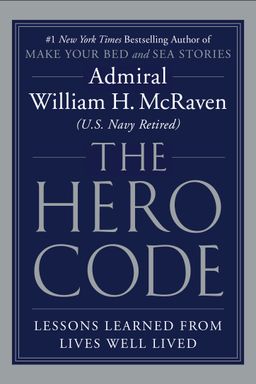
The Hero Code cover

The Hero Code

by William H McRaven

The Hero Code, by Admiral William H. McRaven, explores the principles of heroism through compelling anecdotes and life lessons. Learn how courage, integrity, and perseverance can transform ordinary actions into acts of heroism, inspiring readers to make meaningful impacts in their own lives and communities.

The Hero Code: Becoming the Everyday Hero

When was the last time you looked at the world and thought, “Someone needs to fix this”? Admiral William H. McRaven’s The Hero Code: Lessons on How to Achieve More Than You Ever Thought Possible begins with exactly that feeling—but turns it on its head. McRaven argues that the heroes capable of repairing and uplifting our world aren’t hidden behind masks and capes; they’re the everyday people among us—and within us. His central message is simple but profound: Superman isn’t coming. It’s up to us.

Drawing on his decades of service as a Navy SEAL and global leadership experience, McRaven distills what he calls The Hero Code—a set of ten core virtues that define true heroism: courage, humility, sacrifice, integrity, compassion, perseverance, duty, hope, humor, and forgiveness. These are not mystical qualities meant for the select few; they are human traits anyone can develop through conscious practice. The book becomes both a moral guide and a personal challenge—one that invites you to awaken the hero within yourself.

Heroes Aren’t Born—They’re Built

McRaven begins his journey with childhood wonder—his obsession with Superman. As he matured, he realized that what drew him to the comic-book hero was not superpowers but service. Through the lens of his military career, he came to see that the essence of heroism lies not in extraordinary ability but in ordinary actions performed with extraordinary character.

McRaven’s long career took him to every corner of the globe—witnessing humanity’s best and worst. From scenes of war’s devastation to acts of selfless courage, from despair to compassion, he saw a persistent truth: whether soldier or scientist, teacher or parent, each person has the capacity for heroism when guided by an inner moral compass.

From Code to Conduct

Each virtue in The Hero Code is presented as both a story and a lesson, grounded in real-life examples. The heroes McRaven introduces are completely human—Lieutenant Ashley White, who faced death in Afghanistan with grace; astronaut Charlie Duke, who walked on the moon yet remained humble; Private Ralph Johnson, who sacrificed himself for his comrades; and Dr. Jim Allison, who won the Nobel Prize for his perseverance in curing cancer. Every story reveals how moral strength—not fame or fortune—defines greatness.

These narratives aren’t merely inspirational; they’re instructional. They show how heroism arises from small, daily choices—telling the truth when it’s hard, giving when it’s inconvenient, forgiving when it feels impossible. McRaven doesn’t ask readers to be perfect. He asks them to keep stepping forward—to trust that one small act of virtue builds character and that accumulated character shapes the world.

Why the Hero Code Matters Now

In an age of cynicism, polarization, and distrust, McRaven’s work functions as both balm and battle plan. The “Hero Code” speaks directly to the fractures in modern society—the sense that leadership often fails and that moral compass points nowhere. His antidote is radical responsibility: the belief that every citizen’s ethical conduct strengthens the collective fabric. It’s reminiscent of Viktor Frankl’s belief in finding meaning through moral choice, or David Brooks’s The Road to Character, which frames inner virtue as the true achievement of life.

McRaven reminds you that heroism doesn’t demand uniformed service or public adoration—it begins in quiet moments of courage: defending a friend, telling the truth, or forgiving an enemy. The world doesn’t need more critics or cynics; it needs more people who live the Hero Code.

What You’ll Discover in This Summary

In the chapters ahead, McRaven’s ten virtues come alive through remarkable real-world stories:

  • Courage—overcoming fear through one small step forward, like Ashley White boarding the helicopter into her final mission.
  • Humility—learning from moonwalker Charlie Duke’s quiet grace.
  • Sacrifice—seeing meaning in selflessness through Marine Ralph Johnson’s final act of devotion.
  • Integrity—choosing the harder right, as John Adams did when he defended the British soldiers after the Boston Massacre.
  • Compassion—understanding how Gary Sinise’s kindness in war zones heals unseen wounds.
  • Perseverance—discovering how Dr. Jim Allison’s refusal to give up led to a cancer breakthrough.
  • Duty—learning from John McCain’s steadfast sense of responsibility and an airman’s quiet commitment.
  • Hope—finding light in the darkness of illness and war.
  • Humor—using laughter as armor and bridge, as soldiers and leaders do to endure hardship.
  • Forgiveness—discovering how mercy restores humanity, even between enemies.

By the end, McRaven’s message is unmistakable: You don’t need superpowers to be a hero. You only need to live according to virtues that unite rather than divide, lift rather than crush. Heroism is contagious—and The Hero Code is your invitation to spread it.


Courage: Taking One Step Forward

How do you face fear when every instinct tells you to retreat? McRaven begins his Hero Code with courage, defining it not as fearlessness but as action in the presence of fear. His story of Lieutenant Ashley White captures this perfectly—a young cultural support team officer in Afghanistan who boarded each helicopter knowing it could be her last mission but did so anyway because her comrades depended on her.

Ashley’s courage wasn’t a grand gesture but a daily choice—to show up, to face danger, and to put love of her team above personal safety. Her quiet bravery cost her life in 2011, but her willingness to take “one step forward,” as McRaven puts it, became symbolic of what real courage is: moving through fear for the sake of others.

Facing Inner Battles

McRaven expands courage beyond combat. It’s also the courage to face internal struggles—depression, addiction, or regret. He highlights leaders like Command Sergeant Major Chris Faris and his wife Lisa, who publicly shared their story of post-traumatic stress to help others heal. Their openness saved lives by showing that vulnerability is a form of bravery.

He also mentions General Carter Ham’s candor about his battle with depression and Admiral Sandy Winnefeld’s campaign after losing his son to opioids. Such courage isn’t physical heroism—it’s moral and emotional strength, the quiet defiance of despair. It’s the same courage Churchill called “the quality that guarantees all the rest.”

The Line in the Sand

McRaven closes the chapter with the parable of Colonel William Travis at the Alamo, who drew a line in the sand and gave his men a choice: step forward and fight, or step back and live. For McRaven, life offers similar lines. Taking one step forward—whether into danger, honesty, or change—is the act that begins heroism.

“Take one step forward and get on the helicopter. Take one step forward and fight injustice. Take one step forward and face your inner demons.”

Courage, McRaven insists, is cumulative. Every small act of bravery strengthens your capacity for greater ones. You don’t have to conquer mountains; you just have to take that first step across your own line in the sand.


Humility: Recognizing Our Place in the Universe

“An able yet humble man is a jewel worth a kingdom.” With this quote, McRaven opens his second virtue. His encounter with Charlie Duke—former astronaut and youngest man to walk on the moon—reminds us that true greatness speaks softly. At a dinner hosted by Dr. Kenneth Cooper, McRaven sat beside Duke, unaware of his guest’s achievements. Duke asked thoughtful questions about others but never mentioned his extraordinary past until Roger Staubach revealed it afterward.

When McRaven realized who Duke was, he was struck not by Duke’s fame but his modesty. Duke had walked on the moon yet never announced it; his humility was “hard won,” refined through faith and recognition of the vastness of creation.

The Power of Perspective

For McRaven, humility arises when we recognize how small we are in the grand sweep of existence. Across faiths and philosophies—from the Bible to the Quran, from Confucius to Socrates—humility is the foundation of wisdom. When you understand your limits, you become open to learning from others. You stop needing to prove you’re right, and start striving to be kind.

Humility, he suggests, is not insecurity; it’s strength under control. The humble person doesn’t shrink—they simply refuse to inflate the self. It allows respect for mystery, compassion for difference, and unity across divides.

“The role of every hero is to unite people, not divide them.”

That truth echoes through every story: from astronauts to mothers, real heroes listen more than they speak. In a world obsessed with ego, McRaven’s reminder is revolutionary—be humble, and you’ll elevate everyone around you.


Sacrifice: Giving of Yourself Daily

What would you give up for another’s safety or success? McRaven defines sacrifice not by grand gestures alone but by the daily devotion to others. His core story—Marine Ralph Johnson’s 1968 act in Vietnam—reveals how one moment of selflessness can change history. Johnson hurled himself onto a grenade to save his fellow Marines, symbolizing the ultimate expression of love for others. His Medal of Honor came posthumously—but more importantly, his death echoed across racial and social barriers in a divided America.

Service Over Self

McRaven attended the commissioning of the USS Ralph Johnson and reflected on what Senator Tim Scott said that day: Johnson “was willing to sacrifice his life for a cause greater than himself.” Sacrifice, Scott said, is the essence of service—and McRaven agrees. Whether it’s a parent working two jobs or a teacher spending nights helping a struggling student, real sacrifice is anonymous, quiet, and persistent.

Small Acts of Daily Giving

You don’t need to die to sacrifice. You simply need to give. “Give a little of your time. Give a little treasure. Give a little love.” McRaven compares sacrifice to an investment account: over time, small consistent contributions create immense moral wealth. This echoes Adam Grant’s research in Give and Take—that givers, not takers, ultimately create sustainable success.

Sacrifice, then, isn’t martyrdom. It’s meaning. It’s the steady heartbeat of humanity that keeps society from collapsing under selfishness.


Integrity: Choosing the Harder Right

McRaven’s lesson on integrity comes from the Pentagon, not the battlefield. As a young officer, he learned under Captain Ted Grabowsky that in bureaucracy, as in combat, truth is your survival gear. When Grabowsky refused to fudge budget numbers in front of a three-star admiral, he modeled the Golden Rule of leadership: never lie, never misrepresent. Trust, not flattery, sustains real credibility.

Integrity, McRaven explains, is more than honesty—it’s moral muscle, strengthened through action. It’s making the uncomfortable choice to defend what’s right, even when it costs you approval or advantage.

John Adams and the Courage to Be Honest

McRaven’s mother taught him integrity through stories. Her favorite was John Adams defending the British soldiers of the Boston Massacre—an act that risked his reputation but preserved the principle of justice. Adams’s willingness to serve truth over popularity became a model for moral leadership in America.

Integrity often isolates you before it elevates you. It’s tempting to compromise when everyone else does—but that easy path leaves you unprepared for harder trials later. The rocky road, McRaven insists, is where “you will find heroes.”

“If you lie, cheat, or steal, people may forgive you—but they will never trust you again.”

Integrity thus binds all other virtues. Without it, courage falters, sacrifice becomes self-serving, and compassion rings hollow. To be a hero, you must first be trustworthy.


Compassion: The Power of Kindness

Even in war, McRaven sees compassion as the heartbeat of heroism. His favorite model is actor Gary Sinise, best known for playing Lieutenant Dan in Forrest Gump. When Sinise barged into a war-zone meeting in Afghanistan asking for a plane to deliver school supplies to Afghan children, every general in the room was stunned. His simple request reminded hardened soldiers of what they were fighting for—hope, humanity, and children’s futures.

Acts of Kindness as Strategy

Abizaid gave Sinise the aircraft, and his supplies reached thousands of kids. That single act softened the room’s cynicism. McRaven reflects that compassion reawakens the heart after trauma; it makes us human again. He compares Sinise’s giving to the legendary North Platte Canteen—a Nebraska town that fed millions of passing soldiers during World War II, proving that small kindnesses can transform morale and history.

The Biology of Goodness

Modern science agrees. Kindness triggers dopamine and oxytocin—the brain’s pleasure chemicals, literally making generosity feel good. But McRaven doesn’t reduce it to chemistry: compassion sustains civilization. A society without empathy cannot last. Even in small acts—a meal, a note, a thank-you—you strengthen the social fabric.

“If we lose our sense of charity, of kindness, of compassion, then we will not survive long.”

McRaven’s call is practical: do one kind act daily and expect nothing in return. Compassion isn’t weakness—it’s service elevated to love.


Perseverance: Never Give Up

If courage begins the hero’s journey, perseverance sustains it. McRaven profiles Nobel-winning scientist Dr. Jim Allison, a Texas-born researcher whose stubborn faith in immunotherapy defied decades of rejection. His discovery of how to unlock T-cells to fight cancer saved hundreds of thousands of lives—but only because he refused to quit, even when financiers and peers mocked his “voodoo science.”

The Science of Persistence

Allison spent 15 years pushing his radical idea through rejection. When his first trials succeeded, the results were world-changing. McRaven uses this story to argue that success requires obsession combined with grit—a theme anchored by the SEAL motto: “Take it one evolution at a time.” Each failure isn’t final; it’s formative.

The Anatomy of Grit

In SEAL training, the strongest athletes often quit first; the persistent ones graduate. Like Thomas Edison’s 10,000 attempts or Lincoln’s eight lost elections, perseverance is a greater predictor of impact than talent. “Just don’t quit” sounds simple—but for McRaven, it’s sacred doctrine.

“If you can’t fly, run. If you can’t run, walk. If you can’t walk, crawl—but by all means, keep moving.”

Life’s obstacles—personal, professional, or moral—are the evolutions that shape resilience. Perseverance, McRaven reminds us, is how ordinary people achieve extraordinary ends.


Duty: Doing Your Job with Excellence

Duty, McRaven writes, may be the least glamorous but most defining trait of heroes. From Senator John McCain’s refusal to leave captivity early in Vietnam to a young airman safeguarding the U.S. president at a base gate, McRaven’s stories show that duty anchors all virtue—it’s the unwavering commitment to do what’s right because it’s your job.

Learning from John McCain

While imprisoned in the “Hanoi Hilton,” McCain was beaten, starved, and offered early release as a propaganda tool. He refused because others had been captured before him. His sense of duty—to the Code of Conduct and his comrades—turned personal suffering into moral victory. McRaven calls him the embodiment of unselfish responsibility.

The Duty of the Ordinary

Duty isn’t confined to war. The young airman who delayed McRaven’s convoy to ensure proper clearance—making him late to brief President Obama—showed equal heroism. She followed her orders exactly and earned his Challenge Coin. “I was just doing my duty,” she said. That sentence, McRaven asserts, keeps nations alive.

Whether you run a household, a classroom, or a company, performing your duty “as if it were great and noble” (in Helen Keller’s words) transforms mundane actions into moral triumphs.


Hope: The Strongest Force in the Universe

When McRaven was diagnosed with leukemia, his doctor, Michael Keating, greeted him not with pity but with humor and optimism. “Stop looking for a new boyfriend,” he joked to McRaven’s wife, “he’s going to be fine.” That moment rekindled McRaven’s hope—a light so powerful it eclipsed fear. Hope, he says, gives strength even in the face of mortality.

Hope as Healing

Keating’s blunt positivity freed McRaven from obsessing about outcomes. It’s not denial; it’s direction. Hope lets you face the unknown with energy instead of despair. Every visit to the doctor became, in his words, “a refilling of my tank of optimism.”

The Son Tay Raiders

Hope also lives in acts of loyalty. McRaven recounts the 1970 Son Tay raid—special forces storming a POW camp in North Vietnam, only to find it empty. The raid failed tactically but succeeded morally: American prisoners elsewhere learned of the attempt and said it gave them the will to survive. “We knew we hadn’t been forgotten,” one said. Hope kept them alive.

“Find what you’re good at and give it to others—that’s how you bring hope.”

Hope isn’t blind faith; it’s responsibility in action. When you use your skills to uplift others, you become a generator of endurance. The hero’s ultimate gift is not saving lives—it’s giving hope that tomorrow can be better.


Humor and Forgiveness: The Twin Antidotes to Despair

McRaven closes his Hero Code with two interconnected virtues—humor and forgiveness. Both, he argues, protect the soul from bitterness. Without humor, duty becomes drudgery; without forgiveness, conviction festers into hate.

Humor as Strength

McRaven’s early days as a Navy SEAL taught him that humor is armor. When a salty chief mocked his height and school background, his ability to laugh at himself earned instant respect. The Grinder at Coronado, he writes, “was a daily reminder that those who can’t laugh at themselves will never lead others.”

Throughout war, soldiers used laughter to edge out fear and grief. Burned, wounded, or maimed, they cracked jokes like “You should see the other guy.” Humor was not denial—it was defiance. It gave dignity amid chaos, much as Lincoln’s self-deprecating wit carried America through civil war.

Forgiveness as Freedom

The final virtue, forgiveness, is the hardest. McRaven recounts kneeling before an Afghan father whose family was mistakenly killed. Expecting hatred, he found mercy. “We will not keep anything in our heart against you,” the man said. That act, McRaven writes, lifted an unbearable weight. Forgiveness releases not only the forgiven—but the forgiver.

He connects this to the families who forgave Dylann Roof after the Charleston church shootings. To forgive, Gandhi said, is the work of the strong. McRaven agrees: resentment enslaves; forgiveness liberates.

“Be the victor, not the victim.”

In pairing laughter and mercy, McRaven gives the Hero Code its emotional center. Humor makes endurance possible; forgiveness makes peace real. Both are choices you can make every day to transform pain into purpose.

Dig Deeper

Get personalized prompts to apply these lessons to your life and deepen your understanding.

Go Deeper

Get the Full Experience

Download Insight Books for AI-powered reflections, quizzes, and more.