
Idea 1
Heat: The Defining Force of Our Future
Heat: The Defining Force of Our Future
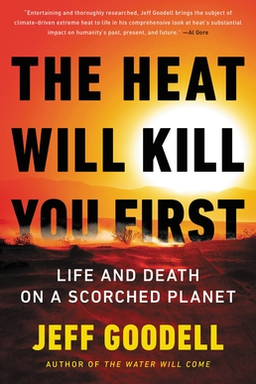
In The Heat Will Kill You First, Jeff Goodell argues that heat is not just another symptom of climate change—it is the most immediate, invisible, and transformative force reshaping life on Earth. You think of hot days as discomfort, but Goodell shows how heat acts like a predator: silent, physiological, and social. The book explores how extreme heat destabilizes bodies, cities, economies, and ecosystems, tracing its reach from human evolution to modern energy use and planetary feedbacks.
The physiology of a killer
You generate heat continuously; your survival depends on shedding it through blood flow and sweat. When that system fails—whether through dehydration, humidity, or impaired cooling—the body turns against itself. Core temperatures rise, cognitive function slips, and death by heatstroke can come quickly. The Mariposa case, where the Gerrish-Chung family succumbed during a simple hike, illustrates how small misjudgments compound under rising temperatures. Heat leaves almost no external evidence but overwhelms the chemistry of life.
From evolution to crisis
Goodell roots the story in deep time: early humans adapted to heat through bipedalism and sweating, evolving in African savannas where motion and evaporation conferred survival advantages. But that advantage works only within a narrow Goldilocks Zone—too hot or humid, and the physics of evaporation itself breaks down. Our physiology, optimized for stability over millennia, now faces a climate changing in decades. (Note: Similar evolutionary framing appears in Elizabeth Kolbert’s work on extinction, but Goodell makes it visceral and personal.)
The social anatomy of heat
Heat amplifies inequality. Wealth buys air-conditioning; poverty leaves people working outdoors or trapped in uninsulated homes. Cities designed with asphalt and glass trap heat that kills the poor first, while industrial systems channel cooling to those who can pay. In Phoenix and Chennai, the urban heat island becomes both physical and moral landscape: cooling access mirrors privilege. The elderly and undocumented workers are among the most vulnerable—people like Sebastian Perez, who died hoeing nursery fields in Oregon at 106 degrees.
Global extensions: oceans, agriculture, and disease
Heat doesn’t stop at the atmosphere. Oceans absorb ninety percent of excess energy from fossil fuels, causing marine heat waves like the Blob that killed millions of seabirds and destabilized kelp forests. Farms struggle as pollen aborts and crop yields collapse, driving food insecurity and migration. Disease vectors—from mosquitoes to ticks—follow the warmth, expanding risks of dengue, chikungunya, and hemorrhagic fevers. These changes connect biology, economics, and public health into a single web of heat dependence.
Technology’s double edge
Air conditioning democratized comfort, but it also deepened the climate trap. Goodman’s “cheap cold air” made life in the Sun Belt possible while embedding a feedback loop: the more heat rises, the more electricity and greenhouse gases we produce to cool ourselves. Refrigerant leaks and skyrocketing demand risk turning relief into acceleration. Cooling becomes both necessity and climate amplifier, defining a new thermal divide between those who can afford protection and those left exposed.
The new politics of accountability
Through attribution science, researchers like Friederike Otto transform climate discussion from tragedy to responsibility. By comparing simulated atmospheres with and without human emissions, they show how extreme events—such as the 2021 Pacific Northwest heat dome—would have been nearly impossible otherwise. This marks the birth of 'science with legal teeth,' opening the door to litigation against companies and governments. Heat becomes an ethical and judicial frontier, not just a physical one.
Naming and acting on heat
To make heat politically visible, cities like Seville have begun naming and ranking heat waves, turning abstract alerts into public mobilization tools. Heat Wave Zoe showed that names change behavior: people closed blinds, hydrated, and checked on neighbors. Goodell argues that communication—how you name and frame heat—matters as much as temperature itself.
Beyond adaptation: choice and responsibility
Ultimately, heat defines the boundary between survival and collapse. From Paris’s zinc rooftops to Baffin Island’s melting ice, Goodell shows a planet leaving its comfortable zone. The book concludes that we are “pleading guilty to first-degree heat” through conscious choices to persist in fossil dependency. You live in the critical moment where cooling, migration, and accountability converge—and whether humanity stays within the Goldilocks Zone depends on what you choose next.