
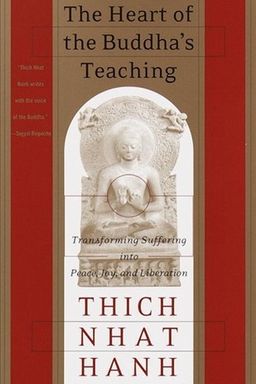
The Heart of the Buddha''s Teaching cover

The Heart of the Buddha''s Teaching

by Thich Nhat Hanh

The Heart of the Buddha’s Teaching reveals core Buddhist principles like the Four Noble Truths, offering practical guidance to transform suffering into joy and peace. Thich Nhat Hanh''s insights help readers apply these teachings to daily life for healing and happiness.

Transforming Suffering into Peace and Joy

How can you live with inner peace when suffering, distraction, and anxiety seem to permeate modern life? In The Heart of the Buddha’s Teaching, Thich Nhat Hanh offers a comprehensive and accessible guide to Buddhist philosophy and practice. He argues that suffering is not an obstacle to happiness but the very means through which liberation becomes possible. By embracing and understanding suffering, you can transform it into compassion, wisdom, and joy.

Thich Nhat Hanh contends that the Buddha’s core teachings — including the Four Noble Truths and the Noble Eightfold Path — provide not abstract doctrine but an experiential path for mindful living. The book translates ancient wisdom into modern practice, teaching how to handle pain, cultivate mindfulness, and nurture compassion amid daily life. By combining philosophical clarity with practical exercises, it positions Buddhism not as a religion to believe in but as a way to live with awareness, healing, and love.

Suffering as the Doorway to Liberation

Rather than denying pain, Hanh teaches that the first step toward liberation is recognizing it. ‘To suffer and not know we are suffering is more painful than the suffering itself,’ he writes. Suffering is not a punishment — it is our teacher. If we run from it, as most people do through distractions, consumption, or denial, we also run from the wisdom it holds. Like a doctor diagnosing an illness, recognition is the first act of healing. The Buddha’s insight, Hanh reminds us, is that because there is suffering, there can also be an end to suffering.

By practicing mindfulness — a gentle, nonjudgmental awareness — you can observe, embrace, and transform suffering. For example, when anger arises, mindfulness helps you recognize its presence (‘Hello, my anger’) rather than suppress or act on it. This transforms anger into understanding, leading to peace. Hanh compares this to a mother holding her crying baby — through attentive care, the intensity of pain melts away.

The Structure of Awakening: The Four Noble Truths

The framework of Buddhist wisdom begins with the Four Noble Truths. These are not beliefs but actions: to recognize suffering, to understand its origins, to realize that it can cease, and to cultivate the path that ends it. Hanh’s presentation is refreshingly modern — he renames the Third Truth “well-being” and the Fourth “the path that leads to well-being.” Suffering is not an end in itself; it is the soil from which happiness grows. When you face your suffering mindfully, you also touch the potential for joy that has always been present.

Hanh’s reworking of these truths makes them accessible beyond doctrine. He likens them to a cycle of discovery: diagnosis (suffering), etiology (its cause), prognosis (cessation), and treatment (the path). Understanding them fully requires direct practice — walking, breathing, eating, and speaking with awareness. “If you do not see the path in your rice or tea,” he writes, “you will not see it anywhere.”

The Eightfold Path as a Map of Daily Life

The Buddha’s Noble Eightfold Path — Right View, Right Thinking, Right Speech, Right Action, Right Livelihood, Right Effort, Right Mindfulness, and Right Concentration — is, in Hanh’s framing, not a rigid sequence but eight interdependent ways of living mindfully. Each element nourishes and supports the others. When your view of life is compassionate, your thoughts and speech follow suit; when your actions are mindful, your livelihood becomes an expression of love. The path is less a moral code than an ecology of awareness.

Hanh illustrates the Eightfold Path as a living system. Right View, for instance, allows understanding of interbeing — the recognition that everything is interconnected. This understanding informs Right Speech, which is truthful, compassionate communication. Right Livelihood means earning a living without harming others, while Right Mindfulness connects all actions to the present moment. The path is thus a training in mindful engagement, not withdrawal from the world.

Mindfulness: The Core Energy of Transformation

At the heart of Thich Nhat Hanh’s interpretation is mindfulness (samyak smriti) — the continuous, loving awareness of what is happening within and around you. Called “the heart of the Buddha’s teaching,” mindfulness is both the method and the goal. Through mindful breathing, walking, or even washing dishes, we reclaim the present moment — the only place where life is truly available. ‘When you wash the dishes, wash the dishes,’ he instructs, meaning that the simplest acts can reveal the depth of being if done with full attention.

He distinguishes mindfulness from mere concentration: attention is mechanical without love. True mindfulness includes compassion. It helps you listen deeply, speak wisely, work ethically, and rest fully. In this sense, mindfulness is a doorway to both individual and collective healing — what Hanh calls “the Buddha of the twenty-first century,” a community (Sangha) that lives peace in everyday action.

Why These Teachings Matter Today

In an age of distraction and violence, Hanh’s message is radical: stop running, touch your pain, and discover joy in the present. He reminds us that peace must begin in our breath before it can exist in politics or society. When nations, families, or individuals learn to listen deeply and speak lovingly, transformation becomes inevitable. Buddhism, in Hanh’s hands, is a psychology of awakening rather than a religion of belief. It is, as he puts it, ‘the art of living in peace and freedom, right in the heart of suffering.’


Understanding and Embracing Suffering

Thich Nhat Hanh begins by transforming how you see pain. Most people try to run from suffering — through work, entertainment, intoxication, or distraction — but the Buddha’s first lesson is to stop and face it. Recognizing suffering doesn’t mean wallowing in it; it means acknowledging its presence so you can heal. Hanh calls this the practice of touching suffering.

The Three Turnings of the Wheel

The Buddha described the process of awakening as turning the wheel of the Dharma. For each of the Four Noble Truths, there are three stages — recognition, encouragement, and realization. First you acknowledge suffering (‘This is pain’), then you make an effort to understand its nature, and finally you experience liberation from its power. This cycle turns twelve times, allowing practice to move from intellectual to experiential insight.

Looking Deeply into Causes

Hanh likens understanding suffering to diagnosing illness. You examine not only symptoms but also causes — the four “nutriments” that feed your happiness or pain: edible food, sense impressions, volition (intention), and consciousness. He uses vivid metaphors — such as a couple eating their child’s flesh to survive — to show how unmindful consumption of food, media, or emotions can become self-cannibalism. Mindfulness allows you to choose nourishment that heals rather than harms.

For example, watching violent movies, gossip, or negative news is like eating toxins. We need to ‘post a sentinel of mindfulness at each sense door’ to protect our mental health. Similarly, our intentions — ambition, revenge, greed — are psychological food. When they are unwholesome, they “drag us into the fire,” as the Buddha said. Real freedom comes from releasing these “cows” — our attachments to wealth, status, or power — that bind us to unhappiness.

Embracing, Not Resisting

Instead of battling your pain, Hanh invites you to hold it gently: “Hello, my dear suffering, I will take good care of you.” Through mindfulness, suffering becomes a teacher rather than an enemy. When you understand its causes, you stop blaming others and start transforming your relationship to life. This leads naturally to stopping the cycle of suffering, one of the central goals of Buddhist practice.

Ultimately, to ‘touch your suffering’ is to touch your humanity. You cannot transform what you do not see. As Hanh often teaches, with every step of mindful walking or conscious breathing, you are already transforming pain into peace.


The Practice of Mindful Well-Being

For Thich Nhat Hanh, healing is not a distant goal but an immediate possibility. The Third and Fourth Noble Truths — cessation and the path — are the realization of well-being through mindful living. When you stop creating the causes of suffering, happiness naturally arises, just as when you stop walking, your footprints cease. Hanh reframes the Buddhist path not as renunciation but as realizing joy in ordinary moments.

Recognizing Non-Suffering as Happiness

Hanh begins simply: when you have a toothache, you know that not having one is happiness. Yet when you don’t have pain, you forget to celebrate it. Mindfulness helps you appreciate your “non-toothache”—the countless unnoticed conditions of happiness already present. As you train yourself to see these small joys, daily life becomes a rich field of gratitude.

Cultivating Joy Through Practice

Healing requires action. Hanh emphasizes “gardening of the mind”: watering seeds of peace through walking meditation, mindful breathing, and kind dialogue. He shares concrete methods — such as tea meditation and mindful eating — to slow down and savor presence. A few minutes of conscious breathing can dissolve despair faster than hours of distraction. The miracle, he writes, is not to walk on water but to walk on the Earth.

The Noble Eightfold Path to well-being becomes a guide to every moment: Right View and Right Mindfulness help you see clearly; Right Speech and Right Action help you relate lovingly; Right Diligence and Right Concentration help you rest deeply. When these are alive in you, each day becomes a continuation of awakening.

The Interbeing Nature of the Four Truths

In the final turning of the wheel, Hanh unites all Four Truths: seeing one fully reveals the others. When you understand suffering, you also see its origins, its cessation, and its path. Similarly, understanding joy requires embracing pain. This insight of interbeing—that all truths depend on one another—turns Buddhist philosophy into a seamless practice of mindful living.

To realize well-being, then, is not to escape life but to live it fully. ‘Don’t run away,’ Hanh urges. ‘Touch your suffering and make peace with it.’ Joy and sorrow are not enemies—they are two faces of awakening.


Mindfulness as the Heart of Practice

Right Mindfulness is the central thread uniting all of Thich Nhat Hanh’s teaching. It is the energy that makes every other element of the Eightfold Path possible — the art of being fully alive. Through mindfulness, you touch everything deeply: a flower, your breath, your child, or your own suffering. Without it, spiritual life remains conceptual; with it, life becomes sacred.

The Seven Miracles of Mindfulness

Hanh describes seven “miracles” mindfulness performs: presence, making others present, nourishing the object of attention, relieving suffering, deep looking, understanding, and transformation. For example, when you say to someone, ‘I know you are there, and I am happy,’ you perform a miracle — you restore presence and connection. Similarly, when you listen deeply to another’s pain without judgment, you allow healing to occur naturally.

The Four Establishments of Mindfulness

Mindfulness must be grounded in practice. Drawing on the Satipatthana Sutta, Hanh teaches awareness of four foundations: the body, feelings, mind, and phenomena. You start with the body — breathing, walking, lying down — then feelings, both pleasant and painful. Next comes awareness of mind (thoughts, emotions), and finally dharmas — the contents of consciousness, including perceptions and ideas. By observing them mindfully, you transform suffering at its roots.

A Path for Everyday Living

Unlike many spiritual traditions, Hanh insists that mindfulness is not confined to monasteries. It flourishes in the kitchen, office, or city street. He encourages “bell of mindfulness” moments — each phone ring or red light is a reminder to breathe. As he writes, “Words can travel thousands of miles. May my words create understanding and love.” By grounding awareness in ordinary actions, mindfulness becomes both meditation and ethics.

Ultimately, mindfulness transforms perception. You begin to see every moment — joy and sorrow alike — as your home. When you are truly mindful, he concludes, “you are the Buddha.”


Interbeing and the Nature of Reality

Thich Nhat Hanh redefines Buddhist metaphysics through the language of interbeing — the radical insight that everything exists only in relation to everything else. Drawing on the teaching of Interdependent Co-Arising (pratitya-samutpada), he shows how the notions of self, time, and existence dissolve into a living network of relationships. When you see this, you are free from fear and separation.

This Is Because That Is

Hanh summarizes the Buddha’s cosmology with one elegant statement: “This is, because that is. This is not, because that is not.” Cause and effect are not linear but interdependent. Just as the chicken and the egg arise together, everything depends on countless conditions. When you drink tea, you taste the rain, clouds, soil, and sunlight. The one is in the all, and the all is in the one.

Going Beyond Being and Nonbeing

A common misunderstanding, Hanh explains, is to see reality in dualistic terms — being or nonbeing, life or death. But the Buddha rejected both extremes. Interbeing means transcending opposites altogether. Birth and death are mere appearances — like the wave that appears and disappears while water continues endlessly. When you touch this insight, fear of death vanishes and compassion blooms. This is what the Heart Sutra means by “no birth and no death.”

The Positive Cycle

Hanh reformulates the traditional Twelve Links of Dependent Origination into a dynamic model that includes both negative and positive cycles. When ignorance conditions craving, the result is suffering. But when wisdom conditions compassion, the result is freedom. This transforms the concept from fatalism to optimism: by cultivating understanding, you can interrupt ignorance at any point in the chain and bring enlightenment into being.

Interbeing is both a philosophy and a meditation. When you breathe, you breathe for all beings. When you smile, the Earth smiles through you. Seeing this interconnectedness is Right View in its purest form — the realization that there is no separate self, only the vast web of life.


Impermanence, Nonself, and Nirvana

The Buddha’s Three Dharma Seals — impermanence (anitya), nonself (anatman), and nirvana — are for Thich Nhat Hanh the fingerprints of ultimate truth. Any teaching that bears these seals is genuine Dharma. Understanding them liberates you from fear and transforms daily life into spiritual practice.

Impermanence

Everything changes — this is not tragedy but opportunity. Without impermanence, growth and renewal would be impossible. Flowers bloom and fade; political systems rise and fall. When you see this, you stop clinging and start loving more deeply. Hanh writes, “We can love flowers because we know they will fade.” Mindfulness of impermanence helps you cherish what is present and release regret for what is gone.

Nonself

There is no independent “I.” Each of us inter-is with the air, the water, the ancestors, and future generations. Hanh compares us to cookies baked from the same dough — each one unique yet inseparable from the same substance. Seeing nonself dissolves alienation and brings compassion. As he explains, “To protect the environment is to protect ourselves.”

Nirvana

The third seal, nirvana, is not an otherworldly escape but “the cooling of all ideas.” It is the peace that comes when notions — of birth and death, gain and loss — are extinguished. The wave does not have to die to become water; it already is water. When you touch that insight in the present moment, you experience nirvana here and now. For Hanh, nirvana means freedom from fear — the deepest happiness.

Together, these three insights form a complete liberation. They reveal that life’s true nature is impermanent, selfless, and deathless. When you breathe mindfully and smile to the ever-changing world, you are already dwelling in nirvana.


Love and the Four Immeasurable Minds

Thich Nhat Hanh invites you to rediscover love as a spiritual practice through the Four Immeasurable Minds: love (maitri), compassion (karuna), joy (mudita), and equanimity (upeksha). He calls these ‘the abodes of true love,’ qualities that can transform relationships, communities, and even nations.

Love (Maitri)

Maitri is the capacity to give happiness. To love truly, you must understand the other’s needs. Without understanding, love can harm. Hanh tells the amusing story of being forced to eat the pungent durian fruit by someone trying to express love — a reminder that affection without insight becomes imposition. Looking deeply into those you love reveals what genuinely nourishes them.

Compassion (Karuna)

Compassion is the wish to relieve suffering. It arises from deep listening. When you truly hear another’s pain, healing naturally follows. Yet compassion must be balanced with strength — if we drown in another’s suffering, we cannot help them. That is why mindfulness and calm are essential companions to karuna.

Joy (Mudita)

True love produces joy in both giver and receiver. Joy is not excitement or pleasure but peaceful delight — the happiness of being alive. When you see others’ happiness as your own, jealousy dissolves. Joy nourishes resilience and gratitude, making love sustainable even in hard times.

Equanimity (Upeksha)

Equanimity means impartial love — seeing all beings as equal. It prevents attachment and possessiveness, allowing others to be free. Hanh writes, ‘If you imprison your beloved in a cage of your love, you will lose them.’ True love gives space to grow. When all four immeasurable minds coexist, love becomes boundless — the heart of enlightenment itself.

Cultivating these qualities daily — by smiling, breathing, listening, and forgiving — allows love to expand indefinitely. Each act of understanding becomes a ripple of peace reaching far beyond yourself.


Living Ethically with Compassion

Hanh turns Buddhist morality into a living, joyful art through the Five Mindfulness Trainings — modern versions of the precepts that guide ethical living. They are not commandments but mindfulness tools to cultivate awareness in relationships, work, and society. Practicing them transforms daily life into a field of compassion.

The Five Trainings

  • Reverence for life — cultivate compassion and protect all living beings.
  • True happiness — practice generosity, sharing time, energy, and resources.
  • True love — act responsibly and protect the integrity of relationships.
  • Loving speech and deep listening — resolve conflicts with empathy.
  • Mindful consumption — protect body, mind, and Earth by consuming wisely.

Each training corresponds to one or more limbs of the Eightfold Path — linking ethics with mindfulness. For instance, mindful consumption is Right Action and Right Livelihood in practice; loving speech is Right Speech embodied.

Right Livelihood and Collective Well-Being

In an interdependent world, morality extends beyond personal virtue to collective consciousness. Hanh challenges us to examine how our work and purchases contribute to suffering — whether producing pollution, violence, or exploitation. Practicing Right Livelihood means aligning our profession with compassion. It is as much about transforming society as transforming self.

‘To practice Right Livelihood is to practice Love,’ he writes. When our work nourishes life instead of harming it, we heal both ourselves and the planet.

Dig Deeper

Get personalized prompts to apply these lessons to your life and deepen your understanding.

Go Deeper

Get the Full Experience

Download Insight Books for AI-powered reflections, quizzes, and more.