
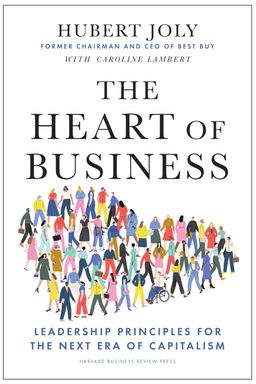
The Heart of Business cover

The Heart of Business

by Hubert Joly & Caroline Lambert

The Heart of Business reveals how Hubert Joly revitalized Best Buy by fostering a people-centric culture anchored in purpose. This insightful guide offers a roadmap for leaders to achieve sustainable success through ethical practices that benefit employees, customers, and stakeholders alike.

Leading with Purpose and Humanity in the New Capitalism

How do you turn a struggling business into a thriving community — one that enriches lives, ignites passion, and achieves long-term success? In The Heart of Business, former Best Buy CEO Hubert Joly argues that the future of capitalism depends on putting purpose and people at the center of business. For too long, he says, companies have followed a distorted model focused narrowly on maximizing shareholder value. The result? Widespread employee disengagement, broken trust in corporations, and a sense that capitalism itself is failing. Yet, as Joly’s own turnaround of Best Buy shows, there is another way — one rooted in what he calls “human magic.”

Joly contends that the purpose of business is not to make money but to make a positive difference in people’s lives. Profit, he insists, is an outcome of acting with purpose, not the purpose itself. This belief redefines everything — from the way we view work, to how companies are structured, to how leaders must behave. The book blends Joly’s personal evolution as a leader with practical lessons from turning around Best Buy and other companies, and it serves as both manifesto and playbook for “the next era of capitalism.”

From Profit to Purpose

Joly begins by diagnosing the flaws of the dominant business model — the tyranny of shareholder value that Milton Friedman popularized in the 1970s. When companies only serve shareholders, they neglect customers, employees, and communities. The result has been environmental damage, inequality, and eroding trust. Joly’s experience as CEO convinced him that obsession with short-term metrics is not just uninspiring; it’s strategically self-destructive. Instead, he frames businesses as “purposeful human organizations” designed to serve all stakeholders in harmony.

Purposeful organizations begin, as he says, with a “noble purpose” — an aspirational reason for being that contributes to the common good. Best Buy’s reinvention of its mission from “selling electronics” to “enriching lives through technology” illustrates how such a reframing can unleash creativity, build loyalty, and open new markets. Purpose, when lived authentically, aligns profits with progress rather than pitting them against one another.

Work as a Search for Meaning

Before reimagining business, Joly argues, we must rethink work itself. Too many people see work as “Adam’s curse”—a necessary evil or means to an end. Drawing on philosophy, theology, and personal experience, he reframes work as part of our human search for meaning and love made visible (quoting poet Khalil Gibran). Humans yearn to make a difference, grow, and connect, not just earn a paycheck. When employees find purpose in their work, they bring out their best selves — what Joly calls “human magic.” Gallup research supports this, showing that only about 16% of workers worldwide are truly engaged. Re-engaging the remaining 84% could transform not only companies but society itself.

To turn work into a positive force, Joly calls leaders to connect each person’s individual dreams with the company’s purpose. Through stories like Best Buy store manager Jason Luciano’s “Dream Board,” where employees wrote down their personal goals — like moving into an apartment or finishing a degree — he demonstrates that when companies invest in people’s aspirations, performance soars naturally.

The Architecture of a Purposeful Human Organization

Joly’s model of a purposeful company is a system of five interlinked elements: a noble purpose, employees at the center, authentic human relationships across stakeholders, profit as an outcome, and continual feedback between all parts. He calls this a “declaration of interdependence,” highlighting how customers, vendors, communities, and shareholders all benefit when people are placed at the heart of business. It’s a radical break from the zero-sum mindset of traditional capitalism.

Examples abound: Best Buy’s partnerships with traditional competitors like Amazon and technology giants such as Samsung showed how viewing others as collaborators rather than adversaries builds value for all. Vendor “stores-within-a-store” created win-win ecosystems that restored profitability while sparking innovation.

Unleashing Human Magic

A crucial concept running through the book is “unleashing human magic” — the extraordinary performance that arises when employees are inspired, connected, and trusted. In contrast to carrot-and-stick management, Joly proposes five ingredients for cultivating human magic: connecting dreams, developing human connections, fostering autonomy, achieving mastery, and putting the wind at your back (through growth and optimism). When people work in an environment where they matter, feel safe to be vulnerable, and are guided by purpose rather than fear, they go beyond rational performance to what Joly calls “irrationally good results.”

The Purposeful Leader

Ultimately, Joly concludes that leadership itself must be redefined. The heroic, all-knowing CEO belongs to the past. The purposeful leader, by contrast, serves others, leads with values, and connects head and heart. Joly distills leadership into the “five Be’s”: be clear about purpose, be clear about your role, be clear about whom you serve, be driven by values, and be authentic. This leader sees business as a noble calling—“work as love made visible”—and builds organizations that are as humane as they are successful.

The implications of Joly’s vision are profound: if leaders across industries adopt purpose and humanity as their compass, capitalism can be refounded as a force for common good. Rather than abandoning capitalism, Joly argues that we must “turn it around from within.” Through purpose, love, and connection, business can once again become a source of hope, meaning, and joy—for employees, customers, and society at large.


Rethinking the Meaning of Work

Why do you work? For income, achievement, or something deeper? Joly invites you to reconsider work as not a curse, but a path to fulfillment. In the opening chapters, he challenges cultural assumptions dating back to ancient Greece, the Industrial Revolution, and religious interpretations that equate labor with suffering. He contrasts this with an uplifting vision: work as part of humanity’s search for purpose and love.

From “Adam’s Curse” to “Work as Love Made Visible”

Ancient civilizations viewed manual work as demeaning, while Christianity framed it as punishment for sin. Joly reinterprets Adam’s curse—laboring “by the sweat of your brow”—not as condemnation but continuation of divine creation. To him, work affirms our humanity when it contributes to others’ well-being. He draws inspiration from Catholic social teaching, Protestant work ethics, and Viktor Frankl’s Man’s Search for Meaning, which found that those who found purpose even in pain could transcend suffering. Joly believes business can facilitate this kind of meaning-making at scale.

Discovering Personal Purpose

After reaching success by his early forties, Joly found himself spiritually empty and joined Jesuit spiritual exercises to rediscover his own calling. Through reflection, he articulated a personal purpose—to make a positive difference for people around him and use his platform for good. He shows readers that purpose can be discovered through introspection: by asking what gives you energy, what the world needs, what you’re good at, and what you can be paid for — aligning with the Japanese concept of ikigai. He stresses that your purpose doesn’t require saving the world; it could be simply “building the cathedral” rather than “cutting stones.”

Applying Purpose to Workplaces

At Best Buy, Joly turned this philosophy into practice. Store leaders began asking employees “what drives you?”—discovering dreams rooted in family, personal growth, and service. These conversations ignited engagement. One example: when a child’s broken toy caused distress, employees transformed a return into a “dino surgery,” dramatizing compassion in action. In essence, helping a boy smile became the day’s measure of success — a vivid microcosm of work-as-love-made-visible. Through such small acts, meaning spread organically, strengthening both morale and performance.

(In comparison, Frankl, Seligman, and other psychologists of meaning-making concur: happiness follows from purpose, not the reverse.)


The Tyranny of Shareholder Value

In Joly’s view, capitalism has lost its soul. When Milton Friedman declared in 1970 that a firm’s only social responsibility was to increase profits, he created a doctrine that overshadowed every other goal. This obsession with shareholder value reduced companies to spreadsheets, measuring success while ignoring the human and environmental costs. Joly calls this the “tyranny of shareholder value.”

Why Profit Isn’t the Purpose

Joly doesn’t dismiss profitability — he recognizes that without financial health, no company survives. But he argues profit should be treated like a patient’s temperature: a symptom of well-being, not the goal itself. When firms chase quarterly targets, they cannibalize the long term by underinvesting in people and innovation. Short-term “surgery”—closing stores, laying off staff, or squeezing suppliers—cuts muscle along with fat. The results? Companies like Sears collapsed under the illusion of efficiency, while Best Buy flourished only after prioritizing relationships over raw numbers.

Stakeholders, Not Shareholders

Customers, employees, communities, and shareholders form an interconnected ecosystem. Treating one group as superior undermines all others. Joly highlights how even investors such as BlackRock’s Larry Fink now insist that sustainable returns require serving all stakeholders. Employees and consumers alike expect companies to uphold fair environmental and social practices. Ignoring them damages reputations and undermines trust. At Best Buy, aligning purpose with stakeholder interest not only rebuilt its culture but multiplied its stock price tenfold—clear proof that serving all creates enduring value.

Business as a Force for Good

Joly envisions capitalism’s renewal through a reorientation toward the common good. By serving human needs and restoring planetary balance, businesses can regain moral legitimacy. In practice, this means integrating environmental, social, and governance (ESG) considerations into strategy—not as PR add-ons but as core to the mission. Capitalism, he insists, isn’t dead but in need of transformation: “We can turn it around from within.” Following that call, his later chapters showcase precisely how.


Building the Purposeful Human Organization

Once businesses abandon the cult of financial targets, they can rebuild themselves as purposeful human organizations. Joly’s guiding equation—People → Business → Finance—flips the traditional order. By nurturing employees and relationships first, companies naturally drive profits as a consequence.

Jean-Marie Descarpentries’ Influence

A key mentor, French executive Jean‑Marie Descarpentries, taught Joly that companies have three imperatives: people, business, and finance. Many confuse the outcomes (profit) with the imperative (people). The true purpose, Descarpentries insisted, is “the development and fulfillment of employees.” Joly traced this philosophy through each company he led — culminating in Best Buy’s blueprint, where “human magic” became the foundation for renewal.

Purpose as Strategy, Not Slogan

Declaring noble purpose is easy; embedding it into operations is hard. Best Buy’s strategy, Building the New Blue, made “enriching lives through technology” the organizing principle for innovation. It spawned new businesses like tech support, health monitoring for seniors, and in‑home advisors—all extending beyond product sales. Every new initiative had to answer four questions: Does it fit our purpose? Is it good for the customer? Can we deliver? Can we make money? By keeping purpose in the decision flow, the company turned philosophy into measurable action.

A Declaration of Interdependence

Joly represents this model as a living system connecting five stakeholder groups—employees, customers, suppliers, communities, and investors—within a web of mutual care. This declaration of interdependence replaces hierarchy with harmony. Each stakeholder helps sustain the others: inspired employees delight customers; satisfied customers attract investors; supported communities sustain talent and trust. When this loop thrives, profits follow organically—just as Best Buy’s recovery demonstrated.


Turning Around with Compassion and Courage

When Joly took charge of Best Buy in 2012, the company was predicted to die within months. Yet under his leadership, it achieved one of the most celebrated corporate turnarounds of the decade. In Renew Blue, his playbook for crisis leadership, the traditional formulas of cost-cutting and fear were replaced with empathy, learning, and shared purpose.

Starting with People, Ending with People

Instead of first slashing jobs or stores, Joly began his “CEO in Training” journey on the front lines—wearing a blue shirt in a St. Cloud, Minnesota store, listening to employees and customers. That humility revealed the sources of failure: low morale, confusing priorities, and misaligned incentives. He learned what mattered most to employees—restoring discounts, simplifying metrics, and being heard. His turnaround principle became clear: people first, always. Growth followed organically when employees felt valued and trusted.

Generating Human Energy

Joly’s team co-created a “good enough” plan rather than a perfect one, mobilizing hundreds to define two priorities: raise revenue, improve margins. Simplifying complexity built momentum and restored confidence. Through transparent communication, small wins, and celebrations of progress, he infused the company with hope. At one point, simply announcing that holiday sales were “flat” — not declining — produced cheers across the company because it signaled that the bleeding had stopped. Human energy, he discovered, was the greatest turnaround currency of all.

These principles challenge the archetype of the ruthless crisis CEO. Joly proved that compassion is not weakness — it’s the engine of sustainable performance.


Unleashing Human Magic: The Five Ingredients

At the heart of Joly’s framework lies a simple question: how do you create conditions where people give their very best — with joy, not coercion? His answer unfolds in five interconnected ingredients for unleashing what he calls “human magic.”

1. Connecting Dreams

Employees thrive when their personal aspirations align with the organization’s purpose. Through practices like asking “What drives you?” and helping team members pursue their dreams, Best Buy transformed engagement. When a store manager helped an associate move from sales to management so she could afford her first apartment, her success inspired others. Meaning spreads when individuals see how their story fits within the company’s story.

2. Developing Human Connections

Joly shows that trust, safety, and vulnerability—not authority—bind organizations together. Leaders like HR chief Kamy Scarlett shared personal struggles with depression, sparking hundreds of employees to open up about their own challenges. Connection, not fear, fuels performance. He also promotes diversity, inclusion, and psychological safety as non-negotiable foundations for innovation and engagement.

3. Fostering Autonomy

Rules and micromanagement stifle creativity. By pushing decision-making to the lowest competent level, leaders empower employees to innovate quickly. At Best Buy, autonomy allowed teams to design their own customer experiences and retail tests. Removing unnecessary controls created speed and ownership—a lesson confirmed by Joly’s RASCI model of accountable decision roles.

4. Achieving Mastery

Purpose without competence lacks impact. Joly argues mastery unfolds when people are coached, not commanded. Inspired by Carol Dweck’s “growth mindset,” he replaced rigid annual reviews with continual conversations focused on learning, coaching, and individual strengths. In Denver stores, managers analyzed each associate’s sales data to identify unique learning goals—a process that boosted results by billions.

5. Putting the Wind at Your Back

Finally, growth—personal and organizational—creates the vital tailwind that sustains enthusiasm. Leaders who frame challenges as opportunities, who “see possibilities rather than headwinds,” help their teams convert pressure into progress. Purposeful optimism, not blind positivity, becomes the fuel for continuous improvement.

Together, these five ingredients form the recipe for environments where “work feels human, life feels meaningful, and performance becomes irrationally good.”


The Purposeful Leader and the Refoundation of Capitalism

In the final chapters, Joly turns from organizations to the individuals at their helm. The crisis of capitalism, he argues, is ultimately a crisis of leadership. To repair it, leaders must evolve—not as superheroes but as purposeful, human guides. He distills this model into five Be’s of purposeful leadership, each redefining what power and impact mean today.

1. Be Clear about Purpose

Purpose starts with self-awareness. Leaders must align their personal calling with their organization’s mission. Joly recounts how Best Buy’s current CEO, Corie Barry, grounds every day in her purpose “to leave things a little better than she found them.” This alignment builds authenticity, clarity, and resilience during adversity.

2. Be Clear about Your Role

Leaders are not problem solvers; they are energy creators. When faced with a potential data breach before Black Friday, Joly reminded his crisis team that such challenges were “incredible leadership moments” to bring their best selves. His calm optimism transformed fear into focus — demonstrating that true leadership regulates emotion as much as action.

3. Be Clear about Whom You Serve

Purposeful leaders serve others, not their own egos. Joly urges executives to see everyone as a customer deserving respect. He contrasts self-serving ambition—symbolized by executives cutting lines and asking “Do you know who I am?”—with the humility to listen and elevate others. Service is leadership’s moral anchor.

4. Be Driven by Values

Integrity, respect, fairness, and compassion aren’t slogans; they’re the scaffolding of trust. Joly praises companies like Johnson & Johnson for living their Credo even at financial risk, as in the Tylenol recall. Similarly, Best Buy closed stores during the pandemic to protect workers before counting costs. Values, he insists, simplify complex choices.

5. Be Authentic

Finally, leaders must bridge the 18 inches from head to heart. Vulnerability and humanity—once taboo in boardrooms—now define genuine leadership. Joly himself ended his Best Buy tenure with an email titled “I love you,” a gesture of gratitude and connection that would have been unthinkable in old corporate culture. Authentic leaders show emotion, admit imperfection, and invite empathy. In doing so, they unleash trust and magic across their organizations.

Joly closes with a call to action for every leader, investor, educator, and reader: to refound capitalism “around purpose and humanity.” Leadership, in his vision, is not about command, but about connection — not about extracting value, but about giving meaning.

Dig Deeper

Get personalized prompts to apply these lessons to your life and deepen your understanding.

Go Deeper

Get the Full Experience

Download Insight Books for AI-powered reflections, quizzes, and more.