
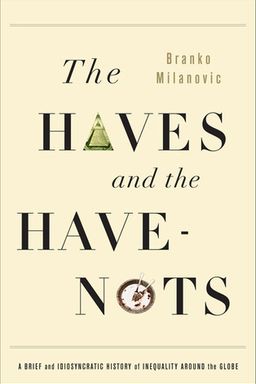
The Haves and the Have-Nots cover

The Haves and the Have-Nots

by Branko Milanović

The Haves and the Have-Nots delves into the history and nuances of global inequality, examining its effects on individuals, countries, and the world. This enlightening journey covers economic growth, justice, and the persistent impact of birthplace on financial mobility, offering a comprehensive view on how inequality has shaped our past and continues to influence our future.

How Inequality Shapes the World We Live In

Have you ever wondered why some nations flourish while others remain poor, or why certain people seem destined for prosperity while others struggle all their lives? In The Haves and the Have-Nots, economist Branko Milanovic takes you on a sweeping tour through history to answer these questions. He argues that inequality — not just between individuals, but between countries and across time — is the hidden architecture of our world. From Roman senators to New York billionaires, from the divide between China and the United States to the inequality between global citizens, Milanovic traces how economic disparities have shaped civilizations, political systems, and personal destinies.

Milanovic contends that inequality is not a recent invention—it has existed in every organized society because social life itself generates differences in power, wealth, and opportunity. But the nature of inequality has evolved: while ancient societies were stratified mainly by birth and class, the modern world is divided by geography and citizenship. Today, where you are born determines more than half of your lifetime income. Milanovic’s central argument is that understanding inequality requires you to zoom out: to look not just within your own country, but across borders and centuries.

Three Dimensions of Inequality

Milanovic builds his book around three fundamental lenses: inequality within nations, inequality between nations, and inequality among the world’s citizens as a whole. Each level tells a different story. The first examines how wealth and income vary among people in a single country—why, for instance, the top 1% can own as much as the bottom half combined. The second explores why nations diverged so radically after the Industrial Revolution, with Britain, the United States, and Japan pulling far ahead while others lagged. The third level, global inequality, is about how these two forms combine: what happens when you treat everyone on earth as if they lived in one global economy.

This structure makes the book unique. It’s not only about the rich and poor within your country, but about how geography, technology, and history conspire to produce global winners and losers. For example, Milanovic shows that inequality between nations has ballooned since the 19th century and now accounts for most of global inequality. In other words, your passport matters more for your income than your talent or effort. Citizenship, he argues, is the twenty-first century’s most valuable—and most unfairly distributed—asset.

Why Inequality Matters

For Milanovic, inequality isn’t just an economic problem—it’s a social, moral, and political one. High inequality distorts democracy by giving outsized influence to the wealthy. It heightens social tension, drives migration, and even fuels financial crises (as in the 2008 crash, which Milanovic traces partly to decades of rising U.S. inequality). At a deeper level, inequality defines our sense of fairness and belonging. Whether you live in New York or Nairobi, your opportunities, ambitions, and frustrations are shaped by the economic ladder on which you stand.

By merging economics with vivid historical anecdotes—Jane Austen’s Elizabeth Bennet, Tolstoy’s Anna Karenina, Roman emperors, Rockefeller, and Bill Gates—Milanovic makes abstract numbers tangible. You see not just the ratios but the human stories behind them: marriage markets, class privileges, family wealth, and even who could “afford” to fall in love. Through these examples, he transforms statistics into narratives of power and fate.

Inequality as a Moving Target

While inequality has always existed, its drivers shift over time. The book traces a historical arc from preindustrial agrarian societies, where everyone lived near subsistence, to industrial economies, where mechanization widened income gaps before eventually creating a middle class. This follows the famous “Kuznets curve,” showing how inequality first rises during industrialization, then falls as societies get richer and more educated. But Milanovic warns that the curve has turned upward again: globalization, automation, and policy choices have reignited inequality within rich nations.

On a global scale, there’s a paradox. While within-country inequality has grown, inequality between countries has started to shrink—largely thanks to China and India’s astonishing growth. Yet the “absolute” income gap between the West and the developing world remains huge. The relative and absolute measures tell different stories: you can have convergence in percentages and divergence in dollars. This insight—“you have to run very fast just to stay in the same place”—captures the treadmill of modern globalization.

Why This Book Matters to You

Milanovic’s work invites you to see inequality not as a distant academic topic but as the structure of your own life: your wage, education, nationality, and even mobility prospects are shaped by systems centuries in the making. When you walk down a street, scroll through the news, or think about the price of your coffee or the brand of your phone, you’re witnessing the outcomes of global inequality. The book gives you tools to interpret those scenes—why Chinese workers, African migrants, and Silicon Valley billionaires coexist in the same global economy but experience entirely different worlds.

Ultimately, Milanovic challenges you to rethink fairness. Should we measure justice only within countries, or across humanity? If your nationality determines more than half your income, can we call the global system just? These are not rhetorical questions—they’re calls to expand how you think about economics, ethics, and global citizenship. From the dinner table to world politics, The Haves and the Have-Nots reveals that inequality is not just a number—it’s the central story of our time.


The Birth of Inequality Within Nations

Inequality isn't new—it dates back to humanity’s earliest attempts at social organization. Before agriculture, hunter-gatherers lived in small, cooperative groups with little surplus to hoard. Once societies began farming, storing grain, and dividing labor, inequality took root. Those who controlled land and knowledge accumulated privileges, while others labored at subsistence. Milanovic begins by tracing how these early distinctions evolved into modern disparities within nations.

From Aristocrats to Capitalists

In ancient Rome, inequality was stratified by class: senators, equestrians, and plebeians. Using historian estimates, Milanovic shows that income inequality then was surprisingly high—similar to today’s United States—with emperors and elites commanding hundreds of times the average citizen’s earnings. Yet most Romans lived just above starvation. When the Roman Empire collapsed, inequality narrowed—not because society became fairer, but because everyone generally became poorer.

Fast-forward to early industrial Britain, where economist Simon Kuznets would later identify a new pattern. As industry replaced agriculture, inequality first rose sharply. Factories created wealthy industrialists alongside low-wage laborers. Over time, education, unions, and redistributive taxes would compress the gap. You can picture this as the famous “inverted-U”—inequality climbs, peaks, then declines. Yet as Milanovic notes, today this curve has turned upward again, reignited by technology and globalization.

How Economists Measure Inequality

Milanovic walks you through the birth of inequality measurement itself. In the 19th century, thinkers like Vilfredo Pareto first used tax records to map income distributions. Pareto claimed an “iron law” that inequality was stable across time—20% of people always held 80% of income. A century later, Kuznets challenged that constancy by linking inequality to economic development. Milanovic synthesizes both, showing that inequality moves in cycles shaped by industrial shifts, wars, and policy choices.

The Gini coefficient—a number between 0 (perfect equality) and 1 (total inequality)—offers one simple measure. Scandinavian countries typically hover near 0.3, while the United States and Russia sit above 0.4, and Brazil close to 0.6. These numbers translate human lives into structure: who can own a home, send children to college, or retire comfortably. Milanovic reminds you that these statistics reflect choices—how societies distribute rewards and risks.

The Politics Behind the Numbers

Under communism, for instance, inequality was drastically reduced—but at great cost to freedom and efficiency. The Soviet Union’s Gini coefficient was around 0.25, one of the world’s lowest, achieved by suppressing private ownership and linking income strictly to state employment. When those systems collapsed, inequality doubled or tripled as market economies emerged. Similarly, in capitalist democracies, policy choices—tax progressivity, welfare programs, education investment—heavily influence inequality trends. Milanovic argues that inequality is always political, not just economic. Who decides what’s fair determines who gets what.

By grounding his analysis in data and history, Milanovic helps you see inequality as a living force—one that shifts with social contracts. Each generation rewrites the balance between incentive and fairness. The question is never whether inequality exists, but how much a society can tolerate before the social fabric tears.


The Great Divide Between Nations

If inequality within countries shapes class, inequality between them shapes fate. Milanovic argues that today’s greatest divide isn’t between rich and poor citizens of one nation—but between whole nations themselves. The Industrial Revolution, beginning in 18th-century Britain, was the Big Bang that split human fortunes apart. Before it, most nations were poor and relatively alike. Afterwards, the West surged forward, and much of Asia, Africa, and Latin America lagged behind.

Measuring the Global Gap

How big is the gap? Milanovic uses GDP per capita adjusted for purchasing power parity—the idea that $1 should buy the same goods anywhere—to compare living standards. Around 1820, the richest country (Britain) was only about three times richer than the poorest (India or China). Today, that ratio exceeds one hundred to one. This explosion in wealth differences over two centuries created what Milanovic calls “income divergence.”

The Industrial Revolution’s technologies—steam, mechanization, and factory production—spread unevenly. Countries that industrialized early compounded their advantages, while others were trapped by colonization, geographic isolation, or weak institutions. European empires extracted resources and wealth from Asia and Africa, ensuring that the gap widened further. For the first time in history, inequality between nations overtook inequality within them.

China, India, and the Turning Point

In the late twentieth century, two nations changed this trajectory: China and India. Together home to over two billion people, both began decades of unparalleled growth—China from the 1980s onward, India slightly later. Because they started at such low income levels, their rapid growth had an equalizing effect on global inequality. Milanovic uses a clever metric he calls “utils of human welfare,” where one “util” equals 100 million people doubling their income. By this measure, China produced 38 utils in three decades—ten times more than the United States over half a century. Never before had so many become richer so fast.

But the absolute gap still widened. Even as China’s GDP per capita rose twelvefold, U.S. income grew too—so the dollar difference between them increased. To match a 1% U.S. income growth, China had to grow nearly nine times faster just to keep up. Milanovic calls this the tragedy of relative progress: running fast only to stay in place. Thus, while convergence in percentages improved, in real terms the divide between rich and poor countries remains vast.

Globalization’s Paradox

Classical economics predicted that globalization—free flow of capital, goods, and ideas—should narrow gaps. Yet “Globalization 2.0,” beginning in the late 20th century, often did the opposite. Capital flowed mostly between rich countries (the “Lucas paradox”), and technology transfers favored those who could afford them. Intellectual property laws, for instance, allowed rich nations to profit from inventions while poor ones paid fees to use them. Milanovic wryly notes that Disney’s biggest hits, derived from global folk tales like One Thousand and One Nights, owe as much to global borrowing as to originality—yet poor nations pay royalties.

By reframing globalization’s promises against its outcomes, Milanovic reveals the hard truth: convergence isn’t automatic. It depends on policies, institutions, and power. Nations rise or fall not just by merit but by historical momentum—and those born into rich states inherit privileges that compound across generations.


Citizenship: The Ultimate Lottery of Birth

Imagine your income being largely decided the moment you’re born—not by your efforts, but by your location. According to Milanovic, that’s the world we live in today. In statistical terms, citizenship explains more than 60% of global income variation. Add your parents’ income class, and over 80% of your earnings are predetermined. Your hard work matters, but where and to whom you’re born matters far more.

The Geography of Opportunity

If you’re born in the United States, Norway, or Japan, you inherit what Milanovic calls a “citizenship premium”—unearned advantage simply for holding a passport from a wealthy nation. Those born in poor countries face a “citizenship penalty.” The same skills, education, or effort earn vastly different rewards depending on country. For instance, a Bangladeshi or Nigerian engineer may make one-tenth of what their counterpart earns in Canada. Yet the difference isn’t in ability—it’s in where the market assigns value.

Milanovic visualizes this with a global “income ladder,” each country represented as a plaque fixed somewhere along a skyscraper-high pole. The U.S. plaque sits near the top, India’s midway, Congo’s near the base. When you’re born, you’re placed somewhere on your national plaque, depending on your family’s income. Hard work might move you upward within that plaque—but unless your entire nation ascends the global ladder, you’ll never reach the heights of those born in richer countries.

Effort, Migration, and Luck

That’s why, Milanovic argues, migration often becomes the most powerful way individuals can change their global position. By “jumping plaques”—moving from a low-income country to a high-income one—a person can multiply their income tenfold overnight. Yet global borders make such movement nearly impossible. Only about 3% of the world’s population lives outside their country of birth, and restrictive migration policies mean most remain locked within their inherited fate.

Even when migration occurs, host societies impose barriers—language, legal status, discrimination—that limit true equality. Milanovic describes this as a moral contradiction: a world that celebrates free movement of goods and capital but tightly polices the movement of people. If inequality between nations is the engine of migration, border walls are its brakes.

The Moral Challenge

Citizenship thus becomes the “feudalism of globalization.” Just as medieval birth determined privilege, modern passports do. For example, Harvard philosopher John Rawls argued that justice applies within nations, not necessarily between them—an idea Milanovic challenges. If the main predictor of one’s life chances is nationality, global ethics must confront not just domestic inequality but the injustice of borders themselves.

By reframing citizenship as an inherited economic asset, Milanovic urges you to see inequality as both injustice and geography. The question isn’t only who earns what—but where you stand when the race begins.


Migration and the Global Wall

When wealth gaps between nations become extreme, people inevitably move. Migration isn’t an anomaly—it’s an economic law. Milanovic’s vivid portraits of North African harraga (“paper burners”) risking death across the Mediterranean or Mexicans scaling U.S. fences capture globalization’s human face. The richer the neighboring shores, the higher the migratory pressure.

Pressure Points of a Divided World

Milanovic identifies four global “fault lines” where wealth gaps and geography collide: Mexico–U.S., North Africa–Europe, Albania–Italy/Greece, and Indonesia–Malaysia. In each case, poor populations are a few kilometers away from rich labor markets. GDP per capita gaps—often over three-to-one even after adjusting for prices—create irresistible incentives. Yet migration remains tiny relative to the potential: it would take centuries for just 10% of the poor-world population to relocate to the rich world at current rates.

The Rise of Global Gated Communities

Rich countries respond not with openness, but fortresses. The U.S.–Mexico border wall, seven times longer than the Berlin Wall, and Europe’s “sea fences” patrolled by the EU’s Frontex agency, embody what Milanovic calls “global gated communities.” He describes the eerie symmetry: Europe spends tens of millions annually chasing migrants across the Mediterranean, almost equal to what smugglers earn transporting them. The result is tragedy—hundreds drown each year, their deaths uncounted, ignored by both continents.

These barriers, Milanovic argues, reveal a moral hypocrisy. The same global system that freely trades goods, money, and information denies mobility to people—the very factor that could equalize incomes fastest. Migration restrictions preserve global inequality, locking the poor in low-wage economies while allowing capital to roam freely in search of profit.

The Human Cost of Exclusion

Through the story of the harraga, young North Africans who burn their IDs to avoid deportation, Milanovic brings the statistics to life. Their desperation indicts both failing governments at home and the West’s selective compassion. He quotes sociologist Ali Bensaad: “One should salute the tenacity and courage of the harraga... lacking any channels of political expression, they react with the means they’ve built from a devastated space.” Migration thus becomes both economic and existential—a rebellion against hopelessness.

Ultimately, Milanovic asks whether a world divided by walls can remain stable. Either incomes converge, or walls multiply. You can’t have open markets and closed borders forever.


Will the World Ever Have a Middle Class?

Politicians and pundits often speak of a “global middle class” rising from globalization’s tide. Milanovic dismantles this myth with sobering math. By wealthy-country standards, the global middle remains poor. As of 2005, the median global income was just $1,225 per year—barely $3.30 per day. Those at the 50th percentile of the world aren’t driving cars or vacationing—they’re surviving.

Where Is the Real Global Middle?

Using painstaking household data, Milanovic defines the global income ladder in PPP dollars. To be in the world’s top 10%, you need about $12,000 per year; to join the top 1%, over $34,000. Nearly half of that elite are Americans. Meanwhile, the so-called “global middle” (people earning roughly $2,500 to $4,000 per year) comprises about 850 million people—mostly from China, India, and Southeast Asia. They represent less than 15% of humanity and receive just 4% of total global income.

These numbers expose the illusion of a shared prosperity. Owning a cell phone or television doesn’t make someone middle class in any meaningful economic sense. Milanovic wryly notes: “A cell phone does not a middle class make.” Most of the global median class remain one shock—illness, crop failure, job loss—away from poverty. The truly affluent world—the top 1%—starts at income levels common to middle-class Americans and Europeans.

A Mirage of Convergence

While global inequality has slightly stabilized, the ladder is still vertical. The richest 1%—some 60 million people—capture more than 13% of global income. Even the bottom 50% combined account for less than 10%. The global “middle” is too small and too poor to drive consumption or stabilize societies, making world growth fragile. As long as the income thresholds remain this steep, Milanovic argues, claims of a global middle class are wishful thinking.

The Hope—and the Warning

Technological change and education could expand true global middle classes, but only if growth spreads beyond Asia. If it remains concentrated, global demand and democracy alike could stagnate. The “reports about the rise of the global middle class,” Milanovic warns, “have been greatly exaggerated.” Until fairer global structures emerge, the world remains divided between the few have-mores and the many have-nots.


Inequality, Financial Crises, and Political Instability

At the book’s close, Milanovic connects inequality not only to poverty but to global crises. He argues that the 2008 financial meltdown was rooted in decades of rising inequality. When middle-class incomes stagnated while the rich amassed excess capital, the financial system transformed that capital into debt for the poor. The resulting credit bubble disguised falling real wages—until it collapsed.

The Politics of Inequality

As the wealthy gained political influence, deregulation and tax cuts tilted policy in their favor. Politicians, fearing voter backlash over inequality, instead promoted easy credit—encouraging home ownership and consumption without wage growth. Milanovic borrows from Montesquieu to describe this illusion: “People imagine they are rich because others imagine they are too.” Credit became a substitute for shared prosperity, buying political peace at the cost of future collapse.

Lessons for the Future

What happens when growth accrues only to the top? Economies overheat, democracies distort, and global systems destabilize. The same inequality driving migration and globalization’s imbalances also fuels political populism and distrust. Milanovic argues that a more equitable income structure—through education, taxation, and global coordination—would reduce both financial risk and social tension.

The warning is clear: economic inequality eventually spills into politics. Without fairer distribution, even the wealthy cannot feel secure behind walls or markets. A stable world, Milanovic concludes, depends not on charity, but on justice.

Dig Deeper

Get personalized prompts to apply these lessons to your life and deepen your understanding.

Go Deeper

Get the Full Experience

Download Insight Books for AI-powered reflections, quizzes, and more.