
Idea 1
How Four Harvard Rebels Rewired Mind, Body, and Spirit
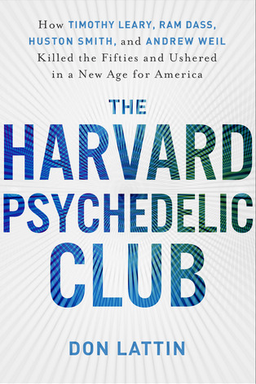
What happens when four visionary minds meet at the crossroads of science, spirituality, and a handful of magic mushrooms? In The Harvard Psychedelic Club, journalist Don Lattin weaves an extraordinary true story about how Timothy Leary, Richard Alpert (later Ram Dass), Andrew Weil, and Huston Smith collided at Harvard in the early 1960s and unintentionally opened the door to the American counterculture. Through psychedelics, they sought not escapism but enlightenment — and in their pursuit, they challenged medicine, religion, psychology, and the social order of postwar America.
Lattin contends that this convergence of scientific curiosity and mystical longing literally "killed the fifties" — a time marked by conformity, suburbia, and Cold War anxiety — and ushered in a new age of personal and cultural exploration. These men might not have known it then, but together they helped Americans see the links between mind, body, and spirit in ways that transformed everything from psychotherapy and medicine to yoga studios, organic food movements, and modern mindfulness.
The Meeting of Minds and Mushrooms
In 1960, a young psychologist named Timothy Leary returned from Mexico, freshly transformed by his first experience with psilocybin — the chemical in magic mushrooms. Harvard invited him to join its prestigious faculty, and within months he was conducting experiments on consciousness under the guise of psychology. Drawn to the same curiosity were three very different men: Richard Alpert, a privileged and closeted psychology professor seeking authenticity; Huston Smith, a theologian yearning for direct mystical experience; and Andrew Weil, a freshman with a budding fascination for plants and altered states who would later expose his professors’ experiments.
This unexpected quartet — the Trickster (Leary), the Seeker (Alpert), the Teacher (Smith), and the Healer (Weil) — set out to explore inner space as pioneers once mapped the New World. What started as scientific research quickly became a cultural catalyst. Their psychedelic sessions blurred the boundary between lab work and sacrament, between psychology and spirituality.
The Cultural Earthquake They Unleashed
Their experiments promised to expand human potential, but Harvard’s administrators and many colleagues saw chaos brewing. Leary’s radical slogan "Turn On, Tune In, Drop Out" would later scandalize the establishment, yet his message carried a deeper spiritual longing: the call to awaken from mechanical living. Alpert’s transformation into Ram Dass turned the psychedelic quest inward, replacing drugs with meditation. Huston Smith traced the same insights through world religions. And Andrew Weil, blending science and ancient wisdom, reinvented holistic medicine decades before it went mainstream.
Lattin explores how each man personified a different thread of the 1960s counterculture. Leary embodied rebellion and risk, Smith embodied faith and scholarship, Alpert embodied inner transformation, and Weil translated psychedelic revelation into practical healing. Colliding at Harvard — a bastion of reason — they helped birth an era that valued experience over dogma, intuition over intellect, and spiritual pluralism over rigid belief.
Why Their Story Still Matters
Their legacy is everywhere you look: in yoga studios, mindfulness courses, addiction recovery groups, holistic hospitals, and the language of emotional intelligence. The 1950s’ faith in technology and control gave way to a generation questioning authority, exploring altered states, and seeking meaning through inner experience — what Alan Watts called “the joyous cosmology.” Yet their revolution also carried contradictions: ego disguised as enlightenment, rebellion turning into escapism, and academic curiosity turning into scandal. Lattin doesn’t idealize them; he traces their triumphs and betrayals, their experiments and excesses, revealing how their intertwined destinies redefined what it means to live a conscious life.
Through vivid storytelling, Lattin invites you to revisit a moment when science met mysticism, when psychedelics met prayer, and when a handful of brilliant misfits changed how America thought about itself. The Harvard Psychedelic Club isn’t just about drugs — it’s about awakening, about how we search for truth in a culture that often fears it.