
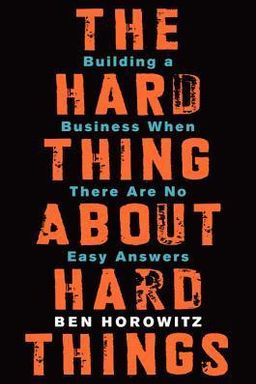
The Hard Thing About Hard Things cover

The Hard Thing About Hard Things

by Ben Horowitz

The Hard Thing About Hard Things by Ben Horowitz provides an unvarnished look at the challenges CEOs face. It offers practical insights into decision-making, leadership under pressure, and building a resilient company culture. Learn from Horowitz''s experiences to navigate the toughest aspects of leadership effectively.

Facing the Hard Thing About Hard Things

What if success as an entrepreneur wasn’t about knowing the answers, but surviving the questions that have no answers at all? In The Hard Thing About Hard Things, venture capitalist and former CEO Ben Horowitz argues that most business books sugarcoat what leadership is really like: messy, uncertain, and full of psychological warfare. Horowitz contends that the hardest problems in business have no formula—only courage, judgment, and endurance. His book is both a memoir and a field manual for surviving the existential crises that come with building companies from scratch.

Throughout his career—from co-founding Loudcloud (later Opsware) and nearly going bankrupt in the dot-com crash to eventually selling the company for $1.6 billion—Horowitz learned that the “easy” management advice in most books breaks down under real pressure. The “hard things” are not about writing elegant mission statements or raising venture capital. They’re the gut-wrenching moments when you must lay off friends, admit failure to your board, or lead your team through a storm you didn’t cause.

The Reality of the Struggle

At the book’s core is Horowitz’s idea of “the Struggle”—a brutal, lonely state of existence known only to those who must carry the weight of an entire company’s fate. In “the Struggle,” every decision feels catastrophic, sleep is impossible, and even success tastes sour. Yet Horowitz insists that greatness only emerges through the Struggle. Like Karl Marx’s line that “life is struggle” (which appears on Horowitz’s grandfather’s tombstone), this phrase defines the entrepreneurial journey. Success comes not from avoiding pain, but learning how to lead when there are no good moves left.

From Communist Roots to Capitalist Realities

Horowitz’s story spans unexpected origins. Raised by Communist grandparents in Berkeley—the self-proclaimed “People’s Republic”—he grew up suspicious of authority but learned critical lessons about courage and judgment. His early friendships, like his life-changing encounter with Joel Clark, a Black classmate he befriended despite prejudice and peer pressure, taught him not to follow convention. Years later, when he entered Silicon Valley, that lesson proved crucial: there are no shortcuts to knowledge, and relying on conventional wisdom can be worse than ignorance itself.

By the time he worked for Netscape alongside Marc Andreessen, Horowitz discovered that competing against Microsoft required both audacity and realism. Under relentless pressure, he learned to confront brutal truths publicly and to discard “silver bullet” thinking—there are no magical fixes, only “lead bullets” and hard work. These experiences forged his later management philosophy: trust your people with the truth, embrace the fight, and lead through fear rather than pretending it doesn’t exist.

The Hard Thing About Being CEO

Horowitz distinguishes between two very different roles: the Peacetime CEO, who optimizes and scales, and the Wartime CEO, who fights for survival. Most management books prepare you for peacetime—delegation, vision statements, team harmony—but Horowitz writes for wartime leaders. He likens being CEO to being “in a fight with no rules”—you must break protocol, make uncomfortable calls, and overwhelm fear with discipline. This is leadership when everything is on fire.

Why These Lessons Matter

Horowitz’s lessons go far beyond tech startups. Every ambitious person faces periods where courage matters more than clarity—whether you’re leading a team, raising a family, or chasing a dream. The book is a study in leadership under duress, teaching you how to stay calm when logic says to panic, how to lay off people humanely, and how to make peace with impossible trade-offs. It’s also a celebration of persistence: even after losing everything during the dot-com crash, Horowitz rebuilt Opsware from the ashes into a billion-dollar sale.

By the end of the book, Horowitz urges you to “embrace the struggle.” Experience, failure, and fear are not obstacles—they are the curriculum of leadership. If most self-help promises shortcuts, The Hard Thing About Hard Things reminds you that shortcuts don’t exist. The only way through is through. And sometimes, that’s enough.


Leaders Tell It Like It Is

Most leaders think positivity keeps their teams motivated—but Ben Horowitz argues that relentless optimism can quietly destroy trust. In his early years as CEO, he believed his job was to keep spirits high by focusing only on successes. But eventually, his teams saw through the charade. Reality was tough, and by pretending it wasn’t, he made himself a source of false hope rather than truth.

Building Trust Through Honesty

Horowitz learned that transparency is the foundation of trust. “Without trust,” he writes, “communication breaks.” Over time he realized a paradox: the more he hid bad news, the less control he had over it. When he finally confessed the company was “getting our asses kicked,” employees didn’t panic—they got to work. People can handle bad news; they can’t handle deception.

He summarizes this with a principle worth tattooing on every manager’s desk: “Given enough eyes, all problems are shallow.” The more brains aware of an issue, the faster you’ll find a solution. Honesty multiplies intelligence.

Overcoming the Positivity Delusion

Why do so many CEOs cling to positivity? Because we confuse calm leadership with cheerfulness. When things go wrong—a missed product deadline, a lost client—leaders feel obligated to smile and “keep morale up.” But that comfort comes at a cost. When truth is buried, employees make decisions based on fantasy. (Patrick Lencioni, in The Five Dysfunctions of a Team, makes a similar point: fear of conflict leads to mediocrity.) Horowitz found that his optimism wasn’t inspiring—it was insulting. His staff already knew the problems; they wanted him to acknowledge them.

Creating a Culture Where Bad News Travels Fast

To fix this, he built what he calls a “culture of candor.” In his companies, you’re rewarded—not punished—for exposing problems. That meant removing fear from the feedback loop: no one loses points for telling the truth. To reinforce this, Horowitz banned a common corporate cliché: “Don’t bring me a problem without bringing a solution.” He argues this line silences the very insights that could save the company. If someone sees fire, you don’t want them searching for a water hose first—you want them yelling “Fire!”

The CEO as Chief Truth Officer

Ultimately, Horowitz believes a CEO’s duty isn’t to be a motivator, but a mirror—to reflect reality as it is. When you’re honest about setbacks, you align truth with action. You also empower your team to own their part in the outcome. “When you expect your employees to act like adults,” he writes, “they generally do.” That mindset transformed his management style from cheerleader to commander—still encouraging, but now credible.

“Stand up to the pressure, face your fear, and tell it like it is.”

The hard thing, Horowitz concludes, isn’t surviving layoffs or fighting competitors—it’s leading your people through uncertainty without shame or spin. When you stop pretending to have all the answers, you finally earn the trust to find them together.


The Struggle Is the CEO’s Real Job

If there’s one concept that defines Ben Horowitz’s philosophy, it’s the Struggle. The Struggle is what life feels like when you’re building something from nothing—when you can’t sleep, can’t eat, and can barely think straight, but still have to lead. It’s the moment when every decision feels like a betrayal of someone: your investors, your cofounders, or your own dreams.

Defining the Struggle

Horowitz opens the book’s most famous section by repeating a painful truth: “The Struggle is when you wonder why you started the company in the first place.” It’s when you lose key employees, deals fall apart, and journalists mock your product. Yet, he insists, the Struggle is not failure—it’s the crucible of greatness. Every legendary founder, from Steve Jobs to Mark Zuckerberg, has faced this invisible battlefield.

When Horowitz’s own company, Loudcloud, faced collapse after losing nearly half its customers during the dot-com crash, he realized there was no manual for survival. The answer wasn’t strategy—it was endurance. “Startup CEOs should not play the odds,” he writes. “You just have to find the answer.”

How to Survive the Struggle

  • Share the burden. Don’t isolate yourself. The CEO carries immense pressure, but hiding it burns you out faster. Trusted teammates can turn panic into action.
  • Play long enough to get lucky. In tech, tomorrow never looks like today. Outlasting your competitors often outperforms outsmarting them.
  • Don’t take it personally. When your company fails, it doesn’t mean you do. Self-hatred kills more startups than competition does.

Horowitz compares the mindset to martial discipline: in Bushido (the way of the warrior), a samurai keeps death in mind at all times so that fear cannot manipulate him. CEOs, likewise, must keep failure in mind—not to surrender to it, but to act with urgency and detachment.

Nobody Cares—So Focus

One of his most brutal lessons came from NFL legend Al Davis, who told coach Bill Parcells after a rash of player injuries: “Nobody cares. Just coach your team.” Horowitz applies that logic to business. Investors, customers, employees, even your mother—they all want results, not rationalizations. Every minute spent explaining why something went wrong is a minute not spent fixing it. The world doesn’t owe you understanding; it owes you nothing. So, stop justifying and start solving.

Despite the harsh tone, this realism is freeing. Once you accept that nobody cares, you’re liberated to focus entirely on execution. The Struggle never ends, but neither does your capacity to grow stronger through it.


Building a Company Culture That Lasts

When Horowitz says “culture,” he doesn’t mean ping pong tables, yoga classes, or cool offices. Company culture is the set of actions that teaches people how to behave when you’re not in the room. As he puts it, culture is your operating system, embedded through shocking simplicity rather than slogans.

Designing Culture Through Behavior

Horowitz argues that culture emerges from what leaders reward and tolerate. You can’t write your values on a wall—people look to your smallest actions as the real standard. When he struggled with profanity complaints at Loudcloud, he didn’t issue a memo banning curse words. He thought through its cultural meaning. Silicon Valley’s best engineers came from brash, informal environments like Microsoft and Intel. Outlawing strong language might make the company feel outdated and stiff. His solution? Allow profanity but outlaw harassment or intimidation. Clear, contextual, and consistent.

Shock Value as a Cultural Tool

Horowitz champions “cultural shock therapy”: simple, symbolic acts that permanently shape behavior. Jeff Bezos’s door desks at Amazon remind employees to be frugal. Facebook’s “Move fast and break things” shatters fear of failure. At Andreessen Horowitz, being late to a meeting with an entrepreneur costs $10 per minute. Why? Because respect for founders isn’t a slogan—it’s a habit taught through penalty. Culture, in this sense, is not about comfort. It’s about clarity.

Culture Evolves with Scale

As companies expand, culture decay is inevitable unless leaders consciously “grade down” privilege. Horowitz calls this “giving ground grudgingly.” Bigger companies require specialization, structure, and process—forms that seem bureaucratic but prevent chaos. The CEO’s role is to implement process without killing flexibility. Culture, therefore, isn’t how things stay the same; it’s how values survive through growth.

“A good culture doesn’t happen by accident. It’s programmed through behavior and reinforced every day.”

Horowitz’s cultural philosophy resembles Peter Drucker’s belief that “culture eats strategy for breakfast.” But Horowitz adds a twist: strategy and culture are the same thing over time—because what you repeatedly do is what your company becomes.


Managing People, Not Just Process

Horowitz insists that the CEO’s first responsibility is not to profits or even to products—it’s to people. “Take care of the people, the products, and the profits—in that order,” his mentor Jim Barksdale told him. Horowitz learned this lesson the hard way through layoffs, firings, and demotions that nearly broke him.

Laying Off People the Right Way

Horowitz recalls being shocked when venture capitalist Doug Leone told him he was the only founder who’d ever survived three consecutive layoffs and still built a billion-dollar company. Most startups implode after one mass firing because culture collapses. How did he avoid it? By doing it right. He followed six steps: act fast, train managers, take the blame, explain why, and speak directly to those affected first. “You can’t let them keep their jobs,” Bill Campbell told him, “but you can let them keep their respect.”

Hiring for Strength, Not Lack of Weakness

Horowitz’s hiring philosophy defies traditional HR orthodoxy. Most managers pick candidates who won’t make glaring mistakes; he hires people who are exceptional at one or two things, even if they’re quirky or abrasive elsewhere. That’s how he hired his legendary head of sales, Mark Cranney—a blunt, square-bodied salesman who terrified interviewers but built a world-class revenue engine. “If he didn’t have those rough edges,” Horowitz told Andreessen, “he’d be CEO of IBM.”

Handling Demotions and Firings

What do you do when a loyal friend can’t scale with the company? Horowitz argues for compassion rooted in truth. Demote them clearly, directly, and decisively—but never with humiliation. Offer them a meaningful new role if possible, or help them find the next step elsewhere. The goal is respect over reputation. Every other employee will judge you not by what you say about values, but by how you act when firing someone who helped you start the company.

These painful lessons reveal the paradox of leadership: taking care of people often means making decisions that hurt people. But done with clarity and integrity, those very decisions are what keep a company human even in its hardest moments.


Becoming a Wartime CEO

Horowitz’s most practical—and unforgettable—framework separates leaders into two modes: Peacetime and Wartime CEOs. Peace is when your company dominates the market; war is when it’s fighting for survival. Most leaders, he argues, are trained only for peacetime. But real founders learn to fight.

Peacetime vs. Wartime

A Peacetime CEO focuses on culture, vision, and scaling—defining mission statements, developing leaders, and hiring for fit. A Wartime CEO focuses on one thing: survival. Horowitz contrasts the two sharply: “Peacetime CEO builds scalable recruiting machines; Wartime CEO builds HR systems that can execute layoffs.” When Intel’s Andy Grove pivoted the company from memory chips to microprocessors, or when Steve Jobs returned to a near-bankrupt Apple, they were wartime archetypes—making ruthless, unpopular choices to keep the company alive.

Why Most CEOs Fail

Most founders, Horowitz warns, hire or behave for the wrong phase. They appoint “optimized” executives when they should be recruiting warriors. Worse, they confuse diplomacy for leadership. In wartime, consensus kills speed. “Sometimes,” he writes, “you gotta roll a hard six.” That means taking decisive, even abrasive action when others hesitate. Staying polite when your company is dying isn’t leadership—it’s denial.

Developing Courage Through Action

Courage, Horowitz notes, isn’t the absence of fear—it’s the discipline to move through fear. He quotes boxing coach Cus D’Amato: “The hero and the coward feel the same thing. The difference is what they do.” As CEO, you will often be wrong. Everyone around you may be smarter, richer, or more convinced than you are. But your job is not to feel confident—it’s to act. “You can’t build a great company by looking for easy decisions,” Horowitz writes. Real leadership is deciding amid chaos and standing by that decision when it’s least popular.

Being a wartime CEO doesn’t mean being cruel—it means being clear. The courage to act decisively, bear the weight alone, and tell the truth even when it burns: that’s the hard thing about hard things.


From Founder to Venture Capitalist

After selling Opsware to Hewlett-Packard, Horowitz faced an existential question: what comes after winning? The answer was helping others survive the struggle. Partnering again with Marc Andreessen, he co-founded the venture capital firm Andreessen Horowitz with a revolutionary vision—to create “a firm for founders.”

Fixing the Venture Model

Traditional venture capitalists, Horowitz observed, often invested “money without mentorship.” They preferred professional CEOs over founders, assuming technologists couldn’t scale leadership. Having lived that bias himself—when early investors at Loudcloud asked, “When are you getting a real CEO?”—he decided to invert the model. Andreessen Horowitz (a16z) would back founders, not replace them, and teach them the skills to grow.

Building a Venture Network

The firm was inspired by Michael Ovitz’s Creative Artists Agency. Ovitz professionalized Hollywood by building “the franchise”—shared networks and functional expertise supporting every talent. a16z applied the same model to startups, creating dedicated teams for recruiting, PR, technical talent, corporate partnerships, and financing. Every partner was focused on helping entrepreneurs where they struggled most: finding people, scaling culture, and making decisions they’d never made before. (In contrast, most VCs offered only quarterly advice over lunch.)

Giving Founders Better Allies

The firm also flipped VC secrecy on its head. If traditional firms acted like old banks—quiet and opaque—Horowitz launched a16z with a Fortune magazine cover story and a public manifesto. Its motto: “Some experience required.” The point wasn’t ego; it was empathy. Founders needed partners who’d fought through layoffs, press attacks, and impossible odds. Who better to invest in entrepreneurs than someone who’d lived the Struggle?

Through this reinvention, Horowitz completed his arc—from panicking CEO to teacher of the next generation. His final advice to them is the same one that closes the book: “Embrace your weirdness. Embrace the Struggle.” Success, after all, is not peace—it’s surviving the war long enough to make peace matter.

Dig Deeper

Get personalized prompts to apply these lessons to your life and deepen your understanding.

Go Deeper

Get the Full Experience

Download Insight Books for AI-powered reflections, quizzes, and more.