
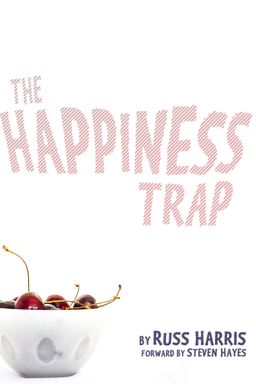
The Happiness Trap cover

The Happiness Trap

by Russ Harris

The Happiness Trap offers a fresh perspective on pursuing a meaningful life by teaching readers how to manage negative thoughts using Acceptance and Commitment Therapy. It provides practical techniques to align actions with personal values, fostering lasting fulfillment beyond transient happiness.

Escaping The Happiness Trap: Why Chasing Happiness Makes Us Miserable

Do you ever feel that no matter how much you achieve or how comfortable your life becomes, happiness always seems just out of reach? In The Happiness Trap, Dr. Russ Harris argues that our cultural obsession with pursuing happiness actually fuels our unhappiness. Drawing on Acceptance and Commitment Therapy (ACT), Harris shows how the very strategies we use to avoid pain—chasing pleasure, controlling feelings, or silencing our inner critic—inevitably increase our suffering.

Harris contends that the human mind, shaped by evolution to detect danger, is naturally programmed for worry, comparison, and self-criticism. Because of this, our attempts to mold our inner world into constant positivity are doomed from the start. Instead of trying to control feelings, ACT invites you to accept them, defuse from unhelpful thoughts, and take committed action guided by your deepest values. True well-being, Harris suggests, doesn’t come from eliminating pain but from learning to live meaningfully alongside it.

The Myths That Build the Trap

Western culture sells four dangerous myths about happiness: that happiness is the natural human state; that unhappiness means you’re defective; that happiness requires eliminating negative feelings; and that you should be able to control what you think and feel. Harris dismantles each of these myths through examples of people who “should” be happy—like Michelle, who has a great job, house, and family but still feels unfulfilled. Her story shows that living up to social ideals doesn’t guarantee inner peace.

We are raised to believe that good emotions are rewards and bad ones are signs of failure. Television, movies, and even self-help books reinforce the idea that life should be smooth and joyful. Harris explains that this belief leaves us unprepared for pain, grief, and fear—inevitable parts of being human. When those feelings arise, we judge ourselves for feeling them, turning discomfort into suffering. It’s not the pain itself that hurts us most; it’s our struggle to escape it.

Evolution’s Booby Trap

Evolution shaped the mind not for happiness but for survival. The same mental wiring that once kept early humans alive—constantly scanning for threats and comparing themselves to others—now manifests as chronic anxiety and insecurity. Our ancestors’ internal alarm system said “don’t get killed.” Ours says “don’t fail,” “don’t get rejected,” or “don’t look stupid.” These are modern predators, and our attempts to escape them—by avoiding discomfort, seeking approval, or endlessly striving for more—make them stronger.

Harris illustrates this through the story of Joseph, who avoids social outings to escape his anxiety about rejection. His avoidance brings short-term relief but long-term isolation. Each time he avoids, his fear strengthens. The harder he tries to control his feelings, the less control he has. This is what Harris calls a “vicious cycle of experiential avoidance.” We fight negative thoughts and emotions through hiding, suppressing, distracting, or numbing—but these methods reinforce the very pain we’re trying to avoid.

A Radical Shift: From Control to Acceptance

The first step to escaping the trap is recognizing that control doesn’t work in the inner world. You can’t stop your mind from producing negative thoughts any more than you can stop your heart from beating. The more you try to suppress thoughts (“Don’t think about ice cream”), the stronger they bounce back. Harris invites readers to consider what would happen if we stopped fighting our minds and started befriending them. Instead of resisting fear or sadness, we can observe them, make space for them, and let them pass naturally.

In evolutionary terms, our minds are doing exactly what they’re supposed to do—anticipate trouble. ACT’s approach is not to “fix” these mental processes but to notice them, detach from them, and refocus on living according to values. Happiness becomes less about chasing pleasant emotions and more about creating a life infused with meaning. This shift transforms life from a tug-of-war with emotion into a mindful navigation of reality.

Why This Matters

Harris’s philosophy aligns with ancient wisdom (as found in Buddhism or Stoicism) and modern psychology alike: suffering is inevitable, but struggling against suffering is optional. Learning to “accept and commit”—to accept what you can’t control and take action toward what you can—lets you experience a richer, more grounded existence. Throughout the book, Harris combines science, metaphor, and compassion to introduce six core skills that together form the foundation of ACT. The rest of the book unfolds these principles, helping you live not in pursuit of happiness, but in alignment with your own heart.


Defusion: Unhooking from Your Thoughts

One of Harris’s most powerful insights is that your thoughts are not facts—they’re just words running through your mind. The problem is that we tend to fuse with these thoughts, reacting to them as if they were the truth. This state, known as cognitive fusion, is what keeps us trapped in anxiety, guilt, and self-doubt. ACT’s defusion techniques teach you to gain distance from your thoughts so they lose their power.

Cognitive Fusion in Action

Imagine your mind as a 24/7 news channel broadcasting endlessly—mostly doom and gloom. Harris calls it “Radio Doom and Gloom.” You can’t turn it off, but you can choose how much you tune in. For example, Roxy, a lawyer diagnosed with multiple sclerosis, can’t stop frightening images of herself in a wheelchair from appearing. Each image makes her panic. When she tries to suppress them, they come back stronger. By learning to say, “I’m having the image of myself in a wheelchair,” Roxy creates separation. These are not prophecies—they’re pictures.

Simple Techniques, Deep Shifts

Harris introduces playful but effective ways to defuse from unhelpful thoughts. Try prefixing your thoughts with “I’m having the thought that…” (“I’m having the thought that I’m not good enough”) or hearing your inner critic’s voice in the style of a cartoon character. Techniques like thanking your mind or singing your negative thought to the tune of “Happy Birthday” help you see them as language, not reality. When you see your mind as a talkative roommate rather than an oracle, you reclaim your ability to choose how to act.

“The aim of defusion is not to get rid of unpleasant thoughts, but to see them for what they are—just words—and to let go of struggling with them.”

Defusion Is Not Positive Thinking

Unlike the “affirmation” techniques popularized by many self-help gurus, defusion doesn’t try to overwrite negativity with positivity. Positive thoughts are still just thoughts, and holding on to them too tightly can make you rigid or self-deceptive. Instead, ACT’s mental flexibility comes from lightness—seeing all thoughts as passing events. As Harris notes, it’s not about replacing “I’m a failure” with “I’m wonderful.” It’s about realizing that both are stories and neither has to control you.

Over time, this practice changes your relationship with your own mind. Instead of trying to silence it, you cultivate a stance of curious compassion. You can acknowledge even the harshest inner voices with a smile (“Thanks, Mind!”) and then channel your energy into meaningful action. The result is less inner noise and more freedom to live deliberately.


Expansion: Making Room for Pain

Have you ever noticed how fighting your emotions just makes them stronger? Harris calls this the “struggle switch”—the inner button that amplifies our suffering. When it’s turned on, a wave of anxiety triggers frustration, self-blame, and even more anxiety. Expansion—the ACT term for acceptance—means turning the switch off. You learn to drop resistance and make space for unpleasant feelings instead of wrestling with them.

The Three Steps of Expansion

Harris guides readers through a simple three-step practice: Observe your feelings, Breathe into them, and Allow them to be. This approach transforms emotions from enemies into experiences. In one session, Donna—grieving the loss of her husband and daughter—learns to stop numbing her sadness with wine. As she observes her grief (“a cold, heavy rock in my chest”) and breathes into it, she realizes she can survive it. Her sadness softens, transforming from something terrifying into something meaningful—a testament to love itself.

The body-focused exercises of expansion emphasize curiosity and physical awareness. Rather than analyzing why you feel bad, you become a scientist studying your sensations. Is the emotion moving or still? Warm or cold? Sharp or dull? By observing and naming sensations, you create space for them to exist without judgment.

Clean vs. Dirty Discomfort

In one of the book’s most memorable distinctions, Harris differentiates between “clean” and “dirty” discomfort. Clean discomfort is the natural pain that comes from living—grief, loss, or fear. Dirty discomfort is suffering created by struggling against those feelings: guilt about your anger, fear of your fear, or shame about your sadness. Acceptance clears away the dirty discomfort so only the authentic emotion remains. When the struggle switch is off, emotions ebb and flow naturally, like waves.

Why Acceptance Works

At first, acceptance sounds like giving up. But Harris likens it to floating on quicksand—the more you fight, the faster you sink. Lying back and allowing the sand to support you doesn’t eliminate discomfort, but it prevents drowning in it. In the long run, this openness builds emotional resilience. You stop wasting energy on control and start investing it in what matters: living fully, loving boldly, and acting intentionally.


Connection: Living in the Present

You can’t live a meaningful life if you’re not fully present for it. Connection—the third core skill of ACT—is about returning attention to the here and now. Harris likens the human mind to a time machine that constantly pulls you into the past (“I failed last time”) or the future (“What if I fail again?”). Connection breaks that cycle by training you to bring awareness back to your current experience—your senses, breath, and surroundings.

Experiencing the World with “New Eyes”

Harris introduces simple but powerful exercises, such as the “Alien Book” practice, where you examine a familiar object as if you were seeing it for the first time. By noticing its weight, color, texture, and shape, you transform mundane reality into something vivid and alive. Similarly, he invites readers to “Notice Five Things” in their environment—what you can see, hear, and feel. This habit trains your mind to ground itself in sensory awareness rather than abstract thought.

The Power of Breathing

Slow, mindful breathing serves as an anchor for presence. In exercises like “Ten Deep Breaths” or “Breathing to Connect,” you learn to notice thoughts without attaching to them, like cars driving past your house. Harris even shares how one deep breath can create life-changing moments: stopping a panic attack, calming oneself before a difficult conversation, or preventing self-sabotage. For Michelle—the overachieving employee haunted by guilt—one deep breath gives her enough space to say “No” to her boss and “Yes” to family time.

Making Connection a Habit

Connection isn’t limited to meditation cushions or yoga studios. It’s something you can practice anywhere—in line at the grocery store, washing dishes, walking your dog. The more you practice, the easier it becomes to notice life’s “sensory feast.” Over time, moments of connection expand from seconds to minutes to days, helping you “wake up” to the richness of ordinary life. The point, Harris reminds us, isn’t to feel good; it’s to be here while life is happening.


Values: The Compass of a Meaningful Life

Once you learn to handle painful thoughts and feelings, the next question is: what do you want your life to stand for? Harris argues that values are the heart of ACT—they’re your compass for navigating meaning. Whereas goals can be achieved and crossed off a list, values are ongoing directions. You never finish being loving, creative, honest, or kind.

The Difference Between Goals and Values

A goal is measurable (“Get married,” “Buy a house”). A value is a direction (“Be a loving partner,” “Care for my family”). The danger, Harris warns, is confusing one for the other—seeking goals without grounding them in meaning. Many people, like Soula and Fred, find that reconnecting with their values transforms even painful or mundane tasks into fulfilling ones. Fred, who lost his business and home, rebuilt purpose by bringing his core values—helping, mentoring, and caring—into every job he did, even a low-paying boarding school job.

Finding Your “Why”

Values clarify why you get up in the morning. Harris references Viktor Frankl’s classic Man’s Search for Meaning, showing how people can endure unimaginable suffering if they’re guided by purpose. In ACT, you explore your own life compass by asking questions like: “What kind of person do I want to be?” and “What would I be doing if fear weren’t holding me back?” Harris calls this the process of “following your heart.” Values such as compassion, curiosity, or courage don’t eliminate pain, but they make it worth enduring.

Acting on Your Values

Once clarified, values must guide action. Harris advises starting small: one phone call to a family member, one honest conversation, one act of kindness. The satisfaction of living by your values is immediate, even if your circumstances remain unchanged. When goals fail or storms hit—as they inevitably do—your values remain steady. They ensure that your direction in life, though challenging, always matters.


Committed Action: Turning Values into Movement

Awareness and acceptance mean little without action. The final step of ACT—committed action—translates values into behavior. As Harris puts it, “A rich, full and meaningful life is created through taking action, guided by those values.” This process builds what psychologists call psychological flexibility: the ability to act effectively under pressure, even in the presence of fear or doubt.

The Thousand-Mile Journey

Harris coaches readers to begin small: “A journey of a thousand miles begins with one step.” Don’t attempt sweeping life-overhauls overnight. Start with one domain—family, health, or career—and set meaningful, specific goals. He warns against “dead person’s goals” (e.g., “stop feeling anxious”), because dead people can’t feel at all. Instead, define live goals that involve doing something, like reaching out to a friend when you feel anxious.

Facing FEAR

Harris identifies four major barriers that keep people from pursuing their values—captured in the acronym FEAR: Fusion with unhelpful thoughts, Expectations that are unrealistic, Avoidance of discomfort, and Remoteness from values. Using ACT tools, you learn to defuse unhelpful thoughts (“It’s too hard”), set realistic goals, open up to discomfort, and reconnect with meaning. This framework turns fear into fuel for growth.

Persistence Over Perfection

Commitment doesn’t mean you’ll never stumble; it means you’ll get up and keep walking. Harris illustrates this with the legend of Robert the Bruce, who drew inspiration from a spider’s persistence in spinning its web despite endless setbacks. The moral: commitment isn’t about never failing—it’s about resuming your course each time you fall. When paired with mindfulness and compassion, this mindset makes long-term transformation achievable.


Willingness and Growth: Saying Yes to Life

At its core, The Happiness Trap is about willingness—the readiness to experience discomfort for the sake of living fully. Harris draws a striking metaphor: when you climb a rain-soaked mountain, the journey is hard and messy, but you endure it willingly to reach the summit. The same applies to emotional growth: pain is the price of admission to a meaningful life.

Willingness isn’t liking or wanting discomfort; it’s agreeing to feel it while taking the next step forward. Harris invites readers to ask, “What thoughts and feelings am I willing to have in order to build the life I want?” By writing out these answers in a Willingness and Action Plan, you acknowledge that challenge and meaning are inseparable. This commitment is a declaration: “Even if I feel scared, sad, or inadequate, I will act in the direction of my values.”

Lessons from Failure and Renewal

Harris shares his own struggle to write this very book—paralyzed by self-doubt until he applied ACT principles to himself. By reconnecting with his values of creativity, helping others, and integrity, he began again, one sentence at a time. His story demonstrates that willingness doesn’t remove fear; it coexists with it. Courage is not the absence of pain, but movement alongside it.

In the end, ACT reframes emotional struggle as a natural condition of being alive. You will never be free from fear, sadness, or uncertainty—but you can be free from their tyranny. If you can welcome every feeling, pleasant or painful, as part of the full texture of living, then you have truly escaped the happiness trap. Harris’s invitation is simple and profound: stop struggling, start living.

Dig Deeper

Get personalized prompts to apply these lessons to your life and deepen your understanding.

Go Deeper

Get the Full Experience

Download Insight Books for AI-powered reflections, quizzes, and more.