
Idea 1
The Happiness Project: Building a Deliberate Life
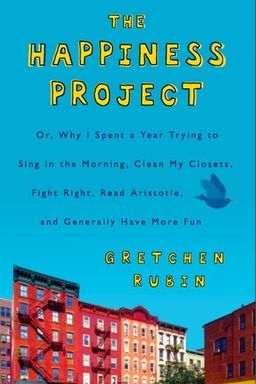
What does it mean to take happiness seriously—not as a vague hope but as a concrete personal experiment? In The Happiness Project, Gretchen Rubin argues that happiness is not a static trait you either have or lack; it’s a set of teachable skills and measurable habits. Drawing on a yearlong experiment in her own life, Rubin transforms the abstract goal to 'be happier' into practical resolutions across twelve themed months. Her premise is simple yet radical: lasting happiness emerges less from dramatic reinventions or exotic retreats than from small daily actions, tracked and refined over time.
The book blends personal narrative with interdisciplinary research, spanning philosophy, psychology, and behavioral science. Rubin structures her project around monthly themes—energy, marriage, work, play, friendship, money, spirituality, passion, mindfulness, gratitude, and attitude—each building upon the last. She couples each theme with measurable daily or weekly actions noted in her Resolutions Chart, a visible accountability system inspired by Benjamin Franklin’s virtues chart. Over the course of a year, she discovers that self-knowledge, consistency, and social connectedness compound into real, sustainable happiness.
Defining Your Own Happiness
Rubin begins by redefining happiness in practical terms. You don’t need an academic theory, she argues—'I know it when I see it' suffices. Citing research that genetics influences roughly half of your baseline mood, she emphasizes the remaining portion—your thoughts and actions—as the lever you can move. Happiness isn’t a destination but a practice: a way of noticing, experimenting, and adjusting what genuinely brings you joy or drains your energy. She distinguishes unhappiness from clinical depression and invites you to observe your life with curiosity rather than judgment. Preparation involves taking an inventory of pleasures, irritations, and aspirations so you can design concrete resolutions that fit you, not a generic ideal of fulfillment.
A Yearlong Laboratory for Change
Rubin’s system breaks down the sweeping goal of greater happiness into manageable monthly experiments. For instance, January’s focus on vitality helps you gain energy through better sleep, movement, and decluttering. February applies behavioral insights to marriage: quit nagging, express affection, and 'give proofs of love.' Later months explore work satisfaction ('Be Gretchen'), playfulness, friendships, spending habits, and gratitude. Each theme translates into a handful of clear behaviors—'Go to sleep earlier,' 'Act the way I want to feel,' or 'Sing in the morning'—that you check off daily. As months progress, earlier habits compound into lifestyle momentum. The cumulative nature mirrors habit stacking models in behavior science (James Clear’s Atomic Habits echoes this principle years later).
The Resolutions Chart: Making Intent Visible
The Resolutions Chart anchors Rubin’s project. It’s a physical record of intentions converted into actions. Each checkmark creates a micro-reward, reinforcing momentum. The chart also functions as a mirror—you see patterns of progress and relapse. Rubin emphasizes the shift from abstract goals ('Be generous') to actionable behaviors ('Send a thank-you note today'). Over time, this record becomes what she calls 'your conscience made visible.' Her approach underscores a truth in behavioral economics: what gets measured, improves.
Principles and Commandments
Guiding maxims supplement the chart. Rubin articulates Twelve Commandments (“Be Gretchen,” “Act the way I want to feel”) and her 'Secrets of Adulthood' (“People don’t notice your mistakes as much as you think”). These heuristics simplify decision-making and guard against perfectionism. Their brevity allows spontaneous recall in tense moments. They work the way Stoic maxims or Buddhist koans operate—compact rules that redirect awareness when you stray from your values.
Growth Through Real Life, Not Escape
Rubin’s most enduring insight is that happiness flourishes in the life you already have. You don’t need to quit your job, move to Paris, or meditate on a mountaintop. You can instead design a laboratory for joy where you stand. Each incremental victory—a cleaned closet, a kind word, a lunch with an old friend—creates ripple effects. By year’s end, Rubin hasn’t transformed into a different person, yet she reports less irritation, more laughter, and a sense of meaningful progress. Happiness, she concludes, isn’t about having it all; it’s about doing small things with deliberate care every day. The power of this book lies in its proof that change is cumulative, and that an ordinary, well-lived life can become extraordinary through attention and design.