
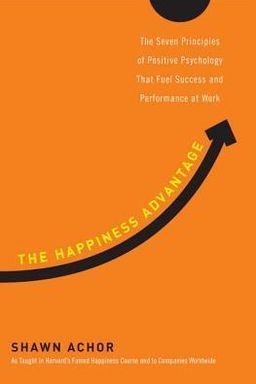
The Happiness Advantage cover

The Happiness Advantage

by Shawn Achor

The Happiness Advantage by Shawn Achor reveals how happiness fuels success, not the other way around. Through research-backed principles, learn to harness positivity, transform challenges into opportunities, and build meaningful connections to enhance your productivity and satisfaction.

The Happiness Advantage: Why Happy People Succeed

Have you ever thought that success would finally bring you happiness—only to find that when you reach your goal, the satisfaction fades faster than expected? Shawn Achor’s The Happiness Advantage turns this familiar equation upside down. He argues that success doesn’t lead to happiness; rather, happiness fuels success. Drawing from research at Harvard and across the globe, Achor contends that cultivating a positive mindset boosts your intelligence, creativity, energy, and resilience—qualities that dramatically improve your performance at work and in life.

This book begins by dismantling the long-standing myth that happiness is a reward you earn after achievement. Achor’s central insight is simple yet revolutionary: happiness precedes success. Through examples from Harvard students, corporate executives, scientists, and even tax auditors, he demonstrates that positive psychology offers a better path to excellence and well-being. Rather than striving endlessly and postponing joy, Achor shows how making yourself happier first unlocks higher achievement and deeper fulfillment.

The Broken Formula of Success

Most people think: work hard, succeed, then be happy. But success doesn’t automatically generate joy. Once one goal is reached, the next replaces it—promotion, salary, status—moving happiness over the horizon. Achor witnessed this pattern vividly during his twelve years at Harvard. Surrounded by brilliant students under immense pressure, he observed many who viewed their education as a burden rather than a privilege. Although they had achieved what others only dream of, they were dissatisfied, anxious, and depressed. The same dynamic echoed throughout the business world, where achievement without positivity often led to burnout and disengagement.

This constant pushing of the goalpost, Achor insists, is the reason so many high achievers remain chronically unhappy. Success without happiness is like an engine running without fuel—it sputters out. In contrast, positive emotions act as high-octane energy that sustains motivation, focus, and creativity. Happiness, therefore, becomes the starting point rather than the finish line.

From Harvard to the World

Achor’s fascination with this reversed formula began through his work with Harvard students. He noticed that those who interpreted their time at Harvard as an opportunity—a gift—thrived in both performance and satisfaction. In contrast, those who viewed it purely as stress or competition struggled academically and emotionally. That realization led him to study a group of students who were “above the curve”—flourishing academically and socially—and identify what gave them their edge. His later studies with corporate employees confirmed the same pattern: optimism and positivity were consistent predictors of high achievement, not merely pleasant emotions.

Through this lens, the book offers seven actionable principles explaining how to harness the “Happiness Advantage”: converting joy and optimism into performance across personal and professional settings. These include learning to adjust your mindset (The Fulcrum and the Lever), retraining your brain to notice opportunities (The Tetris Effect), turning setbacks into stepping-stones (Falling Up), regaining control through manageable goals (The Zorro Circle), creating habits that stick (The 20-Second Rule), and deepening your social relationships (Social Investment). Together, these principles form a cohesive framework for thriving amid challenge and change.

A Science of Positive Potential

Achor’s work builds on the foundation of positive psychology, pioneered by Martin Seligman and Tal Ben-Shahar (one of Achor’s mentors). Traditionally, psychology focused on mental illness—on repairing breakdowns and returning people to “normal.” Positive psychology, however, shifts attention to flourishing: identifying what allows individuals to reach exceptional levels of performance and well-being. Through studies spanning neuroscience, organizational behavior, and education, researchers found that happiness enhances cognitive functioning and resilience. When we feel positive, dopamine and serotonin flood our brains, improving learning, attention, and creativity. This biochemical advantage explains why happiness is not just a mood—it’s a measurable competitive edge.

Achor’s vivid stories—from doctors who make faster, more accurate diagnoses when in a good mood, to salespeople who outperform their peers by 56% when optimistic—illustrate how a positive brain systematically outperforms a neutral or negative one. Leaders who cultivate positive cultures see greater loyalty, lower turnover, and better problem-solving. These effects compound across teams and organizations, generating what Achor calls “The Ripple Effect”: happiness spreading through social networks to amplify collective success.

Why It Matters

In a world driven by competition, stress, and constant change, Achor’s perspective is a vital corrective. Instead of punishing ourselves toward progress, we can nurture success through positivity. The Happiness Advantage reminds you that joy isn’t a distraction from performance—it’s a prerequisite for it. By understanding how happiness rewires the brain, you gain the tools to work smarter, build stronger teams, and bounce back from adversity faster.

Ultimately, Achor’s message boils down to empowerment: happiness is not the result of luck or circumstance; it’s a skill that can be learned and practiced. And the more you practice it, the higher you rise—not just on external measures of success, but in your capacity for meaning, growth, and connection.


Reversing the Formula: Happiness Precedes Success

The most radical claim in Achor’s book is that happiness isn’t the outcome of success—it’s what makes success possible. Putting effort before joy, he argues, robs us of the mental edge we need to perform at our best. Studies of thousands—from Harvard students to corporate executives—prove that when people cultivate positivity first, they become more productive, creative, and resilient. The formula isn’t: work hard → succeed → be happy. It’s: be happy → work smarter → succeed more often.

The Science Behind the Flip

Achor draws on neuroscience to explain why this reversal works. Positive emotions trigger dopamine and serotonin, which turn the brain’s learning centers “on.” These chemicals improve attention, pattern recognition, and information retention. In business settings, this means you’re more likely to spot opportunities instead of problems. In education, students who feel happy before exams perform significantly better because positive moods enhance cognitive flexibility. Doctors put in a good mood before diagnosing patients are 19% faster and three times more accurate in their judgments. Every profession benefits when the brain is primed by positivity.

Examples in Action

At American Express and UBS, Achor taught executives the seven principles of positive psychology right after the 2008 financial crisis. Contrary to expectations, these stressed professionals were eager to learn how optimism could improve results. Within months, participants showed higher life satisfaction and lower stress compared to control groups. Tax auditors trained in positivity before their busiest season reported less fatigue and greater focus—tangible proof that happiness inoculates against high stress. The same methods improved performance at law firms, where notoriously high depression rates dropped following positive psychology workshops.

Implications for Leadership

When leaders adopt this mindset, they reshape company culture. Achor refers to “The Losada Line”—a mathematical ratio showing that teams need roughly three positive interactions to offset one negative. Above this ratio, performance surges; below it, it declines. This insight offers leaders a clear directive: cultivate morale deliberately. Praise authentically, express gratitude, and encourage humor. Google’s playful environments and Virgin’s “fun” philosophy exemplify this principle, proving that positivity is profitable. (Similar ideas appear in Barbara Fredrickson’s Positivity and Martin Seligman’s Flourish.)

Practical Takeaway

You can begin reversing the formula by scheduling moments of joy during your workday—short breaks, gratitude notes, or small acts of kindness. Over time, positivity becomes habitual, and success follows naturally. Achor’s empirical evidence and lively examples prove that happiness first is not wishful thinking; it’s smart strategy. In every domain—from academics to athletics to leadership—happy brains literally outperform every other kind.


The Fulcrum and the Lever: Mindset Shapes Reality

Achor’s second principle borrows an idea from Archimedes: with a long enough lever and the right fulcrum, you can move the world. Translated to psychology, this means your mindset (the fulcrum) determines how much power (the lever) you have to change outcomes. Change your perspective, and your results shift accordingly. He illustrates this with humor and science—from a story about his sister believing she’s a unicorn to experiments proving how our interpretation of reality alters physical and cognitive performance.

Changing Perception Changes Performance

When people believe they can succeed, they often do. This is confirmed by Carol Dweck’s work on growth mindsets: viewing your abilities as malleable leads to improvement, while believing they are fixed leads to stagnation. Achor cites studies where Asian women performed better on math tests after focusing on their cultural identity (associated with math proficiency) than when thinking about gender stereotypes. Similarly, when hospital maids were told their daily tasks amounted to exercise, they lost weight and lowered cholesterol without altering behavior—their belief changed their body.

From Helplessness to Empowerment

The danger of a negative mindset is learned helplessness, a condition Martin Seligman first identified in dogs who stopped trying to escape shocks. Humans show the same pattern when they stop believing effort matters. Achor saw this during economic crises when employees paralyzed by fear performed worse—not because circumstances were impossible, but because their mindset said they were. Shifting from external to internal locus of control—believing you influence outcomes—restores motivation and clarity.

Turning Jobs into Callings

Yale psychologist Amy Wrzesniewski discovered that people view work in three ways: as a job (a chore for money), a career (a ladder for success), or a calling (a source of meaning). Those who interpret their work as a calling are not only happier but perform better. Achor teaches readers to reconnect daily tasks to higher purposes—whether improving others’ lives or mastering personal strengths. Leaders can encourage “calling descriptions,” helping teams see significance beyond paychecks.

The Fulcrum and Lever remind you that circumstances don’t dictate potential—mindset does. Adjusting your mental fulcrum gives you leverage to lift any challenge, creating a world where action feels possible and growth inevitable.


The Tetris Effect: Training Your Brain for Opportunity

Have you ever played a game so much that you saw its patterns everywhere? Achor recounts how after playing Grand Theft Auto, he almost tried to steal a car the next morning—his mind was still stuck in the game. Likewise, Harvard researchers found that after playing Tetris for hours, participants saw falling shapes everywhere. This phenomenon, the “Tetris Effect,” shows how repetitive focus shapes cognition. Applied positively, it means you can train your brain to scan for possibilities instead of problems.

The Problem of Negative Focus

Lawyers searching for flaws in arguments and auditors scanning for mistakes often bring this pattern home. Their professional vigilance turns into personal criticism, anxiety, and depression. Focusing solely on negatives reinforces pathways that perceive life as threat and deficiency. In contrast, successful people cultivate “Positive Tetris Effects”—habits of noticing what’s working, what opportunities exist, and what progress has been made.

Retraining the Brain

Neuroplasticity means these mental filters can change. Achor recommends writing down three good things each day—a practice proven to reprogram attention toward positives. Harvard studies found that participants who did this for a week remained happier and more optimistic six months later. Gratitude lists, journaling positive experiences, and consciously celebrating small wins all build the ability to see opportunities rather than obstacles.

Balanced Optimism

Achor cautions against blind positivity. “Rose-tinted glasses” are helpful only when they admit real problems. Rational optimism means seeing challenges clearly while emphasizing solutions. As psychologist Barbara Fredrickson notes, positive emotions broaden our cognitive scope, helping us identify paths forward instead of getting stuck on limitations.

The takeaway: whatever you repeatedly focus on becomes your reality. Practice noticing progress, kindness, and hope until opportunity recognition becomes second nature. A positive pattern creates momentum—and new ways to win.


Falling Up: Using Failure to Rise Higher

When life knocks you down, do you bounce back—or bounce forward? Achor’s fourth principle, Falling Up, teaches that setbacks aren’t roadblocks but springboards for growth. He introduces the concept of Post-Traumatic Growth, supported by researchers like Richard Tedeschi and Martin Seligman, revealing that adversity can lead to greater compassion, strength, and purpose if interpreted correctly.

Mapping the Third Path

After setbacks, we face three mental paths: staying stuck, spiraling downward, or finding the upward route—the Third Path. Success depends on identifying that upward trajectory. During the 2008 financial collapse, Achor saw executives paralyzed by fear while others reframed crisis as opportunity—reassessing values, innovating new strategies, and building resilience. The difference was mindset, not circumstance.

Learning from Mistakes

Coca-Cola’s CEO began investor meetings by listing past failures, reminding shareholders that mistakes generate progress. Harvard research shows that deliberate errors—used as learning tools—accelerate innovation. People and organizations that “fail forward” gain wisdom faster because they interpret errors as experiments, not evidence of incompetence. (This echoes Carol Dweck’s idea of growth mindset and Tal Ben-Shahar’s view that perfectionism stifles development.)

Optimistic Interpretation

Explanatory style determines whether failure shrinks or expands potential. Optimists view challenges as temporary and localized; pessimists deem them permanent and global. Salespeople with optimistic styles at MetLife outsold colleagues by 37% and quit half as often. Developing resilience means challenging catastrophic thoughts (Achor’s ABCD model): recognize adversity, examine beliefs, observe consequences, and dispute distorted assumptions.

Ultimately, Falling Up reframes hardship as a launch pad. Like Roger Bannister breaking the four-minute mile once others deemed it impossible, those who rise after defeat rewrite what’s possible—not despite pain, but because of it.


The Zorro Circle: Regaining Control Through Focus

Overwhelm is the enemy of progress. Achor’s fifth principle, The Zorro Circle, borrows from the Zorro legend, where the young hero gains mastery by first mastering one small circle. The lesson is simple: focus success within a manageable boundary before expanding outward. When you limit your attention to what’s controllable, you transform chaos into control and helplessness into momentum.

The Neuroscience of Control

Neuroscientist Richard Davidson discovered that resilient individuals activate their prefrontal cortex faster than their limbic “panic” system. Emotional hijacking occurs when stress shuts down rational thought. To counter it, awareness is key: naming emotions reduces their power. Writing worries or voicing them aloud shifts them from impulse to analysis, calming the amygdala and reinstating clarity.

Building Control One Circle at a Time

Achor teaches overwhelmed employees to divide stresses into two categories—things they can control and things they cannot. Then they start with one small, solvable task. Each success expands the circle, reestablishing confidence. A Harvard copywriter who focused first on improving her own writing inspired her team and ultimately raised company performance. From clean desk corners to focused email responses, small victories accumulate into visible change.

The Power of Incrementalism

Psychologists call this method kaizen—continuous improvement through small steps. Like moving a trash bin a foot to improve workflow, micro-adjustments compound into massive progress. The Zorro Circle counters perfectionism and paralysis by proving you can’t sprint your way to a marathon—you start with one lap and expand from there.

When challenges seem insurmountable, shrink your world to what you can influence today. Master that circle, defend it, then widen. Control, confidence, and growth return one deliberate step at a time.


The 20-Second Rule: Making Habits Easier

What if the difference between failure and success in changing a habit was just 20 seconds? Achor’s sixth principle—the 20-Second Rule—reveals that small, strategic adjustments to reduce “activation energy” can make or break our routines. Every good habit requires energy to start, and every bad habit thrives because it’s easy. By flipping that dynamic, you can turn effort into automatic behavior.

Why Motivation Isn’t Enough

Like willpower, motivation is a limited resource. Psychologist Roy Baumeister calls this “ego depletion”—the more you resist temptation, the faster self-control collapses. Instead of relying on willpower, Achor advises designing your environment to make positive behaviors easier and negative ones harder. This mechanism mirrors Daniel Kahneman’s insights from behavioral economics: humans follow the path of least resistance.

Practical Applications

Achor’s own experiment demonstrates its simplicity. When he wanted to practice guitar, placing it 20 seconds closer—on a stand rather than in the closet—transformed inconsistency into daily habit. Conversely, moving his TV remote batteries 20 seconds away eliminated late-night channel surfing. At work, disabling automatic email alerts or hiding social media bookmarks raises the barrier to distraction. Each adjustment shifts the default from procrastination to productivity.

Routine Engineering

You can tweak how habits form by reducing decision fatigue. Preparing your gym clothes the night before, or even sleeping in them, removes morning resistance. Psychologist Barry Schwartz’s “second-order decisions”—rules for when to make choices—limit daily deliberation and conserve cognitive energy. Over time, habits built on minimal activation energy become self-sustaining.

The 20-Second Rule reminds you that transformation isn’t about massive self-discipline but smarter design. Small shifts in convenience compound into major life change. Success is often just 20 seconds closer than you think.


Social Investment: The Power of Relationships

In tough times, people often retreat—but Achor’s seventh principle says the opposite: lean in. Social connection, he argues, is your greatest predictor of happiness and resilience. Isolation breeds helplessness; engagement builds strength. At every level—from firefighters crawling through burning mazes to Wall Street professionals navigating crises—those who hold on to others, not distance themselves, outperform and outlast their peers.

Connection as Survival Strategy

Achor’s story of firefighter training illustrates the metaphor. Blind in smoke, recruits survive only by gripping their partners and walls—connection dictates survival. The same principle holds in the office: during stress, reconnect rather than withdraw. The Harvard Men Study, tracking students over seven decades, found that love and relationships—not wealth or status—were the best predictors of life success. Strong ties reduce stress hormones, boost immune health, and even extend lifespan.

Relationships as Performance Multipliers

Social investment doesn’t just make you happy; it makes you better. Teams with high social cohesion perform more efficiently and survive organizational turmoil. Positive workplace interactions literally lower blood pressure and restore the cardiovascular system to baseline faster. When employees feel cared for by supervisors, productivity rises dramatically—Gallup estimated $360 billion is lost annually from poor manager-employee relationships. CEOs like Aaron Feuerstein, who supported his workers after a factory fire, understood this truth: investing in people is good business.

Spreading Positivity Through Connection

Acts of gratitude and empathy deepen bonds. Research by Shelly Gable shows that responding enthusiastically to others’ good news strengthens relationships far more than consoling sympathy during bad times. Achor encourages leaders to foster “high-quality connections” through trust, eye contact, and active listening. These links ripple outward, amplifying organizational well-being and cooperation.

Ultimately, the Happiness Advantage multiplies through people. Your success doesn’t depend solely on effort—it expands exponentially when you invest in others. Human connection, Achor reminds us, is both the fuel for happiness and the foundation for achievement.


The Ripple Effect: How Positivity Spreads

After exploring the seven principles, Achor closes with a powerful idea: happiness doesn’t stop with you. It ripples outward. Every time you cultivate positivity, it influences your colleagues, friends, and family—up to three degrees of connection away. This finding, supported by Nicholas Christakis and James Fowler’s research, shows that well-being spreads socially, like light bouncing across a network.

Emotional Contagion

Neuroscience explains why positivity is contagious: through mirror neurons. When you smile, others unwittingly mirror your expression and mood. Experiments show that when one team member radiates positivity, the whole group’s mood—and performance—improves. At Yale, Sigal Barsade proved that a single cheerful individual could lift a group’s cooperative spirit and productivity. Conversely, negativity spreads just as fast; anger, cynicism, and stress function like secondhand smoke. Leaders play a crucial role in setting the tone because their emotions shape the entire organizational climate.

Multiplying Momentum

Small positive actions—thanking a coworker, expressing appreciation, maintaining eye contact—create micro-waves of happiness. These waves trigger others to adopt similar behaviors, forming self-reinforcing networks of optimism. Achor compares this to the Butterfly Effect: one simple flap of wings can generate a distant storm. When applied to human behavior, small choices—like keeping gratitude notes or offering encouragement—can transform entire cultures.

From Individual Change to Collective Transformation

Applying the seven principles together magnifies their impact. Achor calls this “spiraling upward”—as you use habits like gratitude and social investment, you prime yourself to notice more opportunities, strengthen bonds, and build resilience. These cumulative effects don’t just make you successful—they elevate those around you. Positive psychology, then, becomes not only a strategy for self-improvement but a blueprint for organizational growth.

The Ripple Effect encourages you to see happiness as your greatest leverage: by practicing positivity yourself, you unconsciously teach others to do the same. Happiness becomes the starting point of a contagious upward cycle that expands far beyond your personal circle and changes how the world works around you.

Dig Deeper

Get personalized prompts to apply these lessons to your life and deepen your understanding.

Go Deeper

Get the Full Experience

Download Insight Books for AI-powered reflections, quizzes, and more.