
Idea 1
Choosing to Make Life Beautiful
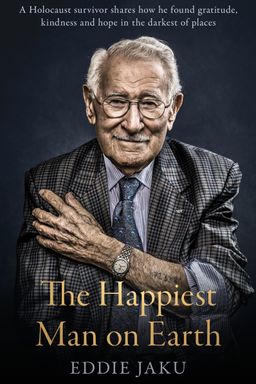
What does it mean to be truly happy—even after losing everything? In The Happiest Man on Earth, Eddie Jaku transforms one of history’s darkest experiences into a luminous testimony to human resilience and kindness. He argues that happiness is not a gift bestowed by circumstance but a daily choice, even when life is unimaginably cruel. As a centenarian Holocaust survivor, Eddie contends that a person can build beauty even out of horror—if they choose compassion over bitterness and hope over despair.
The Power of a Decision
Jaku’s thesis begins with one radical act of will: the vow to smile every day for the rest of his life. Amid genocide, starvation, and inhumanity, that choice became rebellion against evil. Born Abraham Salomon Jakubowicz in Leipzig, Germany, in 1920, Eddie grew up believing deeply in German culture and progress until the Nazis stripped him of identity, home, and family. Through his memoir, he teaches that life’s beauty does not depend on what happens to you but how you decide to respond. Even after losing nearly everyone he loved, Eddie made a deliberate promise—to live joyfully and kindly, so that cruelty would not win.
From Civilization to Barbarism
Eddie’s life embodies the paradox of moral collapse. As a child in Leipzig, surrounded by art and philosophy, he could not imagine that his cultured neighbors would one day revel in beating Jews to death. In November 1938’s Kristallnacht, that illusion shattered. The German people he had loved became his attackers, and his dachshund Lulu was murdered before his eyes. Eddie learned the dangerous truth: ordinary people, when manipulated by fear and weakness, can commit atrocities. This early realization shapes one of his lifelong lessons—that the greatest danger to humanity is not monstrous strength but moral weakness turned into hate.
Survival and the Human Spirit
In Buchenwald and later in Auschwitz, Eddie endured the extremes of human suffering. He saw doctors beaten to death, children murdered, and hopeless prisoners run to the electrified fence to end their pain. Yet amid that horror, small acts of love—sharing bread, whispering jokes, protecting fragile bodies from freezing—became divine miracles. The book is not just about survival, but about ethics: Eddie refused to steal others’ food or betray his morals. “If you lose your morals,” he writes, “you lose yourself.” His integrity transforms survival into meaningful resistance. (Viktor Frankl, in Man’s Search for Meaning, similarly argues that one’s inner attitude defines freedom even in a concentration camp.)
Friendship and Faith in Humanity
One core strand of Jaku’s philosophy is friendship. His bond with Kurt Hirschfeld, another prisoner, became the emotional anchor that kept him alive. Friendship, Eddie insists, is “the best balm for the soul.” It reminds you that you still belong to humanity even when everything around you screams that you do not. This theme later continues with his wife Flore, whose love pulled him fully back into life after unspeakable grief. Compassion, both offered and received, is portrayed as the world’s most powerful medicine.
Postwar Renewal and Moral Responsibility
Surviving the Holocaust did not bring instant joy. Eddie wandered through Belgium, lonely and angry, wondering what freedom meant when everyone he loved was gone. But through acts of kindness—helping other survivors, teaching young engineers, rebuilding his family in Australia—he turned personal tragedy into universal purpose. His work founding the Sydney Jewish Museum became his way of transmuting pain into hope, teaching generations about love over hate. In this, Jaku’s philosophy mirrors that of authors like Desmond Tutu (No Future Without Forgiveness) who urge humanity to transform collective trauma through moral education.
Why This Book Matters Today
Jaku’s century of wisdom is a counterpoint to modern cynicism. He reminds readers that life’s wonders—kindness, family, friendship—still heal, even in times of darkness. His story compels you to ask: how do I respond to cruelty? How do I honor those who suffer? What would it mean to make life beautiful on purpose? By addressing these questions, The Happiest Man on Earth doesn’t just recount the Holocaust—it offers an ethical framework for living joyfully despite chaos. For Jaku, survival alone was not victory. Only through love, generosity, and relentless hope could he and humanity reclaim what the world—and hate—had tried to destroy.
Core Message
“Life can be beautiful if you make it beautiful. It is up to you.” With these words, Eddie Jaku compresses a century’s worth of experience into practical philosophy. Happiness, he insists, is not naïve—it’s courageous. It’s the daily choice to love life even when life doesn’t love you back.