
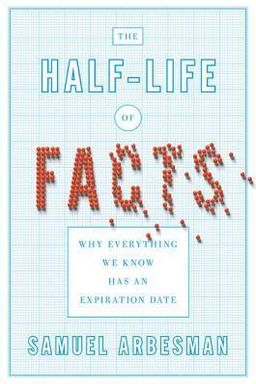
The Half-Life of Facts cover

The Half-Life of Facts

by Samuel Arbesman

The Half-Life of Facts by Samuel Arbesman explores the transient nature of knowledge, illustrating how facts evolve and are often overturned. Through scientific insights and practical advice, the book empowers readers to embrace change and stay informed in a dynamic world.

The Predictable Decay of Knowledge

How long will the facts you know stay true? In The Half-Life of Facts, Samuel Arbesman argues that all knowledge—scientific, technological, social, and personal—has an expiration date. Like radioactive decay, information changes in systematic and measurable ways. Whether it’s the number of chromosomes in a human cell or the height of Mount Everest, what we “know” today will someday be revised, replaced, or refined. Arbesman contends that understanding this predictable churn of knowledge can help you navigate an era where truths seem to flip faster than ever.

The book begins with a story about the moment scientists realized that humans have 46 chromosomes, not 48—a correction that overturned decades of accepted biological fact. This small shift in data represents what Arbesman calls the half-life of a fact: the average time it takes for half of what experts know in a field to become obsolete. Like the half-life of uranium, this process unfolds at a constant, mathematical rhythm that makes the progress of knowledge astonishingly predictable.

Facts Change, but in Regular Patterns

Arbesman proposes that facts aren’t random points of change. Instead, they follow measurable laws of growth and decay. Scientific papers, technological innovations, and cultural knowledge all expand in exponential patterns, but they also become outdated following predictable curves. He draws on studies showing that medical information has a half-life of about forty-five years and that even physics papers lose relevance after roughly a decade. These trends allow researchers—and by extension, all of us—to estimate how much of our own knowledge is currently past its expiration date.

The Science Behind Knowledge Evolution

Arbesman introduces fields like scientometrics—the quantitative study of science itself—to explain how discoveries accumulate and old truths fade away. He explores Derek J. de Solla Price’s observation that scientific journals grow at exponential rates and Harvey Lehman’s research showing that humanity’s creative output, from math to opera, doubles on similarly predictable timescales. The implication: even the creation of new facts adheres to structured growth laws, not chaotic randomness. He extends these insights to technology, noting that Moore’s Law—the rule that computer power doubles roughly every 18 months—is just one example of exponential expansion that governs how our factual world changes.

Living with the Flux

Arbesman divides facts into three broad categories based on how fast they change. On one end are short-term facts, like the weather or stock prices, which renew so quickly that we barely notice their turnover. On the other end are slow facts, like the number of continents or characteristics of physiological constants. In the middle, where most of our knowledge resides, are the mesofacts: facts that change slowly enough to lull us into thinking they’re stable but fast enough to shift within a lifetime. Mesofacts include everyday scientific and social truths—such as medical guidelines or the number of known planets—that steadily evolve beneath our awareness.

Why It Matters Now

In a world overflowing with information, knowing that knowledge has measurable rhythms gives us power. If you can anticipate how facts change, you can adapt before becoming outdated. Doctors who know the half-life of medical research, for example, are motivated to continually retrain. Likewise, individuals who recognize that their understanding of technology, health, or history may soon expire can cultivate lifelong learning to stay current. Arbesman’s thesis is not just about accepting change—it’s about mapping its rate and direction so that you can live intelligently in an ever-shifting factual landscape.

Core Message

Knowledge changes—constantly, predictably, and mathematically. When you grasp the rhythm behind this decay, you stop being surprised by it. Instead of fearing the expiration of facts, you learn to surf the waves of change, guided by the science that explains the very evolution of knowledge itself.


The Mathematics of Discovery

Arbesman invites you to imagine scientific progress as a curve rather than a series of isolated bursts. The work of Derek J. de Solla Price showed that the number of scientific papers published each year doesn’t grow randomly—it increases exponentially. Harvey Lehman extended this logic into art and social science, finding that cultural creation follows similar mathematical patterns. Together, their findings reveal that humanity’s pursuit of knowledge is a measurable process obeying predictable laws of expansion and saturation.

Exponential and Logistic Curves

Price’s stacked volumes of the Philosophical Transactions of the Royal Society sparked his insight: as knowledge grows exponentially, it also faces natural limits. The rate of publication speeds up until it hits a plateau, a point where increasing volume begins to slow down—what mathematicians call a logistic curve. Similarly, technological innovation rises rapidly before plateauing; when one field nears its carrying capacity, a new technology takes over, creating a smooth chain of “linked S-curves.” This framework helps explain phenomena ranging from the rise of digital computation to the gradual transition from steam power to electricity.

Predicting the Future of Science

Scientific progress isn’t infinite. Like bacteria in a petri dish, growth starts quickly but slows as space fills up. By measuring publication rates, we can predict when certain fields will reach saturation points—where new discoveries become harder. Arbesman demonstrates this with examples like the discovery of mammals or asteroids: once the obvious, large examples are found, scientists must invest exponentially more effort to uncover the smaller, subtler ones. The ease of discovery declines in an orderly fashion, often following an exponential decay curve.

Takeaway

Science doesn’t sprint—it flows along predictable mathematical paths. Knowing these trajectories helps you anticipate when breakthroughs might slow, when revolutions will arise, and when steady progress will follow a curve toward equilibrium.


How Facts Approach Truth

What happens when our facts turn out to be wrong? Arbesman shows that errors aren’t failures—they’re steps toward truth. Using examples from biology, astronomy, and chemistry, he reveals that overturned knowledge doesn’t mean collapse; it means refinement. The French neurologist John Hughlings Jackson captured this idea best: “It takes fifty years to get a wrong idea out of medicine, and a hundred to get a right one in.” Science moves forward by correcting itself.

Half-Lives and Asymptotes

Medical studies show that half of the “facts” in a field like hepatitis are outdated after about 45 years. But this turnover doesn’t lead to chaos—it builds a convergent curve, an asymptote that edges ever closer to truth. Arbesman borrows Isaac Asimov’s metaphor of the Earth’s shape: going from flat to spherical was progress, but perfection came from realizing it’s actually an oblate spheroid. Each correction makes the world’s understanding more precise, not less certain.

Rediscoveries and the Long Tail

From the rediscovery of the coelacanth to living species thought extinct for centuries, science often surprises itself. A third of mammals previously declared dead have turned up alive—a reminder that even extinction facts have expiration dates. Arbesman calls this the “long tail of discovery.” The most common facts are quickly found; the rare ones, like deep-sea species or subtle truths about physics, lurk on the far edges of the curve, waiting for rediscovery.

Insight

Science doesn’t replace truths—it refines them. The half-life of facts measures not decay, but the relentless progress of knowledge approaching reality through correction and self-discovery.


Technology: Moore’s Law and Beyond

Technology evolves just like scientific facts—following elegant curves of acceleration, saturation, and rebirth. Arbesman reveals that Moore’s Law, the principle that computer chip capacity doubles roughly every eighteen months, is merely one example of a deeper pattern governing all technological progress. Whether it’s pixels per dollar, gigabytes per drive, or bandwidth cost, exponential doubling describes how innovations advance and how yesterday’s facts become today’s antiques.

Linked S-Curves of Innovation

When a technology nears its limits, it doesn’t stop—it triggers a new curve. Steam gives way to electricity, vacuum tubes yield to silicon, and silicon may one day lead to quantum circuits. This chaining of innovations ensures a constant overall exponential rate of progress. Chris Magee at MIT calls these “linked S-curves,” where each breakthrough grows until plateauing, only to be replaced by the next, perpetuating technological acceleration.

Science and Technology Intertwined

Arbesman emphasizes that science and technology feed each other. Better instruments increase precision, allowing new discoveries. Improvements in measurement—from pendulum meters to atomic clocks—enable finer scientific facts. He cites examples such as the steady improvement of iron’s magnetic purity and the discovery of new elements thanks to particle accelerators, showing that “fact creation” accelerates alongside technological capability.

Limits and Optimism

Technology may someday hit physical bounds—the size of atoms, the speed of light—but humans exploit innovation to leap beyond limits. Each “end” sparks a new beginning. Even if chip miniaturization slows, biotechnology or artificial intelligence may trigger a fresh exponential wave. Arbesman urges you to see technological progress not as fragile, but as an interconnected ecosystem of change continuously reinventing its own possibilities.

Lesson

Every advance carries the seeds of its successor. The more facts technology creates, the faster future discoveries accelerate, keeping humanity perpetually poised on the rising slope of exponential change.


How Facts Spread and Go Wrong

Understanding how facts spread is as vital as understanding how they’re created. Arbesman dives into the sociology of information—how knowledge diffuses through networks, mutates, and sometimes turns to error. When George Wallace was shot in 1972, researchers tracked how quickly news of the event reached Americans. Within hours, nearly everyone knew—a pattern of diffusion following a clean mathematical curve. But not all facts spread so efficiently.

The Printing Press and Social Networks

The spread of Gutenberg’s press across Europe in the 1400s mirrors the spread of facts themselves. It didn’t travel by geography alone but through trust and apprenticeship networks among German craftsmen. Larger cities adopted it faster because their social networks created more chances for connection. Arbesman draws a parallel to modern social media: ideas move not necessarily along physical distances but through relationships and shared affiliations.

How Errors Multiply

Not all spreading is benign. Facts mutate, much like genes or medieval manuscripts filled with typos. Studies by Simkin and Roychowdhury show that 80% of academic citations repeat errors from other papers instead of citing original sources. Arbesman likens these errors to biological mutations—once introduced, they replicate through generations of scholarly work. From Popeye’s mythic spinach iron levels to the lingering use of “brontosaurus,” mistaken facts can persist far longer than truths.

Combating Misinformation

The cure for spreading errors is slow, incremental correction: replication, transparency, and skepticism. Arbesman echoes the early Royal Society motto—“take nothing on faith.” In a connected world, that means fact-checking before sharing, seeking original sources, and accepting that even your most cherished “truths” may require revision.

Reminder

Information travels like contagion: fast, fractal, and fallible. The healthiest intellectual immune system is skepticism tempered by curiosity—a readiness to unlearn as quickly as you learn.


Hidden Knowledge and Undiscovered Connections

Sometimes, facts don’t change—they hide. Arbesman calls this undiscovered public knowledge: truths that already exist in scattered pieces but haven’t yet been connected. His father, Harvey Arbesman, demonstrated this by discovering a skin-based biomarker for ALS through connecting unrelated medical studies—a dermatologist linking neurology with dermatology via databases like MEDLINE and InnoCentive.

The Power of Connection

Don Swanson, the pioneer of this idea, showed that linking two independent findings can create a new fact. He tied studies showing fish oil improves circulation to research revealing poor circulation in Raynaud’s syndrome, generating a new therapeutic insight. The method is simple yet profound: combine disconnected domains, and innovation blooms.

Computers as Discoverers

Now algorithms perform what Swanson once did by hand. Tools like CoPub Discovery and Eureqa connect genes to diseases or derive physical laws directly from raw data. These automated scientists pattern-match across millions of papers, revealing hidden relationships between drugs, proteins, and behaviors. Just as evolution selects for the best traits, these programs evolve equations until they fit the data—computerized discovery at scale.

Preservation Is the Foundation

Arbesman notes that hidden knowledge only matters if preserved. Medieval manuscripts survived centuries because scribes copied them faster than they decayed—a biological survival model applied to ideas. Most ancient texts had “half-lives” of several centuries, showing that even human culture preserves knowledge predictably. Today’s digital archives may ensure our collective facts endure even longer.

Reflection

Hidden knowledge isn’t lost—it’s waiting to be recombined. When you link ideas across boundaries, you become part of the evolutionary process of discovery itself.


Rapid Shifts and Fact Phase Transitions

Some facts change so abruptly that they behave like the boiling of water—phase transitions in human knowledge. Arbesman demonstrates that revolutions in science, technology, and society often follow the same mathematics that describe physical states. When small steady changes accumulate beneath the surface, they suddenly trigger massive transformation in what we know.

From Planets to Smartphones

The discovery of the first exoplanet in 1995 was a knowledge “boiling point”: humanity leapt from speculation about other worlds to confirmation within a single paper. Similar transitions occurred when Neil Armstrong’s footprint erased millennia of lunar absence in seconds or when Apple’s iPhone reshaped technology overnight. Each rapid shift, Arbesman notes, rests on slower underlying progress—a rise in speed, precision, or connectivity—that builds until it cascades into sudden new facts.

Mathematical Models of Change

Borrowing from physics, Arbesman uses the Ising model of magnetism and the sandpile model to show how tiny adjustments can trigger avalanches of change. These models explain why scientific revolutions are predictable in aggregate, even if each feels surprising. A rise in technological capability or dataset size might be the “temperature drop” that crystallizes new understanding.

Society’s Accelerating Transitions

Cities, according to physicist Luís Bettencourt, exhibit superlinear scaling: double a city’s population, and innovation more than doubles. The result? More frequent paradigm shifts, occurring multiple times within a lifetime. Humanity now lives on the edge of knowledge, balancing between stability and perpetual transformation—a state physicists call self-organized criticality.

Essential Idea

Small steady progress breeds sudden revolutions. When a quiet accumulation of facts hits its tipping point, humanity’s picture of reality snaps into a new form. These knowledge avalanches can be mapped—and even anticipated—using the mathematics of physical change.


Measurement, Error, and the Quest for Precision

Arbesman argues that how we measure shapes what we know. From mapping India’s mountains to defining the meter, the pursuit of precision reveals both the triumphs and the fallibility of facts. Every refinement in measurement not only clarifies reality but also exposes new layers of error waiting to be corrected.

From Mount Everest to Microns

The height of Mount Everest changes a little each year due to tectonic movement and erosion—its measurement itself evolves. Similarly, the meter’s definition shifted from pendulum length to distance between poles, then to the wavelength of light, and now to the speed of light’s travel in a fixed interval. Each change marks a deepening precision, illustrating that measurement error decays exponentially as tools improve.

The Decline Effect and Scientific Replication

Arbesman explores how repeated measurement reveals truth’s instability. The “decline effect” shows that initial discoveries often lose strength on replication—Planet X vanished as astronomers refined estimates, and half of published clinical trials later shrink or disappear under scrutiny. John Ioannidis famously demonstrated that most published scientific findings are false, largely due to small sample sizes, publication bias, and human incentives.

Error as a Driver of Progress

Measurement doesn’t merely detect reality—it creates it. Missteps like Pluto’s misclassification or atomic weight adjustments reveal how error fuels refinement. As Lord Kelvin said, “When you cannot measure, your knowledge is meager and unsatisfactory.” Arbesman updates the sentiment: when you can measure, you must also measure your error.

Insight

Every measurement contains an ounce of error—and every correction opens new domains of knowledge. Precision is not perfection; it’s perpetual discovery.


The Human Side of Facts

Even when facts change regularly and measurably, people rarely keep up. Arbesman devotes an entire chapter to our cognitive blind spots: the psychological quirks that anchor us to outdated truths. From frog-like blindness to gradual change to the Semmelweis reflex that rejects new evidence, he reminds us that factual inertia is a deeply human condition.

Biases and Blindness

Humans are wired to notice motion but ignore slow shifts, a tendency known as shifting baseline syndrome. Fisheries collapse without us noticing, technologies age into invisibility, and cultural norms fossilize. Add biases like confirmation bias—the urge to notice only evidence that fits our worldview—and change blindness, and we become poor custodians of evolving knowledge.

Generational Knowledge

Most people update facts in bursts, often when teaching the next generation. You might relearn dinosaurs through your child’s homework or discover that Pluto is no longer a planet via a school project. Arbesman calls these generational “resets” the human rhythm of knowledge updating. Each generation constructs a new factual baseline, unaware that theirs too will age.

Adapting to Change

The solution is continual mental renewal. Arbesman suggests treating facts like investments—diversify sources, audit regularly, and rebalance. Reading omnivorously, learning across disciplines, and using digital tools like search engines or real-time counters can help you stay current. Ultimately, understanding the half-life of facts isn’t about despairing over ignorance—it’s about cultivating curiosity in the face of inevitable change.

Final Lesson

You cannot stop facts from aging, but you can stop yourself from aging intellectually. In a world where truths have predictable lifespans, wisdom lies not in memorizing data—but in mastering the rhythm of forgetting and relearning.

Dig Deeper

Get personalized prompts to apply these lessons to your life and deepen your understanding.

Go Deeper

Get the Full Experience

Download Insight Books for AI-powered reflections, quizzes, and more.