
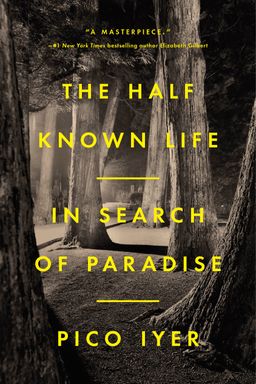
The Half Known Life cover

The Half Known Life

by Pico Iyer

The Half Known Life is a philosophical and travel exploration of paradise, delving into cultural, spiritual, and historical landscapes across the globe. Join Pico Iyer as he unravels the complexity and beauty of earthly paradises, offering profound insights into human longing and the quest for utopia in a digitally connected world.

Searching for Paradise in a Fractured World

Where do you find paradise when the world feels poisoned by its own contradictions? Pico Iyer’s The Half Known Life: In Search of Paradise begins with that haunting question — one that he pursues across holy cities, contested borders, and his own inner life. In a time when paradise is often marketed as a beach resort or a consumer fantasy, Iyer invites you to look closer: What if paradise is less a destination and more a way of seeing?

Iyer, known for his meditative travel writing (The Art of Stillness, The Global Soul), takes readers through a series of earthly paradises — Iran, Kashmir, North Korea, Jerusalem, Ladakh, and Sri Lanka — places where beauty and horror, devotion and violence coexist. His inquiry is both personal and philosophical: Can one find peace amid paradox? Is paradise even possible without suffering? And if every vision of heaven is contested, how do we make peace with imperfection itself?

The Paradox of Paradise

Iyer argues that our longing for paradise often blinds us to the paradise already at our feet. From the Iranian term paradaijah—the root of our word “paradise”—he traces the human impulse to build walled gardens, literal and spiritual, that promise safety from chaos. Yet these walls frequently turn to prisons. In Iran, he finds a people full of mystical grace and everyday duplicity — a place where a devout taxi driver weeps for the Imam but also sneaks back into his country illegally just to see his mother. Here, the paradise of poetry and gardens coexists with political repression and distrust. Every paradise, Iyer finds, is haunted by its own shadow.

Travel as Inner Pilgrimage

Although The Half Known Life is a travelogue, its journeys are inward. Each physical place — from Kashmiri lakes to the Himalayan deserts of Ladakh — reflects an emotional or spiritual landscape. Iyer’s writing moves like a pilgrimage of consciousness, balancing outer observation with inner reckoning. He recalls his English schooldays, his Californian childhood, and his Japanese home, showing how paradise is always filtered through memory and loss. Every country becomes a mirror of the human condition: Iran’s poetry mirrors the ache of divided loyalties; Belfast reveals how myth and music can sanctify even broken streets; Sri Lanka exposes how religion, beauty, and violence can share the same breath.

Iyer’s conclusion is subtle but piercing: paradise isn’t found in purity or perfection but in the coexistence of contradictions — where joy and grief touch. He quotes Omar Khayyam and Rumi as easily as Melville and Thoreau, reminding us that wonder often begins where certainty ends. The “half known life” becomes his metaphor for the spiritual state we inhabit — part knowledge, part mystery, part submission to what surpasses us.

A Global Meditation on Impermanence

The book unfolds through stories of so-called paradises that fail to deliver transcendence. Whether it’s North Korea’s sterile “People’s Paradise,” Kashmir’s divided serenity, or Jerusalem’s pious chaos, Iyer finds that belief systems often collapse under their own transcendental weight. The lesson isn’t despair but humility: when heaven becomes dogma, it hardens into hell. What remains is the small paradise of the present moment — a temple bell ringing in the fog, the tears of a pilgrim at the shrine, or a candle leaving its trembling light in the dark.

Why does this matter to you? Because Iyer’s philosophy suggests that your own search — for belonging, clarity, or peace — may share the same terrain. He doesn’t promise escape from suffering but an awakening through it. “The struggle of your life,” he writes, echoing a Zen master, “is your paradise.” The book becomes a meditation on acceptance: to awaken is to see both the shadows and the sunlight as parts of the same whole.

From Maps to Mystery

By the final chapters, Iyer returns to Japan, where monks feed a saint who has been ‘meditating’ for twelve centuries, and to India’s burning ghats in Varanasi, where death itself becomes a rite of renewal. These closing scenes dissolve the line between travel and transcendence: you realize that paradise isn’t a final destination but a perspective — a habit of awe. In a world divided by certainty, Iyer’s half-known life offers a radical invitation: to live fully in the questions, and to find, within our limits, the infinite.


Iran: Gardens of Contradiction

For Pico Iyer, Iran is both the birthplace of paradise and a living parable of paradox. Arriving in Mashhad after months of bureaucratic negotiation, he expects austerity and surveillance. Instead, he finds Swarovski shops beside mosques, women tapping iPhones beneath their hijabs, and taxi drivers quoting poetry that could have come from heaven itself. Iran, Iyer realizes, is a walled garden — polished, fragrant, and fiercely contradictory.

The Roots of Paradise

The very word “paradise,” Iyer notes, originates from the Persian paradaijah—a walled garden. Ferdowsi’s epic Shahnameh, Rumi’s ecstatic verses, and centuries of Islamic design turned that metaphor into physical form. Yet in contemporary Iran, the promise of eternal paradise justifies both ecstasy and death. The government glorifies martyrdom as the straightest road to heaven, while ordinary Iranians create earthly paradises through art, love, and music. Even dissent assumes poetic language: ta’arof, the art of politeness, becomes a way to say what one cannot say directly.

Faith, Doubt, and Dual Lives

Iyer’s encounters distill the tension of a culture that lives in double exposure. His guide Ali is impeccably Western but deeply pious; his secret taxi driver yearns for Yorkshire yet whispers prayers at Imam Reza’s shrine. During the pilgrimage festival, Iyer witnesses millions weeping and kissing the golden grille of a sacred tomb — while learning that the shrine itself runs one of the largest business conglomerates in Iran. He calls it “a paradise of words,” where beauty and hypocrisy commingle. The driver confides that he sneaks back into Iran each year despite political danger, just to feel close to his mother and the mosque: “Even in England, I call my brother and ask him to hold up the phone so I can hear it.”

Ambiguity as Illumination

Through these contradictions, Iyer discerns an Iranian wisdom: light is inseparable from shadow. The culture prizes ambiguity not as deceit but as refuge. Poets like Hafez and Rumi cloak mysticism in erotic metaphor, signaling that the unseen is truer than the literal. “Find a heaven within,” Rumi urges, “and you enter a garden in which one leaf is worth more than all of Paradise.” For Iyer, that realization becomes a guide: paradise is not a place free from darkness but one luminous with paradox.

By the time he departs, Iyer has learned that Iran’s most sacred architecture lies not in marble mosques but in its people’s encrypted hearts. Its citizens are masters of the “half known life” — maintaining devotion in duplicity, hope amid restriction. As Ulysses S. Grant once observed, “Few important events are brought about by our own choice.” Iran, in Iyer’s vision, embodies that surrender — an unwalled paradise hidden behind walls.


Kashmir and the Fragility of Beauty

In Kashmir, Iyer finds the eternal paradox of paradise: the more beautiful a place, the deeper its capacity for pain. His mother’s stories of Kashmir’s valley, full of wild dogs and crystal streams, glow in her memory as pure innocence. But the paradise she knew — “If there is paradise on earth, it is this” — has become a site of ceaseless conflict and lost certainties. As Iyer glides on Dal Lake, seeing reflections of snowy peaks, he realizes that every dream of heaven eventually founders on politics and human desire.

A Valley of Contradictions

Kashmir’s serenity conceals deep unrest. Iyer witnesses lovers paddling boats below mountains patrolled by soldiers. Temples, mosques, and gardens coexist beside checkpoints and graffiti that reads “Welcome Taliban.” Here, Hindus, Muslims, and Buddhists claim the same paradise — and it tears the valley apart. A local laments, “Peace without justice is no peace at all.” Yet amid the tension, moments of tenderness abound — schoolgirls laughing as they row to class, or musicians on houseboats singing Sufi songs under starlight. Surveillance and song exist side by side.

The Persistence of Hope

Iyer meets survivors who embody resilience. Jonny, an English traveler whose girlfriend died tragically in Kashmir, chooses to keep returning: “The place that took my heart will be the one where I remake it.” A hotelier mourning his wife of sixty-three years salutes departing guests as if to honor a sacred duty. Their endurance becomes a quiet act of defiance — a reminder that paradise may not mean escape but steadfastness. Like the lotus rising from mud, beauty survives through suffering because it has learned to.

Paradise as Projection

For Iyer, Kashmir crystallizes the danger of idealization. Every empire — Mughal, British, Indian, Pakistani — has projected its mythology onto the valley, each declaring it sacred for different reasons. But as he listens to local voices, he learns that paradise becomes cruel when it demands perfection. His final scenes, floating among lotus blossoms while gunfire echoes in the distance, mirror his mother’s tales of bliss and loss. The image is unmistakable: even on “a river of hell,” one can still be rowed through paradise.


North Korea and the Illusion of Perfection

When Iyer visits North Korea — the self-declared “People’s Paradise” — he finds the stark inverse of the gardens of Persia. Here paradise has been industrialized, sterilized, and emptied of humanity. In Pyongyang, citizens cross the street to avoid foreigners; skyscrapers rise, unlit and empty; and the 105-story Ryugyong Hotel looms like a mausoleum for collective dreams. “Perfection,” Iyer observes, “is achieved only by erasing every human flaw — and thus every human being.”

Faith Without Freedom

Guided through official museums, Iyer marvels at Kim Jong Il’s massive pamphlet On the Art of the Cinema, dictating that film must serve the “divine leader.” He walks among vast movie studios, “three times larger than Paramount,” realizing that everyone is an actor, including himself. When a subway passenger asks, “Are you enjoying your trip?” he wonders if the man is real or assigned. North Korea, he concludes, is a masterpiece of performance — an empire of belief without believers.

The Hope of the Half Known

Yet even here, he senses glimmers of the human. Miss Lee, his guide, hums songs from Frozen; another quietly inquires about Steve Jobs’s leadership style. These moments pierce the veil of control, revealing souls still capable of curiosity. Iyer recalls Melville’s notion of the “half known life” — our brief awareness between ignorance and truth. North Korea, he realizes, exemplifies not alien otherness but a human universal: the lure of certainty, the longing for order, the denial of mystery.

Leaving the country, Iyer asks himself whether his own world of information and distraction is truly freer. “The people of Pyongyang know little of the outside,” he writes, “yet we, who can know everything, often choose to know nothing.” The greatest prison, perhaps, is the illusion of knowing it all.


Jerusalem and the Fire of Conviction

Nowhere does Iyer confront paradise’s peril more directly than in Jerusalem — that “home of all returnings,” as he calls it, where competing heavens collide. In this sacred city, devotion and delusion intertwine so tightly that even the holiest sites become stages of conflict. The Church of the Holy Sepulchre — where six Christian denominations share a single building — erupts in broom fights over lamp placements. Pilgrims wail, soldiers patrol, and monks battle for space within the supposed birthplace of resurrection.

Too Much God

Iyer finds that Jerusalem isn’t suffering from a lack of faith but from its excess. Everywhere, he hears competing truths shouted across narrow alleys. Orthodox Jews clash with secular ones; Muslims and Christians contest each stone; even within churches, rival sects war over timing. Iyer quips that Jerusalem is “a place where everyone is right — and therefore everyone is wrong.” His guide wryly tells him, “It’s not a problem — it’s an issue. Problems can be solved; issues must be lived with.”

Seeing Beyond Certainty

Amid the chaos, Iyer retreats to a deserted cave within the church known as “Christ’s Prison.” There, the candlelight flickers, unstable yet enduring. A teenage pilgrim stops, weeps before the flame, and then leaves — a vision of pure faith untainted by ideology. That image becomes Iyer’s antidote to fundamentalism: humility before the unseen. He recalls Thomas Merton’s insight that true belief begins not with answers but with “probably unanswerable questions.”

Jerusalem teaches Iyer that paradise can’t survive possession. When beliefs become boundaries, the divine burns out. The only faith worth keeping, he suggests, is one spacious enough to hold doubt.


Ladakh and the Lessons of Simplicity

Ladakh, a high desert on the edge of the Himalayas, offers Iyer a different kind of paradise — not banished behind walls or doctrines, but lived quietly in daily grace. Here, monks chant beside rivers, dogs doze in dusty alleys, and the air feels “like the morning of the world.” It’s the one place, he writes, where peace doesn’t require forgetting the world but accepting it fully.

The Everyday Sacred

In Leh’s monasteries, Iyer witnesses lives attuned to impermanence. People tag stray dogs to save them from culling, remembering that a dog could have been their mother in a past life. The Dalai Lama’s presence looms as an example of pragmatic compassion — not a saint chasing paradise, but a “doctor of the mind” treating the world’s suffering case by case. He tells his students that seeking utopia is a “wrong dream”; the task is simply to lessen pain where possible.

Progress and Contentment

Even here, globalization intrudes: teenagers sing Bob Dylan at cafés, and monks market mindful tourism to visitors. Yet Ladakh’s serenity endures because it doesn’t cling to purity. Locals can live with contradiction — working for the Indian army by winter and meditating in summer — without anxiety. A father who’s never learned to read saves to send his son to a Delhi school, and that son returns to teach his father how to pray. Their bond, like the landscape, holds both ancient stillness and modern flux.

For Iyer, Ladakh’s greatest revelation is simplicity: paradise arises when you stop fleeing imperfection and start attending to the luminous ordinary — chop wood, carry water, and, as Thoreau once said, “live deliberately.”


Sri Lanka and the Shadow of Paradise

Sri Lanka tempts Iyer with surface perfection — golden beaches, fragrant air, Buddhist calm — yet conceals a history soaked in blood. Visiting Colombo and Kandy, he discovers that beauty here has always lured conquerors. The island’s “teardrop” shape becomes prophetic: every wave of colonization or civil war has left saltwater in its wake. The more the world called Sri Lanka a paradise, the more it resembled purgatory.

The Lotus in Mud

Retracing the steps of Trappist monk Thomas Merton, whose death in Sri Lanka followed a mystical awakening, Iyer experiences the country’s violent tenderness. Merton had called the smiling Buddhas of Polonnaruwa “the faces of true serenity,” but that calm arose from the heart of decay. For Buddhists, as for Merton, enlightenment doesn’t bypass suffering — it grows from it, like a lotus from mud. Iyer realizes that every paradise must confront its own darkness to remain real.

When Paradise Becomes Possession

The island’s tragedies — suicide bombings, ethnic violence, tsunami grief — stem from belief in exclusive salvation. Buddhists and Hindus, Christians and Muslims, each claim Sri Lanka as chosen ground. “If heaven is here,” one might say, “hell must be across the water.” Yet amid ruin, Iyer still finds grace: a wedding singer crooning American pop between curfews; villagers lighting candles at desecrated shrines; monks praying for insects’ souls after monsoon deaths. Life persists through loss.

What remains, Iyer concludes, is acceptance. As Thomas Merton learned too late, paradise isn’t a place of safety but of surrender — the moment you stop resisting life’s impermanence. “The most beautiful flower,” Iyer writes, “is rooted in muck.”


Finding the Half Known Life

By the end of his travels, Iyer circles back to a paradox that shaped every chapter: we live in a state of half knowledge, and that’s exactly what keeps us human. The book closes not in revelation but in reverence — a surrender to mystery. Whether among the graves of Sri Lanka, the cedar forests of Japan’s Mount Koya, or the burning ghats of Varanasi, Iyer sees the same pattern: impermanence as teacher, beauty as consolation, and not knowing as grace.

Death as Illumination

In Japan, monks feed daily offerings to a saint dead for twelve centuries. In India, bodies burn beside children flying kites. Life and death interlace like the warp and weft of the same tapestry. A Buddhist monk tells him, “The fact that nothing lasts is the reason why everything matters.” That insight becomes Iyer’s creed. Paradise, he finds, isn’t the absence of change — it is the awareness of change, lived fully.

The Invisible Bridge

A graveyard caretaker in Sri Lanka, a North Korean guide, a Ladakhi child, a pilgrim in Jerusalem — they all inhabit the same half-known life. Each clings to fragments of paradise where they can: kindness, ritual, love. Through them, Iyer discovers a global fellowship of seekers. “Perhaps,” he muses, “the place we haven’t seen is heaven.” But the more he travels, the more he understands that paradise exists not somewhere else but in every deep act of attention and forgiveness.

Iyer ends not with certainty but serenity. The traveler who chased transcendence across continents finally learns to sit still. In the half known life — where light falls unevenly and the answers never arrive — the journey itself becomes home.

Dig Deeper

Get personalized prompts to apply these lessons to your life and deepen your understanding.

Go Deeper

Get the Full Experience

Download Insight Books for AI-powered reflections, quizzes, and more.