
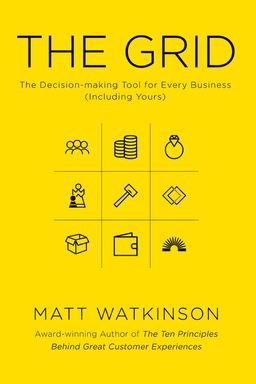
The Grid cover

The Grid

by Matt Watkinson

The Grid by Matt Watkinson reveals a revolutionary framework for making pivotal business decisions. Learn how to evaluate ideas, foresee impacts, and leverage market changes using nine interconnected elements. Perfect for entrepreneurs and leaders seeking sustainable success.

Seeing Business as a Living System

What if your business were not a machine with interchangeable parts but a living organism—connected, adaptive, constantly evolving? In The Grid: The Decision-Making Tool for Every Business (Including Yours), author Matt Watkinson invites you to rethink how you make decisions by treating your business as an interconnected system rather than a fragmented collection of departments. He argues that most businesses fall into reductionist thinking: fixing parts in isolation and mistaking activity for improvement.

Watkinson’s breakthrough is the Grid—a simple yet comprehensive model that reveals how the nine elements of any enterprise work together. He contends that understanding these connections helps leaders make better decisions, avoid unintended consequences, and ultimately build ventures that are desirable, profitable, and enduring. Instead of chasing trends or copying best practices, you can use the grid to see your organization holistically and craft intelligent responses to change.

Three Interlocking Goals

Every successful business, Watkinson explains, must achieve three outcomes: desirability (people want what you offer), profitability (you earn more than you spend), and longevity (you can sustain success over time). These goals are interdependent: customers won’t buy from a firm that isn’t viable, and a profitable firm will soon fail if its offerings become undesirable.

To make progress toward all three, leaders must consider three dynamic lenses—customer, market, and organization—that constantly shift and interact. Watkinson visualizes this by arranging goals and lenses in a three-by-three matrix: the Grid. Each cell represents a critical factor that drives success, from understanding wants and needs to managing revenues, costs, and adaptability. Viewed together, these nine boxes form the complete anatomy of any business.

The Grid’s Nine Boxes

Watkinson walks readers through each box in turn:

  • Customer wants and needs – the psychological and practical drivers behind purchasing decisions.
  • Rivalry – understanding the competitive ecosystem and finding ways to stand apart.
  • Offerings – crafting propositions, brands, and experiences that resonate.
  • Revenues – choosing the right models, prices, and volumes for sustainable income.
  • Bargaining power – handling suppliers and customers with balance and fairness.
  • Costs – managing fixed and variable expenses and understanding cost structures.
  • Customer base – building and retaining relationships that sustain the business.
  • Imitability – protecting unique advantages and preventing competitors from copying.
  • Adaptability – maintaining flexibility through cash flow, capacity, and culture.

Why Systems Thinking Matters

Drawing inspiration from biology, ecology, and engineering, Watkinson argues that treating a business like a living system improves decision-making. You cannot tweak one part without affecting others. Cutting costs may affect quality; raising prices may influence perception; focusing on short-term profits may weaken long-term adaptability.

To illustrate, he recounts his own knee surgery—an unsuccessful isolated fix. Only when a rehabilitation expert examined the whole body system did he solve the problem. Likewise, business leaders must diagnose issues holistically: not just patching symptoms but addressing root causes across interconnected areas.

Why These Ideas Matter

In a world of complexity, rapid change, and conflicting priorities, the Grid offers clarity. It encourages synthesis over analysis, helping teams collaborate across silos and view decisions collectively. You can use it to launch new ventures, review existing businesses, or guide strategic choices. The key insight is that no business fails from a single mistake—it fails from ignoring connection and balance.

Core Idea:

Success arises when all nine boxes reinforce one another. Making decisions in isolation blinds you to systemic effects. By thinking in wholes, you can predict consequences, evaluate trade-offs, and intentionally design a business that thrives long after fashions fade.


Desirability Begins with Human Needs

Watkinson opens his model with the first vital column—desirability. To make something people truly want, you must understand three interlocking dimensions: their values, goals, and barriers. This goes beyond demographics or surface preferences. It’s about empathy—seeing the world from your customer’s standpoint.

Values and Beliefs

People buy products not just for what they do but for what they say about them. That’s why Jean-Claude Biver, the watchmaking legend behind Hublot and Blancpain, insists every brand start with the “king”—the customer. By mapping what customers love, hate, believe, and aspire to, he builds luxury brands that reflect their identities, from Formula One fans to tattooed musicians.

Watkinson borrows psychology here: Curt Richter’s famous experiment showed that belief changes behavior—the rats who believed they’d be saved swam longer. Consumers act the same way; their beliefs shape desires. You must learn what they believe about themselves, your brand, and your category before you can persuade them to change.

Goals and Super Objectives

Every purchase is a means to an end. The drill is only bought because someone wants a hole (as marketing thinker Theodore Levitt said). Watkinson uses actor Constantin Stanislavski’s idea of a “super objective” to help clarify this. By continually asking “why?” you move from a low-level function—buying scales—to a deeper purpose—self-confidence or belonging.

For example, when Hitachi’s Magic Wand, designed as a back massager, became a best-selling sex toy, it wasn’t because the product changed—it’s because customers reinterpreted its purpose around a more powerful goal. Great firms design for the underlying mission, not the apparent task.

Barriers to Adoption

Even desirable products stumble if obstacles block purchase. These can be operational (installation difficulty or regulations), experiential (lack of trialability or learning curve), or financial (price or perceived risk). Airbus’s A380 is a case study—it thrilled passengers but was too big for most airports, a barrier that doomed its profitability.

Success, by contrast, comes from dismantling these barriers. Cloud-computing firms like Amazon Web Services simplify setup (effort reduction), Netflix removes trial risk with subscriptions, and NetJets lowered private jet ownership costs by offering fractional models.

Bottom Line

To make people want what you sell, speak to who they are, what they’re striving for, and remove what stands in their way. Every innovation begins with empathy for human beliefs, motivations, and fears.


Rethinking Competition as an Ecosystem

Most managers see competition as war—beat rivals, capture territory, win market share. Watkinson suggests something richer: think like Darwin, not Napoleon. In business, competitors coexist as species sharing limited resources. To thrive, you don’t fight harder; you evolve differently.

Category and Territory

A clear category makes buyers comfortable. Renault’s Avantime failed because no one understood what a two-door MPV coupé was. Successful brands use recognizable categories—“phone,” “camera,” “subscription”—then expand them over time. Similarly, territory matters: SoulCycle’s expansion from one studio to sixty grew naturally by adapting its offering to local demand.

Positioning among Rivals

Using Al Ries’s Positioning: The Battle for Your Mind, Watkinson advises plotting alternatives on a “market map,” with what customers pay on one axis and what they get on the other. This helps you find empty spaces—what strategist Richard Rumelt calls “white territory.” Jim Jannard did this twice: first with Oakley sunglasses (“more for more”), then with RED Digital Cinema (“more for less”).

Alternatives and Substitutes

The real battle isn’t just with direct rivals but substitutes that solve the same goal differently. Airlines compete with trains; photographers compete with smartphones; your biggest rival may be non-consumption—customers buying nothing at all. Watkinson’s “silver bullet test” asks: if you could convert one rival’s customers instantly, who would you target? The answer reveals your most immediate threat.

Lesson

You compete best by being different, not just better. Define your niche, evolve your category, and position yourself where you naturally attract customers instead of fighting rivals head-on.


Building Offerings that Resonate

An offering combines three inseparable parts—your proposition, your brand appeal, and the customer experience. Ignore one and the others collapse. Watkinson traces how brands like Patagonia and Domino’s succeed because these elements reinforce each other in harmony.

Crafting a Compelling Proposition

Watkinson adapts Geoffrey Moore’s formula from Crossing the Chasm: “For (target customer) who has (goal), our product is a (category) that unlike (alternative) provides (compelling rationale).” This sentence forces clarity. Domino’s, for instance, defined its rationale around effort reduction (fast delivery) and sensory pleasure (taste). When those failed, CEO Patrick Doyle fixed both—revamping recipes and simplifying ordering via emoji, voice, and “zero-click” apps.

Aligning Brand Appeal

Brand is the emotional shorthand for your company. It’s built both “inside-out” (marketing) and “outside-in” (customer experience). The Mast Brothers chocolate scandal showed how broken alignment can destroy credibility—their story of handmade craft fell apart when customers learned they melted industrial chocolate. By contrast, Patagonia’s repair service and environmental activism perfectly match its mission statement: “Build the best product, cause no unnecessary harm.”

Designing Memorable Experiences

Watkinson introduces Daniel Kahneman’s peak–end rule: people remember the emotional peaks and endings of experiences, not averages. A mundane service can delight if it ends on a high. He cites a cinema offering sweets at the exit as more memorable than upgrading its seats. Every journey should finish strong, remove irritations, and include an unexpected high note that reinforces your brand values.

Takeaway

Customers don’t remember what they experienced—they remember how it felt. Make your proposition, brand, and experience tell the same story, end on a positive note, and create emotional memory rather than transactional satisfaction.


Mastering the Revenue Equation

Revenues are the lifeblood of profitability, yet Watkinson insists they’re often mismanaged. Companies obsess over volume or cost but neglect pricing—the single most powerful lever of profit. This section combines lessons on revenue models, pricing patterns, and volume strategies to reveal how small changes yield seismic effects.

Choosing the Right Revenue Model

Revenue models define how customers pay. He catalogs common types: auctions (like the Wu-Tang Clan’s $2M album), pay-as-you-go (Rolls-Royce’s “Power-by-the-Hour”), licensing (ARM earns royalties on chip blueprints), subscriptions (Netflix’s predictable income), and razor–blade (HP’s printer and ink). Each shapes the customer experience and brand identity. Burberry’s licensing fiasco—allowing 23 partners to cheapen its image—shows how model choice can damage desirability.

Pricing and Value

Watkinson favors value-based pricing: start with what customers will pay, then design to profit. Cost-plus pricing, he warns, ignores value perception. See’s Candies proves how small, steady increases compound: a 1% price rise grew profits by 11% for S&P firms, and See’s margins grew from $4M to $82M over 35 years. He encourages experimentation—A/B testing prices online—to find the optimum sweet spot.

Managing Volume Wisely

Volume should reflect brand position. A luxury firm must guard exclusivity; a mass retailer thrives on scale. Tactics include versioning (“good, better, best” as Nine Inch Nails did with multiple album formats), improving propositions, or enhancing awareness. Sometimes small human-focused tweaks matter most: design consultant Jared Spool boosted an e-commerce site’s revenues by $300M annually just by replacing a “register” button with “continue.”

Essential Lesson

Profits grow not from cutting costs but from pricing wisely and aligning your revenue model with customer value. Each model defines not only how money flows but how your brand feels.


Power, Fairness, and Reputation

Power, Watkinson says, is the hidden currency of profitability. Your position between suppliers and customers determines margins—but exploitation destroys longevity. His doctrine is simple: power must be balanced with fairness, restraint, and empathy.

The Dynamics of Bargaining Power

Drawing on Michael Porter’s five forces, Watkinson summarizes five principles: the more you buy, the more power you hold; the harder it is to switch, the less you have; the more vital your product, the stronger you are; the more rivals exist, the weaker you become; and the easier others could do your job, the less leverage you hold. This logic explains why Basecamp avoids large enterprise clients—they prefer many small customers to stay independent.

The Power Paradox

Yet power corrupts. Watkinson recounts how Mylan Pharmaceuticals used regulatory advantages to raise EpiPen prices from $57 to $600, provoking outrage and government intervention. Neuroscientist Dacher Keltner’s “power paradox” explains why: power intoxicates leaders, dulling empathy and clarity. Just like Wells Fargo’s scandal or BlackBerry’s arrogance with Verizon, betraying fairness undermines future strength.

Sustainable Power through Cooperation

Smart companies, Watkinson insists, use power to uplift others. Regaining trust means treating partners as equals, managing regulation ethically, and preserving reputation as the ultimate power source. Taylor Swift’s open letter to Apple—“We don’t ask you for free iPhones”—prompted Apple to change its payment policy overnight, preserving goodwill with artists and customers alike.

Practical Principle

Power used unfairly creates resentment; fair power builds reputation. Profitability depends as much on ethics and perspective as on negotiation skill.


Managing Costs with Intelligence

Every dollar counts—but not every cut helps. Watkinson’s dive into costs shows how smart management strengthens profitability without sacrificing adaptability. Through stories from Dropbox, SpaceX, and LEGO, he reveals the discipline behind lean, enduring businesses.

Fixed vs. Variable

Fixed costs (salaries, rent) weigh you down regardless of volume; variable costs (materials, shipping) shift with production. Many firms, like doomed start-up Powa Technologies, drown in fixed costs—penthouse offices and ballooning payrolls—before earning revenue. Frugality is cultural, exemplified by IKEA founder Ingvar Kamprad, who flew economy and got haircuts in developing countries.

Target Costing and Waste

Watkinson praises target costing—set desired profit and reverse engineer costs. Elon Musk did this at SpaceX, signing off every expense over $10,000 and driving rocket-part costs down from $120,000 quotes to $3,900. He also champions Toyota’s Production System and its war on waste: overproduction, waiting, overprocessing, and defects. LEGO’s turnaround rested on restoring these principles.

Cost Structures and Decisions

Understanding cost structure (fixed vs variable proportions) helps firms choose strategy. Harry’s built its razor business by buying a German factory—higher fixed costs but lower variable costs per unit—creating scale and control over quality. Smart make-or-buy decisions protect margins and adaptability.

Watkinson’s Verdict

Cost management isn’t about austerity—it’s about clarity and control. The best leaders, like Kamprad and Musk, pair ambition with discipline, cutting waste but never cutting value.


Safeguarding Longevity through Adaptability

The final pillar of the grid—longevity—asks how you sustain success amid constant change. Watkinson compares business resilience to surfing: you can’t stop waves, but you can learn to ride them. Longevity depends on adaptability, fueled by cash, capacity, and culture.

Cash Is Oxygen

Profit on paper means nothing if cash runs out. Startups must track burn rate and runway; large firms must guard free cash flow. Charlie Munger’s rule—avoid businesses that consume cash just to exist—distills Watkinson’s warning: liquidity is life support. Manage working capital and avoid traps where rising volume devours cash faster than it returns.

Scalability and Slack

A company’s ability to scale or flex capacity defines responsiveness. American Giant’s sweatshirt went viral overnight; six-month backlogs nearly killed it. The lesson: build controlled slack so you can handle surges. Over-efficiency kills reflection: if everyone’s 100% busy, no one plans for the future.

Complexity and Renewal

Organizations age through predictable cycles: outburst (startup energy), steady growth, conservation, high noon, decline, and reorganization. Adaptability fades as structures harden and egos inflate. To survive, leaders must confront what Danny Miller called The Icarus Paradox—the tendency to overextend strengths until they become weaknesses. Andy Grove, Peter Drucker, and Eric Hoffer—all echoed the same truth: renewal means questioning success before it decays.

Final Message

Adaptability is progress in motion. Keep cash available, create slack for thinking, and stay humble enough to reinvent yourself before the environment forces you to. If you can ride the wave instead of resisting it, longevity follows naturally.

Dig Deeper

Get personalized prompts to apply these lessons to your life and deepen your understanding.

Go Deeper

Get the Full Experience

Download Insight Books for AI-powered reflections, quizzes, and more.