
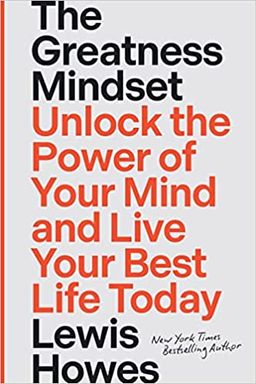
The Greatness Mindset cover

The Greatness Mindset

by Lewis Howes

The Greatness Mindset is your guide to unlocking potential and living your best life. With transformative strategies and personal stories, learn to define purpose, conquer self-doubt, and journey toward a rich, abundant future.

The Greatness Mindset: Unlocking Your Meaningful Mission

Have you ever felt like life was “good” — comfortable, stable, but still missing something? Lewis Howes believes that most people are stuck not because they lack talent or opportunity, but because they haven’t yet discovered their Meaningful Mission — the personal calling that makes their life truly great. In The Greatness Mindset, Howes argues that greatness isn’t a destination reserved for the few, nor is it about ego, fame, or perfection. It’s about uncovering your gifts, overcoming internal barriers, and using your life’s challenges as fuel to serve others.

Drawing from interviews with more than a thousand high achievers on his podcast The School of Greatness—including Jay Shetty, Mel Robbins, Dr. Joe Dispenza, Sara Blakely, and Priyanka Chopra Jonas—Howes offers a practical roadmap for transforming an ordinary life into an extraordinary one. The book’s central promise is both simple and profound: when you identify your Meaningful Mission, overcome your fears, and take consistent imperfect action, greatness begins to chase you instead of the other way around.

From Pain to Purpose

Howes begins with his personal story—a 23-year-old former athlete living on his sister’s couch after a career-ending injury. Lost, broke, and uncertain, he faced not just physical pain but a massive crisis of identity. His father’s traumatic brain injury only deepened that sense of instability. Yet, these hardships became the foundation for Howes’s central philosophy: that pain is the entry point to passion and purpose. By confronting your past, not avoiding it, you can turn your story from an anchor into a propeller. This phase of deep introspection marks the beginning of what he calls The Greatness Transformation Cycle: healing, defining, acting, and celebrating.

To ground his insights, Howes connects his life story to universal struggles—fear of failure, fear of judgment, and lingering self-doubt—that hold nearly everyone back. Like Viktor Frankl in Man’s Search for Meaning, Howes argues that fulfillment only comes when you link your suffering to something greater than yourself: a mission that contributes beyond personal gain.

The Four Steps to Greatness

To turn self-discovery into a replicable process, Howes divides the journey into four practical steps. Step 1 is confronting the Enemy of Greatness—that vague sense of purposelessness that creeps in when you lack a clear mission. Step 2 is overcoming your fears and self-doubt through a “Fear Conversion Toolkit,” which teaches readers to reframe fear into action. Step 3 is developing the Greatness Mindset—a daily practice of managing your thoughts, emotions, and actions to align with your identity. Step 4 culminates in building a Game Plan, a seven-part formula that includes asking courageous questions, giving yourself permission, and enlisting support to stay accountable.

Throughout the framework, Howes emphasizes consistent, imperfect action—a nod to both Carol Dweck’s research on growth mindset and James Clear’s habit philosophy from Atomic Habits. In his words, “Done is better than perfect,” because action breeds clarity and confidence faster than endless preparation ever could.

Healing as the Foundation of Growth

One of the book’s most powerful assertions is that you cannot achieve greatness without healing your past wounds. Whether it’s childhood trauma, abandonment, abuse, or failure, unhealed pain unconsciously drives us to repeat destructive patterns. Drawing from experts like Dr. Gabor Maté and Dr. Shefali Tsabary, Howes reframes healing not as a one-time event, but as ongoing self-awareness. Healing allows you to move from a “suffering state” rooted in fear to a “beautiful state” grounded in peace and compassion. Once your inner child is acknowledged and soothed, you become free to pursue your mission from love rather than lack.

Mindset in Motion

The book is steeped in neuroscience and emotional intelligence. Drawing insight from Dr. Caroline Leaf, Dr. Joe Dispenza, and Susan David, Howes argues that the Greatness Mindset requires syncing three dimensions—thoughts, feelings, and actions—into alignment. He calls this the Mindset-in-Motion Cycle. When negative thinking dominates, emotions like anxiety and shame shut down forward motion. But when you focus on empowering thoughts (“I am enough,” “I can serve”), you elevate your emotional state and naturally take better actions. It’s a self-reinforcing loop of confidence and service-oriented growth.

From Good to Great

According to Howes, the greatest danger isn’t failure—it’s settling for a “good but not great” life. He challenges readers to stop chasing comfort and start embracing challenge, fear, and failure as raw materials for transformation. Examples like Navy SEAL Jason Redman, who overcame catastrophic injuries in service, and entrepreneurs such as Sara Blakely, who reframed failure as learning, demonstrate that courage is not the absence of fear but forward movement despite it.

Ultimately, The Greatness Mindset is a bridge between inner healing and outward impact. Whether you’re starting a business, building better relationships, or searching for fulfillment beyond external success, Howes provides a holistic blueprint—a fusion of psychology, neuroscience, storytelling, and actionable coaching. His central invitation is clear: when you align your identity with service, heal your past, and act with courage, greatness becomes inevitable.


Finding Your Meaningful Mission

Lewis Howes asserts that the first step toward a Greatness Mindset is uncovering your Meaningful Mission—the personal purpose that energizes you to contribute something larger than yourself. Without it, you live adrift, pulled by random goals or the approval of others. Howes calls this emptiness the Enemy of Greatness: living without clear direction.

From Aimlessness to Anchored Purpose

To illustrate this, Howes tells the story of Dwayne “The Rock” Johnson, whose early dream of NFL stardom collapsed when he was cut from the Canadian Football League. With only seven dollars in his pocket, Johnson confronted despair before transforming his pain into a new mission—first to dominate wrestling, then to inspire millions through entertainment and philanthropy. His turning point came when he stopped chasing identity through success and started pursuing significance.

Similarly, Howes himself stumbled upon his mission while stuck in Los Angeles traffic. Frustrated and unfulfilled, he asked, “What if there was a school that taught people how to live meaningful lives?” That spark became The School of Greatness, changing his trajectory and countless others.

Discovering Your Sweet Spot

Howes advises finding your mission at the intersection of three forces: Passion (what excites you), Power (your natural strengths), and Problem (a challenge in the world that calls to you). He calls this your “sweet spot.” For example, Kelly Simpson, a real estate agent, saw rising violence toward agents and created the National Safety Council of Real Estate to train agents in safety. Passion plus skill plus service equals mission.

Exercises for Clarity

Howes includes structured exercises to build focus. His Perfect Day Itinerary invites readers to envision their ideal day from morning to night, revealing deeper values. The Obituary Exercise (adapted from Donald Miller’s Hero on a Mission) helps reverse-engineer your life from the legacy you want to leave. These methods transform vague longings into measurable goals aligned with purpose.

He emphasizes that missions evolve with seasons of life. Today’s business or creative project may just be one mechanism through which your core mission operates. In other words, hold the mission tightly but the mechanism loosely.

Why Money Isn’t the Mission

Perhaps his most repeated warning is confusing money with meaning. Citing Zig Ziglar, he says, “Money isn’t the most important thing in life, but it’s close to oxygen on the gotta-have-it scale.” Financial success is useful, but it is not the mission itself—it simply amplifies who you already are. A clear mission rooted in service prevents wealth from becoming a substitute for worth.

“Your mission evolves, but when purpose leads profit, freedom follows.” – Lewis Howes

Discovering a Meaningful Mission is less about luck and more about listening—to your curiosity, your pain, and your service. It’s the compass that points all other decisions toward greatness.


Overcoming Fear and Self-Doubt

Fear, Lewis Howes argues, is not the enemy; it’s a signal pointing you toward growth. Yet left unchecked, fear mutates into self-doubt—the dream killer. He identifies three specific fears at the root of most resistance: fear of failure, fear of success, and fear of judgment. Each convinces you to shrink your ambitions under the illusion of safety.

Fear of Failure

Sara Blakely’s story embodies healthy failure. As a child, her father asked at dinner, “What did you fail at today?” This reframed failure as evidence of effort rather than incompetence. When she launched SPANX, every rejection reinforced her resilience. “Failure isn’t the opposite of success,” she says, “it’s the foundation of it.” (Echoing Carol Dweck’s growth mindset research.)

Fear of Success

Jamie Kern Lima, founder of IT Cosmetics, illustrates how success can create as much anxiety as failure. After selling her company to L’Oréal for $1.2 billion, she realized she was burnt out and still plagued by imposter syndrome. Success without self-love, Howes notes, just magnifies insecurity. True greatness requires pacing yourself and redefining success beyond endless achievement.

Fear of Judgment

Perhaps the most insidious is the fear of what others think. Howes confesses his people-pleasing tendencies sabotaged relationships and authenticity. Drawing on insights from Dr. Jordan Peterson, he suggests replacing obsession with reputation by aligning with what’s true, not what’s popular. As Navy SEAL Rich Diviney puts it, “Most fears are imagined—ask better questions and reality responds.”

Transforming Fear Into Fuel

Howes’s Fear Conversion Toolkit offers exercises to rewire fear into momentum: writing fear statements, flipping them into abundance affirmations, and using visualization techniques. He even encourages adopting an alter ego (inspired by Todd Herman’s The Alter Ego Effect)—a fearless identity that acts boldly until confidence catches up.

Ultimately, fear’s antidote is action. “What if” transforms into “what’s next” when you lean in with curiosity instead of withdrawal. Once fear becomes a teacher rather than a warden, the dream killer transforms into your greatest motivator.


Healing Your Past to Liberate Your Future

Howes insists that lasting transformation requires emotional healing. “You can’t write a new future,” he says, “if your past keeps editing the script.” Unhealed trauma—rejection, shame, abandonment—dictates reactions, relationships, and self-worth. Healing isn’t forgetting the past; it’s reclaiming your story from it.

Understanding the Inner Child

The book’s most vulnerable moment recounts Howes’s childhood abuse and fear of his father’s anger. These experiences drove decades of overachievement. Through therapy and mentors like Dr. Shefali Tsabary, he realized his “inner child” needed validation, not more proof of worth. Healing meant telling that younger self, “You’re safe now. You’re loved. You’re enough.”

Howes encourages readers to identify coping mechanisms—overworking, people-pleasing, substance use—that once served survival but now block growth. The key is awareness without shame. (Dr. Gabor Maté’s research on trauma-inspired addiction heavily influences this section.)

Coach vs. Critic

You always have two internal voices: the fear-based critic and the love-based coach. Healing comes when the coach replaces the critic. The critic says, “You’re broken,” while the coach says, “You’re learning.” This shift reprograms your nervous system from defensiveness to creativity. Dr. David Perlmutter’s neuroscience-backed explanation strengthens Howes’s claim that reframing fear reactions literally rewires the brain toward compassion.

Exercises like writing letters to one’s younger self or journaling emotional triggers help externalize pain and transform reflection into resolution. Healing is never linear—but every choice toward peace reinforces self-trust. The healed self becomes the foundation for every great mission.


The Mindset-in-Motion Cycle

At the heart of the Greatness Mindset lies a loop Howes calls the Mindset-in-Motion Cycle—the real-time interplay between thoughts, emotions, and behaviors. To master this cycle is to master your present moment, the only place where real change occurs.

Thoughts: Reprogramming the Mind

Most people wake up replaying yesterday’s problems, letting old memories set today’s tone. Drawing on Dr. Joe Dispenza’s neuroscience, Howes explains that “thoughts are the language of the brain; feelings are the language of the body.” To change your future, you must teach your mind to focus on growth-oriented thoughts. Mel Robbins’s “High-Five Habit” and Gabby Bernstein’s “Choose Again” method both reinforce this point: awareness, self-forgiveness, and reframing create new thought patterns.

Emotions: From Bottling to Agility

Emotional mastery, not repression, fuels emotional intelligence. Psychologist Susan David distinguishes between bottlers (who suppress emotion) and brooders (who obsess over it). Both stay stuck. Instead, Howes champions David’s “gentle acceptance”—the discipline of acknowledging feelings without letting them dictate behavior. Joy, fear, or anger all contain data, not destiny.

Behaviors: Aligning Action With Identity

Behavior, says Howes, is identity in motion. When you say “I am a runner,” every small workout proves the statement true. Drawing from Nir Eyal’s idea in Indistractable, he explains that consistent action isn’t about willpower—it’s about aligning what you do with who you believe you are. Each aligned act strengthens the Mindset-in-Motion loop; misaligned acts weaken it.

Greatness depends on keeping this loop intact: think positive, feel aligned, act with intention. Break any one of these, and stagnation returns. Maintain it, and progress compounds automatically.


A Game Plan for Greatness

Once your mindset is set in motion, Howes presents a seven-step Game Plan for Greatness—a playbook to turn purpose into performance:

  • Ask courageous questions – Challenge self-limiting beliefs, like when Howes asked entrepreneur Rachel Rodgers, “If you had $10 million, what would you do?” That prompt birthed her foundation that helps Black mothers access childcare.
  • Give yourself permission – Stop waiting for approval to start. Seth Godin reminds us, “No one’s going to pick you. Pick yourself.”
  • Accept the challenge – Take the uncomfortable leap. Howes joined Toastmasters despite his terror of public speaking and later became a sought-after keynote speaker.
  • Define your Greatness Goals – Clarity creates power. Align goals around Business, Relationships, and Wellness, three “players” of life that sustain balance.
  • Enlist support – Accountability multiplies results. From CrossFit to therapy, Howes stresses you’re “in charge of you,” but success is a team sport.
  • Get stuff done – Replace perfectionism with progress. Rory Vaden calls it “taking the stairs”—doing the hard, necessary work now for easier success later.
  • Celebrate – Gratitude sustains growth. Recognizing daily wins transforms effort into energy.

This Game Plan blends psychology, structure, and practical momentum. It’s what transforms insight into impact. Each step reinforces the idea that greatness is not granted—it’s built, steadily, intentionally, one courageous act at a time.


Celebration and the Truth That You Are Enough

The journey ends—and continues—with acceptance. You are enough now, even as you keep growing. Early in his life, Howes only celebrated outcomes—after winning games, landing deals, or breaking records—but never felt satisfied. Now, he celebrates effort itself. This final shift completes the Greatness Mindset: realizing that identity precedes achievement.

The Power of Celebration

Celebration isn’t arrogance; it’s alignment with gratitude. Howes suggests ending each day by naming three things to celebrate—effort, learning, or kindness. Research, he notes, validates this: positive reflection boosts motivation, creativity, and well-being (echoing Shawn Achor’s The Happiness Advantage).

Redefining Success

For sports agent Nicole Lynn, success once meant money and prestige. After reaching those heights, she felt emptier than ever. Only when she learned to “be present in the moment and celebrate the small wins” did fulfillment return. Howes reinforces that greatness lies not in arrival but in continuous becoming.

Living the Greatness Mindset

The book concludes with a ritual of self-recognition—creating a “BRAG list” (Big Results, Accomplishments, and Goals). Reviewing past wins isn’t vanity; it’s proof that progress compounds. Each line whispers: if you did it once, you can do it again. Combined with Howes’s nightly gratitude practice, this habit anchors confidence in self-trust.

Ultimately, The Greatness Mindset isn’t about becoming someone new; it’s about remembering who you are when fear, shame, and doubt fall away. When you live from that space—healed, humble, purposeful—you stop chasing greatness. Greatness starts chasing you.

Dig Deeper

Get personalized prompts to apply these lessons to your life and deepen your understanding.

Go Deeper

Get the Full Experience

Download Insight Books for AI-powered reflections, quizzes, and more.