
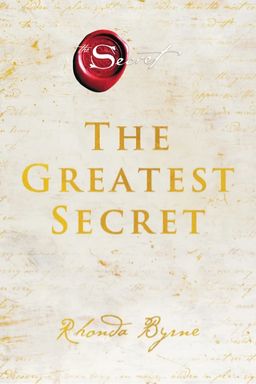
The Greatest Secret cover

The Greatest Secret

by Rhonda Byrne

The Greatest Secret by Rhonda Byrne reveals a profound truth about human identity and happiness. Through the power of Awareness, readers learn to transcend negative thoughts and beliefs, embrace their true nature, and attain lasting peace. This book offers practical exercises to transform your consciousness and unlock a life of unlimited joy.

The Greatest Secret: Awakening to the Truth of Who You Are

What if every struggle you’ve faced—every disappointment, fear, or restless search for happiness—arose from one simple misunderstanding? Rhonda Byrne’s The Greatest Secret contends that the root of human suffering is mistaken identity. We think we are our minds, our bodies, our stories—but Byrne insists that our true nature is vastly greater. Beneath the churning thoughts and emotions lies an unchanging presence: Awareness itself. Discovering and living from this Awareness, she claims, is the key to lasting happiness, peace, and freedom from all suffering.

In this deeply spiritual continuation of her earlier work The Secret, Byrne moves from the Law of Attraction to an exploration of being itself. Rather than teaching techniques to attract external success, she now wants readers to experience their inherent completeness—the blissful Awareness that precedes all experience. Drawing on quotes from modern teachers like Mooji, Rupert Spira, and David Bingham as well as enlightened figures such as Ramana Maharshi and Rumi, Byrne builds a bridge between metaphysical insight and day-to-day wellbeing.

From Attraction to Awareness

After the worldwide phenomenon of The Secret, many readers wondered, “Is there something beyond manifesting desires?” Byrne’s own story begins when, despite her dream life of success, health, and gratitude, she felt an unexplainable yearning. Her search across mystical traditions—Buddhism, Christianity, Hinduism, Sufism—culminated, unexpectedly, with a single revelation: what she had always sought was not out there but within. She discovered she was not a person looking for happiness—she was happiness itself. That realization became the seed of The Greatest Secret.

The Core Premise: You Are Awareness

According to Byrne, almost everything we’ve been taught about who we are is incomplete. From birth we identify with labels—gender, race, job title, personality—which creates the illusion of separation. This narrow identity gives rise to fear, desire, and endless striving. The “Greatest Secret” is the understanding that beyond the mind and body, you are the Awareness that perceives all of it. Awareness was present when you were a child, a teenager, an adult; bodies, moods, and circumstances changed, but the witnessing consciousness never did.

This Awareness is eternal, says Byrne. It does not die when your body dies. It cannot suffer, worry, or feel lack. And realizing this shifts life entirely—from struggle and resistance to effortless peace. You begin to live with a quiet joy that persists regardless of circumstances. The book frames this realization not as an esoteric goal for saints but as our natural birthright.

Awakening from the Dream

Byrne borrows from ancient teachings that describe ordinary waking life as a dream-state. We wander through the world convinced it’s solid and real, unaware that it’s the projection of mind and belief. To “wake up,” she writes, is to notice what has always been true—that life is a temporary play appearing within consciousness itself. The moment you realize this, struggle loses its grip. Problems, pain, even death dissolve into the larger understanding that you, the Awareness watching it all, were never touched by any of it.

Freedom from Mind and Emotion

A central obstacle to recognizing Awareness is the incessant mind. Byrne portrays the mind as a brilliant but noisy tool that, when mistaken for “you,” becomes a tyrant producing negativity, anxiety, and judgment. The practice is not to destroy the mind, but to stop believing its stories. You, the reader, are encouraged to observe thoughts and feelings without resistance: see them as energy passing through Awareness, not defining it. This simple shift—from identification to observation—loosens the knots of suffering and restores a sense of peace.

Practical Path to Liberation

Although Byrne’s message is metaphysical, she offers grounded methods to experience it. Her signature Awareness Practice begins with a single question: “Am I aware?” This instant inquiry pulls attention from thinking back to pure conscious presence. More experiential exercises follow—such as welcoming rather than resisting negative feelings, releasing limiting beliefs, noticing Awareness throughout the day, and dissolving attachments. These tools, she believes, gradually retrain the mind to rest in being rather than doing.

Why This Secret Matters

The implications of Byrne’s revelation are profound. If you are Awareness itself, then the world you experience is not happening to you but within you. There’s nothing to fear, resist, or fix—only to recognize. Peace, love, and joy stop being pursuits and become your default state. As she and her teachers repeat: all unhappiness is due to mistaken identity; all happiness is remembering who you are. This message echoes ancient nondual traditions, reframed for modern seekers who feel lost in noise, stress, and self-improvement loops.

By the book’s end, The Greatest Secret reads less like a sequel to The Secret and more like its transcendence. Where the first awakened millions to creative power, this work points to the awareness behind the creator itself. Byrne’s hope is that understanding this truth will “end all suffering and bring everlasting happiness.” Whether you see it as metaphysical inspiration or spiritual invitation, her message centers on one timeless question: If you are not the thoughts you think or the person you imagine—then who are you, really?


Hidden in Plain Sight: The Truth of Identity

From the very beginning of The Greatest Secret, Byrne emphasizes that the truth has always been hiding in plain sight—closer than your breath, closer even than thought. Humanity’s great error, she writes, is “a case of mistaken identity.” We believe ourselves to be a collection of experiences: a name, a profession, an age, a story. Yet all suffering—anxiety, loneliness, uncertainty—arises from this limited view.

The Mistaken Self

Byrne draws on teachers like Anthony de Mello and Jan Frazier to make the point: the “person” you think you are is merely an experience, not the experiencer. She invites you to test this by observation. Notice that thoughts, emotions, and sensations all appear and disappear, but something constant is aware of them. That constant witnessing Awareness—unchanging across time—is your true identity.

She compares this to being lost in a dream. In a dream, our dream-character seems real until we wake up and realize it was all mind-made. Similarly, awakening is the recognition that even the “awake, thinking person” is still a dream character, projected by consciousness.

Signs of the Mistake

Byrne uses everyday examples—feeling offended, worrying about money, fearing death—to show how the false self operates. When you feel these emotions, she says, notice the common thread: each assumes you are a limited body vulnerable to loss. But the infinite Awareness that you are cannot be threatened by time, change, or circumstance. The surest gauge of your life, she adds, is your happiness. If it fluctuates, it’s because you’ve again forgotten who you really are.

Remembering the Real You

Byrne calls this realization “awakening,” but leaves the term flexible: enlightenment, self-realization, remembering—it’s all the same. Everybody can have it because it’s not something new to gain, but something already here to notice. Happiness, she concludes, isn’t an achievement. It’s your nature emerging the moment identity with the false self falls away. Recognize this even briefly, and you glimpse what sages call peace beyond understanding.

(This idea echoes timeless teachings—from the Buddha’s concept of Anatta, or no-self, to Ramana Maharshi’s question “Who am I?” Byrne’s modern phrasing transforms them into practical insight: every upset is a reminder that you’ve mistaken your identity again.)


The Revelation of Awareness: You Are Not Your Mind or Body

Byrne’s key turning point comes when she states that only one subtle belief blocks the discovery of truth: the belief that you are your body and mind. You use your body as a vehicle and your mind as a tool, but they are not you—their impermanence proves it. Just as you don’t say “I am my car,” you are not the body driving through life.

The Body-Mind Illusion

Using reminders from teachers like Lester Levenson, she explains that the body is inert matter. Your heart doesn’t know it’s a heart; your brain doesn’t know it’s a brain. Yet you know them both—which shows the knowing must come from somewhere beyond. That “knowing” is Awareness. The same logic applies to the mind: it is only a stream of thoughts appearing and vanishing. If no thoughts arise, where is the mind? When you watch thought without engagement, you notice something larger—Awareness—that was always there.

The One Awareness

Perhaps her most stunning claim is that there aren’t billions of separate consciousnesses but only one Awareness refracted through many minds, like one sunlight shining through countless windows. “Our name is ‘I,’” she writes, quoting Rupert Spira. Realizing this unity dispels fear and loneliness—the Awareness in you and in everyone else is the same infinite being. You are, literally, one with God, Source, or Consciousness itself.

Experiencing Awareness Directly

Byrne offers an experiential exercise: pause and ask, “Am I aware?” Instantly, a quiet openness appears—the background in which all sensations occur. That still presence was never created and will never die. She calls it “the white paper behind the words,” using Rupert Spira’s metaphor for the screen on which life’s movie plays. Thoughts, emotions, and events are ink; Awareness is the page that makes them visible yet remains untouched.

The more often you notice Awareness, the more your old identity dissolves. Problems appear smaller, happiness grows steadier, and you begin to glimpse immortality—not as theory, but as direct experience. (This aligns with Eckhart Tolle’s teaching in The Power of Now that presence itself is freedom from the mind’s tyranny.)


Freedom from the Mind’s Tyranny

Byrne insists that your mind is meant to be a creative servant, not a master. Yet most people let their inner voice dictate their emotions, believing every thought as fact. Her solution is simple: stop believing your thoughts. Once you see them as just mental noise, their power evaporates.

Understanding the Mechanism

She portrays the mind as a mechanical processor—comparing, judging, describing. It can only reference memory or predict the future; it never lives in the present moment. Everything it says, she writes, is about measurement (“too much,” “not enough”) or description (“it’s hot,” “it’s bad”). Recognizing this pattern reveals the futility of identifying with thoughts. They are commentary, not truth.

Believing Creates Suffering

Following Byron Katie’s insight—“If you believe your thoughts, you suffer”—Byrne shows that all emotional pain traces back to belief. Every worry, resentment, or guilt begins as a thought we treat as reality. When Awareness observes thinking without attachment, the thought fades like a bird crossing the sky. She compares it to leaving a virtual reality game: the moment you remove the headset of belief, the illusion dissolves.

Living Beyond Thought

Freedom from mind isn’t about quieting the brain; it’s about not being owned by its chatter. In practice, when a stressful thought arises, notice it and ask, “Is that true?” or “Who is aware of this thought?” That brief pause reveals that the real “you” is the observer, untouched by thinking. As this stance stabilizes, peace replaces reaction. Actions become spontaneous, guided by intuition—the natural intelligence of Awareness. It’s not mindless living, but living without mental bondage.

(This approach parallels teachings in mindfulness and Advaita Vedanta: thoughts come and go, Awareness remains. Byrne reframes these ideas in accessible language, emphasizing their emotional payoff—relief, lightness, and consistent joy.)


Welcoming Feelings: Dissolving Emotional Pain

One of Byrne’s most practical teachings concerns emotions. She asserts that negative feelings, like anger or fear, are stored energy produced by resisting life. The more you resist—by suppressing, judging, or escaping—a feeling, the stronger it becomes. The antidote? Welcome it completely.

The Mechanics of Emotion

Feelings, she explains, are vibrations generated by thought. Positive thoughts produce high-frequency feelings like joy or calm, while negative ones produce dense, heavy states. Over years of suppression, these emotions accumulate in the subconscious, coloring perception and health. Drawing on Lester Levenson and Dr. David Hawkins, Byrne notes that repressed feelings act like pressure cookers—they find external triggers to vent themselves through repeated patterns of conflict or illness.

The Practice of Welcoming

To release this buildup, she introduces “welcoming.” Instead of pushing an emotion away with “I don’t want this,” you open to it: “Yes, you are welcome here.” Awareness, being infinite acceptance itself, dissolves resistance. You can even open your arms physically, as if embracing the feeling. The power lies not in fixing the emotion but allowing it to fully exist within Awareness until it passes naturally. Byrne recounts using this method to lift herself out of depression in days—after months of futile struggle with positive thinking. The moment she stopped resisting sadness and embraced it, it dissolved.

The Super Practice

Combining this insight with her Awareness training, she created what she calls the “Super Practice”: Step 1, welcome anything negative; Step 2, stay as Awareness. This dual approach both ends emotional suffering and anchors you in truth. Problems lose charge, body tension fades, and joy naturally re-emerges. Byrne’s stories—welcoming depression, staying calm during wildfires—illustrate liberation in action.

(This mirrors therapies like Acceptance and Commitment Therapy (ACT) and Buddhist vipassanā practice, yet Byrne frames it less as a discipline and more as remembering your natural openness. Resistance holds pain; welcoming restores wholeness.)


Breaking Free from Limiting Beliefs and Attachments

If feelings create emotional suffering, Byrne says beliefs create the mental box that sustains it. A belief, she explains, is merely a thought repeated until assumed true. Yet every belief sets a boundary in an infinite field—believing you are limited makes you limited.

The Belief Factory

From childhood, culture imprints certain axioms: you must work hard to succeed, life is short, suffering builds character. These “recordings,” stored in the subconscious, run automatically like computer code. The mind then seeks evidence to reinforce them. Byrne urges awareness of phrases like “I believe…” or “I think…” as red flags—each one points directly to a belief. When brought to light, beliefs dissolve under scrutiny, taking with them thousands of attached thoughts.

Reactions Expose Beliefs

One practical tip: watch your emotional reactions. Every strong reaction reveals a hidden belief. Anger at a bill might expose “There’s never enough.” Envy might reveal “I can’t have what others have.” Becoming aware of the reaction is enough to release its power—Awareness, she writes, is the solvent of all falsehood.

The Freedom of No Belief

When no beliefs dictate experience, life becomes fluid and effortless. Byrne recalls Lester Levenson’s story—he reached enlightenment by dismantling every belief, erasing even his fear of death, and healed all disease within three months. She quotes Rumi: “Be like a tree and let the dead leaves drop.” In letting go of belief, you stop collecting mental clutter and rediscover the joy of being unconditioned. In her view, Awareness has no beliefs because it already knows everything.

Free of belief and attachment, you don’t stop caring—you love more fully. Nonattachment does not mean withdrawal but fearless enjoyment of life as it changes. You can own possessions, love people, and pursue desires, all while knowing your happiness depends on none of them. (This stance resonates with Anthony de Mello’s distinction between attachment and love: true love allows, attachment clings.)


Awakening to Everlasting Happiness

Byrne culminates her journey with the realization that happiness is not a goal but your essence. “You are happiness,” she declares, echoing the ancient Upanishads: your very being is bliss. You don’t achieve it—you uncover it by removing what clouds it.

The Illusion of Conditional Joy

She observes that most people tie joy to external “ifs”: I’ll be happy when I’m healthy, successful, loved. But because everything external changes, that happiness fades. Each loss or unmet expectation renews suffering. True joy appears when you stop waiting for life to meet conditions; it arises naturally when you rest as Awareness. Then, even in chaos, you feel an inner current of bliss that nothing can disturb.

Resisting and Allowing Happiness

Paradoxically, many resist being happy because of old conditioning—childhood teachings that joy is silly or prideful. Recognizing this resistance and releasing it is liberating. Byrne invites you to simply allow happiness now, without reason. Happiness needs no cause; sadness requires effort. In her words, “You need nothing to be happy; you need something to be sad.”

From Attachment to Love

She makes a crucial distinction between attachment and love. Attachment fears loss; love celebrates freedom. Once happiness is found within, relationships transform from dependence to joyful sharing. You stop trying to extract happiness from others and radiate it instead. This state, she says, is the essence of enlightenment: unbroken happiness that embraces all life as itself.

(Philosophically, this mirrors the teachings of mystics like Paramahansa Yogananda and Anthony de Mello—happiness is self-existing awareness, not emotion. Byrne’s contribution is reframing it in the accessible language of daily emotional reality.)


Beyond the World: Seeing That All Is Well

Late in the book, Byrne expands the scope from personal awakening to cosmic understanding. Drawing from both mysticism and modern physics, she asserts that the world itself—physical reality—is an appearance within consciousness. The world is not simply your experience; it is in you.

The Illusion of a Separate World

She cites physicists like Max Planck and Deepak Chopra to explain that matter is mostly empty space, held together by observation. Like a movie projected on a screen, the world exists as mental images created and perceived within Awareness. When we wake from that illusion, we see that despite surface chaos, “all is well.” Awareness itself—the true reality—was never harmed or disturbed.

Living in the Dream with Clarity

Knowing the world’s dreamlike nature doesn’t make you passive or indifferent. It invites compassion. When you realize every being shares the same Awareness, judgment dissolves and love expands. You engage life playfully but peacefully, understanding that what passes on the screen never touches the screen itself. Problems, suffering, even death lose their finality within this recognition.

The Unity of Existence

In Byrne’s closing chapters, she joins mystics like Rumi and Eckhart Tolle in affirming that consciousness is the one substance behind everything. This infinite Awareness is omnipresent, omniscient, and omnipotent—it is what religions have called God. Realizing you are that Awareness transforms fear into serenity. You no longer need to fix the world to be at peace; peace was your own nature all along.

When you see this clearly, she writes, “All shall be well,” echoing the mystic Julian of Norwich. Life continues—bills arrive, bodies change—but beneath every moment runs the same quiet revelation: nothing real can be threatened, and nothing unreal exists.

Dig Deeper

Get personalized prompts to apply these lessons to your life and deepen your understanding.

Go Deeper

Get the Full Experience

Download Insight Books for AI-powered reflections, quizzes, and more.