
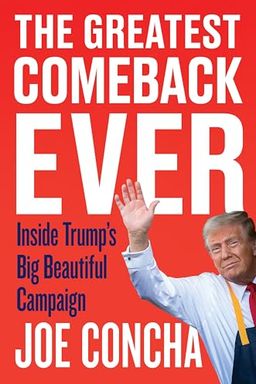
The Greatest Comeback Ever cover

The Greatest Comeback Ever

by Joe Concha

The Fox News contributor gives his take on the 2024 presidential election.

How Trump Turned Attacks Into Advantage

How do you turn a narrative designed to finish you into the very fuel that powers your comeback? In The Greatest Comeback Ever, Joe Concha argues that Donald Trump’s 2024 victory wasn’t a fluke or a grievance-driven flail—it was a deliberate inversion of the political forces aligned against him. Concha contends that a perfect storm of overreach (legal, media, cultural), a deeply unpopular status quo (inflation, crime, immigration), and a relentlessly informal, “normal-person” campaign ethos enabled Trump to flip the script. The more the system tried to crush him, the more he looked like the only disruptive alternative to a stagnating establishment.

Concha’s central claim: when the Biden administration indicted Trump, the media painted him as a fascist, and institutional consensus hardened against him, many voters didn’t see a would-be authoritarian. They saw an anti-establishment foil to a government and media ecosystem they no longer trusted. That instinct only intensified after two attempted assassinations (Butler, PA; West Palm Beach, FL), a catastrophic Biden debate, and a Harris campaign that ran on vibes, avoided scrutiny, and flubbed high-visibility moments—from 60 Minutes edits to skipping the Al Smith Dinner.

What This Book Covers

You’ll move through the crucial beats that shaped 2024: a Biden cognitive cover-up that imploded live on debate stage; the mid-summer shooting in Butler that turned a bloody fist pump into an indelible image of resolve; the VP calculus that made JD Vance look normal and Governor Tim Walz look strangely performative; and a media environment that—by turns credulous, partisan, and self-parodic—became a character in the race. Concha threads these episodes with on-the-ground color (boarding Trump’s plane for the Wildwood rally, watching the Butler feed roll in from the Fox greenroom) to argue this wasn’t just politics; it was an authenticity test.

Why It Matters Now

If you’ve felt the ground shifting beneath “how politics works,” 2024 is the case study. Concha says elite curation failed: polls missed late-breaking realignments; legacy outlets fact-checked selectively; celebrity endorsements felt paid and hollow; and a “joy” campaign without policy ballast snapped under pressure. Meanwhile, Trump and his coalition found new pipes (podcasts, X, Rogan) and new validators (Musk, RFK Jr., Tulsi Gabbard), while focusing on tangible checkbook issues. The lesson for any reader in a leadership role: if the gatekeepers don’t reflect your customers’ reality, they’ll find new gatekeepers—or none at all.

The Big Ideas You’ll Find Here

  • The Biden cover-up collapses: the June debate shatters a two-year insistence that cognitive lapses were “cheap fakes.”
  • Butler, PA changes the race: an assassination attempt reframes Trump as resilient while exposing security failures.
  • Running mates as Rorschach tests: JD Vance’s media gauntlet vs. Tim Walz’s unraveling backstory and a debate that flipped “weird.”
  • Media as protagonist: ABC’s debate gatekeeping, MSNBC’s remote-convention optics, and 60 Minutes’ missing transcript drama.
  • A campaign about nothing: Harris’s “joy” brand collides with hard questions on fracking, immigration, and inflation—and loses.
  • Coalition churn: Teamsters neutrality, Black/Latino and younger male movement, and the Rogan-Musk-RFK Jr. lane.
  • Polls and spend don’t equal votes: the Selzer shock, CBS flash polls vs. outcomes, and a $1.5 billion Democratic burn rate.

Core Thesis

Trump didn’t win by relitigating 2020. He won by offering a simple contract—make life cheaper, safer, and saner—while letting his opponents overplay the “threat to democracy” card and misjudge how their own institutions looked from outside the bubble.

If you lead teams, launch products, or simply want to understand how trust shifts in an information-saturated world, Concha’s chronicle doubles as a playbook. The “greatest comeback” is framed as an execution story: the right enemies, at the right time, said the wrong things—and a candidate who understood stagecraft, retail, and platforms met the moment. Whether you love or loathe Trump, Concha says you can’t miss what happened: the establishment became the undercard in its own main event.


When the Biden Story Broke on TV

Concha frames June 27, 2024, as the night the “Biden is fine” narrative collapsed under the weight of live television. For months, legacy media dismissed questions about the president’s fitness as partisan “cheap fakes.” Even CNN re-hired Brian Stelter to popularize the term. But the Atlanta debate stripped away the curated protections: a halting voice, meandering answers, and Trump’s disciplined restraint created a split-screen that no edit could fix.

The Build-Up: Cheap Fakes vs. Common Sense

Leading into the debate, the White House’s defenders scolded skeptics. MSNBC’s Joe Scarborough declared Biden “the best Biden ever,” telling critics to “start your tape.” Press handlers blamed sandbags and TV staging for Biden’s stumbles, while surrogates branded viral moments as “decontextualized.” Concha cites Mika Brzezinski chastising staffers for not protecting Biden from falls as emblematic—the problem wasn’t the president’s condition; it was the camera angles and logistics.

The Moment: A Live-Action Reversal

Then came 90 minutes no one could massage. On Medicare, Biden trailed off—“We finally beat Medicare”—and Trump deadpanned, “He beat it into the ground.” On immigration, Biden paused and lost his train; Trump replied, “I don’t think he does either.” Crucially, Trump stayed measured, a sharp contrast to his 2020 first-debate brawl. The postgame headlines (CNN: “pitched into crisis”; Time: “debate disaster”) signaled more than a bad night—they signaled the end of a protective media consensus.

Why It Landed

Concha argues the debate confirmed what voters already suspected from daily life. After years of being told their eyes lied, viewers got a real-time audit. Within days, Biden’s internal polling reportedly projected a 400+ electoral vote wipeout; public-facing columnists at the New York Times suddenly demanded he step aside. (Compare to Michael Lewis’s observation in The Premonition about institutions denying obvious COVID data—people forgive mistakes but not being gaslit.)

What Came Next: A Collapsing Firewall

The Supreme Court’s July immunity ruling stalled Jack Smith’s election case, stripping Democrats of their “courtroom calendar as campaign calendar” gambit. Calls for Biden to withdraw intensified (Senators Sherrod Brown and Jon Tester, and even Adam Schiff), but the family circle and senior aides resisted. Then came July 13 in Butler, Pennsylvania—an event that would make even wavering voters reassess the storyline entirely.

Takeaway For You

If you run teams or brands, this sequence is instructive: when your audience’s lived experience diverges from your messaging, the risk isn’t disagreement—it’s credibility collapse. Concha’s read is blunt: the debate didn’t create doubts about Biden; it confirmed them, and it discredited voices who’d insisted nothing was wrong. In a trust economy, that’s a turning point you can’t “spin” away.

(Context: Jay Rosen and Margaret Sullivan have chronicled media’s “defensive objectivity” problem for years; Concha offers the mirror-image critique—protective bias. Either way, 2024 showed the cost when guardrails become gates.)


Butler: Courage, Failure, and a Fist Pump

The attempted assassination in Butler, Pennsylvania, changed the emotional geometry of the race. Concha recounts watching the feed from the Fox greenroom: shots, screams, Trump clutching his ear, then vanishing behind agents. Moments later came the image that froze the country: Trump rising, blood across his face, and pumping his fist as he mouthed, “Fight! Fight! Fight!” Concha’s instinctive reaction—“He just won the election”—captures his thesis: resilience, not rage, became the defining frame.

A Chain of Preventable Failures

Concha details a litany of security lapses that reads like a case study in broken systems: an unsecured rooftop with direct line of sight; countersnipers lacking radios; a 90-minute window after a local SWAT sniper flagged the suspect as a “person of interest”; and no immediate evacuation even after a police officer retreated under threat. He lists ten “WTFs,” from resource misallocation (more agents with Jill Biden at an indoor event than at Trump’s outdoor rally) to the director’s slanted-roof excuse.

The bullet glanced off Trump’s ear because he had turned sharply to refer to a border chart—another detail that became lore. Trump reportedly told Rep. Ronny Jackson, “That chart saved my life.” The counterfactual is chilling—and Concha leans into it to argue the assassination attempt inadvertently simplified the race for undecideds. It affirmed the sense that Trump is uniquely durable and that institutions charged with fairness were not playing fair—or competent.

Media Reactions That Backfired

Concha’s sharpest media critique here targets the MSNBC panel that questioned whether glass—not a bullet—injured Trump, and later called his bandage a “prop.” Snopes later debunked the theory; a New York Times photo captured a bullet’s near miss. Within days, the press moved on. Voters didn’t. As Concha notes, a majority told NBC they believed extreme rhetoric contributed to the attempt. The Subtext: half the country thinks media heat is part of the problem, not the solution.

Leadership Signal vs. Systemic Noise

If you manage crises, note the contrast. Trump’s first instinct was to show supporters he was okay. The Secret Service director’s instinct was to cite “ongoing investigation.” One built resolve; the other sounded evasive. Concha emphasizes that Trump’s “get up” moment wasn’t mere bravado—it was a deliberate signal to steady a crowd and a country watching live.

Political Impact

Within 48 hours, Concha reports, Trump allies and even critics muttered the same thing: that image sealed voter intuition. When Harris later skipped the Al Smith Dinner and retreated into controlled media encounters, it only amplified the contrast. Whether you see Trump as hero or showman, Concha argues the Butler fist pump became the campaign’s Rosetta Stone—it told voters who he is under fire, and who wasn’t showing up when the moment called.


Running Mates: Vance vs. Walz

Concha treats the VP selections as a credibility stress test. Trump tapped JD Vance—Marine, bestselling author, Yale Law grad—and sent him into the lion’s den of unfriendly media. Harris chose Minnesota governor Tim Walz, a folksy “midwest dad” who soon found himself explaining a DUI, embellishments about China and Tiananmen, and claims of battlefield “weapons of war.” The contrast hardened during the VP debate, which Concha calls an outlier: a vice-presidential showdown that actually moved votes.

The “Weird” Attack Boomerangs

Democrats caricatured Vance as “weird,” recycling a 2021 “childless cat ladies” quip to paint him as hostile to women. Concha notes the stat pack that undermined the outrage theater: historic declines in fertility, cities with more dogs than kids, and the economic math of fewer workers supporting more retirees. Far from flustered, Vance brought mockery and math to hostile sets (ABC with Martha Raddatz; CNN), reinforcing an “unruffled competence” brand. (Parallels: Barack Obama’s calm under fire vs. McCain in 2008, or DeSantis’s policy-first style in Florida pressers.)

Walz’s Resume Problem

Walz was supposed to humanize Harris with Big Ten warmth. But Concha catalogs a rapid series of credibility dings: fleeing a unit deployment to Iraq; wrongly claiming he was in Hong Kong during the Tiananmen crackdown; proposing “ladder companies” to scale Trump’s border wall; installing tampon machines in boys’ bathrooms; apologizing to rioters after delays deploying the National Guard in 2020 Minneapolis. Even goofy gaming banter (“run a mean pick-six”) landed as inauthentic—a coach who didn’t know the game’s basic terms.

Debate Night: Who’s Actually “Weird”?

At CBS, Norah O’Donnell and Margaret Brennan promised no fact-checking, then fact-checked Vance mid-answer in Springfield, Ohio—and cut his mic when he rebutted with details about the CBP One app and parole-by-app model. Walz, pressed on Tiananmen, veered into childhood bicycles, coaching, and teaching—never directly addressing the discrepancy until a belated “misspoke.” Concha argues that on split-screen optics Vance looked calm and precise, Walz overwhelmed and canned. The post-debate flash polls (CNN, CBS) gave Vance the win—and Harris-Walz lost the night’s core message: competence.

What You Can Use

When your product is under attack for “vibes,” lean into demos, not adjectives. Vance accepted tough interviews and brought receipts. Walz leaned on slogans and biography. In high-stakes settings, audiences reward precision over personality tales—especially when performance threatens to contradict the stories you tell about yourself.


Media as a 2024 Protagonist

If there’s a fifth character in Concha’s narrative—after Trump, Biden, Harris, and Vance—it’s legacy media. He doesn’t just critique slants; he shows how editorial choices became the story: MSNBC anchoring the RNC from a New York LED set instead of Milwaukee; ABC’s moderators limiting policy questions and fact-checking Trump while leaving Harris’s misstatements untouched; 60 Minutes’ missing full transcript from a choppy interview; and networks elevating celebrity endorsements over union defections and kitchen-table math.

Three Set Pieces That Stuck

  • ABC’s Philadelphia Debate: David Muir and Linsey Davis lavished time on January 6 and abortion, skipped or minimized crime, China, Afghanistan, and education, and corrected Trump midstream (e.g., post-birth abortion) while letting Harris’s claims (no fracking ban intentions; best unemployment inherited) pass. After the debate, CNN and C-SPAN focus groups scored Trump on economic competence—suggesting viewers heard what wasn’t asked as loudly as what was.
  • The 60 Minutes Edit: CBS promoted a version of Harris’s Israel answer that differed from a longer version aired earlier on Face the Nation, and refused to release a complete transcript—a standard it had applied to Trump in 2020. Trump threatened suit; CBS claimed editorial discretion. Concha’s point isn’t legal—it’s trust: if you quietly change cuts in campaign home stretch, you’re no longer coverage; you’re a variable.
  • RNC’s Virtual Critics’ Table: MSNBC’s remote convention set in NYC became a metaphor. Jake Tapper ribbed it; viewers memed it. Concha argues it crystallized a deeper perception: insiders commentating about outsiders without leaving their zip code. (Compare to Matt Taibbi’s “silo” critique or Chris Arnade’s Dignity chronicling class disconnection.)

Platform Arbitrage: Trump’s Workaround

While broadcast fights about frames, Concha shows Trump built elsewhere: a three-hour Joe Rogan interview (50M+ YouTube views alone), extended X clips, and long-form conversations that reached low-propensity young men and non-college voters. Campaign calculus 101: prioritize distribution where attention already lives. Harris’s team sought to control—with pre-tapes, friendlies (Stern, The View), and limits (declining Rogan under restrictions). In a year of authenticity audits, that control strategy looked like fear.

A Note on Fairness

Concha’s critique is pointed, but not novel: it echoes Glenn Greenwald’s post-2016 issues with gatekeeping and Nate Silver’s frustrations with pundit certainty. The difference in 2024 is consumer behavior; when audiences sense curation, they route around it. Politically, that meant Trump could sell competence on the economy and immigration even when moderators didn’t want to talk about them.


Harris’s ‘Joy’ Meets Policy Gravity

Concha is toughest on the core Harris strategy: rebrand as “joy,” avoid unscripted settings, sand down 2019 positions (e.g., decriminalizing border crossings; banning fracking; taxpayer-funded transitions for inmates), and ride a media tailwind. He argues the plan collapsed because voters wanted prices, safety, and borders discussed in concrete terms. By the time Harris faced skeptical questions—Dana Bash, Bret Baier—she often filibustered (“deadlines around time”) or contradicted her record. The vibe clashed with the bill at checkout.

Three Moments That Broke the Spell

  • The View “layup” miss: asked what she’d do differently from Biden, Harris answered, “There’s not a thing that comes to mind.” Concha calls it the campaign’s most revealing sentence: a change-agent who won’t (or can’t) draw a contrast in a 65% wrong-track country.
  • 60 Minutes’ math gap: when Bill Whitaker pressed, “How do you pay for it?” Harris pivoted to fairness rhetoric instead of pay-fors. The follow-up—“we’re dealing with the real world here”—symbolized a tone reset: platitudes were now penalties.
  • Al Smith Dinner no-show: Harris skipped, sending a prerecorded Molly Shannon skit to the Catholic charity gala. Trump delivered a sharp, self-aware roast. Concha argues Catholics noticed; exit polls later showed a dramatic shift toward Trump (NBC: 58–40).

Reversal Without Reassurance

Harris tried to reposition on fracking (“I will not ban fracking”) and the border (ad imagery with wall footage), but Concha notes the trust problem: earlier positions (ban offshore drilling; decriminalize crossings; taxpayer coverage for trans care for inmates) were on tape. When Bret Baier pressed on her 2019 stances—and noted Walz had made those benefits state law—Harris blinked rapidly and retreated to talking points. You didn’t need to dislike her to feel whiplash; you just had to remember 2019.

Leadership Lesson

If your brand promise is “joy,” your operational promise must be “specifics.” Otherwise joy reads as denial—especially in a cycle dominated by grocery prices and housing. Concha’s verdict is blunt: Harris ran a Seinfeld campaign—about nothing—when voters demanded substance.


Coalitions, Endorsements, and New Pipes

You can tell where a party is headed by who stays silent. Concha points to three movement tells. First, the Teamsters (1.3M members) refused to endorse Harris; their internal polling had flipped from Biden majorities to Trump +27 among rank-and-file. Second, elite endorsements stacked up for Harris (WaPo editorial board wavered; Hollywood poured in), but the validators who mattered in 2024—podcasters, entrepreneurs, and apostate Democrats—tilted Trump: Elon Musk, Joe Rogan, Tulsi Gabbard, RFK Jr., Dennis Quaid, Dana White, Dr. Phil.

Why These Voices Mattered

Rogan’s three-hour interview (52M+ YouTube views; more on Spotify) introduced Trump to apolitical younger men at scale—an audience Harris struggled to reach with controlled formats. RFK Jr.’s late endorsement signaled permission for disaffected Democrats to cross; Musk’s amplification on X made it hard to quarantine clips. Concha argues these weren’t “celebrity” endorsements in the old model; they were distribution endorsements—algorithmic gateways into feeds that bypassed network filters.

Union and Working-Class Movement

Concha emphasizes the Teamsters anecdote: Harris’s team limited questions and signaled they’d win “with or without you,” which Teamsters President Sean O’Brien called “arrogant.” Add firefighters’ neutrality and the resonance of “no tax on tips” and “no tax on overtime” to service workers. From border town sheriffs to UAW shop floors anxious about EV job losses, Concha says the ground shifted from elite testimony to paycheck logic. (Echoes of Ruy Teixeira’s “working-class revolt” thesis.)

Early Vote and Ground Game

A quiet structural shift: Trump’s embrace of early voting. Persuaded by Susie Wiles, Lara Trump, and PA legend Rob Gleason (“Your voters are excited; give them permission”), Trump campaigned for banked votes. Meanwhile, organizers like Scott Pressler registered new rural and Amish voters in Pennsylvania, reducing Democrats’ registration edge to a 50-year low. Concha highlights the math: in 2020, Biden entered Election Day in PA with a 1.1M early-vote lead; Harris entered 2024 with ~400k—an impossible gap when Republicans led on day-of turnout.

The Lesson for Campaigns—and Companies

Don’t confuse celebrity with distribution. In 2024, a Joe Rogan sit-down did more to reshape late deciders than ten glossy rallies with musical cameos. And don’t confuse leadership buy-in with member buy-in: elite endorsements mean less when the floor is moving.


Polling Misses, $1.5B Spent, and What Voters Said

Concha closes by contrasting perception with outcomes. On the eve of the vote, Iowa’s “gold standard” Selzer poll put Harris +3 in a state Trump had won by 8–10 points. Cable handicappers assured a close finish with a Harris popular-vote edge. Then voters wrote a different story: Trump 312 electoral votes; six state flips (PA, MI, WI, GA, AZ, NV); and dramatic movement among married voters, Latinos (Trump 46%), young men, and Catholics (NBC: Trump 58–40). In Iowa, Trump won by 13—Selzer was off by 16.

Why the Misses?

Concha suggests “social desirability bias” and late deciders breaking on cost-of-living. But he also blames institutional priors: models that coded 2024 as a base election misread churn among non-college men, service workers, and union rank-and-file. He quotes Jon Stewart’s Election Night rant at pollsters—“Blow me”—to capture the public’s exasperation. The bigger bruise: outlets that predicted democratic doom missed the scale of discontent with inflation, crime, and immigration.

Spending Isn’t Strategy

Harris’s campaign burned through roughly $1.5B in three months, Concha reports, ending in debt and prompting donors’ fury. Among the revelations: $10M for a Beyoncé rally cameo without a performance; ~$1M paid to Oprah’s company for a soft-focus event; six figures to build a one-off podcast set; and multimillion outlays to music acts (Megan Thee Stallion, Lizzo, Eminem) in a cycle dominated by grocery bills. Contrast with Trump’s high-ROI earned media (Rogan, X virals, McDonald’s stunt in Reading, PA).

Postgame: Narratives That Didn’t Survive

  • “Democracy or fascism” as a sufficient message when eggs are up 30% and rent 20%.
  • “Celebrity endorsements move votes.” (Distribution > celebrity in 2024.)
  • “Unions = automatic Democratic votes.” (Leaders vs. rank-and-file split.)

So What Did Voters Say?

In Concha’s telling: make life cheaper, safer, and less crazy. Stop talking to us like we’re bad people for wanting borders and basic standards. If you call skepticism “weird” or “fascist,” don’t be surprised when we tune you out—and route around your preferred channels to find voices we trust.

(For a broader lens, see Ruy Teixeira’s “normie voter” essays and John Judis’s caution about the Democrats’ coalition dilemma. Concha’s book is that thesis, told as field reporting from a rollercoaster campaign.)

Dig Deeper

Get personalized prompts to apply these lessons to your life and deepen your understanding.

Go Deeper

Get the Full Experience

Download Insight Books for AI-powered reflections, quizzes, and more.