
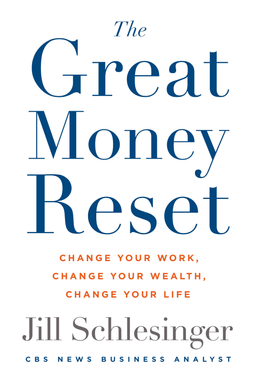
The Great Money Reset cover

The Great Money Reset

by Jill Schlesinger

The Great Money Reset empowers individuals to align their finances with their dreams, providing practical guidance on making bold, sustainable life changes without compromising financial security. Discover how to negotiate better roles, curb unnecessary spending, and leverage assets to transform your life.

The Great Money Reset: Rethinking Work, Wealth, and Life

When was the last time you paused to ask, “Is this really how I want to live?” That question sits at the heart of The Great Money Reset by Jill Schlesinger, Emmy Award–winning CBS News business analyst and host of the Jill on Money show. In this lively and practical guide, Schlesinger argues that the post-pandemic world has offered us a rare chance to rewrite the rules of work, money, and purpose. Millions of people, she observes, are taking stock—questioning their careers, reassessing their spending, and redefining success. The key, she says, is not reckless reinvention but a carefully planned financial transformation—a Great Money Reset that lets you align your money with what truly matters in your life.

Schlesinger’s central claim is that money is not an end in itself—it’s a tool. It exists to support the life you actually want, not to trap you in one that no longer fits. Drawing on stories from her radio show and personal experiences, she shows how you can make bold changes—switch careers, move cities, scale back work, travel, start a business, or retire early—without blowing up your finances in the process. Her book blends heartfelt storytelling with the kind of no-nonsense financial advice that has made her a trusted voice for Americans navigating uncertainty and ambition alike.

The Life Shock That Started It All

The spark for the book came from her audience’s pandemic revelations. As Schlesinger recounts, callers who once obsessed over retirement timelines suddenly had different questions: “Can I quit and move closer to my parents?” “Can we sell our city condo and live simpler?” “Can I finally align my work with my values?” Many of them were stable and affluent, yet restless. COVID, isolation, and burnout stripped away distractions and made them realize that money without meaning wasn’t satisfying. Schlesinger calls these moments the stirrings of a Great Money Reset—a recalibration of financial life to match emotional truth.

Her friend Melissa’s story captures that spirit. A media executive in New York City, Melissa looked glamorous on paper until pandemic lockdowns left her drained and lonely. When remote work erased the parts of her job she loved, she finally quit—with no new job waiting. Her parents thought she was crazy. Her boss offered a promotion to keep her. But Melissa knew it was time. To Schlesinger, Melissa’s leap wasn’t reckless; it was a deliberate decision backed by savings, planning, and a willingness to embrace vulnerability. She had run the numbers and granted herself permission to change.

From Great Resignation to Great Reset

The world dubbed 2021’s quit wave the “Great Resignation,” but Schlesinger reframes it as a Great Money Reset. For decades, we followed a scripted formula: work endlessly, save aggressively, and retire someday. The pandemic demolished that illusion of control. Now, she says, the more meaningful path is to use your money strategically—to design a life you want now, not twenty years from now. Like the World Economic Forum’s call for a “Great Reset” of global systems, Schlesinger urges individuals to reset their personal economies with mindfulness and courage.

Yet, she doesn’t romanticize change. Every chapter underscores that freedom has a price tag. Leaping without preparation can turn a dream into disaster. That’s why her book mixes introspection with spreadsheets. Before you pivot, she says, you must take a hard look at your finances, run possible scenarios, and make sure your emotional urges are supported by numeric reality.

A Practical Playbook for Major Transitions

The book unfolds like an interactive course in mindful financial planning. Schlesinger’s framework centers on ten areas of money management that underpin a successful life reset—from assessing assets and debts, to managing spending, investments, housing, taxes, and relationships. She combines what she calls her “Aunt Jill” empathy with the skepticism of a certified financial planner. Each thematic chapter blends real stories with concrete tools: she teaches readers to create a “pink notebook” for organizing decisions; to map “best,” “middling,” and “worst-case” scenarios; to experiment with small changes before leaping; and to calculate what freedom will truly cost.

Readers journey through essentials of financial clarity (the “Fabulous Five” checklist: resources, liabilities, housing, spending, and obligations), behavioral awareness (examining consumption, hidden spending rules, and social pressures), and career confidence (learning to “bully your boss” to negotiate better pay or flexibility). Schlesinger also devotes entire chapters to smart investing, navigating the IRS, and rethinking real estate—all designed to help you gain agency and minimize regret.

Why It Matters Now

At its heart, The Great Money Reset is a manifesto for intentional living. As Schlesinger says, bad things happen—pandemics, recessions, divorces, deaths—and nobody can rely on indefinite stability. But you can reclaim control by using your money as a lever for purpose rather than a weapon of fear. She encourages readers to recognize that wealth and well-being aren’t rival goals. By aligning finances with values, you can build a life that’s not just financially sound but emotionally rich.

In a phrase, her book answers the question, “How can I change my life without losing my mind—or my nest egg?” The answer, she says, lies in balancing financial prudence with emotional daring. Whether your reset means quitting a toxic job, downsizing your home, starting your own business, or simply spending more intentionally, Schlesinger insists: courage and caution can co-exist. That’s the art—and the power—of the Great Money Reset.


Take a Good, Hard Look at Your Finances

Before you blow up your life, Jill Schlesinger insists, you must sit down and “get your numbers straight.” That’s the guiding principle of her first major step toward any transformation. In Chapter 1, she outlines a five-step process—the “Fabulous Five”—to assess your financial reality with precision. As she jokes, data is the antidote to panic. When you truly know what you have, owe, and spend, you can separate courage from recklessness.

1. Calculate Your Resources

Start by listing all your income sources and assets—salary, bonuses, savings, investments, property, retirement accounts, and even flexible spending accounts. Equally important is distinguishing liquid assets, or cash you can actually access without penalties. Schlesinger warns how transitions create surprise expenses: health insurance costs after leaving a job can easily hit $15,000 annually for a couple. A bigger cash cushion means more peace of mind. She tells you candidly: “Cash works better than Klonopin.”

2. Calculate Your Liabilities

Debt may quietly erode freedom, so outline every obligation—mortgages, credit cards, car loans, lines of credit, and tax liabilities. For future retirees especially, she warns not to equate a million-dollar portfolio with readiness. Retirement funds aren’t all spendable because they’ll be taxed on withdrawal. Keeping too little liquidity might box you into tapping high-cost debt later. Her contrarian advice: sometimes, it’s smarter not to rush to pay off a mortgage if it means draining accessible savings.

3. Assess Your Housing Situation

Housing is the largest budget line for most, yet sentiment clouds judgment. Many romanticize owning a “forever home,” but Schlesinger quips, “Nothing is forever—certainly not a house.” She asks readers to weigh property maintenance (1–3% of value yearly), taxes, and lifestyle flexibility. Sometimes, downsizing or refinancing before a major change is essential. During periods of transition, she even suggests establishing a home equity line of credit while your income is strong, simply to preserve future borrowing power.

4. Understand Your Spending Habits

Too many people dramatically underestimate expenses. Schlesinger’s letters and callers often reveal an optimism bias: they assume they’ll “live on less later” and still be happy. Most don’t. She encourages creating an honest expense diary or using digital tracking tools. When you budget for a new phase—be it sabbatical, freelancing, or retirement—err on the high side. Longevity and inflation can stretch “temporary” spending into decades. Plan for the long game, not for a short burst of freedom.

5. Anticipate Obligations to Others

Your financial plan must include dependents and extended family. Are you supporting college-age children or elder parents? Will grandchildren need help later? Many understate these hidden commitments. The emotional heart often overrides fiscal reality; her advice is to confront those expectations upfront and factor them in. Love doesn’t mean financial martyrdom—it means planning so generosity remains sustainable.

Test Multiple Scenarios

Once your pink notebook holds the Fabulous Five data, Schlesinger urges you to run best, middle, and worst-case futures. Her own move from Providence to New York during the 2008 recession offers an example: she calculated what would happen if her TV career fizzled (Plan C: return to financial advising). Every dreamer needs backup plans backed by real math. Importantly, she emphasizes incremental experimentation—whether taking a short leave, part-time role, or small relocation—before an all-in leap. It’s not cowardice; it’s calibration.

The Power of Clarity

For callers like Ross, a mid-50s executive thinking of early retirement, Schlesinger’s process revealed hard truths. With $2 million in savings and a college-age child, Ross assumed he was set. After running the numbers, Jill showed that quitting outright would strain their finances; a “partial reset”—switching to a lower-stress job for a decade—was smarter. He followed that advice, proving that clarity creates confidence. Or as she reframes it, “Many people wait for permission to change—I hereby grant it, if you’ve done the math.”


Curb Your Consumption and Question Your Rules

For all her financial savvy, Jill Schlesinger admits that one timeless secret underlies every dream: spend less. It’s not glamorous, but as she insists, it works for everyone—from modest earners to millionaires. In Chapter 2, she delves into the psychology of spending, showing how our beliefs, habits, and emotions around money shape our freedom. To fund a Great Money Reset, you don’t need more income—you need fewer automatic outflows.

From Mindless to Mindful Spending

Schlesinger illustrates this with Julie’s story. A university lab technician earning $40,000 in Boston, Julie accepted an early retirement offer at sixty-one. Her employer gave her a year’s salary and lifelong health insurance—security that allowed her to move to Salt Lake City nine years earlier than planned. She survived comfortably on $2,500 a month because she had always lived frugally. Her philosophy was simple: buy only what adds real joy. To Schlesinger, Julie proves that disciplined restraint isn’t deprivation—it’s empowerment.

The Great Consumer Rethink

The pandemic made Americans rethink consumption. Cancelled commutes, travel, and social events slashed expenses—and many realized they didn’t miss their old habits. Schlesinger herself broke her TV wardrobe addiction, cutting fashion spending to a quarter of its former level. She invites readers to run the same experiment: observe what you bought pre-pandemic and ask, “Do I actually miss this?” This personal audit often reveals how consumption once padded stress rather than happiness.

Uncovering Hidden Spending Rules

Drawing on MIT researcher Drazen Prelec’s work on the moral psychology of money, Schlesinger says most of us live by silent rules—“never buy store brands,” “dine out weekly,” “private school equals good parenting.” These maxims become identity markers, not rational choices. Her diagnostic questions—What do I really need? When do I feel guilt or anxiety after spending? Who influences my choices?—help surface these internal scripts. Once visible, they can be rewritten to reflect current priorities rather than inherited norms.

Run Experiments, Not Deprivation Plans

She encourages running controlled experiments instead of radical vows. Blair and Mitchell, a Portland couple, tested living on $70,000 less annually before one partner quit a corporate job to pursue podcast production. Within months, they discovered they could easily cut $50,000 in spending—without misery. By simulating a pay cut in advance, they built confidence and savings at once. Comparing this to behavioral economist Richard Thaler’s “nudge theory,” Schlesinger shows that incremental changes sustain motivation far better than all-or-nothing austerity.

Freedom Through Frugality

Not every thrift story ends neatly. Marjorie and Brent, a dual-income couple in their fifties, mistakenly believed living on one salary meant permanent freedom. In truth, their savings and benefits couldn’t cover college, emergencies, and healthcare. For them, Schlesinger prescribes realism: frugality amplifies opportunity, but only if built on solid math, not wishful thinking. True financial independence is less about squeezing pennies than about understanding your relationship with enough.


Bully Your Boss: The New Power of Negotiation

Schlesinger’s most entertaining chapter flips workplace dynamics on their head. After decades of employers holding all the cards, she argues the labor market has shifted: in the era of the Great Resignation, workers possess bargaining power—if they dare to use it. To harness it, you need her playfully named BULLY framework: Button up your Big Ask, Understand the full picture, Lose the ego (sort of), Leave time to practice, and Don’t Yuck it Up.

Button Up Your Big Ask

First, get crystal clear about what you want—not just money but flexibility, growth, or better work-life balance. Research compensation norms, list priorities, and craft multiple acceptable outcomes. Her advice echoes Harvard negotiation expert William Ury: clarity precedes power. She even gives a “pro tip”—propose a salary range rather than a single figure, pegged to market data and your minimum acceptable outcome. Giving your boss room to say yes preserves dignity for both sides.

Understand the Full Picture

Negotiation is part reconnaissance, part reflection. Investigate how your firm values employees like you, listen for budget realities, and assess your unique contributions—including invisible ones like mentoring, diversity initiatives, or networking wins. She highlights David, an attorney who leveraged an outside job offer not to leave, but to double his salary internally. His preparation—knowing his worth and timing his discussion—turned potential conflict into mutual respect.

Lose the Ego (Sort of)

Confidence should never morph into arrogance. Begin conversations with appreciation, not accusation. Schlesinger reminds readers that bosses are human: they feel loyalty reactions when employees demand more. Gratitude disarms defensiveness and creates cooperation. When stating your case, blend logic with empathy—acknowledging your boss’s constraints while asserting your value. This emotional intelligence, she argues, is especially crucial for women and minorities who’ve been socially conditioned to under-negotiate. By owning your worth without hostility, you reclaim agency.

Practice and Don’t Burn Bridges

Role-play before stepping into your boss’s office. Rehearse with a friend who’ll challenge you, anticipate counterarguments, and adjust your tone until confidence replaces defensiveness. If denied, stay composed and gracious. Never give ultimatums that trap both sides. Leaving gracefully matters: as Schlesinger notes, “you never know when you’ll cross paths again.” Even rejections prepare you for future asks. Every conversation builds negotiation muscle—a vital skill in any Great Money Reset.


Invest in You, Not Just the Market

When pandemic volatility upended markets, many feared the rules of investing had changed. Schlesinger insists they haven’t—the fundamentals still win. But she adds a twist: money should serve your inner life as much as your financial portfolio. Chapter 4 reframes investing as both a practical and personal act of self-care. It’s about staying diversified and disciplined while allowing room for joy, risk, and purpose.

Stay the Course—Passively

Channeling Vanguard founder John Bogle’s wisdom, she reiterates that passive index investing beats most active strategies over time. Emotions trick investors into chasing hot stocks or abandoning bonds too soon. Schlesinger quotes journalist Robin Wigglesworth: “The math around indexing is irrefutable.” Through indexes, you can participate in the market’s long-term growth without gambling on timing. This stability becomes your anchor through transitions.

Take Smart Risks

If you crave excitement, cap it at 5% of your holdings. Her listener Taylor, who turned a $10,000 bitcoin bet into $1 million, illustrates both luck and prudence: he could afford to lose it. Small, intentional risk-taking keeps portfolios lively without endangering safety nets. Her rule: don’t bet the farm—bet the fun fund.

Beware Familiar Traps

Too many tie their fate to their employer’s stock. Mike and Erin in New York let company shares swell to 25% of their net worth—what Schlesinger calls “nuts.” Diversification is nonnegotiable: even CEOs sell their own stock because they know risk multiplies when your income and investments depend on one firm. Likewise, avoid paying down ultra-low-interest mortgages prematurely—it kills liquidity, your best stress antidote.

Balance Present and Future

Perhaps her biggest post-pandemic lesson is to value now. Perfect portfolios mean nothing if you’re miserable. She applauds Sarah, a nurse anesthetist who quit to hike all 2,193 miles of the Appalachian Trail. Sarah’s years of disciplined saving bought her freedom to wander without wrecking her retirement plan. Smart investing, Schlesinger concludes, should create not just wealth but optionality—the ability to choose a fuller life whenever you’re ready.


Make the IRS Your Ally

Most people recoil at the letters IRS, but Schlesinger wants you to smile instead. Taxes, she declares, are a lever—not a punishment. A major life change often creates temporary dips in income that open golden opportunities for tax optimization. In Chapter 5, she translates complex code into plain English, showing how to turn Uncle Sam into your unexpected partner.

Rethink Roth Opportunities

Her Boston caller Steve and his wife Christina, both in their late fifties, faced a layoff-induced income drop. Jill guided them to convert part of their traditional IRAs into Roth IRAs while their tax rate was lower. They’d pay some taxes now to enjoy tax-free withdrawals later—and avoid mandatory distributions that inflate Medicare premiums. The move potentially saved them thousands over retirement. Her mantra: “Use a downturn as your tax turn.”

Harvest Gains at Lower Rates

If your income dips during a reset, sell long-term appreciated assets while you fall into a lower bracket. Schlesinger walks readers through how couples earning under $80,000 can legally pay zero percent capital gains tax. Strategic timing transforms what feels like investment chaos into long-term efficiency. Even real estate sales can be partly shielded—married homeowners can exclude $500,000 of profit from tax. “Why not let the IRS subsidize your reinvention?” she quips.

Leverage Self-Employment

Working for yourself can amplify tax advantages: home office deductions, deductible retirement plans like SEP-IRAs or solo 401(k)s, and write-offs for technology, insurance, and even workspace improvements. One couple, Rachel and Larry, bought a second apartment solely for offices and deducted major renovation and depreciation expenses. Far from rebellion, this was lawful strategy—proof that with good records, entrepreneurship can sweeten your tax bill rather than sour it.

Give and Gain

Charitable giving also becomes a smart lever. Donating appreciated stocks skips capital gains; “bunching” several years of giving into one maximizes itemized deductions; and donor-advised funds let you claim an instant deduction while gifting gradually. For retirees over 70½, Qualified Charitable Distributions (QCDs) can redirect required IRA withdrawals straight to charities—tax-free. To Schlesinger, generosity and genius often overlap when properly documented.


Home as a Financial Launchpad

For many Americans, the home is their biggest asset—and emotional anchor. In Chapter 6, Schlesinger argues that real estate can either trap you or liberate you. Used wisely, it fuels a Great Money Reset; handled sentimentally, it delays freedom. Her case studies—from a grieving widow to debt-saddled urbanites—reveal how letting go of property can open both emotional and financial doors.

Selling to Heal and Simplify

Marilyn, a retired banker in Buffalo, faced harsh winters and painful memories after her husband’s death. Selling their beautifully decorated home was emotionally excruciating but financially transformative. She purchased two smaller properties—one in Florida, one in Buffalo—enjoying both sun and community. Her taxes dropped drastically, and she kept her part-time income. The sale became not just a reset, but a rebirth. “Everything you want,” Schlesinger says, “is often on the other side of fear.”

Unlocking Equity to Break Cycles

For Alan and Marie in New York, selling their apartment wasn’t optional—it was salvation. Despite earning $320,000 a year, they juggled $110,000 in credit-card debt and sky-high private school costs. By selling, paying off debt, and renting cheaper, they restored their sanity and avoided financial ruin. Schlesinger is blunt: sometimes equity is “your emergency escape hatch,” but it only works if paired with a vow to fix bad habits that caused the crisis.

Rethinking Real Estate Rules

She dismantles outdated wisdom: fixer-uppers aren’t always bargains amid inflated labor costs; renting can rival buying in flexibility; and market timing is folly. Her mantra: real estate decisions should follow your life plan, not lead it. Whether downsizing before retirement or selling mid-boom, she urges rational math and gut honesty over peer pressure or nostalgia.

Emotional ROI

Ultimately, Schlesinger wants readers to see homes not as trophies but tools for well-being. Ask if your property sustains your goals—freedom, adventure, security—or drains them. When you synchronize home, heart, and bank account, you convert bricks into possibility.


Start, Sell, or Evolve a Business

Entrepreneurship, in Schlesinger’s telling, isn’t about quitting your day job overnight—it’s about scaling courage with prudence. The pandemic inspired countless people to turn side hobbies into ventures or rethink existing companies. Her guidance covers the full arc: starting smart, selling wisely, or evolving creatively when markets shift.

Start Small but Smart

Landscape architect Cheri Ruane illustrates this perfectly. She’d once invented a bumper guard idea that someone else commercialized. During the lockdowns, she revived her entrepreneurial itch by sewing masks, then developed a dating-organizer app called Bl@ckbook. By investing only her “facelift fund”—$10,000 she could afford to lose—she protected her financial base while feeding her creativity. Schlesinger praises such controlled experiments: test, don’t torpedo.

Side Hustles as Safety Nets

For many, part-time passion projects bridge the gap between stability and fulfillment. Drawing on Chris Guillebeau’s concept of micro-entrepreneurship, Schlesinger encourages using side gigs to validate demand and build skills before making full transitions. Her friend Andrea did this by organizing bicycling events for lesbians that evolved into Women on a Roll, a thriving travel and entertainment business rooted in community purpose.

Selling Without Greed

Some resets mean letting go. Brent, a father of eight and cofounder of a $22-million software firm, chose to sell while the market was hot. He’d rather secure $5 million after taxes than risk future collapse. Schlesinger urges entrepreneurs to ask: “Would selling now be life-changing?” If yes, take the win. Waiting for perfect timing often breeds regret.

Evolving or Dying

If circumstances destroy your old business model, pivot instead of surrender. Andrea, when COVID wiped out her travel company, launched Women on the Net, a virtual entertainment platform. Within months, it became profitable and community-sustaining. Resilience, Schlesinger concludes, is the entrepreneur’s ultimate currency.


Educate Yourself Strategically

Education can spark a reset—or sink it under debt. Schlesinger’s eighth chapter teaches discernment: not every degree buys freedom. She outlines a three-step analysis to decide whether going back to school truly serves your goals.

1. Clarify Purpose

Her nephew Jimmy left a $75,000 urban planning job to attend a coding boot camp. In a year, he landed a $230,000 software job. His schooling was fast, targeted, and purposeful—unlike friends who chased expensive M.B.A.s just to feel legitimate. As she notes, “Don’t pay six figures for a status symbol.” If education directly builds your needed skill or credential, proceed; if it’s about ego or escape, pause.

2. Calculate True Costs

Include not just tuition but opportunity costs—lost salary, benefits, and stress. Don’t raid retirement funds; pursue scholarships or employer stipends. Her example of Jen, who earned a free M.B.A. through an arts scholarship, shows that persistence pays. Paying for degrees with home equity or 401(k) loans, by contrast, jeopardizes long-term security.

3. Consider Cheaper Alternatives

Often, you can reskill without classrooms. Volunteer for projects, pursue certificates, or learn on the job like Jeff, who pivoted from sports journalism to digital media by jumping internally to a new division. Or emulate Andy, the lawyer who found fulfillment coaching basketball after hours—no new degree required. As Schlesinger quips, sometimes “you don’t need to go back to school, just back to yourself.”

Her framework, blending pragmatism with self-awareness, asks one ultimate question: will this investment buy you both competence and contentment? If not, save your tuition and reinvent through experience instead.


Family, Fear, and Financial Harmony

Money decisions rarely happen in isolation—they ripple through families. Schlesinger devotes Chapter 9 to navigating emotional landmines that appear when making big financial moves. The stories remind us that love doesn’t cancel human drama, especially when cash and change collide.

Navigating Advice and Autonomy

When Jill left her financial planning career for television, her mother urged caution. Her father, however, offered the wisdom she needed: “You’ve already decided—you just need someone to tell you it’s okay.” His validation anchored her leap. Her larger point: family input is valuable only when filtered through self-knowledge. Recognize loved ones’ biases and remember: you’re seeking perspective, not permission.

Clarify Financial Support

Few resentments run deeper than undocumented family loans. Schlesinger’s anecdote of siblings Samantha and Barry—estranged for decades over an ambiguous $10,000 loan—illustrates why every transfer should be written and signed. Whether you’re giving or receiving family money, define whether it’s a gift or loan, and when repayment applies. Transparency protects love better than sentimentality ever will.

Balancing Love and Independence

Rebecca and Gene’s move from Michigan to California sparked outrage from their adult children, who wanted the family home preserved (and future handouts continued). By calmly sharing their financial plan and promising emotional—not monetary—presence, they rebuilt understanding. Similarly, David, a high-earning cardiologist who downshifted careers, succeeded because he and his spouse negotiated expectations candidly. Communication, Schlesinger stresses, is the bridge between affection and autonomy.

When “Crazy” Ideas Work

Her final example flips skepticism into triumph: her friend Keith ignored her advice against investing in an independent bookstore—and saw it flourish. The moral: even loved ones experienced in money (including Jill herself) can misjudge what’s right for you. Courage tempered by awareness should ultimately guide family decisions.


Go Long: Planning Ahead for Change

Schlesinger’s concluding message is simple: plan your reset before you need it. Too often, crises force transformation. Instead, she invites readers to build what she calls “financial resilience”—an intentional foundation for life’s next act.

Anticipate, Don’t React

Her father’s heart surgery inspired this lesson. Realizing time was finite, he phased out his stressful Wall Street career gradually, securing both income and peace. You, too, can pre-build freedom by saving aggressively, reducing obligations, and mapping “what-if” scenarios—so a future crisis becomes a pivot, not a meltdown.

From FIRE to FINE

While the trendy FIRE movement seeks early retirement, Schlesinger favors what one listener dubbed “FINE”—Financial Independence, New Endeavor. Rather than quitting work entirely, aim for the freedom to choose your next phase—a lower-stress job, a creative pursuit, or part-time consulting. Build non-retirement cash reserves, pay essential obligations early, and plan for dependents. Flexibility, not luxury, marks true independence.

Plan for the Worst

Estate documents, life insurance, and healthcare planning are integral, not optional. Schlesinger recounts how poor succession planning turned a family’s marina inheritance into years of sibling conflict. The fix? Update wills regularly, insure adequately, and discuss family expectations openly. Preparation is an act of compassion.

Change from Within

Beyond numbers, Schlesinger underscores emotional readiness. Borrowing from psychologist Sharon Melnick and therapist Larry Shushansky, she explains how small daily commitments—like one man’s literal stone wall–building project—can rewire mindsets, preparing you for larger shifts. “Real, deep change,” she concludes, “is not a single event but an evolution.” Money may fund transformation, but courage and clarity make it real.

Dig Deeper

Get personalized prompts to apply these lessons to your life and deepen your understanding.

Go Deeper

Get the Full Experience

Download Insight Books for AI-powered reflections, quizzes, and more.