
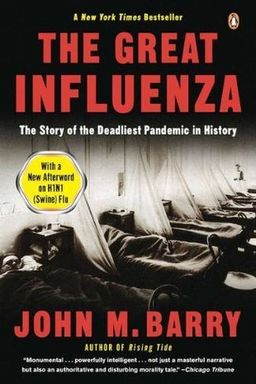
The Great Influenza cover

The Great Influenza

by John M Barry

The Great Influenza by John M. Barry explores the devastating 1918 flu pandemic that reshaped the world. Through meticulous research, Barry unveils the virus''s origins, the scientific struggle to combat it, and the social and political failures that exacerbated its impact. This gripping narrative offers valuable lessons for understanding pandemics and human resilience.

The Pandemic that Redefined Modern Medicine

You enter John M. Barry’s The Great Influenza at a moment when modern science and nature collide. The book argues that the 1918 pandemic was not merely the deadliest epidemic in human history but also the crucible in which American medical science proved its necessity and limits. Barry’s central claim is that the influenza pandemic became the defining test of a young scientific system: laboratories built from the germ theory revolution suddenly confronted an enemy that mutated faster than their tools could follow, forcing both science and society to transform.

An unprecedented biological event

Barry opens by showing scale and speed. The pandemic infected hundreds of millions and killed between 50 and 100 million worldwide, more than any war or plague recorded. Unusually, half of those who died were young adults—people in their twenties and thirties whose robust immune systems paradoxically doomed them. In a span of twenty-four weeks, more than two-thirds of deaths occurred. You see entire cities—Philadelphia, Boston, and lesser towns—halted by mass burials and civic paralysis. The book continually reminds you that in 1918, humanity faced a disease that moved faster and struck deeper than anything science had imagined.

The scientific backdrop: from germ theory to institutions

Before you reach the chaos of the outbreak, Barry explains how the U.S. built the scientific infrastructure that would confront it. Johns Hopkins University, founded in 1876, imported the German model of research-based education. William Welch, its leading architect, recruited brilliant minds—William Osler, William Halsted, Howard Kelly—and fostered rigorous laboratory medicine. The Rockefeller Institute under Simon Flexner carried that spirit into research hospitals and national laboratories. Abraham Flexner’s 1910 report then reformed medical education nationwide. Those institutions supplied a generation of physicians and bacteriologists armed with scientific discipline but still learning how to turn benchwork into lifesaving therapies. The pandemic would test whether education and philanthropy could translate knowledge into action.

War, movement, and the perfect storm

World War I shaped every vector of contagion. Millions of men crowded in poorly ventilated camps like Funston and Devens, then traveled across continents in trains and ships where infection incubated unnoticed. Military orders outranked medical advice; General March refused to halt troop transport despite warnings. Censorship made open reporting impossible—neutral Spain printed freely about its king’s illness, and thus the false label “Spanish flu” was born. In this tinderbox of propaganda, crowding, and global movement, influenza found infinite opportunity to spread. Barry makes you see logistics—harbors, trains, coal stations—as arteries through which the disease flowed.

Biology versus medicine: the mutant swarm challenge

The scientific core of Barry’s book rests on influenza’s biology. It is an RNA virus, which means it mutates with staggering speed because RNA replication lacks proofreading. Each infected cell produces hundreds of thousands of variants—a “mutant swarm.” This swarm adapts quickly, changing surface proteins (hemagglutinin and neuraminidase) through drift or shift, allowing new viral generations to evade immunity. The result is unpredictability: vaccines, which target fixed antigens, struggle against a moving ensemble. You learn that influenza’s segmented genome permits reassortment; two strains co-infecting one host can trade genetic parts and yield a lethal hybrid. That biological agility stands at the heart of why science could not fully contain 1918.

Clinical horror and immune overreaction

At the individual level, Barry takes you into the wards. Doctors describe cyanotic soldiers turning dark blue, bleeding from mucous membranes, and dying within hours. Autopsies reveal lungs burned from inside—a pattern now recognized as Acute Respiratory Distress Syndrome (ARDS). Young adults die most often, not because they are weak but because their immune systems launch a cytokine storm that destroys lung tissue. The virus kills directly through viral pneumonia and indirectly by inviting bacterial invaders, especially pneumococcus. Researchers like Rufus Cole and Oswald Avery at the Rockefeller Institute fight back with antisera that halve mortality for some pneumonia types. Yet the viral damage remains unstoppable, foreshadowing later discoveries about immune overreaction and viral pathogenesis.

Social collapse and moral lessons

The scientific story intertwines with moral failure. In Philadelphia, political greed leads officials to stage a Liberty Loan parade despite medical warnings; within ten days thousands die and bodies fill the streets. Surgeon General Rupert Blue delays decisive federal action, even rejecting research grants that could have accelerated understanding. Public trust fractures as newspapers alternate between minimizing and panicking. By contrast, San Francisco’s health officer William Hassler tells the truth early, closes public spaces, and mobilizes volunteers—one of the few examples of effective leadership amid disaster. The book insists that honesty and clear communication save lives as surely as science.

Legacy and enduring relevance

After the pandemic's peak, the scientific consequences continue. Oswald Avery’s sustained research on pneumococcal transformation leads to the 1944 discovery that DNA is genetic material—a direct descendant of influenza-era laboratory rigor. Globally, epidemiologists learn how waves attenuate: early severe outbreaks exhaust susceptible hosts, later waves lose intensity through immunity and mutation toward moderation. Barry concludes with a warning: the same viral mechanisms remain, and new influenza strains (like H5N1 and H7N7) show that pandemics are inevitable. The ultimate lesson is preparedness—scientific, political, and ethical—and the humility to face unpredictability with truth and collaboration. In that way, The Great Influenza becomes less a history than a manual for the next pandemic.


Birth of Modern Medical Science

You see America reinventing medicine before 1918. Barry shows how a nation of small medical schools transformed into a research powerhouse through institutional visionaries. Johns Hopkins was the pivot: Daniel Gilman’s design in 1876 and William Welch’s leadership created graduate-level science within medicine. Welch’s recruitment of Halsted, Osler, and Kelly built a culture of research-based practice—a radical break from lecture-only education. Their methods—laboratory autopsies, bedside teaching, experimentation—model the German system that births rigorous physicians.

Philanthropy and the Rockefeller connection

Financier John D. Rockefeller establishes the Rockefeller Institute in 1901, entrusting its direction to Simon Flexner. You learn how philanthropy merges science with entrepreneurial organization. Flexner’s blend of practical goals and aggressive publicity converts his institute into America’s premier biomedical laboratory, producing vaccines and antitoxins. Abraham Flexner’s 1910 report leverages the Hopkins example to close mediocre medical schools nationwide and channel funds into strong ones. The parallel movements—Hopkins’s academic rigor and Rockefeller’s applied research—create a national scientific infrastructure just in time for the pandemic’s test.

A cadre of problem-solvers

Welch’s protégés occupy key positions when influenza hits: Oswald Avery at Rockefeller deciphers pneumococcal types; William Park and Anna Williams in New York industrialize antitoxin production; Rufus Cole runs hospital trials that cut pneumonia mortality. These scientists embody Barry’s theme that personality and method matter. Welch’s paternal charisma (“Popsy”) nurtures collaboration instead of rivalry. Flexner’s discipline maintains efficiency under war stress. Together they represent the maturity of American science: no longer reliant on European breakthroughs, but still unprepared for a mutating RNA virus.

Core insight

You learn that scientific institutions are as vital as experiments. Without organized laboratories, the 1918 fight would have been chaos; with them, discovery could persist beyond tragedy and lead eventually to the molecular age.

Barry’s chapters on Welch and Flexner thus provide a biography of an entire system—the apprenticeship that generated heroes of laboratory medicine whose success and frustration alike would define how modern science operates under crisis.


The Virus’s Shape-Shifting Nature

Barry turns to virology to explain why influenza resists containment. You meet the virus at the molecular level: hemagglutinin binds cells; neuraminidase cleaves receptors so new virions escape. They are the visible faces to your immune system. Because influenza’s genome is segmented RNA lacking proofreading, each replication cycle creates countless micro-mutations, forming a 'mutant swarm.' Most variants die, but some slip past antibodies, driving continuous evolution.

Drift, shift, and reassortment

You learn two mechanisms: antigenic drift (gradual point mutations causing yearly changes) and antigenic shift (major swap of H or N genes producing a new subtype). When avian and human viruses co-infect pigs or people, their genome segments can reassort—yielding hybrids that leap species barriers. In 1918, one such adaptation through human passage likely intensified virulence between spring and fall waves. Later outbreaks—H5N1 in 1997, H7N7 in 2003—repeat this logic. (Note: Barry's emphasis mirrors Richard Shope’s later discovery in swine influenza confirming viral, not bacterial, origin.)

Mutation over time

Influenza’s evolution explains shifting severity. Early camps hit by virulent strains suffer catastrophic pneumonia rates—over 60% mortality among pneumonic cases—whereas later ones see far lower rates. Barry explains this with adaptation: society and virus coevolve; immunity accumulates; extreme virulence reverts toward a mean. Epidemic waves therefore demonstrate biology in motion, not static recurrence.

Scientific takeaway

You cannot treat influenza as a single species. It is a swarm, and planning for one strain means planning for an adaptable system—a lesson that underlies modern WHO surveillance networks.

In short, you see mutation as not just an obstacle but a natural rhythm of influenza itself. The 1918 narrative becomes a study of evolving biology interacting with evolving human behavior—a theme that transcends its century.


War and the Machinery of Spread

Barry situates the pandemic squarely inside World War I’s logistical web. Training camps, ships, and censorship combine to spread influenza worldwide. Camp Funston in Kansas provides the likely spark: Dr. Loring Miner’s early cases travel outward with recruits. By March 1918 thousands in Funston are sick, and troop trains ferry infection to other bases. At the same time, secrecy—enforced by Wilson’s Committee on Public Information—delays acknowledgment. Newspapers print optimism instead of warnings.

Camps and trains as amplifiers

Barry’s portraits of Camp Devens and Camp Grant show how overcrowding multiplies catastrophe. Devens collapses under 1,500 new cases in one day; hospitals overflow; the morgue becomes a corridor. Grant’s command decisions to house men tightly in cold weather convert precaution into disaster. Even troop trains carry infection: one loaded train sends 3,000 men south, and two-thirds are hospitalized on arrival. Mobility becomes the virus’s greatest ally.

Global transport: ships and colonies

On sea routes, coaling stations and troopships repeat the same tragic physics. HMS Mantua spreads influenza through Freetown, Sierra Leone; subsequent ships like Tahiti and Chepstow Castle lose dozens of crew. Quarantine fails; bodies bury at sea. Within weeks, the disease jumps continents—from West Africa to India and the Pacific. The pattern is logistical contagion: disease as a by-product of industrialized movement.

Lesson from history

In crises, mobility can be both power and peril. When political imperatives overrule medical warnings, infrastructure designed for victory can deliver mortality instead.

In Barry’s reconstruction, war is the pandemic’s engine—not its cause but its accelerant, showing how modern transportation networks bind humanity to shared biological fate.


Science Under Siege: Discovery and Error

During the pandemic, laboratories race to identify the cause. Many experts follow Richard Pfeiffer’s earlier lead, blaming Pfeiffer’s bacillus (B. influenzae). Scientists like William Park, Anna Williams, and Oswald Avery isolate it from many patients. But Barry narrates how this hypothesis unravels. As cultures improve—thanks to Avery’s chocolate agar method—researchers discover multiple strains with limited cross-reactivity. Park and Williams realize that the bacillus is a frequent secondary invader, not the primary pathogen.

The filterable virus debate

Meanwhile, others experiment with filtration—trying to pass infectious material through bacteria-trapping filters. Results conflict. Rosenau’s human trials fail; Nicolle's small successes in monkeys remain uncertain. For years confusion reigns: bacteriologists versus virologists, results versus replications. Barry uses this episode to depict science functioning under extreme pressure—driven by urgency, yet limited by technology and human error.

Failing forward into DNA

The same meticulous techniques developed to study capsules and transformations later enable Oswald Avery’s 1944 discovery that DNA carries heredity. Thus, the failures of 1918 propel molecular breakthroughs. Rockefeller’s serum labs, Flexner’s coordination, and Biggs’s commissions all collect preserved specimens that scientists like Jeffrey Taubenberger will use decades later to reconstruct and sequence the 1918 virus genome.

Scientific insight

Progress often begins in error. Laboratories that failed to prove bacterial causation built the vocabulary, ethics, and specimen archives for modern virology and genetics.

Barry’s portrayal of 1918 science gives you a dual image: brilliant people thwarted by biology, yet their persistence sets the stage for the genomic age. The struggle itself becomes the source of future clarity.


Collapse, Memory, and Emotional Sequelae

Barry closes with the human dimension. Society fractures under combined trauma—war, censorship, and plague. Philadelphia’s corpse-strewn streets and orphan waves echo globally: in India, 14 million dead; in Western Samoa, 22% of people gone; in Alaska, villages erased. Fear silences communities. Newspapers alternate denial and despair, undermining trust. Volunteerism falters as contagion exhausts courage. Rituals of burial vanish—dogs gnaw bodies, steam shovels dig trenches.

Psychological and neurological aftermath

Influenza leaves mental scars. Karl Menninger observes post-influenzal psychoses; the AMA documents delirium and melancholy. Autopsies show brain inflammation and vascular lesions, hinting that influenza can cross the blood-brain barrier. Later parallels—encephalitis lethargica and Parkinsonian rises—suggest that viral damage and immune activation might echo for years after crisis. Barry uses these to expand influenza beyond a lung disease—an event that reshapes minds and behavior.

Silence and remembrance

Despite its scale, the pandemic nearly vanishes from literature and history. Few writers—Katherine Anne Porter among them—record it vividly. Barry argues that societies prefer to remember human conflict over natural catastrophe. War becomes celebrated; disease becomes buried. Yet the demographic scars remain: millions of orphans, a labor shift, and a cultural melancholy that colors the 1920s. He invites you to see memory itself as a public-health variable—forgetting tragedy risks repeating it.

Human truth

The pandemic killed not only bodies but confidence—the belief that civilization could control nature. Recovering that faith required science and honesty, lessons that remain critical as pandemics recur.

In Barry’s closing argument, the 1918 influenza stands as both catastrophe and catalyst. It pushed medicine to new heights and revealed the cost of secrecy. What survives is not just virus and memory but an enduring call for transparency and preparedness.


Preparedness and the Next Pandemic

Barry concludes with a plea that reads like prophecy. Future pandemics are inevitable because influenza’s biology guarantees it: reservoirs in birds, constant mutation, and occasional genetic reassortment. The lesson of 1918, he writes, is not nostalgia but preparation. Governments must stockpile antivirals and antibiotics, plan logistics for rapid distribution, indemnify manufacturers, and clarify legal frameworks for quarantine and vaccination authority.

Scientific readiness

Vaccines are powerful but slow; production through eggs takes months and may fail when the virus kills embryonic tissue. Antivirals help only early and face resistance. Surveillance networks—like WHO’s post-1948 system—are humanity’s eyes. Barry urges open data sharing, warning that just weeks of delay can transform manageable outbreaks into global disasters (he compares SARS in 2003 and avian influenza responses). Preparedness thus depends on honesty as much as technology.

Ethical and political dimensions

You must also weigh justice: who receives scarce doses first? How far can liberty bend for collective safety? Barry frames these as moral equations echoing 1918 dilemmas—between political optics and medical truth. After 9/11 and anthrax attacks, these questions achieved new urgency; his analysis prefigures debates about bioterror and global health funding.

Essential warning

Preparedness is costly, but complacency costs more. Institutional coordination, transparent leadership, and sustained investment are the only antidotes to panic and paralysis.

Barry’s final chapters transform history into blueprint: science must couple with governance; truth must override propaganda; and every epidemic must remind you that modernity’s health depends on remembering—and planning for—the lessons of 1918.

Dig Deeper

Get personalized prompts to apply these lessons to your life and deepen your understanding.

Go Deeper

Get the Full Experience

Download Insight Books for AI-powered reflections, quizzes, and more.