
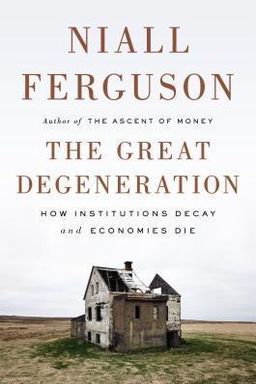
The Great Degeneration cover

The Great Degeneration

by Niall Ferguson

The Great Degeneration delves into the declining power of Western nations, attributing it to the decay of institutions that once drove global dominance. Niall Ferguson argues for radical reform to avert future economic and geopolitical instability.

How Institutions Decay and Economies Die

What happens when the structures that once made societies flourish begin to falter? In his book The Great Degeneration, historian Niall Ferguson confronts one of the pressing concerns of our time: the slow, mostly unnoticed decline of Western civilization’s core institutions. After centuries of dominance in economics, science, and governance, the West, Ferguson argues, has entered a state of institutional decay—a great degeneration that threatens its capacity for innovation, social mobility, and self-renewal.

According to Ferguson, today’s stagnation can’t simply be blamed on debt bubbles or financial crises. Nor is it merely a question of “deleveraging” after too much borrowing. Instead, he contends that our malaise stems from a breakdown in the four institutional pillars that once underpinned the West’s success: democracy, capitalism, the rule of law, and civil society. These systems have not disappeared—they’ve become distorted, overgrown, and self-serving. Where once they created opportunity, accountability, and trust, they now produce debt, bureaucracy, and dysfunction.

The Fate of Western Civilization

Ferguson begins by recalling Francis Fukuyama’s 1989 proclamation of “the end of history” and the triumph of Western liberal democracy. A generation later, that optimism looks misplaced. China's state capitalism is ascendant, Western economies are burdened by unprecedented debt, and social mobility has stalled. Ferguson calls this the “stationary state” of the West, echoing Adam Smith’s warning that once-productive societies stagnate when corrupt elites exploit legal and economic systems for personal gain.

The culprit, Ferguson suggests, lies not in globalization or technology, but in ourselves—specifically, in the erosion of the institutions that once energised Western life. These institutions, once adaptive and self-correcting, have decayed into bureaucratic webs and self-referential rulebooks. They now reward rent-seeking elites and political paralysis rather than innovation or long-term responsibility. Without reform, Ferguson warns, our societies risk becoming exactly what Smith saw in 18th-century China: prosperous once, but trapped in mediocrity and decline.

The Four Black Boxes

To diagnose this institutional sickness, Ferguson “opens up” four interlocking systems:

  • Democracy – Once a partnership between generations, it’s now a machinery for the living to borrow from the unborn. Vast public debts and unkept fiscal promises reveal a broken social contract where the old exploit the young through unsustainable welfare entitlements.
  • Capitalism – The engine of growth has become a jungle overgrown with regulation. Excessive rules, dishonest incentives, and moral hazard have mutated once dynamic markets into fragile systems dependent on bailouts and endless tinkering.
  • The Rule of Law – The foundation of Western liberty is eroding into legal bloat. The U.S., Ferguson claims, is shifting from a nation ruled by law to one ruled by lawyers, where justice is costly and regulation smothers initiative.
  • Civil Society – Once the realm of voluntary associations and community initiative, it’s been hollowed out by the welfare state and the siren call of digital networks. Facebook “likes” cannot replace the Lions Clubs or church committees that built social trust and civic virtue.

Like the inner workings of a computer, each of these institutions interacts with the others. When one fails, the entire circuitry begins to short-circuit. Ferguson’s argument is both historical and moral: just as the West’s rise was institutional, so too is its decline.

Why This Matters

Ferguson’s warning carries real urgency. Unlike economic downturns, institutional decay doesn’t announce itself through sudden collapse; it creeps. Democracies load their young with impossible debts. Regulators multiply faster than entrepreneurs. Judges, not voters, become policymakers. Citizens retreat from community engagement, preferring to tweet about problems instead of solving them. The ultimate danger, Ferguson suggests, is that dynamic liberal societies ossify into slow-moving bureaucratic states—tolerant of vice, allergic to risk, and incapable of renewal.

But decay is not destiny. By studying history’s cycles of institutional rise and fall—from the Glorious Revolution to modern Asia—Ferguson believes we can still reverse the great degeneration. Doing so means rediscovering the habits, accountability, and moral imagination that built the West in the first place.

“Institutions are to humans what hives are to bees,” Ferguson writes. “If the hive fails, the colony perishes.”

In the chapters that follow, Ferguson unpacks each “hive” in turn—probing how democracy’s intergenerational contract broke, how capitalism’s regulators became parasites, how the rule of law turned inward, and how civil society’s grassroots eroded. Ultimately, The Great Degeneration is both a diagnosis and a rallying cry: a call for citizens—not just governments—to reclaim responsibility for the survival of free civilization.


Democracy and the Broken Social Contract

When did democracy stop being a partnership between generations and become a system of intergenerational theft? Niall Ferguson argues that modern democratic states have abandoned Edmund Burke’s vision of a social contract linking “the dead, the living, and the unborn.” Instead of stewardship, they’ve embraced short-term self-interest, running up vast debts to satisfy present voters while burdening the next generation with the bill.

The Rise of Intergenerational Debt

Ferguson reveals the extent of the imbalance: by 2013, countries like Greece, Italy, and Japan were drowning in public debts exceeding 100% of GDP, while the United States faced unfunded liabilities of nearly $200 trillion when accounting for future entitlement promises such as Medicare and Social Security. The illusion of prosperity masks what Ferguson calls an “intergenerational Ponzi scheme,” where those in power buy votes through deficits and welfare expansion, passing insolvency to younger citizens who cannot yet vote.

This, Ferguson insists, is not a financial crisis—it’s an institutional and moral one. Governments now function like reckless trust managers, spending their wards’ inheritance. The postwar democratic miracle—universal suffrage combined with welfare states—has created political incentives to spend more and defer pain. While Keynes argued that “in the long run we are all dead,” Ferguson reminds readers that our descendants will still be very much alive—and paying interest.

Adam Smith’s Stationary State Returns

Drawing on Adam Smith, Ferguson frames the modern West as a society entering Smith’s “stationary state”—a once-progressive civilization now mired in stagnation. In this state, wages stagnate, elites manipulate law to entrench privilege, and innovation wanes. Like eighteenth-century China, which Smith criticized for bureaucratic rigidity and rent-seeking mandarins, the West’s governments have grown complex and self-protective, serving incumbent interests rather than fostering new opportunity.

The welfare state, argues Ferguson, makes matters worse: it turns citizens from contributors into dependents and replaces civic duty with entitlement. Bureaucracies grow not from efficiency but inertia. Generations that once built institutions to empower their descendants now cannibalize them through fiscal irresponsibility.

Possible Remedies—and Their Obstacles

Ferguson offers pragmatic—if politically difficult—solutions: transparent government balance sheets that reveal hidden liabilities; adherence to Generally Accepted Accounting Principles (like those used in business); and regular generational accounts showing the true long-term costs of policy. Only when citizens know the intergenerational math, he argues, can democracies restrain themselves.

Yet the difficulties are daunting. Young voters often fail to see how heavily the future depends on present deficits, and older voters—who tend to turn out reliably—overwhelmingly support preserving benefits. In this climate, Ferguson warns, elections become “auction markets in stolen goods.”

If democracies are to survive, they must rediscover Burke’s sense of continuity between generations. Without that moral backbone, Ferguson cautions, the West risks becoming a decayed hive, once buzzing with cooperative industriousness, now consumed by short-term greed.


Regulation and the Darwinian Economy

Ferguson’s second institutional autopsy tackles the economy. Contrary to popular belief, he argues, the financial crises of recent years were not caused by a lack of regulation, but by the wrong kind. Far from being a deregulated free-for-all, the modern financial system is, he shows, a labyrinth of poorly designed laws that multiply fragility. In this sense, regulation is not the cure—it’s the disease masquerading as medicine.

The Myth of Deregulation

Ferguson challenges the narrative advanced by economists like Paul Krugman—that Reagan-era deregulation unleashed banker greed and caused the 2008 financial collapse. As he documents, financial markets in the 2000s were more heavily regulated than ever, governed by complex international frameworks such as the Basel Accords. These rules encouraged perverse incentives, allowing banks to treat government bonds as risk-free assets and to self-assess the safety of their portfolios using credit ratings. As a result, banks ballooned their balance sheets—legally—until they became “too big to fail.”

The result, Ferguson laments, was a fragile ecosystem dominated by a handful of massive institutions whose size and interconnections guaranteed catastrophe when the bubble burst. When governments rushed in to save them, they entrenched moral hazard and public cynicism. The response, the 2010 Dodd–Frank Act, only compounded the problem by adding thousands of pages of new rules few could understand.

Finance as Natural Selection

To explain what went wrong, Ferguson invokes a Darwinian analogy: finance, like nature, thrives on variation and selective pressure. Successful firms adapt; failed ones die. But overregulation prevents this evolutionary process by protecting the weak and suppressing experimentation. Where Bagehot’s nineteenth-century financial system allowed bad banks to fail, today’s “intelligent designers” at central banks and regulatory agencies engineer environments where survival is political, not competitive. The result is not a self-correcting ecology but a fragile monoculture—like a forest prevented from burning, only to explode later in an unstoppable fire.

Back to Bagehot: Simplicity and Enforcement

So what does work? Ferguson reintroduces Victorian economist Walter Bagehot’s ideas from Lombard Street (1873). Bagehot argued that central banks should lend freely but at high rates during crises, maintain ample reserves, and employ experienced, prudent leadership rather than rigid formulae. Ferguson interprets this as a call for simpler, principle-based regulation: rules should empower discretion, not replace judgment. More importantly, wrongdoers must face real consequences—something sorely missing after 2008. As he notes, few bankers went to jail; most kept their bonuses. When dishonesty carries no risk, corruption metastasizes.

Ferguson concludes this chapter with a paradox: while bankers have long been caricatured as untamed predators, the real danger lies with the bureaucrats who claim to “control” them. Complex rules build brittle systems. Only the return of accountability, moral responsibility, and institutional humility can make capitalism truly Darwinian again—self-correcting, not self-protecting.


The Decline of the Rule of Law

No civilization, Ferguson insists, survives without a credible rule of law. Yet in the modern West—especially in the United States—the law itself has become bureaucratic, inconsistent, and captured by vested interests. Instead of protecting liberty and property, it now rewards litigation, complexity, and political favoritism. The danger is subtle but systemic: the shift from the rule of law to the rule of lawyers.

From Common Law to Legal Bloat

Ferguson celebrates the English common law tradition—a flexible, precedent-based system that balanced stability with adaptation. Figures like Lord Camden and Lord Mansfield helped establish principles of property, contract, and liberty without grand constitutions or revolutions. But this delicate evolution, Ferguson warns, is being reversed by a modern mania for codification and legal intervention. Statute books groan under the weight of tens of thousands of new rules; ordinary citizens face prohibitive legal costs; and governments legislate impulsively, often under media pressure.

The consequence is a legal climate hostile to enterprise and justice alike. Drawing on data from the World Economic Forum and World Bank, Ferguson shows that the United States—once the beacon of “rule-of-law capitalism”—now ranks below Hong Kong and even Taiwan on measures of efficiency, fairness, and corruption. The legal system, he argues, has been captured by a professional class more interested in rent extraction than reform.

Why Legal Disease Matters

The fallout extends far beyond courtrooms. Excessive tort litigation and regulatory complexity cost U.S. businesses trillions annually—hidden taxes that stifle entrepreneurship and innovation. Ferguson quotes economists David Kennedy and Joseph Stiglitz, who admit that current U.S. laws promote “partially indentured servants”—citizens trapped by debt, patents, and predatory contracts. When legal systems become instruments of inequality rather than fairness, he argues, they lose their moral authority.

Meanwhile, developing nations are learning from the West’s mistakes. Countries ranging from Rwanda to Malaysia have streamlined legal procedures, cut red tape, and improved property-rights enforcement—just as Anglo-American systems have done the reverse. The irony is painful: as former colonies reform, their old mentors decay.

“Americans could once boast proudly that their system set the benchmark for the world,” Ferguson laments. “But now what we see is the rule of lawyers, which is something different.”

Reversing the degeneration, he suggests, means simplifying legislation, enforcing existing laws fairly, and curbing the political power of the legal class. Otherwise, the system that once safeguarded liberty will continue its drift toward self-parody—and justice will remain a privilege of those who can afford it.


The Collapse of Civil Society

The final pillar of Ferguson’s diagnosis concerns civil society—the web of associations, clubs, and voluntary organizations that bind citizens outside state control. It is, he argues, the glue of free societies, the classroom of civic virtue, and the seedbed of trust. Yet like the reefs eroded by rising seas, civil society in the modern West is disintegrating.

From Tocqueville’s America to Facebook’s Age

Ferguson begins with Alexis de Tocqueville’s famous portrait of 19th-century America—a nation of joiners who formed countless associations to address everything from education to moral reform. These voluntary networks, Tocqueville observed, kept democracy energetic and decentralized, preventing tyranny by fostering cooperation. In contrast, modern societies, saturated by government welfare and digital connectivity, are losing the habits of face-to-face association. Membership in community groups, churches, and unions has plunged across the U.S. and UK since the 1970s. Robert Putnam’s Bowling Alone captured this trend; Ferguson extends it, showing that even philanthropic giving and volunteering have declined among younger generations.

He counters the comforting belief that social media replaces civic life. Facebook, for instance, creates networks that are “wide but weak”—efficient for signalling opinions, useless for doing difficult things together. You can’t clean a beach, build a school, or care for the elderly through likes and retweets.

The Welfare State and the Infantilization of Citizens

The deeper enemy, Ferguson contends, is not technology but the state’s expansion into every sphere of social life. Welfare bureaucracies have replaced the local charity, the parish, the club, and the guild. Citizens once active in self-help or mutual aid now await entitlements from above. Quoting Tocqueville, Ferguson warns that modern democracies may become “a herd of timid and industrious animals of which the government is the shepherd.” The result is infantilization: people who once governed themselves can barely organize a town meeting without official permission.

Reviving Civic Association through Education

To restore vitality, Ferguson urges the revival of independent education and voluntary initiative. He praises Britain’s growing network of academies and “free schools” that, like Sweden’s voucher-based system, encourage parental involvement and autonomy. Similarly, he sees promise in independent schools that provide scholarships and community outreach, breaking the monopoly of state education. True civic renewal, he suggests, begins when citizens take back functions the state has colonized—from teaching children to caring for neighbours.

Civil society, Ferguson reminds us, isn’t abstract. It’s built in school boards, charities, clubs, and common efforts—like the seaside cleanup he personally organized in Wales. When ordinary people rediscover that collective action need not depend on the state, the West may yet recover the vitality that once made it exceptional.


Reviving the West: Lessons from History

The book concludes with a sweeping reflection on what the past can teach about future renewal. Ferguson believes that civilizations fall not from natural decay but from institutional failure—and that recovery begins when people reimagine and rebuild those institutions. The West has faced stagnation before and emerged stronger; doing so again demands honesty about where it went wrong.

Institutions and Evolution

In Ferguson’s view, institutions evolve like species. They can adapt to new environments or perish through inertia. Britain’s Glorious Revolution produced inclusive political and financial institutions because elites accepted rule-bound governance. By contrast, societies that adopt extractive institutions—where the powerful manipulate rules for personal gain—soon stagnate. Ferguson credits historians and economists such as Douglass North and Daron Acemoglu for showing that long-term prosperity depends more on institutions than on geography or culture.

Warnings and Possibilities

The risk today, Ferguson warns, is that Western institutions are becoming extractive again. Governments mortgage the future; corporations capture regulators; law serves insiders; and citizens retreat into apathy. This combination sets the stage for what he calls “the stationary state” of the 21st century. Yet history also shows moments of transformation: post-Glorious Britain, postwar Japan, or today’s reforming African nations like Rwanda. These cases prove that decline can be reversed when civic energy, competition, and accountability are restored.

A Call to Citizens

For Ferguson, salvation lies not in technocratic fixes but in civic awakening. The state, the market, and the law depend on the moral capital of active citizens. Rebuilding trust, restraining debt, simplifying law, and reviving voluntary spirit must be grassroots efforts led by ordinary people. The “Big Society,” as he notes, should not be a political slogan but a lived habit of self-government and cooperation.

Ultimately, The Great Degeneration ends not in despair but in challenge. Ferguson asks readers to see systemic decay as reversible—and to act as restorers, not cynics. Just as past generations built the frameworks that sustained liberty and prosperity, today’s citizens can reconstruct them. Clearing the debris of bureaucracy and rekindling civic trust is not nostalgia; it’s survival.

Dig Deeper

Get personalized prompts to apply these lessons to your life and deepen your understanding.

Go Deeper

Get the Full Experience

Download Insight Books for AI-powered reflections, quizzes, and more.