
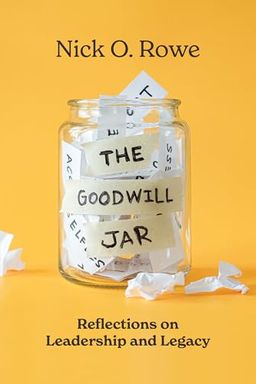
The Goodwill Jar cover

The Goodwill Jar

by Nick O Rowe

The Goodwill Jar presents timeless wisdom on building meaningful relationships and leaving a positive legacy. By choosing goodwill-guided actions, readers can overcome feelings of disconnectedness, embrace purpose, and create ripple effects of joy in their lives.

What It Means to Be Human in a Post-Human Universe

What does it really mean to be human—especially in a future where biology, technology, and economics blur our most basic definitions of self? In A Jar of Goodwill, Tobias S. Buckell drops us into a world where humanity has fled the old Earth, corporations own the stars, and survival is literally measured in breaths of air. But beneath the high-tech systems and alien politics, this story asks a timeless question: what remains of our humanity when every choice is entangled in profit, power, and survival?

At its core, this novella is about moral identity under economic tyranny. Buckell imagines a world where humans, aliens, and hybrids coexist under exploitative systems resembling late-stage capitalism on a cosmic scale. Through the eyes of Alex Mosette—a debt-ridden professional “Friend” genetically engineered for empathy—the story explores the profound loneliness of sentient beings cut off from genuine connection and forced into transactional existence.

The Fragile Economics of Survival

Life in this future is a constant negotiation. You pay for air, food, and space inside orbital stations owned by the alien Gheda, whose patent rights and mercenary ethics dominate entire civilizations. Alex’s opening situation—being overdrawn on oxygen—sets the tone. Every breath she takes costs money, and debt means hibernation or worse. When offered a dangerous contract with a crew of rogue scientists, she accepts not out of ambition, but to stave off asphyxiation. This is a survival narrative wrapped in corporate bondage.

The resulting tension mirrors modern human realities: economic insecurity, dependence on extractive systems, and the way systemic inequality forces people into moral corners. In Buckell’s world, friendship, compassion, and ethics are commodified just like everything else. Alex, as a “Friend,” is literally engineered and trained to anticipate emotional needs and monitor truth—a professional companion who sells empathy for survival.

The Crossroads of Empathy and Exploitation

Alex’s journey places her amid four contrasting moralities: the ruthless practicality of the Gheda, the desperate ambition of the freelance scientists, the collective mind of the Compact, and the developing civilization of the aliens called Vesians. Each introduces a fragmented reflection of humanity’s struggle to define itself through relationships and meaning rather than through domination.

When Alex is tasked to serve as a friend to Beck—a drone from the Compact, a hive-mind of interconnected humans—the novella digs into an unnerving mirror. Beck, stripped of ego and individuality, still seeks comfort and contact. His relationship with Alex becomes a moral litmus test, raising haunting questions: is empathy authentic when it’s contractual? Can connection exist in a post-human economy that owns even your feelings?

The Central Moral Dilemma

The heart of the story turns on one decision: a group of human scientists, led by Oslo and Kepler, discover the Vesians—chlorine-breathing insectoid aliens who might be intelligent. If declared sentient, the Gheda will seize control, wiping out any human claim to the discovery. But if the scientists fake the data, lobotomizing the Vesians with a virus to mask their intelligence, they can retain ownership and patent the alien ecosystem for unimaginable profit. This impossible choice traps Alex and Beck between complicity and conscience.

Buckell forces you to confront what kind of ethical action still matters in a universe where corporations own morality. Do you protect yourself, others, or the abstract “idea” of life? The story’s resolution—where Beck sacrifices himself and the Vesians ascend into a new form of alliance with the Compact—reveals a grim yet flickering hope: even in systemic oppression, cooperation and compassion can subvert exploitation.

Why It Matters Today

Buckell’s novella is both intimate and global in its implications. It reads as both science fiction and social allegory. The oxygen debt recalls modern-day debt peonage and inequality. The Compact Hive evokes digital collectivism and the erosion of privacy in technology-dependent societies. And the Gheda stand in for predatory corporations claiming ownership of nature, technology, and even knowledge itself.

If you’ve ever wondered whether our technological progress is eroding the things that make us human, this story gives a chilling answer: the struggle for empathy and fairness isn’t over—it’s just been moved off-world. Buckell’s humanistic vision refuses utopia but still leaves room for moral evolution. Humanity may adapt, even hybridize, but the spark of conscience—embodied in Alex’s final rejection of wealth and her quiet gratitude for still breathing—remains unstoppable.

“Few things are human anymore,” Alex reflects at the end. Yet her empathy, her friendship—freely offered at last—prove that being human is not a matter of biology or contract, but of choice.


Debt, Survival, and the Price of Air

In Buckell’s universe, every breath has a price tag. Alex Mosette’s oxygen debt is not just a detail—it’s the foundation of an entire moral and economic structure. It brilliantly reshapes your understanding of survival: not as a basic right, but as a financial constraint controlled by the wealthy or the inhumanly rational.

The Economics of Breathing

The opening scene—with Alex being reminded by a partial cyborg harbormaster that she’s “overdrawn” on air—is a brutal redefinition of poverty. Space is privatized down to the cellular level. The more you breathe, the more you owe. In many ways, this world is a metaphorical extension of our modern gig economy, where access to basic needs is mediated through contracts, fees, and surveillance.

Alex’s relationship with the harbormaster, a half-machine bureaucrat bound by fairness algorithms, evokes a paradox: systems meant to be impartial can still enforce cruelty with mathematical precision. It’s a cold justice that mirrors what happens when fairness is stripped of compassion.

Fair Trade and Moral Compromise

The harbormaster’s offer—accept hibernation or join a perilous freelance mission—highlights a world where fairness doesn’t mean justice. Like many laborers in desperate economies, Alex must choose between certain stagnation and a dangerous gamble. Her eventual decision to board the scientists’ ship represents the thin line between autonomy and exploitation.

Buckell structures this as a quiet tragedy: fairness without empathy becomes another form of control. Even the harbormaster’s “kindness” is conditional. For readers, it’s a powerful reminder that systems that seem neutral often perpetuate inequality—especially when survival is contractual, not human.


Friends, Drones, and the Commodification of Empathy

Alex’s profession as a “Friend” offers one of the story’s most chilling insights: empathy itself is a service industry. She’s modified and trained to anticipate emotions, interpret micro-expressions, and translate empathy into productivity. In short, she sells care. In Buckell’s future, compassion has a corporate rate.

The Emotional Middleman

Friends act as both psychological translators and companions—tools used by the powerful to smooth over cultural misunderstandings or negotiate contracts. Yet Alex’s interactions with others reveal her own emotional isolation. She’s always managing, decoding, and soothing others, but she rarely receives authentic care in return.

This commodification of empathy reflects a broader critique of modern labor: where emotional intelligence becomes another metric of productivity. (Readers might notice parallels to Arlie Russell Hochschild’s concept of “emotional labor.”)

Connection Inside Artificial Bonds

Alex’s relationship with Beck, the Compact drone, transforms her understanding of connection. Beck’s hive-linked consciousness allows him to experience belonging Alex never has—but it also erases individuality. As the two share cramped quarters, sleep side-by-side, and dance between duty and care, they reveal the fragile line between intimacy and performance.

Their growing closeness culminates in a paradox: only by connecting with a being designed to erase self does Alex rediscover her own agency and compassion. Buckell subtly suggests that empathy—genuine empathy—can’t be bought or programmed. It’s chosen, often at great cost.


Corporate Empires and Alien Capitalism

The alien Gheda loom over this story as silent gods of capitalism. They are not villains of passion or cruelty; they’re bureaucrats of intellectual monopoly. The Gheda’s dominance isn’t physical—it’s legal, contractual, and patent-based. They control technology by retroactively claiming ownership of parallel discoveries, turning human innovation into stolen property.

This resonates eerily with present-day debates about intellectual property, corporate monopolies, and colonial extraction. Buckell’s Gheda weaponize bureaucracy the way empires once wielded armies. Humans, reduced to subcontracts and debt, live in the moral aftermath of selling their world for progress that isn’t theirs anymore.

Patent Wars as Modern Colonization

Through the scientists’ desperate search for a new patentable ecosystem, Buckell satirizes the endless cycle of capitalist exploitation. The discovery of the chlorinated planet Ve is not a scientific breakthrough—it’s a scramble for ownership. Knowledge itself has become currency, and life forms are intellectual property waiting to be harvested.

By aligning capitalism with alien detachment, Buckell highlights the moral alienation that occurs when innovation loses its ethical dimension. The Gheda do not hate; they just invoice. And that’s far more terrifying.


Artificial Intelligence and Hive Consciousness

Where the Gheda represent cold capitalism, the Compact represents its opposite extreme: total collectivism. Beck, a chemically neutered drone linked to a hive mind through implants, is a living metaphor for the tension between unity and individuality. His every thought is part of a vast, distant consciousness—and yet he feels isolation when disconnected by distance and signal delay.

Through Beck, Buckell explores how even perfect connection can be dehumanizing. What happens when we outsource morality to the collective? Beck’s faith in the hive echoes our growing dependence on algorithmic consensus—from AI-driven governance to crowd-sourced truth.

The Ethics of the Collective

When the Compact votes against genocide, its morality is logical, not emotional. Yet this cold idealism saves lives. Buckell raises an unsettling idea: maybe human compassion isn’t enough—we might need collective intelligence to prevent our worst impulses. Still, through Beck’s exhaustion and yearning, the story reminds you that moral clarity without emotional understanding is as hollow as data without context.


The Alien Question: Intelligence, Exploitation, and Survival

The conflict over the Vesians—the plastic-bodied, chlorine-breathing species of Ve—is the heart of the story’s ethical tension. Their ant-like hives and chemical language make them an evolutionary mirror of humanity’s struggle for recognition. Are they intelligent? Or just organized instinct? The answer determines who owns a planet.

Cruzie’s discovery—that the gourds carried a chemical language equivalent to writing—confirms the Vesians’ sentience. This revelation ignites a moral and political crisis. The same fact that should inspire awe instead becomes the basis for a corporate cover-up and a planned lobotomy of an entire species.

Buckell uses this dilemma as allegory for human history: the colonizer’s impulse to redefine intelligence so that only exploitable beings qualify as “less than.” Alex and Beck’s resistance, though small, preserves some integrity in a system where recognizing another civilization’s humanity threatens profit.


Moral Evolution and the Choice to Care

The story culminates in Alex’s moral awakening. Surrounded by those willing to commit genocide for profit, she chooses otherwise. Her contract, her training, even her survival instincts all pressure her toward compliance, yet she defies them—not by heroic action, but by simple decency.

Small Humanity in a Vast System

When Beck reveals that he’s been altered by the Compact to communicate with the Vesians, Alex’s empathy becomes her rebellion. She doesn’t save the universe; she saves her soul. By refusing to betray Beck and witnessing the Vesians’ survival, she reclaims the human essence her world has commodified away.

The final scene—Alex returning to the orbital station, granted comfort but haunted by what she’s seen—embodies Buckell’s thesis. Being human isn’t a matter of species, technology, or contract. It’s the stubborn act of caring in an uncaring world.

In the end, the “jar of goodwill” symbolizes all that remains of grace—an alien gift of gratitude passed between beings who chose connection over control.

Dig Deeper

Get personalized prompts to apply these lessons to your life and deepen your understanding.

Go Deeper

Get the Full Experience

Download Insight Books for AI-powered reflections, quizzes, and more.