
Idea 1
Reclaiming Life from Work
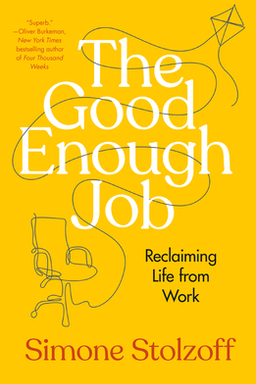
How much of your identity is tied to your job? In The Good Enough Job: Reclaiming Life from Work, journalist Simone Stolzoff invites you to confront this question head-on. He argues that modern society—especially in the United States—has blurred the boundary between who we are and what we do. Work, which once existed as a means to earn a living, has evolved into a quasi-religion: a source of purpose, identity, and status. Stolzoff contends that to live fulfilling, balanced lives, we must stop worshipping at the altar of work and instead cultivate identities that extend beyond our occupations.
The book’s central thesis—that a “good enough” job is not a failure but a path to freedom—draws inspiration from psychologist Donald Winnicott’s idea of the “good enough parent.” Like a parent who doesn’t strive for perfection but instead nurtures resilience, Stolzoff asks us to seek sufficiency over idealization in our professional lives. The goal isn’t to stop working or to find the mythical dream job but to build a sustainable relationship with work, one that leaves room for love, rest, community, and purpose beyond the office.
The Rise of Workism
At the heart of Stolzoff’s book lies a critique of what Derek Thompson, writing in The Atlantic, called “workism”—the modern belief that work should be simultaneously our economic engine and our ultimate source of meaning. Through cultural history and personal storytelling, Stolzoff tracks how this belief took hold in America. From early Protestant ideals that sanctified labor as divine duty to post-industrial management culture that rebranded work as self-expression, each era has deepened our collective attachment to jobs as mirrors of self-worth.
Stolzoff shows that this obsession spans class lines: white-collar professionals conflate success with fulfillment, while service workers often feel pressure to find “meaning” in survival-level labor. Even those who don’t aspire to career passion are judged by their productivity. “In America,” he writes, “a person’s worth is often measured by their output.” Work, once a part of life, has become its organizing principle.
Personal Stories, Cultural Mirrors
The book unfolds through richly detailed portraits of nine workers—from Michelin-star chefs and journalists to librarians and tech employees—each revealing a myth about work that shapes modern lives. Divya, a chef-turned-founder exploited by her mentor, shows how overidentifying with professional success can erode personal boundaries. Ryan, a pastor-sociologist, illustrates how people trade organized religion for the “religion of work.” Fobazi, a librarian, exposes how “vocational awe” can justify underpayment in passion-driven fields. And Megan, a media executive, confronts her burnout and struggles to rediscover herself outside her career.
These stories serve as both diagnosis and mirror, revealing the emotional, spiritual, and systemic costs of overwork. They show that meaning extracted from labor is fragile; when jobs end or identities shift, meaning collapses. As cultural references, Stolzoff draws on thinkers like Max Weber, Hannah Arendt, and Sarah Jaffe to underscore how capitalism and technology have intensified work’s moral gravity. His lens is anthropological yet intimate—each character embodies a societal pattern, and together they chart the emotional terrain of a generation rethinking productivity as virtue.
From Dream Jobs to Good Enough
Stolzoff critiques the modern obsession with finding a “dream job,” tracing it back to Richard Bolles’s What Color Is Your Parachute? and Silicon Valley’s “Do what you love” ethos. Pursuing passion as a professional imperative, he argues, can become a trap—a recipe for exploitation and burnout. When love of work replaces fair compensation or rest, devotion turns destructive. The “good enough” job, by contrast, doesn’t demand that work be perfect or all-consuming. It allows space for imperfection—for the messy, contradictory realities of human life beyond the desk.
Why It Matters Now
In a post-pandemic landscape, where remote work, gig economies, and burnout crises redefine labor, The Good Enough Job argues for cultural recalibration. Stolzoff doesn’t suggest quitting en masse but recalibrating expectations. He envisions a society where policies, businesses, and individuals respect leisure and redefine success. His closing chapters offer a blueprint: reestablish collective protections like unions, enforce systemic boundaries such as shorter workweeks, and empower people to value their “nonwork selves.”
Ultimately, Stolzoff’s book is a cultural intervention disguised as a collection of human stories. It teaches that reclaiming life from work is neither laziness nor rebellion—it’s an act of self-preservation. The “good enough job” is not mediocrity; it’s sufficiency, security, and sanity. In his words, “You are not what you do.” Yet, the power in his message lies in showing that once you believe this, paradoxically, your work—and your life—both become better.