
Idea 1
The Golden Thread of Civilization
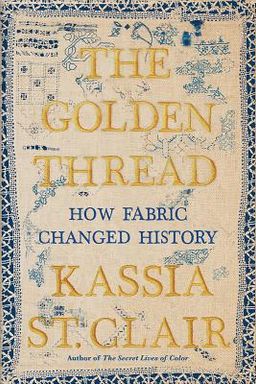
If you glance down at the clothes you are wearing, you’re touching humanity’s oldest and most transformative technology. In The Golden Thread, Kassia St Clair argues that textiles are not peripheral crafts but the connective tissue of civilization—binding together innovation, economy, identity, and power from prehistory to the present. The story she tells is not just about fabric, but about how people have used fiber to build societies, explore worlds, and even survive the vacuum of space.
From fiber to civilization
Textiles emerge in this book as the earliest form of applied science. Long before metal or writing, people twisted plant fibers into string, wove cloth, and used that flexible technology to make tools, nets, clothing, and sails. The first weavers in the Dzudzuana Cave, 34,000 years ago, were already dyeing their fibers pink, yellow, and turquoise. Cloth made possible warmth, mobility, and cooperation—linking skill to survival. (As historian Eric Hobsbawm once observed, you can’t talk about an Industrial Revolution without saying 'cotton'.)
By tracing cloth’s expansion—from Egyptian linen and Chinese silk to Viking wool and industrial cotton—St Clair shows how fiber technologies underpinned economies and empires. Each stage of textile evolution, from spindle to power loom, tracks a phase of human civilization: domestic innovation, industrial revolution, globalization, and the digital age.
Textiles as technology and identity
For St Clair, fabrics are not only practical solutions but cultural scripts. Linen in Egypt sanctified the dead; silk in China became a diplomatic language; wool in medieval England financed monasteries and crowns; cotton underwrote both industrial modernity and slavery. The fibers we wear tell stories about status, belief, and exploitation. Clothing, in her account, functions as social code and currency, capable of blessing, disguising, enslaving, or liberating its wearer.
Even modern synthetics continue this historical logic. Rayon, nylon, and polyester democratized comfort and style but exposed workers to toxicity and ecosystems to microplastic pollution. A 1942 test near an American Viscose plant killed fish within minutes—proof that cheap mass production carried invisible costs. The same pattern appears in fast fashion: low prices built on hidden labor. St Clair’s litany of tragedies—from viscose mills to Rana Plaza—reminds you that innovation without ethics repeats old sins in new materials.
Threads that shaped exploration and imagination
The book widens its fabric lens to exploration, from the woolen sails that carried Vikings across the North Atlantic to the gabardine, fur, and down that made polar survival possible. St Clair invites you to consider the polar suits of Amundsen and Scott as experiments in applied material science. When technology and clothing align with environment, you live; when values like pride or tradition override knowledge—as with Scott’s rejection of Inuit fur—you die. In the same way, spacesuits blend engineering and seamstress craft into survival armor, the literal thread between human and void. The Playtex seamstresses who built Apollo suits represent a throughline from domestic needlework to space-age engineering.
By the time the story reaches modern performance fabrics and spider-silk biotech, textiles have become laboratories for ambition. NASA-engineered swimsuits, silk derived from genetically edited goat milk, and 'bio-suits' that hug astronauts under pressure—all trace their lineage back to linen fields, spinning wheels, and patient loom-workers. They remind you that the history of clothing is the history of problem-solving in fiber form.
Why textiles matter today
The deeper claim of The Golden Thread is moral as well as material. Every fiber you wear encodes a record of labor, environment, and ingenuity. To treat clothing as disposable commodity is to misread both human history and the planet’s limits. St Clair’s closing meditation on golden and sea-silk fabrics—rarities woven for gods and kings—raises a question that binds ancient opulence to modern consumption: what do we choose to value, and who pays for that gleam?
Core insight
Textiles are not background decoration; they are civilization’s architecture in soft form. From Paleolithic flax to lunar Mylar, the history of fiber mirrors—and often determines—the history of humanity itself.