
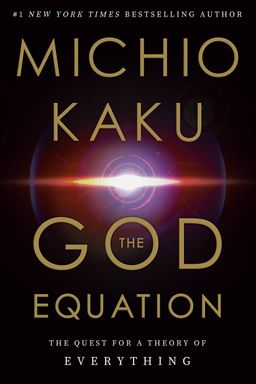
The God Equation cover

The God Equation

by Michio Kaku

The God Equation by Michio Kaku takes readers on an enlightening journey through theoretical physics, from Newton to string theory. It demystifies complex scientific concepts and explores the tantalizing quest for a ''theory of everything,'' bridging the gap between science and philosophy in an engaging narrative.

The Search for the God Equation: Humanity’s Ultimate Quest for Unity

Have you ever looked up at the night sky and wondered if there’s a single idea that ties everything together—the stars, your smartphone, your heartbeat, and the birth of the universe? In The God Equation, theoretical physicist Michio Kaku leads us through humanity’s epic attempt to find that answer: one elegant formula that explains all the forces of nature. This dream, which Einstein called the "theory of everything," has occupied scientific minds for centuries, from ancient Greek philosophers to string theorists of today.

Kaku argues that this “God Equation” would be physics’ Holy Grail—a single framework that unites the laws of the very big (Einstein’s general relativity, which governs planets and galaxies) with those of the very small (quantum mechanics, which explains subatomic particles). If scientists succeed, it could allow us to understand how the universe began and what might lie beyond black holes or even beyond time itself.

Why This Quest Matters

Kaku reminds us that each milestone in physics has changed human destiny. Newton’s laws launched the Industrial Revolution. Maxwell’s equations ignited the electrical age. Einstein’s relativity and quantum theory powered the digital and nuclear eras. The next breakthrough could propel us toward even greater frontiers—perhaps controlling energy at the scale of stars or traveling through the fabric of space-time itself.

The book isn’t simply about equations; it’s about meaning. Kaku weaves science, philosophy, and wonder to show how each scientific revolution brought us closer to viewing the universe as a coherent whole. He connects cutting-edge physics with ancient questions from Aristotle, Galileo, and Einstein: What is reality made of? Why does the universe exist? And could there be multiple universes?

The Storyline of Discovery

Kaku traces how our ideas of unification evolved through seven major stages, each represented by chapters in the book:

  • The ancients’ dream of unity—atoms, harmony, and mathematical beauty.
  • Einstein’s lifelong goal of merging gravity and light.
  • The rise of quantum mechanics and the puzzling uncertainty of the subatomic world.
  • The birth of the Standard Model, or what Kaku calls the “theory of almost everything.”
  • The mysteries of black holes, dark matter, and dark energy.
  • The emergence of string theory as the best candidate for the unified theory.
  • The philosophical reflections on God, meaning, and the purpose of the universe.

A Journey through Time and Thought

Kaku begins thousands of years ago, when Pythagoras heard harmony in vibrating strings and Democritus imagined invisible atoms. He takes us through Newton’s description of gravity as a universal force and Maxwell’s unification of electricity and magnetism, which revealed light as an electromagnetic wave. Einstein then transformed physics with his elegant equations of relativity, showing that space and time themselves could bend and stretch.

But Einstein’s dream of unifying gravity with quantum mechanics eluded him. The new quantum theory, pioneered by Planck, Schrödinger, Heisenberg, and Bohr, suggested a universe ruled by probability and chance—not the deterministic laws Einstein loved. Later physicists built upon these discoveries to create quantum electrodynamics (QED) and the Standard Model, which accurately describes three of the four known forces: electromagnetism, and the weak and strong nuclear forces.

Only gravity remained outside this framework. The search for a "quantum gravity" theory—the one that finally unites Einstein and the quantum—has driven Kaku and his contemporaries toward string theory: the idea that everything, from electrons to galaxies, is made of tiny, vibrating strings whose resonances give rise to all particles and forces. According to Kaku, “The universe is a symphony of strings,” and the mind of God might well be the cosmic music playing throughout space-time.

The Larger Implications

Kaku sees in this pursuit not just scientific progress but a philosophical awakening. The God Equation could explain why the universe is fine-tuned for life, shed light on the multiverse, and even blur the boundary between science and spirituality. Yet he cautions that string theory still lacks experimental proof—the “theory of everything” might currently be a “theory of anything.” Still, he believes we’re inching closer to a grand synthesis that unites physics, cosmology, and consciousness.

“The universe is a symphony of strings, and the mind of God is cosmic music resonating through space-time.”

In this sweeping exploration, Kaku urges you to look beyond the mathematics and see physics as humanity’s quest for meaning. Science, he suggests, doesn’t replace awe—it deepens it. By retracing the steps of the great unifiers—from Newton to Einstein to today’s string theorists—you glimpse not only the structure of the cosmos but also the creative spirit driving our species toward understanding itself and its place in the universe.


The Ancient Dream of Unity

Long before physicists filled blackboards with equations, humanity looked to the skies and wondered: Is there a hidden order behind the chaos of nature? In Kaku’s retelling, the ancient Greek philosophers launched our first scientific revolution when they pursued two key ideas that still echo through modern physics—atoms and harmony.

From Myth to Mathematics

Pythagoras found mathematical beauty in music, discovering that harmonious tones corresponded to simple numerical ratios. He proposed that the entire universe followed patterns of vibration and proportion. Meanwhile, Democritus suggested that all matter could be reduced to tiny, indivisible particles—atoms—moving through the void. Together, these two visions—vibration and atomism—planted the seeds for both quantum mechanics and string theory millennia later.

Unfortunately, their ideas were buried for a thousand years during the Dark Ages. Knowledge gave way to superstition until the Renaissance, when thinkers like Galileo, Kepler, and Newton reclaimed the power of observation and mathematics to decode the cosmos. Galileo’s telescope proved the heavens were not perfect spheres but worlds of rock and crater. Kepler applied rigorous laws to planetary motion, and Newton gathered their insights into his great synthesis.

Newton’s Universal Law

When an apple dropped at his feet, Newton asked: If an apple falls to Earth, does the moon also fall? His answer—yes, under the same force—sealed the first great unification in science. Gravity was universal, binding heavenly and earthly realms together under a single law. This merging of the terrestrial and celestial marked the birth of modern physics.

Newton’s equations revealed a new kind of beauty—symmetry. The law of gravity worked the same everywhere, whether an apple fell in England or a planet orbited the sun. This symmetry became the foundation for future unifications: Maxwell’s electromagnetism, Einstein’s relativity, and the Standard Model. By showing that nature’s laws could be expressed in simple mathematical terms, Newton also opened the door to the machine age that powered our civilization.

Faraday, Maxwell, and the Second Great Unification

Two centuries later, Michael Faraday—a self-taught bookbinder—discovered that electricity and magnetism were two sides of the same coin. By moving a magnet through a coil, he produced electricity, and vice versa. James Clerk Maxwell then translated Faraday’s experiments into four elegant equations describing how electric and magnetic fields wove together into light itself. Maxwell had unified electricity, magnetism, and light into a single framework—the electromagnetic force.

“Light is an electromagnetic wave—an endless dance between electric and magnetic fields.”

By the late 19th century, physicists believed they had solved everything. Newton and Maxwell appeared to explain all motion and all energy. But as Kaku notes, these two pillars contradicted each other: one assumed absolute time and space; the other embedded light’s constant speed as an unbreakable rule. The next unifier—Albert Einstein—would reshape our concepts of reality itself.


Einstein’s Revolution: Space, Time, and Gravity

Imagine racing alongside a beam of light. What would it look like? That thought experiment, posed by a young Albert Einstein, changed physics forever. In The God Equation, Kaku presents Einstein as both rebel and visionary—the man who redefined space, time, and ultimately gravity itself.

Special Relativity: When Time Bends

Einstein’s special relativity shattered Newton’s notion of absolute time and space. He realized that the universe must maintain one constant—the speed of light. Everything else, including time and mass, could shift to preserve that constancy. If you travel close to light speed, time slows down for you; your mass increases; distances shrink. Einstein revealed that space and time are intertwined in a four-dimensional fabric—space-time.

From this insight emerged perhaps the most famous equation in history: E = mc². It showed that energy and matter are interchangeable, which later explained the power of the sun and the destructive potential of atomic bombs. This was a breathtaking unification—space and time, matter and energy—all linked through symmetry.

General Relativity: When Space Curves

Yet Einstein wasn’t satisfied. His second great leap—general relativity—came from an ordinary moment. Leaning back in a chair one day, he felt weightless and realized that “acceleration and gravity are equivalent.” This simple idea led to a radical model of gravity not as a force, but as the warping of space-time itself. Mass tells space how to curve, and curved space tells mass how to move.

Einstein’s prediction that starlight would bend near the sun was confirmed during a 1919 eclipse, instantly turning him into a global icon. Today, every GPS satellite and physics experiment—from black hole imaging to cosmology—rests on the mathematics of curved space-time. Einstein’s genius lay not in complexity, Kaku writes, but in beauty: he replaced mystery with clarity, showing that the stage of reality itself could bend, stretch, and ripple.

Einstein’s Final Quest: Unity and Frustration

In his later years, Einstein searched obsessively for a unified field theory that would join gravity and electromagnetism. But the quantum revolution left him behind. The probabilistic world of electrons and photons, where uncertainty ruled, seemed irreconcilable with his geometrically precise universe. Kaku portrays Einstein as the ultimate dreamer—undaunted, but tragic—whose faith in symmetry inspired generations to continue his quest. As physicist Max Planck warned him, Einstein’s mission might fail, “but if you succeed, you will be the next Copernicus.”

Einstein never found his unifying equation. Yet he gave physics its spiritual drive—the conviction that nature must be harmonious and unified at its core. Kaku picks up where Einstein left off, guiding us into the quantum century that would redefine matter itself.


The Quantum Revolution and Uncertainty

While Einstein was bending space and time, other scientists were uncovering a stranger realm—the subatomic world. Here, certainty dissolves into probability, and reality flickers between wave and particle. In this section, Kaku unpacks how the quantum revolution redefined our understanding of matter and energy—and why its philosophical questions still disturb us today.

From Glowing Metals to Photons

It all began when Max Planck tried to explain why hot objects glow. Classical physics predicted infinite energy—an impossible result. Planck solved the problem by proposing that energy comes in discrete packets, or quanta. Later, Einstein took this further, showing that light itself was quantized into particles called photons. Suddenly, nature appeared dual: both continuous waves and discrete chunks of energy.

Schrödinger, Heisenberg, and the Wave of Probability

Erwin Schrödinger’s equation, written in 1925, allowed scientists to calculate the probability waves governing electrons. But as Max Born and Werner Heisenberg emphasized, the equation didn’t yield certainties—it predicted likelihoods. Heisenberg’s uncertainty principle shattered determinism: you can’t know both an electron’s position and velocity with perfect accuracy. Reality, it seemed, was statistical, not mechanical.

Einstein resisted this indeterminacy, famously protesting, “God does not play dice.” His debates with Niels Bohr in the 1930s became philosophical showdowns over the nature of truth. Bohr argued that observation creates reality—a notion dramatized by Schrödinger’s cat, simultaneously dead and alive until measured. Though Einstein lost the argument, Kaku notes he was right to sense something missing in the quantum picture—its inability to reconcile with gravity.

Quantum Power and the Modern World

Despite its paradoxes, quantum mechanics works astonishingly well. Richard Feynman and others refined it into quantum electrodynamics (QED), which predicts experimental results with staggering precision—accurate to one part in 100 billion. This theory birthed our digital civilization: semiconductors, lasers, transistors, and computers all owe their existence to quantum mechanics.

Yet the quantum world feels alien to intuition. In Kaku’s words, if Planck’s constant were larger, reality would be unrecognizable—objects would blink in and out of existence, and you might literally be in two places at once. Still, beneath all this weirdness lies a profound symmetry: wave and particle, uncertainty and order, coexist in perfect harmony. For Kaku, that harmony hints at an even deeper unity—one that Einstein sought but quantum physics had yet to supply.

“The universe is not deterministic—it’s musical, playing by probability’s rhythm.”

Quantum theory revealed an invisible framework of tiny energies and symmetries that guide all material existence. It paved the way for the Standard Model—but also set the stage for its greatest limitation: the inability to explain gravity, dark matter, or the birth of the cosmos. The next step would demand an even larger unification.


The Standard Model: A Theory of Almost Everything

The decades after World War II saw physics consolidate its fragmented discoveries into one astonishing structure: the Standard Model. Kaku calls it “the theory of almost everything,” a dazzling yet incomplete jigsaw puzzle that explains all known matter and forces—except gravity.

How the Model Works

After Erwin Schrödinger’s equation mapped the atom, scientists explored deeper, aided by ever-stronger particle accelerators. They discovered two nuclear forces: the strong force that binds quarks inside protons and neutrons, and the weak force that governs radioactive decay. The electromagnetic force, already unified via quantum electrodynamics, completed the trio of quantifiable interactions. Each could be represented by “exchange particles” or field quanta—photons for electromagnetism, gluons for the strong force, and W/Z bosons for the weak.

Building on Murray Gell-Mann’s quark model and the Yang-Mills framework, physicists merged these ideas into a single system. The model’s intricate symmetry, expressed through SU(3) x SU(2) x U(1) group theory, organizes matter like a cosmic periodic table. In 2012, CERN’s Large Hadron Collider confirmed its final missing piece—the Higgs boson, the “God particle,” which gives mass to all others. Yet despite its triumphs, the theory’s patchwork design felt inelegant to many, including Kaku.

The Missing Piece: Gravity

Gravity—the weakest yet most pervasive force—refused to fit. Einstein’s smooth space-time geometry clashed with quantum mechanics’ jittery particles. Attempts to quantize gravity created mathematical infinities that even Feynman’s renormalization tricks couldn’t eliminate. The graviton, a hypothetical quantum of gravitational energy, remained out of reach both experimentally and theoretically.

Thus, while the Standard Model explained everything from chemistry to nuclear power, it broke down at cosmic extremes: inside black holes and at the Big Bang itself. To fully understand the universe’s birth or its ultimate fate, physicists needed a theory that could merge gravity with quantum fields—a true “God Equation.”

A Triumph with Flaws

Kaku describes the irony: The Standard Model is both spectacularly accurate and aesthetically clumsy—“a theory only a mother could love.” It contains twenty arbitrary constants and three redundant generations of particles. Worse, it offers no explanation for dark matter, dark energy, or the universe’s asymmetry between matter and antimatter. For all its power, the model feels like a prototype—a near-perfect melody missing its final chord.

“We have a theory of almost everything—but almost isn’t everything.”

That missing symmetry drives the next act of Kaku’s story: the fusion of relativity and quantum mechanics through string theory, a framework bold enough to reshape our understanding of dimensions, matter, and even the origins of reality itself.


Exploring the Dark Universe

If the God Equation seeks to explain everything, then understanding everything means confronting what we can’t see. In Kaku’s fifth chapter, he delves into black holes, wormholes, dark matter, dark energy, and the quantum mysteries of the cosmos—phenomena that force us to reevaluate space, time, and the universe’s destiny.

Black Holes: Gravity’s Edge

Kaku recounts how Karl Schwarzschild’s 1916 solution to Einstein’s equations revealed the possibility of black holes—objects so dense that not even light can escape their gravity. Once dismissed as science fiction, black holes are now observable reality. In 2019, humanity saw the first image of one: a glowing ring surrounding a shadow in galaxy M87. Kaku explains their paradoxes—where time appears to stop at the event horizon, and matter is stretched into “spaghettification.”

Stephen Hawking’s calculations added a quantum twist: black holes aren’t perfectly black but emit faint radiation. They can even evaporate over eons. Yet this caused a deeper quandary—is information lost forever inside them? If so, quantum mechanics fails. Kaku shows how string theory might solve this by encoding all information on a black hole’s surface, a hint toward the “holographic universe.”

Wormholes and Time Travel

Einstein’s math also allows for wormholes—cosmic tunnels connecting distant regions of space and time. Kaku describes them as “a shortcut through the fabric of the universe.” They could theoretically permit time travel, though they’d require exotic negative energy to remain stable—something no known technology can yet produce. Still, he speculates that advanced civilizations might someday wield such control over energy, using wormholes as interstellar escape routes or even gateways to other universes.

Dark Matter and Dark Energy

Even more mysterious are the invisible forces shaping our cosmos. Dark matter, first hinted at by galaxy rotation speeds, makes up about 27% of the universe, yet it emits no light. Dark energy—an even greater enigma—accounts for nearly 70%, propelling cosmic expansion at accelerating speeds. The discovery of this accelerating universe in 1998 overturned Einstein’s earlier “blunder,” his discarded cosmological constant, now reborn as the driver of cosmic acceleration.

The problem? Quantum physics predicts a vacuum energy 10^120 times greater than observed—one of science’s most embarrassing discrepancies. For Kaku, this mismatch signals that our theories are incomplete. The true ‘God Equation’ must account for dark matter and dark energy, explaining why the universe is so finely tuned for life yet destined for entropy—the Big Freeze or Big Rip.

“Over two-thirds of the cosmos is invisible energy—and physics still has no equation for it.”

These cosmic enigmas lead directly to the next frontier: string theory, a daring framework that could unify the known forces, tame black holes, and perhaps illuminate what happened before the Big Bang itself.


String Theory: The Symphony of the Universe

The heart of The God Equation is Kaku’s explanation of string theory, the audacious and controversial idea that everything—from atoms to gravity to spacetime itself—is made of vibrating strings. He presents the theory not merely as science, but as a culmination of millennia of humanity’s search for unity.

Vibrating Strings, Infinite Symmetry

Born in 1968 from an accidental mathematical discovery, string theory suggested that what we call particles are actually tiny strings oscillating at different frequencies. Just as plucking a guitar string produces distinct musical notes, different vibrations correspond to different particles—electrons, quarks, photons, and more. In this cosmic symphony, even the graviton—the quantum of gravity—emerges naturally, solving the century-old tension between relativity and quantum mechanics.

Kaku, who helped develop “string field theory,” describes the beauty of these equations: they produce a finite, self-consistent description of all forces. Unlike previous models plagued by infinities, the interactions of strings elegantly cancel out unwanted divergences. The universe, it seems, requires harmony.

Superstrings and Hidden Dimensions

The theory’s most shocking result is its prediction that the universe has ten dimensions (later extended to eleven in M-theory). Six of these dimensions, Kaku explains, are curled up too small to perceive. If our atoms are confined to a three-dimensional “membrane” within this higher-dimensional hyperspace, then the extra dimensions could hold the key to unifying all forces. Gravity’s weakness, for instance, might come from leaking into these unseen realms.

String theory also introduced supersymmetry, a vast symmetry where every matter particle (a fermion) has a corresponding force particle (a boson) partner. This symmetry cancels mathematical anomalies, yielding a perfectly balanced framework. Though unproven experimentally, supersymmetry inspires what Kaku calls the most beautiful mathematics ever conceived—a fusion of quantum fields, geometry, and vibration.

M-Theory and the Multiverse

In 1995, Edward Witten merged five separate string theories into one: M-theory, based on eleven dimensions and vibrating membranes. Kaku likens the five string theories to shadows of a single higher-dimensional entity—the “super symposium” of all equations. Its breathtaking implication: each mathematical solution could describe a different universe. Our cosmos, then, might be just one bubble in an infinite multiverse sea.

“If string theory is correct, reality is music on a multidimensional harp.”

Still, Kaku concedes the critics have valid concerns. String theory remains untested, and its vast “landscape” of possible universes—each obeying slightly different physical laws—raises questions about predictability. Yet, for Kaku, the theory’s elegance outweighs its uncertainty. It may not be finished, but it best fulfills Einstein’s dream: a single equation embracing all of nature’s forces, written—someday—on a single inch of paper.


The Meaning of the Universe

In the final chapter, Kaku steps beyond physics into philosophy. If the God Equation exists—and if it truly explains all creation—what does that mean for faith, purpose, and humanity’s future? His reflections bridge science and spirituality, suggesting that knowledge itself may be our most sacred calling.

Einstein’s Two Gods

Einstein, Kaku notes, believed in the God of Spinoza—not a personal deity who intervenes in human affairs, but the impersonal harmony of the cosmos. “The universe could have been ugly and chaotic,” Kaku writes, “but it is elegant, ordered, and simple.” To Einstein, discovering this order was a spiritual act. Kaku agrees: understanding existence through physics is humanity reading the mind of God through mathematics.

Science, Philosophy, and Purpose

From Saint Thomas Aquinas to Stephen Hawking, thinkers have asked who—or what—set the universe in motion. Kaku revisits Aquinas’s “cosmological proof,” which posited a First Cause for everything. Even if the multiverse existed eternally, he argues, we’d still need to ask: where do the laws of physics come from? The answer, Kaku suggests, may lie not in theology but in logic. The universe exists because it’s the only mathematically consistent way for anything to exist. All other hypothetical realities collapse under contradiction.

This idea provides intriguing responses to questions like “Why is there something instead of nothing?” According to quantum mechanics, even “nothing” teems with fluctuations—tiny bubbles of energy that emerge and disappear. One such bubble may have expanded into our universe. Thus, creation might be the natural, inevitable act of quantum physics, not divine intervention—but one that still evokes awe and purpose.

The Human Meaning

For Kaku, meaning is not given—it’s made. The God Equation may describe how the universe works, but humans give it emotional and moral significance. “Everything that has meaning,” he writes, “is the result of struggle and sacrifice.” Even if the universe ends in entropy, intelligent life may find ways to endure—perhaps migrating through wormholes to new universes. The quest to understand, to explore, and to unify is itself our purpose.

“The universe is a symphony, and we are its melodies thinking about themselves.”

By the end, Kaku leaves you not merely with science, but with humility and wonder. Whether or not the final equation is ever written, the search for it transforms us. The real act of creation, he suggests, is not cosmic—it’s human: our relentless, beautiful drive to understand.

Dig Deeper

Get personalized prompts to apply these lessons to your life and deepen your understanding.

Go Deeper

Get the Full Experience

Download Insight Books for AI-powered reflections, quizzes, and more.