
Idea 1
Finding the Goal That Drives Everything
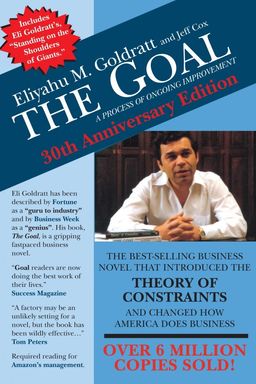
When Alex Rogo takes over a failing manufacturing plant in Eliyahu Goldratt’s The Goal, he faces chaos—missed shipments, mounting backlogs, and relentless pressure from his boss, Bill Peach. The factory seems efficient on paper, with high machine utilization and record production volumes, yet it hemorrhages money. The breakthrough comes when Alex, guided by the physicist-turned-consultant Jonah, redefines what business success actually means: the goal of any company is to make money now and in the future. Everything else—quality, technology, efficiency—is secondary to that singular purpose.
From vague priorities to measurable clarity
Early in the story, Alex and his team chase too many competing priorities. They pride themselves on reducing cost-per-part, increasing machine utilization, and keeping people busy. Jonah challenges this thinking by asking a deceptively simple question: “Did you sell more as a result?” The answer exposes the flaw—production is meaningless without sales. Jonah replaces traditional financial metrics (net profit, ROI, cash flow) with their operational equivalents: Throughput (money generated through sales), Inventory (money tied up in materials intended for sale), and Operational Expense (money spent turning inventory into throughput).
This triad bridges executive strategy and shop-floor action. If something increases throughput, reduces inventory, or decreases operational expense—and does so in a balanced way—it moves the company toward its goal. If not, it’s waste.
Why local improvements fail
Alex’s plant installs robots that improve one department’s efficiency by 36%. Yet inventories swell, payroll remains unchanged, and sales stay flat. Jonah’s verdict: the supposed improvement actually worsened the system by increasing both inventory and depreciation. This revelation forces Alex to abandon local performance metrics in favor of system-wide flow performance. Only when the entire process moves faster from raw material to sold product does efficiency make financial sense.
Dependencies, variation, and reality
Jonah teaches Alex that manufacturing is not a collection of independent machines; it is a dependent chain. Each process’s output depends on the prior step, and small fluctuations accumulate catastrophically. The “Herbie” hike—where one slow Scout delays the entire troop—and the dice-and-matches experiment both dramatize this point: even perfectly balanced lines perform far below theoretical capacity because variability and dependency combine to throttle flow. The lesson? Balance is the enemy. You cannot run every resource at the same rate and expect high throughput.
Shifting from balancing to focusing
Instead of balancing capacity to demand, you must identify the constraint—the smallest pipe in the system through which everything must flow—and reorganize around it. The constraint determines throughput; every other resource either supports or interferes with it. Goldratt’s logic dethrones traditional cost-accounting control and replaces it with flow-based thinking. The factory’s improvement journey becomes a detective story where each breakthrough comes from treating production not as parts and machines, but as the flow of money.
Core takeaway
You make money by improving the flow of value through the system, not by maximizing efficiency at individual points. Every decision should move throughput up, inventory down, and operating expense down.
This reorientation—from local performance to whole-system throughput—is the turning point in Alex’s thinking and the foundation of the Theory of Constraints (TOC). It’s also a broader leadership lesson: progress begins when you question metrics that seem sacred, clarify the goal, and align every action across the organization to achieve it.