
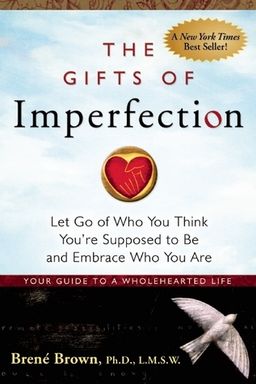
The Gifts of Imperfection cover

The Gifts of Imperfection

by Brene Brown

The Gifts of Imperfection by Brene Brown offers a transformative guide to living authentically. Through ten powerful principles, readers learn to embrace imperfections, trust their intuition, and cultivate gratitude, leading to a more joyful, connected, and fulfilling life.

The Power of Wholehearted Living

Have you ever felt trapped by the belief that you must be perfect before you can be worthy of love or happiness? Brené Brown’s The Gifts of Imperfection confronts this very human struggle and offers a radical alternative: to live and love with your whole heart, embracing imperfection instead of running from it. Brown argues that true belonging, joy, and authenticity don’t come from fitting in or performing—they come from courageously being yourself, even when vulnerability feels terrifying.

Brown, a research professor at the University of Houston, spent more than a decade studying shame, vulnerability, and connection. What she found transformed not only her research but her life. She discovered that people who experience deep love and belonging—the Wholehearted—share one central belief: they believe they are worthy of love and belonging exactly as they are. From this foundation of worthiness, these individuals cultivate courage, compassion, and connection—the gifts that arise when we stop chasing perfection and start accepting ourselves.

Wholehearted Living: A Daily Practice, Not a Goal

Brown describes Wholehearted living as a lifelong process rather than a finish line. It’s about learning to wake up each day thinking, “No matter what gets done today, I am enough,” and going to bed believing, “I’m imperfect and sometimes afraid, but I am still brave and worthy of love.” This shift requires daily courage—the courage to show up authentically, the compassion to be kind to yourself and others, and the connection that comes from being real instead of perfect.

Rooted in her grounded theory research, Brown identifies ten guideposts for cultivating Wholeheartedness. Each one pairs a practice to cultivate with something to release: authenticity over approval, self-compassion over perfectionism, resilience over numbing, gratitude and joy over scarcity, faith over certainty, creativity over comparison, rest and play over exhaustion, calm over anxiety, meaningful work over self-doubt, and laughter over control. Each guidepost represents a deliberate act of letting go and leaning in.

The Role of Shame and Vulnerability

Brown’s entry point into this work was shame—a universal yet rarely discussed emotion she defines as the intensely painful belief that we are flawed and therefore unworthy of connection. Shaming experiences thrive in secrecy and silence; the less we talk about them, the more power they hold. But Brown discovered that vulnerability—the willingness to be seen and to share our stories—breaks shame’s grip. She calls this practice shame resilience, and it’s the bedrock of wholehearted living. To live fully, you must be willing to engage your vulnerability instead of armoring up against it.

Through stories from her own life and from countless participants, Brown shows how a culture obsessed with perfection, certainty, and productivity isolates us from our humanity. Her own 2007 “breakdown spiritual awakening,” when she confronted the gap between her research and her own perfectionism, grounds the book in authenticity. It’s not a lofty academic concept—it’s a lived reality of struggle, therapy, and transformation.

Why These Ideas Matter

In a world that equates worth with achievement and busyness with importance, Brown’s message feels like an act of rebellion. Wholehearted living challenges the cultural mandates that tell you to please, perform, and perfect. Instead, it invites you to rest, play, connect, and trust that you are enough. This doesn’t mean abandoning ambition or responsibility; it means grounding your self-worth in being rather than doing.

What makes The Gifts of Imperfection so powerful is Brown’s mix of academic depth and heart-centered storytelling. Her voice balances the tough love of a researcher with the vulnerability of someone walking the same path. By the end, you realize that embracing imperfection isn’t failure—it’s freedom. The book isn’t about becoming fearless; it’s about learning to live bravely, love deeply, and let your messy, beautiful humanity be enough.


Courage, Compassion, and Connection

Brené Brown calls courage, compassion, and connection the three gifts of imperfection—but they’re also the tools that make Wholehearted living possible. These qualities don’t simply appear when life gets easy; they’re built through practice, one vulnerable moment at a time.

Ordinary Courage: The Heart of Vulnerability

The word “courage” comes from the Latin cor, meaning “heart.” Originally, courage meant speaking one’s truth by telling one’s whole heart. Today, Brown reframes courage not as heroism but as the willingness to be emotionally open. Courage is saying, “I don’t know,” “I need help,” or “I feel hurt.” When Brown’s young daughter Ellen called from a sleepover to ask to come home, Brown told her that asking for what she needed was one of the bravest things she could do. Courage shows up in small, everyday actions like this. As Mary Daly wrote, “You learn courage by couraging.”

Compassion and Boundaries

Gemlike in its simplicity, Brown’s insight is that compassionate people are boundaried people. Too often we assume that being kind means never saying no—but real compassion requires holding people accountable and protecting your own limits. Without boundaries, resentment grows. Compassion, Brown argues, is “learning to suffer with” others, which demands honesty about your needs. Her journey teaches that sweetness without strength is not compassion; it’s compliance.

Connection: The Energy of Being Seen

Connection, Brown writes, is “the energy that exists between people when they feel seen, heard, and valued.” It’s not dependent on constant communication or social media likes—it’s rooted in presence and empathy. In her story about a disastrous school talk where she faced a hostile audience, she felt shame flood her body—heat, tunnel vision, racing heart. Instead of hiding, she called her sister, who responded with empathy rather than pity or judgment. That moment of connection disrupted shame’s power and deepened their bond. Shame cannot survive being spoken inside compassion.

From this perspective, courage, compassion, and connection reinforce each other. Courage lets you be vulnerable; compassion helps you stay kind to yourself and others; connection is the result—a sense that you belong without conditions. Practicing these three daily transforms fear into freedom. Brown reminds you that being brave isn’t about winning or losing—it’s about showing up with your heart open.


The Trap of Shame and the Path to Resilience

Shame, according to Brené Brown, is the master emotion that keeps us from living wholeheartedly. It’s the quiet voice whispering, “You’re not good enough,” or “Who do you think you are?” Brown defines shame as the painful belief that you are flawed and unworthy of love and belonging. Unlike guilt (“I did something bad”), shame says, “I am bad.” And while guilt motivates change, shame corrodes the very belief that you can change.

How Shame Works

Everyone feels shame, but few talk about it. The less you discuss it, the more power it holds. Shame feeds on three things: secrecy, silence, and judgment. The antidote to shame is empathy—the moment you open up about your struggle to someone who listens without judging, shame begins to wither. In one of Brown’s anecdotes, she describes receiving an email from a stranger who criticized a candid photo of her online. Her first reaction was anger and defensiveness—her “shame shield.” But after talking it out with a trusted friend, she realized that her sting wasn’t about the photo but the deeper fear of being seen as silly or imperfect. That awareness transformed the shame into self-compassion.

Building Shame Resilience

Brown identifies four key elements of shame resilience. First, recognize your triggers—know what situations spark your feelings of inadequacy. Second, practice critical awareness by questioning cultural expectations (“Does being thin or successful really make me more worthy?”). Third, reach out to someone who has earned the right to hear your story. And finally, speak your shame—use the word, name what happened, and ask for what you need. As Brown puts it, “Shame happens between people, and it heals between people.”

When you develop shame resilience, you stop letting fear of judgment dictate your actions. You can share your story without letting it define you. This practice is more than self-improvement—it’s liberation. It doesn’t erase pain, but it allows you to own your story fully, knowing that your imperfections are not proof of unworthiness, but part of what makes you human.


Cultivating Authenticity Over Approval

Authenticity is the foundation of Wholehearted living, yet it’s also one of the most challenging practices. Brown defines authenticity as “the daily practice of letting go of who we think we’re supposed to be and embracing who we are.” That means choosing honesty and vulnerability over pleasing and performing, even when it feels unsafe. It’s about courage, not comfort.

The Culture of Conformity

From a young age, most of us are trained to fit in rather than belong. We learn the rules of what’s acceptable—how to dress, speak, succeed—to gain approval. But fitting in is the opposite of belonging. Belonging requires you to be yourself; fitting in requires you to change who you are. Brown highlights how authenticity challenges societal scripts, especially around gender. Cultural norms tell women to be “thin, nice, and modest,” and men to “control emotions, work hard, and pursue status.” Authenticity means breaking these expectations to show up as your full self.

The Risk of Being Real

Choosing authenticity is risky because it makes you visible. Your honesty might unsettle others who prefer politeness to truth. But Brown warns that trading authenticity for approval leads to anxiety, depression, and resentment. She even calls it a public health risk. While vulnerability brings criticism, it also opens the door to genuine connection. Courage and authenticity are contagious; when you’re brave enough to show your imperfections, you give others permission to do the same.

Ultimately, authenticity is not a one-time decision but an ongoing practice. As E. E. Cummings wrote, “To be nobody-but-yourself in a world which is doing its best, night and day, to make you everybody but yourself—means to fight the hardest battle which any human being can fight.” The choice to stay real, especially when it costs you approval, is the essence of living wholeheartedly.


Letting Go of Perfectionism Through Self-Compassion

Perfectionism, Brown explains, is not the same as striving for excellence. It’s not about growth—it’s about fear. Perfectionism is the twenty-ton shield that we carry to protect ourselves from shame, blame, and judgment. It whispers, “If I look perfect and do everything perfectly, I can avoid the pain of being judged or rejected.” The problem is that perfectionism doesn’t protect you; it prevents you from fully living.

The Roots of Perfectionism

Many perfectionists grow up being praised for achievement rather than for effort or character. Over time, success becomes your identity: “I am what I accomplish.” This belief system traps you in an endless loop of people-pleasing, performance, and fear of failure. Brown links perfectionism to shame because both are driven by the belief that you must earn worthiness. The antidote isn’t to lower your standards but to replace the question “What will people think?” with “Am I being kind to myself?”

Learning Self-Compassion

Borrowing from Dr. Kristin Neff’s research, Brown describes self-compassion as a three-part practice: self-kindness (treating yourself gently), common humanity (remembering that imperfection is universal), and mindfulness (staying present without overidentifying with pain). Self-compassion allows you to speak to yourself the way you’d speak to someone you love—with grace rather than judgment. Brown illustrates this with humor: after misspelling an author’s name in an email, her perfectionist side spiraled into self-criticism until she remembered her own teachings and told herself kindly, “This isn’t a big deal.”

Practicing self-compassion doesn’t make you complacent—it makes you resilient. When you know that you’re worthy regardless of outcome, you can take risks, fail, and try again. As Brown sums up, “Perfectionism doesn’t lead to results—it leads to peanut butter.” When you trade self-criticism for kindness, you unlock the courage to grow.


Resilience, Spirituality, and the Courage to Feel

One of the most empowering revelations in Brown’s research is that resilience—the ability to recover from adversity—is rooted in spirituality. Not necessarily religion, but the awareness that we are connected to something larger than ourselves, through love and compassion. This spiritual grounding gives rise to hope, authenticity, and meaning, enabling us to face challenges without numbing our emotions.

The Elements of Resilience

Brown distills resilience into five common factors found in people who thrive under stress: resourcefulness, help-seeking, belief in one’s ability to cope, supportive relationships, and connection with purpose. Yet beneath these lies a deeper truth—the spiritually grounded belief that life, even when painful, holds meaning. Resilient people cultivate this belief through gratitude, mindfulness, and community.

Hope as a Cognitive Practice

Drawing on psychologist C. R. Snyder’s research, Brown defines hope not as emotion but as a thinking process—a trilogy of goals, pathways, and agency. Hopeful people set realistic goals, persist through obstacles, and believe they can influence outcomes. You can teach and learn hope through consistent encouragement, boundaries, and persistence. (Angela Duckworth’s concept of “grit” echoes this idea.)

Numbing vs. Feeling

Brown admits that before her research, she was a “take-the-edge-off-aholic,” using work, food, and busyness to dull feelings of vulnerability. Her insight: you can’t selectively numb emotion. When you numb pain and fear, you also numb joy and love. The Wholehearted experience emotions fully, trusting that joy is worth the risk of sorrow. Spiritual resilience teaches you to feel your way through discomfort instead of hiding from it. As Brown writes, cultivating a resilient spirit doesn’t shield you from storms—it teaches you to dance in the rain.


Gratitude and Joy: The Power of Enough

Gratitude and joy are inseparable in Wholehearted living. Brown discovered that joyful people aren’t joyful because they’re grateful—they’re grateful, and therefore joyful. Gratitude is not an attitude; it’s a practice. Without it, we live in scarcity—believing we’re not enough, don’t have enough, or haven’t done enough.

From Scarcity to Sufficiency

Most of us wake up thinking, “I didn’t get enough sleep,” and go to bed thinking, “I didn’t get enough done.” This scarcity mindset drives anxiety and comparison. Brown cites Lynne Twist, who says sufficiency isn’t an amount but a state of consciousness—a knowing that there is enough and you are enough. Practicing gratitude invites sufficiency, shifting focus from what’s missing to what’s present.

Gratitude in Practice

For Brown, gratitude means deliberate daily rituals: journaling, giving thanks before meals, even saying aloud what you’re grateful for when fear strikes. She learned this the hard way as a mother—finding herself unable to feel joy when watching her children sleep because she feared losing them. Her epiphany came when she realized that gratitude, not worry, protects love. Joy doesn’t come from guaranteeing safety but from fully embracing the moment you have.

In her words, “A joyful life is made up of joyful moments gracefully strung together by trust, gratitude, inspiration, and faith.” When you let go of scarcity and allow gratitude to define your days, you rediscover the sacred ordinariness of life: laughing with friends, a meal with family, watching the light change—each is a thread in the fabric of joy.


The Freedom of Creativity and Play

Creativity and play are not luxuries; they’re vital signs of a healthy, Wholehearted life. Yet most of us abandon them early. Brown shares how her childhood was full of painting, cooking, and imagination until comparison and conformity took over. Creative expression faded into self-criticism and productivity. Recovering it became a cornerstone of her healing.

Comparison: The Thief of Happiness

Brown calls comparison “the thief of happiness.” It traps us in conforming while competing—trying to fit in yet stand out. We measure success by how we stack up to others rather than how alive we feel. But creativity demands vulnerability: the risk of being original. When you let go of comparison, creativity becomes play again—something you do for joy, not judgment.

Play as Medicine

Dr. Stuart Brown defines play as “apparently purposeless activity done for its own sake.” Play, like sleep, is essential for emotional well-being. The opposite of play isn’t work—it’s depression. Play renews your spirit, fosters connection, and unleashes creativity. In Brown’s research, people who play regularly handle stress better and find more meaning in their work. She and her family now treat play as sacred: playing music, cooking, or dancing together. She even took a gourd-painting class—her first creative leap in decades—and rediscovered joy.

Living creatively means accepting that imperfection and experimentation are part of the process. When you risk looking silly and allow yourself to laugh, your heart opens again. As Brown concludes, “Unused creativity is not benign; it lives within us until it’s expressed, neglected to death, or suffocated by fear.” Creating, then, is not just about art—it’s about reclaiming your soul.


Meaningful Work and the Courage to Be Enough

We all long for work that has meaning, but Brené Brown reminds us that meaningful work doesn’t have to be our paycheck—it’s any expression of our gifts and values. When we squander our talents, we feel disconnected and restless; when we use them, we align with our spiritual purpose.

Gifts, Talents, and Spiritual Connection

Brown defines spirituality as recognizing our connection to each other through love and compassion. Sharing your gifts is one of the most profound ways to honor this connection. Whether you’re a teacher, parent, artist, or accountant, using your gifts bridges you to others. When you suppress them out of fear or practicality, you feel spiritually starved. Brown warns that unexpressed creativity leads to anxiety and resentment.

Battling Self-Doubt and “Supposed To”

The biggest barriers to meaningful work are self-doubt and cultural expectations—the “supposed to’s.” You’re supposed to choose money over meaning, stability over joy. Brown suggests confronting these gremlins by writing down their voices: “Who says?” “Why?” Exposing them robs them of power. She also challenges the habit of defining yourself by job titles. Instead of reducing your identity to a role, embrace your multiple passions—the “slash” identities described by career coach Marci Alboher (for example, lawyer/chef, therapist/violin maker). Life’s meaning often lives in the slashes.

Brown closes with a quote from Howard Thurman that captures this calling: “Don’t ask what the world needs. Ask what makes you come alive and go do it.” What the world needs, she insists, are people who have come alive. The courage to be enough—to know that your contribution doesn’t need to impress anyone—is what transforms work into purpose.


The Healing Power of Laughter, Song, and Dance

The final guidepost celebrates laughter, song, and dance—the purest expressions of our humanity. Across cultures and history, people have used them to connect, mourn, and celebrate. Yet in adulthood, we often stop participating out of fear of looking foolish. Brown argues that reclaiming these embodied forms of joy is essential to healing our sense of belonging.

Collective Joy and Vulnerability

Drawing on Barbara Ehrenreich’s Dancing in the Streets, Brown calls laughter, song, and dance “collective ecstasy”—a sacred experience that reminds us we are not alone. True laughter is “knowing laughter”: that shared moment of recognition that says, “Me too.” Singing, too, connects us emotionally, stirring empathy and memory. And dancing is full-body vulnerability—the only other act as exposing, she jokes, is being naked. When we dance, we let our hearts speak.

Letting Go of Being Cool

Our culture idolizes being “cool” and “in control.” But these are shields against embarrassment. As Brown writes, “The only true currency in this bankrupt world is what you share with someone else when you’re uncool.” Real connection demands uncoolness—risking silliness, mistakes, and joy. She recounts a vivid story of watching her daughter dance in a store, feeling the judgment of others, and choosing instead to dance alongside her. That small act of courage kept her from betraying her child’s joy and her own authenticity.

Laughter, song, and dance remind us that authenticity is not just about serious introspection—it’s also about delight. Healing doesn’t always look like calm meditation; sometimes it looks like singing loudly with friends or dancing in your kitchen. When you let your heart speak through rhythm and laughter, you reconnect with your most human self. Wholehearted living ends where it begins—with courage to be seen, in all your imperfect glory.

Dig Deeper

Get personalized prompts to apply these lessons to your life and deepen your understanding.

Go Deeper

Get the Full Experience

Download Insight Books for AI-powered reflections, quizzes, and more.