
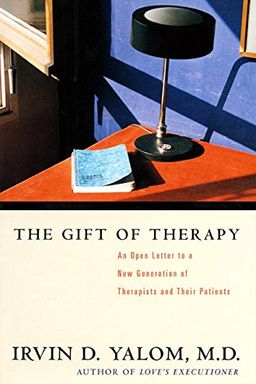
The Gift of Therapy cover

The Gift of Therapy

by Irvin D Yalom

Irvin D. Yalom''s The Gift of Therapy provides an insightful guide for therapists seeking to enhance their practice through trust-building and self-disclosure. By focusing on the therapeutic relationship, existential questions, and dream analysis, therapists can facilitate profound healing and personal growth for their patients.

The Gift and Craft of Therapy

How can helping others heal also become your own path toward self-understanding? In The Gift of Therapy, psychiatrist and writer Irvin D. Yalom argues that psychotherapy is not only a science or a set of techniques but also a profoundly human, relational, and existential art. Therapy, he insists, is a collaboration between two fallible people who must together confront the central challenges of being human—death, freedom, isolation, and meaning.

Yalom contends that the best therapists are not magicians hidden behind a professional curtain but fellow travelers who walk beside their patients with openness and humility. By sharing his wisdom from decades of practice, he reframes therapy as both a privilege and a responsibility. His book invites new and seasoned therapists alike to rediscover the sacredness of authentic connection and to find renewed meaning in their work.

A Living Tradition of Healing

Yalom’s generational perspective shapes his core message. Psychotherapy, he notes, has drifted under financial and bureaucratic pressures—from managed care dictating brief, mechanistic therapies toward protocols that risk flattening human complexity. Yet, he writes, the tradition of genuine healing—rooted in presence, empathy, and mutual growth—mirrors an ancient lineage stretching back to philosophers and physicians like Socrates, the Buddha, and Freud. The therapist’s task is not to impose solutions but to help reveal what already lives within the patient’s capacity to heal.

That belief echoes Karen Horney’s image of human growth as an acorn seeking to become an oak: the therapist’s work is to remove obstacles so the natural process of self-actualization can occur. This optimism underlies Yalom’s entire philosophy. He sees the therapy room as a small sanctuary where two people face life's raw realities together—and where conversation itself becomes the medium of transformation.

The Therapist as a Fellow Traveler

Rejecting the notion of the detached, all-wise expert, Yalom imagines therapist and patient as equals in the wider human journey. He recalls Hermann Hesse’s story of two healers, each seeking the other’s wisdom, discovering on their deathbeds that they had been helping each other all along. “There is no such thing as a fully grown-up person,” Yalom quotes André Malraux, reminding us that every human being—including the therapist—is unfinished and vulnerable.

This humility opens the path to authentic relationships. Therapy is not a one-sided service; it is a meeting of two consciousnesses where both can be changed. Patients often heal through the experience of mattering deeply to someone; therapists, in turn, are changed by the courage and pain they witness. For Yalom, therapy’s intimacy becomes a mirror for all relationships.

The Centrality of Relationship and the Here-and-Now

Yalom’s approach centers on the lived relationship unfolding between therapist and patient. He borrows from interpersonal and group therapy traditions the concept of the here-and-now—using the immediate dynamics in the room as a living laboratory for awareness. Rather than analyzing the past abstractly, he focuses on how old patterns replay in real time between therapist and client. By illuminating these moments of distance, closeness, or frustration, both parties can understand the patient’s relational world from within.

The here-and-now also nurtures authenticity. When the therapist discloses feelings—warmth, confusion, boredom, or discomfort—it provides data for exploration rather than weakness. Such transparency transforms therapy into a collaborative investigation, not a theatrical performance.

An Existential Foundation

Beneath these relational techniques lies an existential core. Drawing from thinkers such as Heidegger, Sartre, and Kierkegaard, Yalom frames much human suffering as a confrontation with four "ultimate concerns": death, isolation, freedom, and meaninglessness. Therapy helps patients face, rather than flee, these realities—discovering that confronting them can lead to richer, more intentional living. For example, fear of death can awaken appreciation for life; the anxiety of freedom can inspire responsibility; the ache of isolation can deepen one’s capacity for love and understanding.

Far from morbid, this confrontation offers liberation. As Tolstoy’s Ivan Ilyich learned on his deathbed, “Though death destroys us, the idea of death may save us.” Existential awareness, Yalom suggests, is not despairing—it’s the key to authenticity and purpose.

Why These Lessons Matter

Yalom’s message to therapists—and to anyone seeking growth—is clear: real healing happens through genuine human connection and existential courage. In an age where therapy risks becoming procedural, he calls us back to the heart of the work: presence, empathy, honesty, and shared vulnerability. The Gift of Therapy is not only a manual for psychotherapy but also a meditation on what it means to live fully awake to our mortality, freedom, and shared humanity.


Remove Obstacles, Don’t Force Growth

Yalom begins with Karen Horney’s elegant metaphor: every person is like an acorn with the innate potential to become an oak. Therapy’s purpose, then, is not to sculpt a new tree but to remove the weeds, rocks, and shadows that block its natural unfolding. You don’t have to give your patients motivation, morality, or creativity—they already have those within them. Your task is to clear the debris that prevents those qualities from emerging.

Removing Fear and Shame

One young widow told Yalom she had a “failed heart”—she feared she would never love again after losing her husband. Teaching her to love wasn’t possible. Instead, Yalom patiently helped her identify each irrational belief blocking love: that loving again betrayed her husband, that enjoying life meant forgetting him, that happiness would invite another tragedy. As she named and challenged these inner obstacles, she naturally began to love again. No persuasion was needed.

The Therapist as Gardener

Effective therapy resembles horticulture more than surgery. Like a gardener, the therapist tends the conditions—trust, warmth, and self-understanding—under which growth occurs. Trying to impose change can backfire, but fostering awareness and safety allows patients to use their own energy for transformation.

This compassionate approach contrasts sharply with contemporary managerial systems that emphasize measurable outcomes. Yalom insists that growth cannot be standardized. Each patient requires a unique environment—a new therapy for each person—because every psyche blooms in its own season and soil.

Let the Patient Matter to You

To remove obstacles effectively, the therapist must be genuinely moved. Yalom recalls a British analyst whose group therapy patients told him, after ten years, that he had never changed. The analyst proudly called this “good technique.” Yalom saw tragedy instead—how sterile to spend a decade with people and not be changed by them. When you let patients matter to you, their struggles become your teacher. Therapy then becomes a two-way act of growth: they learn to love; you learn to care more deeply and authentically.


The Power of the Here-and-Now

The beating heart of Yalom’s method is the here-and-now: the living interaction between therapist and patient as it unfolds moment to moment. Rather than dissecting the past endlessly, Yalom encourages therapists to study how old relational patterns appear in real time within the therapeutic encounter. The room becomes a social microcosm where the patient’s entire way of being with others plays out in miniature.

From History to Presence

Whenever a patient recounts a painful story about conflict with a friend or partner, Yalom asks: “Can you recall feeling something similar with me?” This shift from the “there-and-then” to the “here-and-now” makes therapy vivid and precise. Unlike speculative interpretations about the past, the here-and-now offers direct, verifiable data: you can feel the tension, withdrawal, or warmth as it happens.

Learning Through Relationship

Patients eventually discover that how they relate to their therapist echoes how they relate to life. A patient who reports being “always used by others” may unconsciously test that narrative by provoking disappointment; one who fears rejection may hold back affection until it becomes a self-fulfilling prophecy. Pointing out such patterns compassionately teaches them responsibility: though others contribute, their choices sustain the cycle.

Yalom likens this process to being in a laboratory of intimacy. It’s experiential learning: instead of talking about life, the patient practices living differently right in the session. Once insight meets genuine emotional experience, transformation begins.

The Therapist’s Feelings as Data

If you feel bored, confused, or shut out, Yalom urges you to trust those emotions as instruments of understanding. A therapist’s authentic responses are like diagnostic radar, revealing the patient’s effect on others. Speaking these feelings carefully (“I feel distant from you right now”) becomes both mirror and medicine. Therapy, he reminds us, is an alternating rhythm between feeling and analysis—immersing in emotion, then stepping back to understand it.


Self-Disclosure and Transparency

Freud’s “blank screen” model—the idea that analysts should be neutral, faceless figures—has long since cracked. Yalom replaces opacity with transparency. When therapists honestly bring their humanity into the room, they model authenticity and dissolve false hierarchies. Done judiciously, self-disclosure creates trust and accelerates progress.

Three Kinds of Disclosure

Yalom distinguishes three types: explaining the mechanics of therapy (being transparent about process), revealing here-and-now feelings toward the patient, and occasionally sharing something of the therapist’s personal life when it aids trust. Clarity about what’s shared and why prevents confusion. He stresses that therapist statements should always pass one test: Is this in the service of the patient’s growth?

Examples of Healing Honesty

When Yalom returned to his therapy group after his mother’s death, he spoke openly about his grief. Rather than derailing the group, his vulnerability deepened it—the members felt honored by his trust and dared to reveal their own pain. In another case, he confessed to a patient how hurt he felt when she called him “repulsive.” Her surprise at mattering to him catalyzed intimacy and growth.

Even everyday authenticity—admitting fatigue, confusion, or mistakes—can be transformative. Patients who have been betrayed or neglected often need to meet a real, responsive person, not an aloof performer in a white coat.

Transparency vs. Oversharing

Yalom warns that disclosure must never serve the therapist’s own needs. It is not confession but contact. Overexposing personal life blurs boundaries and risks burdening the patient. Yet hiding everything also communicates mistrust and superiority. The balance comes from mindful authenticity: sharing enough truth to strengthen the alliance while keeping the focus where it belongs—on the patient’s journey of self-discovery.


Facing Death, Finding Meaning

Few themes pulse more powerfully through Yalom’s work than mortality. He argues that fear of death—often disguised as anxiety about time, aging, or purpose—underlies much human distress. But paradoxically, confrontation with death can fuel transformation. “Though death destroys us,” he writes, “the idea of death may save us.”

Death as Awakening

Through his groups with terminally ill patients, Yalom observed that many sick people become more alive as death nears. They drop petty concerns, value connection, and savor the moment. Patients told his students: “The pity is that we waited until now to learn how to live.” Such “boundary experiences” can jolt anyone—from a near-death event to a funeral or milestone birthday—into deeper living.

He connects these findings to philosophers from Epicurus to Heidegger, who argued that mortality awareness grants life urgency and meaning. Like Tolstoy’s Ivan Ilyich, realizing life’s finitude invites a genuine evaluation of how we have lived—and a chance to change before it’s too late.

Helping Patients Face Mortality

Rather than skirt death anxiety, Yalom advises asking gently direct questions: “When did you first become aware of death?” or “What frightens you most about dying?” These explorations often reveal that it’s not nonexistence itself but unlived life that terrifies us. Therapy thus becomes about living fully now. He tells patients to imagine Nietzsche’s thought experiment of eternal recurrence: if you had to live your life exactly as it is, forever, could you bear it? The answer points the way toward changes needed for a 'regret-free' life.

Meaning and Self-Transcendence

Like Viktor Frankl, Yalom finds that meaning arises through engagement rather than speculation. Asking “What is the meaning of life?” is less useful than choosing a meaning and living it—through love, creativity, or service beyond oneself. Such self-transcending projects, what he calls “rippling,” ensure that part of us endures in the effects we leave on others. For therapists, this ripple of influence is both comfort against death anxiety and the essence of their craft.


Responsibility, Freedom, and Choice

Freedom, in Yalom’s universe, is both exhilarating and terrifying. We are the authors of our lives; no one else writes the script. This autonomy generates what existentialists call “groundlessness”—the deep anxiety of knowing that beyond our choices lies no fixed order guaranteeing meaning or safety. When patients blame genes, partners, or fate for their suffering, therapy’s task is to help them reclaim authorship.

Assuming Responsibility

Yalom sometimes tells patients, “Even if ninety-nine percent of what happened to you is someone else’s fault, let’s work on the one percent that’s yours. That’s where you have power.” This shift awakens agency. As long as people see themselves as victims, they remain stuck. But when they recognize their complicity—even if small—they rediscover freedom to choose differently.

Group therapy illustrates this vividly: members see how their behavior shapes others’ reactions, how they unknowingly recreate old roles, and how feedback transforms self-image. Responsibility becomes not a burden but a tool for liberation.

Decisions as Existential Clues

For Yalom, decision-making reveals one’s core fears and beliefs. Avoiding choice is itself a choice—often made to dodge freedom’s anxiety and the pain of renunciation (“alternatives exclude,” as philosopher John Gardner wrote). By examining how people dodge responsibility—through procrastination, blaming, or letting others decide—therapy leads them to authenticity.

He illustrates this through patients paralyzed over whether to end relationships or careers. Instead of dictating answers, he explores what each option symbolizes and asks the crucial question: “Are you satisfied—both with your decision and with how you make decisions?” Genuine ownership of choice becomes more healing than any particular outcome.

Freedom’s Double Edge

Freedom means we are unanchored, floating in “the abyss of possibility.” But rather than flee this terror through dependency or dogma, Yalom invites us to transform it into creativity. Freedom’s anxiety is the price of an examined life, yet within it lies the profound joy of authorship: the realization that, imperfectly but truly, we are the makers of our own being.


Dreams as Windows into Truth

Against the grain of modern skepticism, Yalom defends dream work as a vital therapeutic tool—not because dreams hide secret symbols but because they illuminate the emotional core of patients’ lives. “Loot the dream,” he tells students. “Use whatever insights advance the therapy, and don’t worry about the rest.” Dreams are not puzzles to solve but messages waiting to be unpacked in dialogue.

Dreams as Emotional Maps

Each dream, Yalom argues, distills lived feelings into images vivid enough to bypass defenses. A patient who dreamt of prosecuting her father for rape while dressed as a man revealed—without explicit theory—her simultaneous fear and empowerment about confronting her trauma. Another’s dream of descending rickety stairs to a basement exposed her terror of looking into her own depths at therapy’s beginning.

Sometimes a dream’s simplest image—a full gas tank, an unwanted baby, a vanished friend—uncovers forgotten histories or unmet needs. The analytic goal isn’t decoding but engaging: letting the dream speak its own associations until the emotional thread reawakens consciousness.

Dreams About the Therapist

Especially powerful are dreams that feature the therapist. A patient dreaming of urinating on Yalom’s watch revealed anger and boundary testing; another, seeing his office turned into a memorial library, expressed fear of losing him to death. Such dreams spotlight the inner representation of the therapy relationship and often anticipate turning points in treatment. Discussing them openly deepens intimacy and trust.

Dreams as Transitional Guides

Ultimately, dreams connect therapy’s two aims: insight and engagement. They help both therapist and patient navigate between intellect and emotion, between past trauma and present healing. In Yalom’s hands, the dream becomes a rehearsal for life itself—a stage on which the unconscious rehearses new possibilities for waking existence.


The Therapist’s Own Growth

While Yalom calls his book a “gift” to future therapists, it is also an invitation to self-renewal. To practice well, you must keep growing. The work’s emotional intensity can easily breed isolation, fatigue, or demoralization. Yet these hazards, when faced honestly, become sources of wisdom. Therapists, he reminds us, are both healers and humans—cradlers of secrets who must also tend their own inner world.

Beware Isolation and Burnout

Therapists spend their days in deep intimacy yet often lack reciprocal closeness. When the day ends, they can feel empty, disconnected, or grandiose from patients’ dependence. Yalom urges practitioners to cultivate peer groups and friendships that nourish their own humanity. In his own life, he found renewal through a small support group of fellow therapists who met biweekly to share their struggles freely.

Facing Occupational Hazards

Psychotherapy’s risks are real: patient suicide, malpractice fears, sexual boundary violations, or emotional overload from constant witnessing of trauma. Avoiding these through rigidity leads to defensiveness; meeting them with reflection transforms them into growth. Each ethical dilemma demands authenticity and balance—love without romantic entanglement, empathy without fusion, openness without indiscretion.

Freud advised analysts to return to therapy every five years to cleanse the psychic residue of their work. Yalom updates this advice: join communities of equals, seek supervision, and re-enter therapy whenever inner life grows dim. Our clients’ courage continually challenges us to expand our own capacity for love and honesty.

Cherishing the Privilege

For all the strain, Yalom ends with gratitude. To witness another’s transformation, to hold their darkest confessions, to share in their wisdom—this is a privilege few professions offer. Therapy, he says, purifies the therapist’s vision: seeing clearly the sorrow and beauty of the human condition, we become gentler and more accepting. The greatest gift of therapy may not be the healing we give but the humanity we learn.

Dig Deeper

Get personalized prompts to apply these lessons to your life and deepen your understanding.

Go Deeper

Get the Full Experience

Download Insight Books for AI-powered reflections, quizzes, and more.