
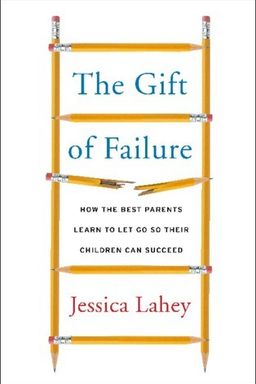
The Gift of Failure cover

The Gift of Failure

by Jessica Lahey

The Gift of Failure by Jessica Lahey reveals the hidden power of allowing children to fail. By stepping back, parents can help their children develop confidence, autonomy, and responsibility. This insightful guide promotes a parenting style that fosters resilience and independence, preparing children for the challenges of adulthood.

The Gift of Failure: Why Letting Kids Fail Helps Them Succeed

What if the best gift you could give your child isn’t protection from failure—but failure itself? In The Gift of Failure, educator and writer Jessica Lahey argues that our culture’s obsession with preventing mistakes has backfired. By shielding children from every scrape, setback, and disappointment, we’ve robbed them of the chance to develop resilience, independence, and genuine confidence. Lahey’s message is revolutionary in its simplicity: failure, far from being something to fear, is the foundation of learning, character, and competence.

Drawing from her experience as a teacher and parent, Lahey explores how overparenting—what she calls an epidemic of hovering, rescuing, and micromanaging—undermines children’s growth. Parents intervene out of love and fear, convinced they are setting their kids up for success. But the opposite happens: children become anxious, helpless, and afraid to take risks. Lahey calls for a cultural recalibration: a return to parenting that fosters autonomy, intrinsic motivation, and mastery.

How Parenting Went Wrong

Lahey traces the decline of resilience to twentieth-century shifts in parenting and education. Earlier generations raised children to be competent contributors to the household. Over time, as childhood became more precious, parenting turned into performance. When Dr. Spock reassured parents to trust their instincts, and later the self-esteem movement preached constant praise, love morphed into control. By the twenty-first century, parenting was defined not by preparing children for independence but by orchestrating their success. College admissions, trophies, and status replaced character, competence, and community as the metrics of good parenting. (Psychologists like Jean Twenge have documented how this shift fostered a rise in narcissism and anxiety.)

The Costs of Overprotection

Children whose parents micromanage everything—from homework to hygiene—seem high-achieving, but they often suffer from what Lahey calls “learned helplessness.” They fear mistakes, crave validation, and crumble under stress. Teachers see it firsthand: students who expect constant feedback, panic at imperfect grades, and lack creativity because they’ve never developed real problem-solving skills. Lahey’s research aligns with Carol Dweck’s work on fixed and growth mindsets—kids who are praised for innate talent rather than effort retreat from challenges to avoid losing their “smart” label.

The results are alarming. Adolescents arrive in high school without basic executive function skills like organization, planning, and self-control. College professors report students incapable of self-advocacy or coping with ordinary setbacks. In extreme cases, these dependency patterns stretch into adulthood, creating the so-called “failure-to-launch” generation. The paradox: the more we do for our kids, the less capable they become.

The Science of Motivation and Growth

To reverse this trend, Lahey leans on decades of psychological research. Edward Deci and Richard Ryan’s Self-Determination Theory shows that people thrive when three core needs are met: autonomy, competence, and connection. Reward systems—like paying for grades—undermine those needs by substituting external carrots for internal motivation. In Lahey’s classroom, when students chose their own projects and managed deadlines, they became far more engaged than when she dictated everything. Similarly, at home, letting children make decisions, deal with the fallout of mistakes, and feel the pride of mastery builds real self-esteem.

Intrinsic motivation, Lahey explains, is the engine of lifelong learning. When children act out of curiosity or passion rather than fear or reward, they push through frustration and develop grit. In contrast, extrinsic motivation—praise, prizes, constant parental pressure—produces compliance, not competence. Angela Duckworth’s research on “grit” echoes this: persistence through difficulty predicts success better than IQ or talent. Failure, reimagined, becomes a teacher rather than a threat.

Learning to Let Go

The book’s title reflects its central paradox: parents must give failure as a gift by letting go. This means resisting the urge to fix every problem, even when the stakes feel high. Lahey describes her own moment of reckoning when she forced herself not to deliver her son’s forgotten homework. The pain of watching him face the consequence was real—but so was his growth. He owned his mistake, talked to his teacher, and built a system to remember next time. That short-term discomfort was the seed of long-term responsibility.

Lahey shows how “autonomy-supportive parenting” differs from permissiveness or neglect. It requires structure, expectations, empathy, and faith in children’s capacity to self-correct. Parents must guide, not control; coach, not perform. Whether it’s packing lunches, managing homework, or choosing friends, the principle remains the same: practice, fail, and try again.

Why This Matters

Lahey’s insights resonate far beyond the family. Schools, sports teams, and workplaces all struggle with an overemphasis on performance and avoidance of failure. The author’s message is an antidote to our anxious age: resilience, curiosity, and joy emerge only when we let failure do its work. In the chapters that follow, she translates this philosophy into practical guidance for every stage of childhood—from household chores to middle school chaos, from teenage independence to partnerships between teachers and parents. The Gift of Failure ultimately reframes parenting as a humble, hopeful act of trust: believing that our children can, and must, become the authors of their own success.


How Failure Became a Dirty Word

Lahey begins by tracing how America’s concept of childhood evolved from survival and utility to protection and perfection. In the 1600s, colonial parents valued obedience and resilience—children were contributors to the household. Fast-forward three centuries and kids are treated as priceless creatures whose every move must be cultivated and recorded. This change, Lahey argues, created a fragile generation of children unprepared for real life.

From Locke to Helicopters

John Locke’s 17th-century approach to parenting emphasized discipline through reason. Hardship “hardened” children for the future. Beginning in the early 1900s, however, experts—armed with psychology degrees—told mothers to stop trusting their instincts and defer to professional advice. By mid-century, Dr. Benjamin Spock’s gentle reassurance (“Trust yourself. You know more than you think.”) backfired: parents became anxious about doing everything “right.”

By the late 20th century, the self-esteem movement tipped parenting toward overindulgence. Parents praised every act, rewarded every task, and equated self-worth with feeling good. This “feel-good” era created kids who had confidence without competence. Psychologists like Jean Twenge later identified the rise of narcissism that followed—children who were more self-involved, less resilient, and easily deflated by failure.

The Consequences of Perfection Parenting

This historical swing left parents terrified of discomfort. Whether driven by fear, guilt, or cultural pressure, modern parenting became about curating perfection—spotless transcripts, flawless trophies, and spotless children. The result is exhaustion on both sides. Parents act as project managers; children act like projects. Lahey notes the irony: in trying to prevent all hurt, we unintentionally raise adults unable to handle it.

Her storytelling is funny and self-aware: she admits she once organized her son’s entire life using spreadsheets. Only later did she realize those systems were stunting his growth. The message is simple but urgent: protectiveness must give way to preparation. The goal of parenting isn’t a smooth childhood—it’s a capable adulthood.


The Power of Intrinsic Motivation

Why do kids who start curious and bold often end up anxious and unmotivated? Lahey blames our reliance on extrinsic motivators—grades, bribes, and praise—that replace curiosity with compliance. Citing Edward Deci’s classic research, she compares students to monkeys in an experiment. When monkeys solved puzzles for fun, they were engaged; when offered raisins as rewards, they slowed down. Humans, it turns out, aren’t much different.

Autonomy, Competence, Connection

Lahey builds on Deci and Ryan’s Self-Determination Theory: real motivation depends on three needs—autonomy (control over one’s actions), competence (a sense of mastery), and connection (feeling valued). When parents impose control, even through well-meaning reminders or rewards, they erode autonomy. When they fix problems, they steal opportunities for competence. And when they make affection contingent on performance, they harm connection. True motivation thrives only when all three are supported.

Growing Grit Through Struggle

Lahey’s classroom examples illustrate this well. A “bad speller” improved not when rewarded with money, but when allowed to wrestle through mistakes. The hardest lessons—formulating a thesis, showing work in math—develop persistence. Psychologist Angela Duckworth calls this grit: passion and perseverance for long-term goals. Like muscle, grit strengthens through strain.

Parents can build grit by talking less and letting consequences teach. Resist rescuing. A forgotten lunch or late slip costs little now but teaches lessons worth fortunes later. The paradox: pain rehearses perseverance.

Learning from Desirable Difficulties

Educational psychologists Robert and Elizabeth Bjork coined the term “desirable difficulties”—challenges that deepen learning. When effort is required, knowledge sticks. Smooth sailing produces shallow understanding. Lahey applies this to parenting: when kids face manageable struggles and recover, they encode courage. “Desirable difficulties” are parenting gold—uncomfortable, yes, but transformative.


Parenting for Autonomy and Competence

In one of the most practical chapters, Lahey outlines how parents can transition from rescuers to coaches. This requires a mindset shift: your child’s success is about their effort, not your efficiency. She calls it “autonomy-supportive parenting.” It’s not permissive—there are still expectations—but kids are responsible for meeting them. You offer guidance, not micromanagement.

Letting Go of Control

Lahey describes the inner battle parents face when a child forgets something important. Her viral Facebook post about resisting the urge to deliver her son’s homework captures that pain. Choosing not to save him, even when convenient, sent a message of trust. Later, he owned his mistake, devised a reminder system, and rarely forgot again. Growth hurts, but it’s the honest price of maturity.

Guidelines for Autonomy

Lahey contrasts controlling versus autonomy-supportive behaviors. Controlling parents give unsolicited advice, fix everything, reward routine chores, provide solutions immediately, or make decisions for the child. Autonomy-supportive parents ask guiding questions (“What happens when you add another five?”), allow mistakes, value effort as much as outcome, and acknowledge frustration. The point isn’t perfect execution—it’s learning resilience, accountability, and problem-solving.

She compares the transition to “parental detox.” After years of nagging, both kids and parents suffer withdrawal. But soon, children begin to crave independence as its own reward. The household grows calmer, the relationship stronger. As Lahey writes, “All the love, none of the rescuing.”


Household Duties and Purpose

Lahey reframes chores as “family contributions.” They aren’t punishments or bribery opportunities—they’re how children build competence and purpose. When her student complained about bad lunches, Lahey challenged her to pack her own. The girl discovered empowerment—and even pride in baking her birthday cupcakes. The lesson: participation breeds ownership.

Why Household Work Matters

Too often, parents “swoop and fix.” We smooth the beds, refold the towels, or redo the cleaning. These corrections, though well-intentioned, tell kids they’re incapable. Over time, children learn that participation isn’t worth it. By giving them real jobs—laundry, dishes, pet care, yard work—you tell them, “You matter to this family.” This nurtures significance and belonging, which Amy McCready (founder of Positive Parenting Solutions) calls a “hardwired human need.”

From Chores to Character

Lahey offers age-by-age guidance: toddlers can carry laundry and sort; elementary kids can cook simple meals; adolescents can manage full household tasks. Mistakes—burned dinners, broken dishes—are part of the course. Each failure is a feedback loop toward mastery. Over time, “family contributions” cultivate grit, humility, and meaning. Studies link a sense of purpose with resilience and mental health; Lahey connects this directly to depression prevention in teens.

Her delicate challenge to parents: do you care more about neat towels or your child’s competence? Once you let go, you not only free yourself from micromanagement but model lifelong learning and self-reliance.


Middle School: Prime Time for Failure

Lahey calls middle school “prime time for failure” because it’s where kids’ brains, hormones, and expectations collide. It’s a developmental crucible for executive function—the suite of mental skills that manage time, attention, and organization. Most middle school failures stem not from laziness but from underdeveloped brains. As Lahey quips, “Executive function deficit is simply a synonym for adolescence.”

Understanding the Chaos

The middle school years look messy: crumpled papers, forgotten assignments, scattered emotions. Lahey reassures parents this chaos is normal. Teachers expect it and use it as a training ground. Each missed lunch or zero on homework builds the scaffolding of executive skills. Every rescue, on the other hand, robs a child of a self-corrective moment. “Every intervention is a lesson lost.”

Teaching Executive Function

Lahey details practical strategies: use signals instead of shaming to redirect impulsive kids; teach organization through weekly locker cleanouts; help them manage transitions with consistent routines and family calendars. Techniques like the “Pencil Game” or “FER” (Flag, Eye contact, Rehearse) help students train attention. The goal isn’t perfection—it’s gradual independence before high school raises the stakes.

For parents, this stage demands patience and perspective. Short-term failures—a lost book, a late project—are the tuition fees of maturity. The reward comes later when, as Lahey notes, that formerly disorganized sixth grader “somehow manages his life by graduation.”


Letting Go in High School and Beyond

By high school, the stakes feel higher—but that’s exactly when parents must resist doubling down. Lahey meets parents who’ve never let their teenagers fail. At seventeen, one mother whispered, “Is it too late?” Lahey’s answer: it’s never too late, but the clock is ticking. Adolescence is the final laboratory for independence before adulthood.

The Adolescent Brain’s Opportunity Window

Teens finally develop the neural wiring for long-term reasoning and strategy—what psychologist David Bainbridge calls the emergence of “fully mental humans.” This is the ideal time for parents to transfer command. Let them organize their schedules, manage deadlines, apply for jobs or college, and deal with teachers. The learning happens in the doing.

Failure at Low Stakes, Success at Life

Lahey argues that a failed test or disciplinary mark in high school is far safer than failures later in college or work. When students learn responsibility now—showing up late, flunking an essay, dealing with consequences—they build the coping framework adulthood demands. Overprotected teens, by contrast, enter university fragile and dependent. College professors tell Lahey they routinely get calls from parents arguing over grades. The law forbids it—but the dependency persists.

Lahey encourages parents to redefine success: not admissions letters or scholarships, but readiness for real independence. Let them navigate roommate conflicts and write their own emails. Let them fail now—so they can recover later. As Lahey ends, "Once they walk out that door, their life becomes their own story. Our job is not to edit it into perfection, but to help them write it authentically."


Redefining Success in School and Grades

Lahey tackles one of parenting’s most loaded symbols: grades. They were designed to measure progress, but now serve as proxies for worth. She calls them “the worst thing that ever happened to learning.” Research confirms that when kids expect grades, their curiosity and retention drop. Lahey shows how to restore meaning to education without letting grades rule the household.

Grades vs. Growth

Through stories of students obsessed with scores and parents who panic over Bs, Lahey shows that grades encourage comparison, not mastery. Teachers like K.C. Potts remind their classes: “Grades measure how well you play the game of school—not how much you’ve learned.” Learning, Lahey insists, is about inquiry and risk, not metrics. Failure, paradoxically, often precedes deep understanding.

Reframing the Conversation

Instead of asking, “What did you get?”, parents can ask, “What did you learn?” This subtle shift signals trust and curiosity rather than control. Encourage children to set goals instead of fixating on grades: completing homework without reminders, improving organization, or mastering a skill. Celebrate these milestones as much as letter grades.

Finally, Lahey warns against 24/7 grade portals like PowerSchool. Constant surveillance kills autonomy and trust. Teachers she interviews call it “helicoptering by proxy.” True academic growth, she concludes, requires a space for reflection, failure, and conversation—not just numbers on a screen.

Dig Deeper

Get personalized prompts to apply these lessons to your life and deepen your understanding.

Go Deeper

Get the Full Experience

Download Insight Books for AI-powered reflections, quizzes, and more.