
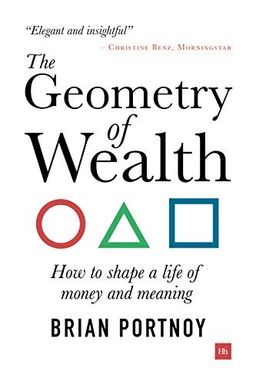
The Geometry of Wealth cover

The Geometry of Wealth

by Brian Portnoy

The Geometry of Wealth by Brian Portnoy is a compelling guide to achieving true wealth through a blend of financial acumen and philosophical insight. It explores how aligning material success with personal fulfillment leads to a life of abundance. Discover practical strategies to manage your finances wisely, embrace gratitude, and make meaningful investments for a prosperous future.

The Geometry of Wealth: Redefining What It Means to Be Wealthy

How can you build a life that feels rich, not just one that looks rich? In The Geometry of Wealth, behavioral finance expert Brian Portnoy argues that true wealth isn’t about accumulating money—it’s about cultivating funded contentment. This phrase defines wealth as the ability to finance a meaningful life, not merely to maximize financial assets or status. Portnoy shows that most people pursue money without clarity about what it’s actually for, mistaking the chase for the reward. His book offers an antidote: a practical and philosophical framework for aligning your finances with your deepest sense of purpose.

Portnoy writes for everyone overwhelmed by financial noise and unsure where happiness fits in. He contends that to be wealthy is to answer one central question: Am I going to be okay? This question blends emotional security with financial stability. Unlike traditional financial manuals focused on investing strategies or retirement math, The Geometry of Wealth ties neuroscience, psychology, and philosophy together into a human-centered guide for making peace with money. Throughout the book, Portnoy reshapes how we think about prosperity, revealing that purpose, priorities, and simplicity—not market performance—shape a meaningful life.

Three Shapes to Map a Meaningful Life

Portnoy’s organizing metaphor is geometric. He uses three shapes—a circle, triangle, and square—to symbolize the progression from purpose to practice. The circle represents your purpose, the ongoing, adaptive process of understanding what makes life meaningful. The triangle addresses priorities, helping you set the right actions in motion to protect, balance, and aspire with your finances. Finally, the square marks tactics, guiding how to make smart, simple decisions in a complex financial world.

These three shapes act as a visual journey—from reflection to action. They are connected by what Portnoy calls adaptive simplicity, the mental discipline of cutting through complexity while staying flexible to life’s changes. (Think of it as mindfulness applied to money management.) In this way, geometry becomes a metaphor for living with clarity, direction, and balance in your financial life. Purpose answers why you seek wealth, priorities answer what to focus on, and tactics answer how to make choices wisely.

From “Rich” to “Wealthy”

Portnoy begins by challenging the cultural obsession with being “rich.” Rich means having more—more income, more stuff, more comparison points. But “more” is a treadmill. The rich chase ever-moving targets of satisfaction and social status. Wealth, however, is different. It’s not a number but a state of funded contentment—having enough resources to underwrite what truly matters to you. You can’t chase it through greed; you cultivate it through wisdom and self-awareness.

To illustrate this, Portnoy invokes both ancient philosophy and modern science. Aristotle’s concept of eudaimonia—living well by developing virtue—frames the pursuit of wealth as an ethical and emotional discipline. Meanwhile, behavioral economists like Daniel Kahneman and Richard Thaler reveal how the brain’s wiring often sabotages satisfaction. The more we acquire, the higher our expectations rise, and the more fleeting our happiness becomes. Instead of escaping this pattern, Portnoy urges readers to redefine wealth so it centers on meaning, not accumulation.

Why Money and Meaning Must Be Integrated

Money can’t be separated from life’s story. It touches every decision about family, health, work, and community, yet it’s often treated as taboo. Portnoy calls money “a Lord Voldemort topic”—powerful, feared, and rarely spoken of. This silence prevents us from understanding how financial decisions shape emotional well-being. By blending fields from neuroscience to philosophy, Portnoy seeks to make money humane again: less a technical problem to optimize and more a relationship to nurture.

He shows that wealth emerges when clear minds and dirty hands work together: clear minds to define meaning, dirty hands to take consistent action. Readers learn to engage both perspectives—the abstract and the practical—and view them as partners, not opposites. We need financial literacy to plan well, and emotional intelligence to live well. Together, they allow us to find stability and possibility in an uncertain world.

Why This Framework Matters Today

We live in an era of financial anxiety. Portnoy notes that modern workers face shrinking pensions, volatile markets, and information overload. More choice, paradoxically, brings more confusion. He argues that “we live in an age of anxiety” precisely because we mistake control for freedom. People must manage their own retirement, investments, and safety nets, yet few feel equipped to do so. In this context, The Geometry of Wealth becomes a map for navigating modern money life: one that prioritizes mindfulness over metrics, simplicity over optimization.

Ultimately, Portnoy doesn’t promise riches or complex formulas. He promises perspective. Through the lens of the circle, triangle, and square, you’ll see how purpose, priorities, and tactics interact to form a life of contentment you can actually afford—financially, emotionally, and spiritually. The result is a transformative definition of prosperity: not more money, but more meaning per dollar.


Adaptive Simplicity: Mastering Mind and Money

Adaptive simplicity is Portnoy’s key to navigating a noisy world. It combines flexibility and clarity—rolling with life’s punches while cutting through its clutter. Rather than chasing expertise or perfection, Portnoy invites you to develop something far more powerful: awareness of how your own mind works when making money decisions. Drawing on Daniel Kahneman’s Thinking, Fast and Slow, he explains how your two-track brain—intuition (System 1) and reason (System 2)—often pulls you in opposite directions.

Your Two-Speed Brain

System 1 is your fast, automatic, emotional brain. It protects you instinctively, scanning for danger and creating coherence from chaos. It pushes you to follow gut reactions—often useful in survival but hazardous in financial decisions. System 2 is your slow, effortful, reflective brain. It evaluates options, weighs probabilities, and powers deliberate planning. Both systems are essential for making wise money choices, but they can conflict. The trick is not to silence intuition but to coordinate it with reason.

“We are not irrational; we are human.”

Portnoy echoes Kahneman to remind us that cognitive biases aren’t failures—they’re features of survival. When you understand them, you can manage them with grace rather than guilt.

The 40% Solution: What You Can Control

Portnoy draws on psychologist Sonja Lyubomirsky’s research to show that roughly 40% of your happiness stems from intention—your deliberate choices and mindset. The rest comes from disposition (your genetic “set point,” about 50%) and circumstance (only 10%). The takeaway? You can’t control everything, but you can control enough to steer your story. That 40% is your toolkit for adaptive simplicity.

This proportion encourages humility and empowerment at once. You can’t eliminate financial uncertainty or emotional bias, but you can prepare mentally to respond wisely. Portnoy calls this developing a “prepared mind”—a concept borrowed from Louis Pasteur—meaning the ability to adapt gracefully to change. It’s the ultimate financial advantage.

Less Information, Better Decisions

Oddly, more knowledge about money doesn’t lead to better results. Portnoy cites research showing that as people gather more financial data, their decisions often worsen. We overload our slow-thinking brain, which leads to paralysis or overconfidence. Simplicity means pruning the noise—focusing on fewer, clearer principles that actually matter: living within your means, avoiding big risks, saving regularly, and investing patiently. These ideas sound simple but are exceedingly hard in practice, which is why Portnoy’s geometric clarity matters.

From Complexity to Clarity

Adaptive simplicity applies to every domain of your money life—earning, spending, saving, and investing. In earning, it means calibrating ambition with balance. In spending, it means aligning expenses with purpose instead of impulse. In saving, it means embracing discipline without obsession. In investing, it means focusing on long-term probabilities rather than short-term predictions. In life, it means understanding that calm beats clever.

By cultivating adaptive simplicity, you don’t eliminate uncertainty—you master it. You learn to simplify without oversimplifying, to bend without breaking. As Goethe’s quote from the book’s epigraph reminds us: “Do not hurry; do not rest.” That line becomes your mantra for shaping a wealthy life—steady, thoughtful, and resilient.


The Four C’s: What Really Matters for a Meaningful Life

What makes a life worth funding? Portnoy distills the science of happiness and decades of psychology into four essential sources of joy—the Four C’s: Connection, Control, Competence, and Context. These aren’t luxuries; they’re psychological necessities. Together, they define the content of a meaningful life—the “what” behind funded contentment.

Connection: Belonging and Relationships

Humans are tribal creatures. We are “wired to connect,” as neuroscientist Matthew Lieberman writes. The quality of your relationships—not your income—most predicts your well-being. Portnoy describes walking his children to school and the joy of seeing neighbors. That sense of belonging, not the digits in your account, is the emotional bedrock of wealth. (This mirrors Robert Waldinger’s Harvard Study findings that close relationships are the strongest drivers of happiness.) Investing in community—family dinners, friendships, or volunteering—pays higher dividends than stocks ever could.

Control: Autonomy and Freedom of Choice

Control is the ability to direct your own life—to make choices that align with your values. Isaiah Berlin’s concept of liberty infuses Portnoy’s view: we want to be “a subject, not an object.” Yet even illusory control feels valuable. This explains why people prefer picking their own lottery ticket, even when odds don’t change. Portnoy cautions that while freedom is precious, too much choice breeds anxiety—the “paradox of choice.” True control balances agency with acceptance, reflecting Viktor Frankl’s lesson that even in suffering, one can choose meaning.

Competence: Mastery and Meaningful Work

Work provides both bread and identity. Portnoy shares Shannon Mulcahy’s story—a steelworker whose job loss cost her not just money but pride and purpose. Competence fuels self-worth because being good at something meaningful fulfills the need for progress (echoing Mihaly Csikszentmihalyi’s concept of “flow”). Money rewards your labor, but mastery rewards your soul. Pursuing competence means valuing effort, grit, and challenges—the hard-earned satisfaction that Carol Dweck calls a “growth mindset.”

Context: Purpose Beyond the Self

Meaning doesn’t exist in isolation. It comes when you contribute to something larger—be it faith, community, or service. Portnoy invokes Martin Luther King Jr.’s “mountaintop” speech to show how transcendent purpose enlarges life. Without context, success feels hollow; with it, even sacrifice feels rich. Context surrounds the other three C’s, binding belonging, autonomy, and mastery into a larger story.

Balancing the Inner and Outer Life

Connection and context relate to your outer, social life, while control and competence center on your inner world. The tension between self and group—freedom and belonging—is inescapable, as Portnoy admits. True contentment means honoring both: defining your own story while staying part of something bigger. As Brené Brown writes, “True belonging requires us to believe in and belong to ourselves so fully that we can find sacredness both in being a part of something and in standing alone when necessary.”

When you invest money wisely—not just in markets, but in experiences, generosity, and time—you’re funding these Four C’s. The dividends they yield aren’t measured in dollars but in joy, resilience, and purpose.


Does Money Buy Happiness? Yes, Not Really, It Depends

Portnoy tackles the question that haunts almost every financial decision: Can money buy happiness? His answer—“Yes, Not Really, It Depends”—captures the nuance revealed by research from Daniel Kahneman and Angus Deaton. Money matters only up to a point, and mostly as a buffer against sadness. Beyond modest income levels, more money doesn’t make you much happier day to day. But it can enhance your deeper sense of fulfillment—if it’s used wisely.

The Hedonic Treadmill

Humans quickly adapt to new levels of comfort. Psychologists call this “hedonic adaptation.” Whether you win the lottery or suffer a setback, your happiness tends to return to its baseline. Portnoy invokes Mad Men’s Don Draper: “Happiness is what you get right before you want more happiness.” No matter how much you have, expectations rise, and satisfaction resets. This treadmill explains why prosperity doesn’t produce peace—it only raises the bar for “enough.”

Money Alleviates Sadness More Than It Creates Joy

Kahneman and Deaton’s large-scale study revealed two distinct types of happiness: experienced (everyday mood) and reflective (overall life satisfaction). Experienced happiness plateaus around $75,000 a year (adjusted for inflation). More money doesn’t brighten your day—it only cushions you against stress. Reflective happiness, however, continues to rise with income because it deepens your sense of security and agency. Money helps you worry less, not smile more.

How to Spend for Happiness

Portnoy shares three ways to turn money into meaning: spend on experiences, others, and time. Experiences create memories that resist adaptation and build connection. Give to others—charity or small acts of kindness—to enhance joy and empathy. Finally, use money to buy time: eliminate distractions, ease burdens, and reclaim presence. Research shows that people who prefer time over money are happier across demographics. (See also Elizabeth Dunn and Michael Norton’s Happy Money.)

Practical Balance: More vs. Enough

Money’s role isn’t to replace meaning but to enable it. Portnoy reframes wealth not as endless accumulation but as the ability to underwrite the things that matter—those Four C’s. If you can afford connection, control, competence, and context, you’re wealthy. The sweet spot is calibrating your financial life to support—not distort—your purpose. This means replacing the question “Am I rich enough?” with “Am I funded enough to be content?”

In the end, Portnoy doesn’t ask you to stop seeking prosperity; he asks you to redefine it. Money can’t buy happiness, but it can buy the conditions that allow happiness to flourish.


The Triangle: Setting Priorities That Protect and Guide

Once you’ve defined your purpose, Portnoy helps you translate it into a plan. The triangle symbolizes this stage—turning intentions into priorities. He organizes financial life into three essential actions: Protect, Match, and Reach. Each represents a practical layer of financial strategy—risk management, goal alignment, and aspiration.

Protect: Avoid Big Mistakes

The first rule of wealth is not to lose it. Portnoy uses Pascal’s Wager—a philosophical bet on faith—to illustrate this mindset. Just as Pascal chose belief to avoid infinite loss, we invest time and resources to minimize catastrophe. This is the psychology of loss aversion: the pain of losing a dollar is twice as strong as the pleasure of gaining one. Protecting yourself through insurance, diversified investments, or emergency savings isn’t glamorous, but it’s the foundation of staying wealthy. In Portnoy’s words, “win by not losing.”

Match: Align What You Own With What You Owe

Financial equilibrium comes from understanding your balance sheet—assets (what you own) versus liabilities (what you owe). Few people ever calculate this directly, but it’s crucial for clarity. Portnoy urges readers to map financial goals—both terminal (fixed dates and lump sums, like college tuition) and flow goals (continuous needs, like retirement income). Near-term goals should involve less risk; long-term ones can tolerate more. Matching money to timing helps you stop guessing and start planning deliberately.

Reach: Aspire With Gratitude

After protection and balance, you can dream bigger. But Portnoy cautions: most people misinterpret “reach” as “more.” Reaching isn’t greed—it’s growth in alignment with purpose. He encourages generosity and gratitude as the real markers of reaching well. Wealth isn’t a trophy; it’s a tool for creating impact and joy in others’ lives. Practicing gratitude, according to psychologist Robert Emmons, strengthens humility and happiness simultaneously. In Portnoy’s model, reaching means expanding meaning, not materialism.

The Power of Being Less Wrong

Portnoy reframes success as managing risk intelligently rather than chasing perfection. “Being less wrong” beats “being more right.” Prudent investors control risk—not avoid it—so they can survive to win long term. Insurance, diversification, and debt control are all acts of humility before uncertainty. In his triangle, safety comes first, balance second, ambition last—and in that order lies real peace.

The triangle teaches you not only how to plan wisely but why to plan at all. It’s not about optimizing everything; it’s about orchestrating your financial choices to serve your greater purpose. Protect what matters, match your means to your goals, and reach with gratitude—that’s how funded contentment becomes sustainable.


The Square: Simplifying Complex Decisions for Better Outcomes

Portnoy’s final shape—the square—turns financial complexity into four clean corners of decision-making. In a world obsessed with precision, he teaches that investing well is less about finding the “perfect” formula and more about managing expectations through simplicity. The square’s four corners represent the irreducible elements of all investment decisions: Growth, Pain, Fit, and Flexibility.

Growth: Setting Realistic Expectations

Growth means estimating the returns your investments can realistically achieve. Stocks may average 10% annually over decades, but actual results fluctuate wildly. Portnoy illustrates this with “rolling periods”—short-term results vary drastically, while longer-term ones narrow toward predictability. Bonds, by contrast, offer steadier but lower results. The key isn’t predicting exact numbers—it’s understanding ranges and probabilities. This shift from certainty to realism replaces stress with confidence.

Pain: The Emotional Cost of Risk

Every investment carries emotional pain—the volatility that makes you doubt your decisions. Portnoy calls volatility “the price of admission.” Investors often panic during market drops, selling low and missing rebounds—a behavior gap that halves long-term returns. Recognizing that drawdowns are part of the ride helps you stay invested. Being wealthy requires emotional endurance as much as financial strategy.

Fit: The Harmony of Your Portfolio

Fit means understanding how each investment interacts with your existing holdings. Diversification—owning assets that don’t move in sync—is essential but emotionally annoying. Some parts of your portfolio will always feel “wrong.” Portnoy calls this “the broccoli of investing”—healthy but often unpleasant. True diversity guards you from catastrophe but requires patience and discipline, especially during market stress.

Flexibility: The Freedom to Adapt

Flexibility reflects liquidity—the ability to change your mind. Portnoy contrasts two identical funds, one fully discretionary and one locked into automatic retirement accounts. The autopilot investors did far better because they couldn’t act impulsively. He calls this “the Ulysses strategy”—tying yourself to the mast to resist temptation. Sometimes limiting control leads to better outcomes. Liquidity, paradoxically, can be dangerous if it enables bad behavior.

Simplify to Succeed

Einstein’s adage guides Portnoy’s square: “Everything must be as simple as possible, but no simpler.” Successful investing isn’t about precision—it’s about progress. By focusing on these four corners, you transform uncertainty into bounded clarity. Money life becomes manageable when you realize you don’t need to know everything. The humility to say “I don’t know” is, Portnoy insists, the hallmark of great investors like Charlie Munger and Warren Buffett.

Through the square, Portnoy helps you see finance not as a math puzzle but as a meditation on control, patience, and expectations. Master these four corners, and you’ve mastered the geometry of decision-making itself.


Time, Presence, and Progress: The Art of Enough

In Portnoy’s final chapter, the abstract becomes personal. He asks, “How much is enough?” The tension between wanting more and being satisfied defines our financial and emotional lives. Drawing from Stoic philosophy and neuroscience, Portnoy reveals that wealth is a balance between progress and presence—between striving and savoring. You can pursue goals without losing the ability to enjoy where you are.

The Tug of War: More vs. Enough

We’re wired to chase “more.” From evolution onward, striving ensured survival. This drive built civilizations and inspired innovation, but it also breeds anxiety and comparison. Portnoy contrasts Gordon Gekko’s “Greed is good” speech from Wall Street with the question Bud Fox asks him: “How much is enough?” Few of us can answer. Yet contentment—the wise acceptance of enough—is the true measure of wealth. Philosophers from Epictetus to Lao Tzu echo this truth: gratitude transforms scarcity into abundance.

The Gremlin of Time

Money forces us to think through time: planning for the future while living in the present. Portnoy calls time the “gremlin” that shapes all financial anxiety. Psychology and finance view time differently—finance assumes it’s linear, but the mind experiences it as elastic. Our days feel slow, our years fly by. Understanding time’s subjectivity helps you appreciate presence and patience as essential components of wealth.

Practicing Presence

Mindfulness bridges the gap between now and later. Being “here,” as Thich Nhat Hanh writes, is the real miracle. This doesn’t mean giving up ambition—it means pacing it. By grounding yourself in moments of joy and gratitude, you escape the tyranny of “I’ll be happy when…” Portnoy warns against living on the hedonic treadmill of future-focused goals. True happiness emerges from everyday awareness, not distant success markers.

Progress Without Hurry

You can move forward without rushing. Adaptive simplicity teaches “Do not hurry; do not rest.” Whether saving for the future or cultivating purpose, steadiness beats intensity. Portnoy highlights concepts like delayed gratification (Walter Mischel’s “marshmallow test”) and compounding—proof that small, consistent progress yields exponential reward. Investing and living both reward patience.

Balancing Being and Becoming

You are never finished. “Human beings are works in progress that mistakenly think they’re finished,” psychologist Daniel Gilbert says. Portnoy embraces this evolving self—the adaptive self whose rhythm oscillates between being and becoming. Wealth is not a finish line but a flow: accepting where you are while continuing to grow. Funded contentment is living with both gratitude and aspiration held in balance.

In the end, The Geometry of Wealth teaches that prosperity is geometry—an ongoing motion between shapes, between purpose and practice, between enough and more. When you keep pace calmly, neither hurrying nor resting, you find freedom in sufficiency. You are here—and that’s wealth.

Dig Deeper

Get personalized prompts to apply these lessons to your life and deepen your understanding.

Go Deeper

Get the Full Experience

Download Insight Books for AI-powered reflections, quizzes, and more.