
Idea 1
The Intelligent Bird: Rethinking Minds and Evolution
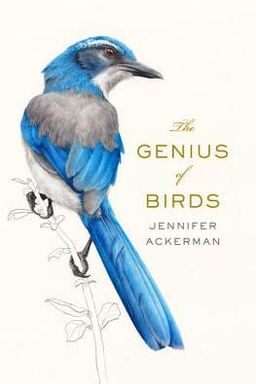
Jennifer Ackerman’s The Genius of Birds challenges one of the most persistent myths in natural history—that to be small-brained is to be simple-minded. You learn that avian intelligence is not an echo of human or primate thought but an independent, convergent evolution of complex cognition. Birds have evolved intricate neural designs, flexible behaviors, and social and technical intelligence that rival mammalian standards. Across the book, Ackerman dismantles the old insult “bird brain” and replaces it with evidence for creativity, planning, and learning distributed across species.
From Primitive to Parallel
For more than a century, scientists labeled bird brains with terms like paleo- and archi-, implying primitiveness. Modern neurobiology overturned this view: researchers such as Harvey Karten, Anton Reiner, and Erich Jarvis mapped the avian pallium and showed that its clusters perform cortical-like computations. Work by Suzana Herculano-Houzel revealed how parrot and corvid brains pack high neuron densities—meaning that small size can hide immense processing power. When crows or chickadees plan, remember, and invent, they deploy differently wired but equally capable networks compared to mammals. You begin to see evolution as an engineer with multiple viable blueprints for intelligence.
Multiple Kinds of Genius
Ackerman organizes avian brilliance into several dimensions. Technical intelligence appears in toolmaking species like New Caledonian crows and Goffin’s cockatoos who shape pandanus leaves or wire hooks. Social intelligence emerges in species that cooperate, deceive, and teach—scrub jays guarding caches, pied babblers tutoring fledglings. Vocal learning reveals neurological parallels to human speech, while artistic and architectural display—bowerbirds arranging blue ornaments or finches tailoring nests—illustrates creativity driven by sexual selection and aesthetics. Even spatial and migratory genius, as in homing pigeons or chickadees, shows how avian navigation intertwines sensory chemistry, memory, and experience. Each form of intelligence evolved to solve distinctive ecological and social problems.
Measuring Minds in Context
Ackerman builds on Louis Lefebvre and Daniel Sol’s work combining lab tests and field innovation counts. You discover that scientific measurement of bird cognition demands both controlled puzzles and real-world creativity. Lab tasks—string pulling, reversal learning, or water displacement—clarify mechanisms, while innovation databases track spontaneous behaviors in the wild. Taken together, they highlight that intelligence in animals must be read through ecology and temperament, not only through test scores.
Brains that Change, Cultures that Spread
Ackerman emphasizes plasticity: chickadees expand hippocampal tissue in winter; crows and babblers learn socially; songbirds regenerate neurons during learning. Culture, once thought human-exclusive, appears whenever behaviors spread socially and persist—whether tool styles in crows or song dialects in finches. These examples argue for evolution as a cultural collaborator, merging genetic potential with learned tradition. Urban birds like sparrows demonstrate yet another frontier—flexibility under human-made conditions. They show how cognition becomes a survival toolkit amid rapid change.
Key insight
Avian intelligence is not about imitation of humans but about independent innovation—an evolutionary experiment revealing multiple routes to advanced thinking, creativity, and social life.
By the end, you realize that the “bird brain” is not a lesser design but a different one—dense, modular, and dynamic. Birds force you to reconsider what intelligence looks like across nature: not a single ladder with humans on top, but a broad landscape of minds, each evolved to meet its world with ingenuity.