
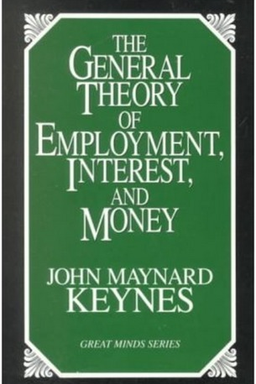
The General Theory of Employment, Interest, and Money cover

The General Theory of Employment, Interest, and Money

by John Maynard Keynes

John Maynard Keynes''s The General Theory of Employment, Interest, and Money offers a transformative approach to understanding economic fluctuations and employment. It challenges conventional theories, advocating for strategic government intervention and dissecting the psychological factors influencing investment decisions to foster economic stability during downturns.

Reinventing Economic Theory for a Real World

How can you understand unemployment when the old postulates of economics assume it cannot exist? In The General Theory of Employment, Interest, and Money, John Maynard Keynes dismantles the elegant but unrealistic classical system and replaces it with a model grounded in human expectations, money, and demand. He argues that economies are not self-correcting machines tending toward full employment but social organisms dominated by confidence, liquidity, and spending behaviour.

Keynes attacks two classical postulates: that wages equal the marginal product of labour and that real wages equal the marginal disutility of labour. These, he shows, only hold in a special limiting world where people care only about real wages and markets instantly clear. In the world you live in—where contracts, uncertainty, and expectations reign—they collapse. Keynes therefore insists that employment is determined not by wage bargains alone but by effective demand—the total expected proceeds from consumption and investment spending.

Demand replaces equilibrium

Keynes defines effective demand as the intersection between entrepreneurs’ demand-price (expected sales proceeds) and their supply-price (the minimum receipts needed to employ labour profitably). Employment settles where these two meet, not where the real wage equals workers’ disutility. This switch—from wage-centric to demand-centric equilibrium—is revolutionary. It explains why labour markets can fail even without wage rigidity and why recessions stem from insufficient demand rather than individual laziness.

Psychological foundations: propensity and expectation

Two behavioural forces shape effective demand. The first is the propensity to consume: consumers spend a fraction of every income increment, leaving a residual that must be absorbed by investment if employment is to rise. The second is the state of long-term expectation: entrepreneurs’ forecasts of future returns, which determine their willingness to invest. These forces interact dynamically—confidence drives investment; investment drives income; and income drives consumption.

Because consumption rises less than income, savings emerge; investment must fill the gap to maintain full employment. And when expectations collapse—as in 1929—investment contracts faster than consumption can compensate, generating deep involuntary unemployment. Classical theory’s failure lay in overlooking this psychological interdependence.

Money and liquidity as determinants

Money, for Keynes, is not neutral. It has a unique role because people value its liquidity more than its yield. This preference—liquidity-preference—governs the interest rate. You hold money for transactions, precaution, and speculation; the last motive makes interest the price for parting with liquidity. When confidence falters, liquidity-preference surges and the interest rate resists falling, choking investment even when savings accumulate. Hence, monetary policy alone may fail without addressing confidence and liquidity traps.

A new economics of expectations and policy

Keynes weaves these concepts together into a practical doctrine. In his system, employment depends on total spending; income equals production adjusted for costs and depreciation; saving equals investment structurally, though expectations determine how much investment actually occurs. Shifts in the marginal efficiency of capital—the expected profitability of new projects—drive booms and slumps, while liquidity-preference and institutional wage-setting define how far policy can push recovery.

He therefore calls for coordinated state action: fiscal policy to raise demand when private investment fails, and monetary management to moderate speculative extremes. Wage flexibility alone is unreliable, for wage cuts often depress consumption and expectations more than they stimulate employment. Stability of wages and proactive investment are his preferred tools.

Where the story leads

You journey from the limits of classical geometry to Keynes’s non‑Euclidean world—one where economy rests on psychology and time. Later sections elaborate how multipliers amplify spending, how elasticities define price response, and how mercantilist and Gesellian ideas anticipate modern insights. Keynes’s vision ends with social purpose: a world where capital grows plentiful enough to extinguish the rentier and restore employment as a matter of policy, not fate.

(In modern policy terms, Keynes’s doctrine underlies fiscal stabilization, countercyclical public works, and the management of expectations—all vital when markets freeze under uncertainty. He transformed economics from a theory of allocation to a theory of activity.)


From Classical Limits to Effective Demand

Keynes begins by exposing the limitations of classical postulates—the assumptions that wages automatically equate supply and demand for labour and that price shifts restore equilibrium. He likens classical economists to Euclidean geometers rebuking reality for violating their axioms. Real economies, he warns, contain involuntary unemployment—a condition impossible under classical premises but visible everywhere in depressions.

Three types of unemployment

You can classify unemployment as frictional (temporary mismatch), voluntary (choice not to work at given wages), and involuntary (systemic deficiency of demand). Keynes’s decisive innovation is to formalize the third type: when both supply and demand for labour would rise with a small price increase, yet actual employment remains lower due to deficient effective demand, unemployment is involuntary.

Effective demand’s mechanics

To explain this, Keynes constructs dual functions—aggregate supply price, Z = φ(N), and aggregate demand price, D = f(N)—each defined in labour and money units. Equilibrium employment arises where D = Z. Entrepreneurs increase hiring only until expected proceeds match expected costs. Beyond that, further employment is unprofitable. If consumption and investment fail to generate sufficient D, employment stalls below full capacity.

Conceptual shift

Effective demand converts a static supply theory into a dynamic one of expectations. It identifies the true causal variable behind employment changes—aggregate spending intentions—not nominal wages alone.

Consumption and investment as joint drivers

Aggregate demand D divides into D1 (consumption) and D2 (investment). Because consumption increases less than income, investment must fill the saving gap. Communities with high propensities to save require proportionally higher investment to maintain employment. Failure of inducement to invest thus translates directly into involuntary unemployment. This insight overturns Say’s Law, showing that supply does not automatically create its own demand.

Practical consequences

Policies that aim only to lower wages without restoring investment cannot resolve unemployment. Keynes preserves the marginal productivity principle as a theory of distribution, but insists employment hinges on aggregate expenditure. That recognition—effective demand as determinant of output—marks the beginning of macroeconomics itself. (Note: in this formulation, Pigou’s and Marshall’s wage theories become special cases, valid only under full employment.)


Expectation, Investment and Business Cycles

Every entrepreneur faces two horizons of expectation: the short term for current production and the long term for investment returns. Keynes teaches you how shifts in these expectations drive fluctuations in employment and generate the business cycle. Optimism breeds expansion; disillusion breeds contraction.

Short-term versus long-term expectations

Short-term expectations govern immediate output decisions using existing capital. Long-term expectations govern new investment—projects requiring multi‑year forecasts. Because the latter involve more uncertainty, they move erratically and determine the cyclical rhythm of the economy. Investment surges when confidence rises, but collapses when it falls, dragging effective demand with it.

Marginal efficiency of capital

Keynes expresses entrepreneurs’ confidence through the marginal efficiency of capital (MEC)—the expected internal rate of return on new assets. Investment proceeds until MEC equals the market rate of interest. Because MEC depends on expectations about yields, costs, and demand, its schedule shifts abruptly when optimism wanes. Sudden declines in MEC precede slumps; recoveries occur only when wear and depreciation restore scarcity and MEC gradually rises.

How the cycle unfolds

Booms emerge when rising profits and speculation push MEC above interest. Expansion continues until overproduction or disappointment collapses expected returns. Slumps last because capital assets are durable and excess stocks take time to absorb. Keynes empirically notes two forces prolong downturns: the average life of capital equipment and the multi‑year digestion of unsold inventories. That explains why post‑crisis recoveries, such as after 1929, drag on even when money becomes plentiful.

Policy interpretation

You learn that trying to curb booms by permanently high interest rates merely enshrines chronic under‑employment. The wiser path is to stabilize expectations—through public investment, monetary flexibility, and coordination—to prevent the MEC collapse that initiates slumps. (Note: Keynes’s treatment of expectations refines his earlier Treatise on Money, replacing mechanical credit cycles with behavioural cycles anchored in fluctuating confidence.)


Money, Interest, and Liquidity

In Keynes’s system money is not just a medium of exchange; it is an asset with a distinctive yield structure that determines the rate of interest. You hold money because it offers liquidity—a psychological and practical premium unmatched by other assets. The rate of interest thus becomes the price for surrendering that liquidity.

Liquidity-preference and rate of interest

Three motives explain money holding: transactions, precaution, and speculation. The speculative motive is crucial—it links future expectations and interest rates. Given a finite money supply M and a liquidity-demand function L(r), equilibrium satisfies M = L(r). The interest rate r adjusts not to equate saving and investment as classical theory suggested, but to balance this liquidity equation.

Key insight

Interest is a monetary phenomenon, not a real one; it reflects liquidity-preference, not intertemporal barter. Thus policy can influence r by changing the money supply or by altering expectations that shape liquidity demand.

Money’s own-rate and its rigidity

Every asset has an own-rate defined by its yield (q), carrying-cost (c), and liquidity-premium (l). For most goods q > c, l ≈ 0; for money q ≈ 0, c ≈ 0, but l is large. This makes money uniquely attractive especially in uncertainty. Because money’s own-rate changes slowly with supply—it cannot be rapidly produced and has no substitutes—liquidity traps arise. Even aggressive monetary expansion may not lower rates enough to stimulate investment, as people simply hoard cash.

Why policy must broaden beyond money

Keynes explored proposals like Silvio Gesell’s stamped money, where holding currency incurs cost to reduce liquidity-premium. He sympathized with the idea’s logic but warned that substitutes (bank reserves, foreign money) might absorb liquidity unless reforms are holistic. Lasting full employment demands lowering the money-rate to match the social MEC—not through mechanical savings equilibria but through managed liquidity and confidence. (Context: this chapter influenced later theories of liquidity traps and post-war monetary policy doctrines.)


Propensity to Consume and the Multiplier

Keynes transforms consumption from a passive residual into an active determinant of output. He formalises a propensity to consume function showing how consumer spending relates to income and uses this to derive the investment multiplier—the ratio linking changes in investment to total changes in income and employment.

Understanding consumption behaviour

You can express consumption in wage-units Cw = χ(Yw). The marginal propensity to consume, c = dCw/dYw, typically lies between 0 and 1, meaning people save part of new income. This behavioural fact underlies Keynes’s claim that saving does not automatically convert into investment: unless new investment fills the saving gap, output falls.

Multiplier mechanism

When investment increases by one unit, income rises by k = 1/(1 - c) units. The higher the marginal propensity to consume, the larger the multiplier. Keynes builds on R.F. Kahn’s employment multiplier, linking increased spending to cascading rounds of job creation. But he warns that leakages—interest rises, foreign trade, or relief borrowing—dilute effects in practice. Empirical evidence from Kuznets and Colin Clark suggests practical multipliers around 2–3, not the theoretical 10 of a closed system.

Policy implications

High consumption propensities boost multipliers but require proportionally larger investment to maintain full employment. Public works spending magnifies employment, yet financing matters: reckless borrowing can offset gains by raising rates. States must calibrate fiscal tools to sustain demand without crowding out private activity. Keynes demonstrates how fiscal stimulus operates through this multiplier logic, turning investment into amplified national income.

(Note: his multiplier concept remains the foundation of modern macro-fiscal models. It reveals why austerity—reducing expenditure amid weak demand—tends to multiply contraction rather than recovery.)


Wages, Prices and Employment Stability

Classical policy promised salvation through wage cuts. Keynes dismantles this myth. He explains that general reductions in money-wages seldom improve employment because they alter psychological and financial variables—the propensity to consume, marginal efficiency of capital, and liquidity-preference—often in opposite directions.

The seven repercussions of wage cuts

  • Redistribution lowers consumption by shifting income toward rentiers with lower spending propensities.
  • External trade may benefit, but only in open economies.
  • Expectations worsen if wage reductions signal continued decline, lowering investment.
  • Liquidity-preference may drop modestly as cash needs fall, but unrest or debt-deflation can reverse gains.
  • Real debt burdens rise as prices fall, depressing confidence.
  • Fragmented wage adjustments invite industrial conflict and uncertainty.
  • Only coordinated, universal cuts might lift expectations slightly, but practical constraints make this unlikely.

Why rigidity may help

Keynes concludes that stable money-wages are preferable. Attempts at flexibility can create self‑defeating deflationary expectations and debt stress. Wage stability anchors expectations while fiscal and monetary policy tackle demand shortfalls directly. You thus learn that deflation is not a cure but a symptom of deficient demand.

(This argument anticipates modern insights on downward wage rigidity and sticky prices in behavioural and new Keynesian models. It redefines ‘discipline’ from cutting wages to stabilizing aggregate demand.)


Social Purpose and Economic Policy

Keynes closes by reconnecting technical theory to moral purpose. He praises the mercantilists and reformers like Gesell for intuitively grasping the link between money, interest, and employment long before formal analysis existed. Their mistakes were practical, not conceptual: they understood that a nation’s prosperity depends on managing the flow of money and the level of interest, not just on laissez‑faire competition.

Mercantilist lessons and usury laws

Mercantilists sought to maintain gold inflows to keep domestic interest low and employment high. Usury laws likewise aimed to suppress rentier gains that throttled investment. Keynes reinterprets these as early attempts at demand management. Far from barbaric, they reveal societies trying to balance liquidity control with social welfare.

Euthanasia of the rentier

In a world of managed liquidity and abundant capital, the scarcity-rent of ownership—the unearned income of the rentier—can disappear. Keynes envisions gradual “euthanasia” of this class, not through confiscation but through policy that drives interest low enough to equate MEC and encourage full employment. That outcome aligns justice with efficiency: savings find use, labour finds work, and wealth ceases to accumulate through idle claims.

The ethical dimension

Keynes’s final vision fuses economics with ethics. Government, he argues, should guide aggregate consumption, investment, and money so that abundance replaces scarcity as the organizing principle of capitalism. The goal is not endless growth but balance—where enterprise flourishes without dependence on speculative confidence. (This closing synthesis still shapes debates on fiscal responsibility, monetary sovereignty, and social justice.)

Dig Deeper

Get personalized prompts to apply these lessons to your life and deepen your understanding.

Go Deeper

Get the Full Experience

Download Insight Books for AI-powered reflections, quizzes, and more.