
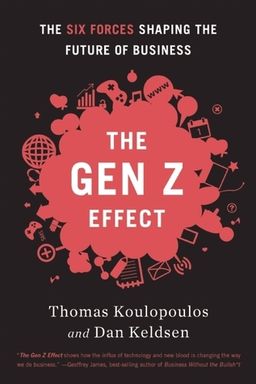
The Gen Z Effect cover

The Gen Z Effect

by Tom Koulopoulos

The Gen Z Effect reveals how the mindset and innovations of Generation Z will shape the future of business. By embracing these changes, organizations and individuals can unite across generations to create a brighter, interconnected future. Discover how to thrive in a world defined by openness, adaptability, and technological progress.

The Gen Z Effect: How Technology is Erasing Generational Divides

Have you ever wondered why the lines between generations—Boomers, Millennials, Gen Z—feel increasingly blurred? In The Gen Z Effect, Thomas Koulopoulos and Dan Keldsen argue that we are witnessing the collapse of these old labels. Technology, education, and social interconnectedness are dissolving the generational boundaries that once defined how people work, learn, and live. What’s emerging, they contend, is a post-generational world united by shared digital behaviors rather than age brackets.

The authors define the “Gen Z Effect” as a convergence of six forces—breaking generations, hyperconnecting, slingshotting, shifting from affluence to influence, adopting the world as my classroom, and lifehacking—that together reshape humanity’s relationship with technology, learning, and work. Rather than describing Gen Z as merely those born around 2005, they position it as a mindset open to continuous adaptation, technological fluency, and inclusive collaboration.

From Birthright to Choice

Unlike traditional demographic generations, being Gen Z is not about when you were born but how you choose to act. A Baby Boomer who crowdsources ideas online or a Gen Xer who takes MOOCs to retrain professionally exemplifies the Gen Z Effect as much as a teenager designing apps. The authors urge readers to stop seeing each demographic band as a cultural island and start seeing the connecting technologies—like smartphones, online education, and digital collaboration—as bridges across age.

Why It Matters Now

Koulopoulos and Keldsen argue that dissolving generational divides isn’t just about social harmony—it’s essential for innovation. The world’s biggest challenges—climate change, education access, economic disparity, and technological disruption—demand cross-generational collaboration. They note that “the greatest impediments to solving global problems are the generational chasms we’ve been taught to accept.”

Understanding the Gen Z Effect means realizing how generations are converging rather than separating. Older adults are as likely to use tablets and video calls as children who grew up with them. A grandmother Facetiming her infant grandchild and a teen taking a free MIT course online are part of the same phenomenon: the collapse of technological barriers and the rise of shared digital literacy.

Six Forces Reshaping Humanity

The authors map six transformative forces defining this new era:

  • Breaking Generations: How demographic shifts and longer lifespans will make equal age distribution globally—the “population skyscraper”—replacing the pyramid of the past.
  • Hyperconnecting: How constant access to networks of people and devices turns the world into one vast collaborative system.
  • Slingshotting: How simplification and usability in technology allow late adopters to leapfrog decades of progress instantly.
  • Shifting from Affluence to Influence: How social networks and connected platforms empower voices over wealth, democratizing impact.
  • Adopting the World As My Classroom: How universal, lifelong, and gamified learning transcends age and geography.
  • Lifehacking: How the hacker ethos—creative problem solving and system reimagining—becomes a global competency.

Together, these forces are creating what the authors call “the last generation”—not because history ends, but because future generations will no longer be defined by age cohorts. Instead, they’ll be defined by the ability to collaborate fluidly across them.

The Bigger Picture

At its heart, The Gen Z Effect is a hopeful manifesto. It challenges cynicism about technology by showing how it can empower rather than divide. Koulopoulos and Keldsen blend futurist analysis with real-world case studies—from Google’s peer-to-peer learning programs and Cisco’s reverse mentoring to Khan Academy’s free education model. Each story illustrates how behaving like a Gen Zer means staying curious, connected, and purpose-driven. The message is clear: the future belongs not to the youngest or oldest, but to those who never stop learning.


Breaking Generations: The End of Demographic Pyramids

For centuries, humanity has visualized society as a population pyramid—many young supporting a smaller aging tier. Koulopoulos and Keldsen reveal that demographic reality is shifting toward a “population skyscraper”: by 2080, each five-year age band up to age sixty-five will encompass roughly the same percentage of global population. The authors call this transformation one of the most profound social reconfigurations in history.

From Pyramid to Skyscraper

This new shape results from rising life expectancy, educational access, and health care combined with declining birth rates. The old pyramid—narrow at the top and wide at the base—was built for an era when few lived beyond sixty and large families were the norm. The skyscraper model challenges our economic, political, and cultural infrastructure. Pension systems, employment structures, and the notion of “retirement” will all need rethinking as five, ten, or more generations coexist productively.

The Third Act of Life

Instead of traditional retirement, the authors introduce the “Third Act”. This is not passive leisure but a new stage where work, purpose, and lifelong learning converge. With longer work-life expectancy—a trend increasing faster than life expectancy itself—many people will choose to remain active contributors into their 70s and 80s, merging career with meaning.

Shattering Stereotypes and Listening Between Generations

Modern companies, such as Hyatt Hotels under HR leader Robb Webb, are pioneering what the authors call “empathetic listening.” Borrowing from Stanford’s d.school and its design-thinking methods, Hyatt conducts empathetic interviews with employees of all ages to uncover real motivations beyond stereotypes. Instead of labeling workers as Millennials, Gen Xers, or Boomers, Hyatt treats each as an individual—resulting in increased engagement and recognition (a practice that earned Hyatt the Gallup Great Workplace Award three years in a row).

The Remote Revolution

Breaking generations also means breaking geography. Remote work—once resisted as lazy or disconnected—has become the great equalizer of modern labor. Citrix’s Justin Levy describes the company’s “results-oriented” approach: what matters is impact, not face time. IBM’s 40% remote workforce and its $700 million in real-estate savings provide evidence that multi-generational flexibility pays off. As Koulopoulos and Keldsen note, the gig economy and digital collaboration now blur boundaries between work and life, challenging older concepts of 9-to-5 employment.

“You are not a generation, an age, a category—you’re a person, and we all want to be understood as people, not labels.” – Robb Webb

Ultimately, breaking generations is about freeing people—and organizations—from outdated assumptions. When workplaces measure engagement, empathy, and outcomes instead of age or tenure, they unlock what the authors call “100% engagement across every demographic.”


Hyperconnecting: From Me to We

Hyperconnectivity, the second force of the Gen Z Effect, describes a world in which billions of people and tens of billions of devices interact continuously. The authors note that there are already more connected devices on Earth than people. This explosion of connectivity reshapes attention, learning, and even human relationships.

Living in Two Worlds

Koulopoulos and Keldsen vividly illustrate the new reality with the story of a father whose daughter’s boyfriend “moved in” via Skype—his smiling face always open on the girl’s laptop. This always-on connection may seem strange to older generations, but for Gen Z it’s an extension of presence. The authors argue that technologies like video chat and social networks are merging online and offline life into one integrated continuum.

The End of Digital Fear

Where past generations feared technology’s depersonalizing effects, Gen Z sees connection as empowerment. Psychologist Sherry Turkle’s critique of constant connectivity (“Alone Together”) contrasts sharply with the authors’ optimism. They argue that hyperconnectivity enables people who were once isolated—like children with disabilities or adults living remotely—to participate fully in community and work. The story of Barry, a young man with Tourette’s syndrome who finds fluency while gaming online, exemplifies technology’s potential to liberate rather than isolate.

Reverse Mentoring and Digital Trust

Companies like Cisco and GE are using reverse mentoring—pairing senior leaders with younger digital natives—to exchange knowledge both ways. At Cisco, senior executive Carlos Dominguez launched a program where Millennials coach executives in new technologies and social behaviors. The result is a flattening of hierarchy and an appreciation that learning can flow upward as easily as downward. This mutual mentorship embodies the ethos of Gen Z: continuous, multidirectional learning.

Seeing the Invisible Network

Hyperconnection also demands new visualization tools. Researcher Marc Smith, creator of NodeXL and the Social Media Research Foundation, likens mapping social media to taking “aerial photographs of crowds online.” His work helps companies see conversation clusters and invisible influencers, transforming social chaos into patterns of insight. As the authors note, every desk worker of the future will likely use a network graph, not just a pie chart, to understand influence flows in their organization.

Hyperconnecting turns technological intimacy into a shared language—and invites all generations to participate equally in an interconnected conversation.


Slingshotting: Leaping Into the Future

Slingshotting describes how late adopters—often older or less technical users—suddenly catch up to cutting-edge technology without suffering the painful learning curve early adopters endured. Through usability, accessibility, and data-driven simplicity, technology becomes invisible and intuitive for everyone.

Simplification and the Ideal Experience

Human factors expert Dr. Joseph Keebler told the authors that technology adoption depends on two metrics: usefulness (does it help me do something?) and usability (how easy is it?). The iPad and voice assistants like Siri epitomize this merger. By making technology feel natural, they allow billions to “slingshot” past decades of complexity. As the authors observe, many seniors avoided computers not from fear, but from lack of perceived relevance—until simple interfaces gave them a reason to connect.

Flow and Gamification

Slingshotting also happens psychologically through what the psychologist Mihaly Csikszentmihalyi called flow—the state where challenge meets skill perfectly. Games, learning apps, and even fitness trackers like Fitbit and Basis use gamification to keep users in flow: rewarded, motivated, and continuously improving. These tools blur the difference between play and learning—a theme echoed later in Gen Z’s educational revolution.

From Affluence to Access

Another critical part of slingshotting is affordability. As prices drop and features converge, what was once luxury becomes universal. The smartphone serves as the authors’ perfect metaphor: an invention that began as elite and became ubiquitous. By lowering barriers of cost and complexity, slingshotting creates inclusion, effectively erasing the “technology lag” between generations and regions.

In essence, slingshotting is not about gadgets but about human empowerment—using design and accessibility to propel everyone into the same digital future.


Shifting From Affluence to Influence

Influence, not wealth, now determines impact. Koulopoulos and Keldsen trace this shift through history—from newspaper tycoon William Randolph Hearst’s money-fueled media empire to Facebook activists and YouTube stars who mobilize millions with a tweet. The democratization of communication redefines power itself.

The Six Principles of Persuasion

Drawing on psychologist Robert Cialdini’s research, the authors explain six universal influence levers: reciprocity, commitment, social proof, authority, liking, and scarcity. These drive both consumer behavior and online social sharing. Modern marketing uses data to tailor persuasion individually—a practice called persuasion profiling. Amsterdam-based firm Science Rockstars builds profiles that predict whether you’ll respond better to scarcity (“limited time offer”) or social proof (“everyone’s buying this”)—a sign that influence is now a measurable science.

From Paid Media to Earned Media

Traditional advertising—“paid media”—is losing ground to earned media: viral content and authentic advocacy. The authors highlight Dove’s “Campaign for Real Beauty”, a $135,000 YouTube video that sparked global discussion on body image and generated $150 million in earned publicity. Likewise, the nonprofit Free the Children, founded by 12-year-old Craig Kielburger, mobilized 2.3 million youth without spending on ads. These cases prove that meaning and authenticity trump wealth as engines of attention.

Data-Driven Trust and Feedback

The same influence logic reshapes management. The old performance review—annual, static, and dreaded—is being replaced by real-time feedback systems like Work.com and Google’s Project Oxygen. These gamified reviews offer continuous coaching, badges, and manager ratings to build transparency and motivation. Instead of commanding authority, leaders now earn influence by empowering their teams.

Combined with Big Data analytics—such as Lowe’s tracking online behaviors to refine customer experiences—the authors foresee a world where influence is constantly measured, optimized, and democratized.


Adopting the World as My Classroom

Education, argue Koulopoulos and Keldsen, is the great equalizer and one of the most explosive Gen Z forces. Universal access to affordable, self-directed learning is closing generational gaps faster than anything else. “Tomorrow’s illiterate,” Alvin Toffler once warned, “will not be the man who can’t read but the one who has not learned how to learn.”

The Rise of MOOCs

Massive Open Online Courses—like those offered by Coursera, EdX, and Udacity—began when Stanford professors Peter Norvig and Sebastian Thrun opened their Artificial Intelligence course to 160,000 online students. MOOCs rewrite the traditional teacher-student dynamic through free or low-cost access, peer interaction, and mastery-based learning. By 2014, millions were studying online from renowned universities, effectively making top-tier education a global commons.

Teaching Out Loud

Salman Khan’s accidental creation of Khan Academy turned tutoring into a global platform. His “teach out loud” approach—recording short, informal video lessons on YouTube—demonstrates that simplicity and transparency build trust faster than credentials. Khan’s philosophy of mastery learning (“don’t advance until you’ve mastered each skill”) resonates with Gen Z’s gaming culture, where progress happens through experimentation and failure.

Learning Through Games and Work

Gen Z blends play, work, and learning seamlessly. Ubisoft’s Rocksmith teaches guitar in real time by adjusting difficulty based on your performance—a living model of personalized, gamified learning. Companies are imitating this through Google’s Googler-to-Googler (g2g) peer learning and Eventbrite’s employee-led “Brite Camps”, where staff teach one another everything from coding to sales. Learning is no longer a prelude to work; it’s embedded in daily life.

In the Gen Z classroom, education is everywhere, for everyone, all the time—and the barrier between teacher and learner collapses entirely.


Lifehacking: Reinventing Systems and Status Quo

The final Gen Z force, lifehacking, is about breaking systems to make them better. Inspired by hacker culture but applied ethically, it celebrates innovation through creative circumvention—whether in funding, manufacturing, or intellectual property. Each domain, the authors argue, is undergoing democratization.

Hacking the System: Funding

Crowdfunding flips venture capital on its head. Platforms like Kickstarter and Indiegogo let entrepreneurs test ideas directly with the public. A $9.3 million Honolulu government website was rebuilt by Code for America volunteers for $9,300—an act of “civic hacking.” IBM’s internal iFundIT program applies the same principle to large corporations, letting employees pitch and crowdfund internal innovations. The result: democratized entrepreneurship where ideas, not hierarchy, decide funding.

Hacking Manufacturing: 3D Printing

Fifteen-year-old Suman Mulumudi exemplifies the manufacturing hack. Using a $1,500 MakerBot printer, he created the Steth IO—an iPhone case that functions as a digital stethoscope—and co-founded a startup with his physician father. 3D printing lets imagination leap directly into production, collapsing the gap between design and physical reality. For Gen Z, to invent is to build, instantly.

Hacking Ideas: Open Source and Copyleft

Intellectual property is next. From Linux to Wikipedia to Tesla’s decision to release its patents, open collaboration is replacing legal exclusivity. The authors predict a future where “copyleft”—using shared access to spur innovation—trumps patent hoarding. This mirrors the Gen Z ethos of transparency and contribution over control. As they note, the 21st-century motto might well be: “Ideas are most valuable when shared.”

Pulling the Andon Cord

Borrowing from Toyota’s practice of empowering any worker to halt the assembly line by pulling an andon cord, the authors liken lifehacking to giving everyone that authority in society. Gen Z doesn’t wait for permission from governments or corporations—they “pull the cord” to fix broken systems. In a world facing massive environmental, social, and economic crises, this hacker mindset may be humanity’s greatest adaptive tool.

The Gen Z Effect ends on this note of empowerment: the future isn’t just arriving—it’s being hacked into existence by those who dare to challenge it.

Dig Deeper

Get personalized prompts to apply these lessons to your life and deepen your understanding.

Go Deeper

Get the Full Experience

Download Insight Books for AI-powered reflections, quizzes, and more.