
Idea 1
The Geek Way: A Cultural Operating System for Innovation
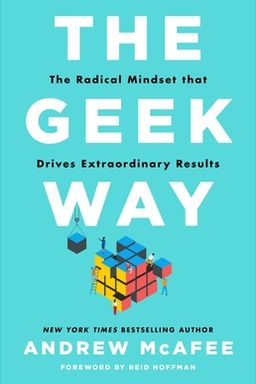
In The Geek Way, Andrew McAfee argues that the biggest revolution of the modern era isn’t technological—it’s cultural. The world's most adaptive organizations, from Amazon to SpaceX and Netflix, run on a distinctive social code he calls the “geek way.” McAfee contends that this code—built on four intertwined norms of speed, ownership, science, and openness—is a cultural operating system that outcompetes the bureaucratic habits of the industrial age.
You’ll learn that this isn’t about hoodies or beanbags, but about rewiring how humans interact, decide, and learn together. You’ll see how these norms build on deep insights into human evolution—our nature as what McAfee calls Homo ultrasocialis—and how to design organizations that channel our social instincts toward progress rather than politics. Finally, you’ll see how to avoid the pitfalls that destroy even well-intended systems, and how evidence shows geek cultures dramatically outperform their bureaucratic rivals.
From Homo sapiens to Homo ultrasocialis
McAfee invites you to shift from an individual to a group lens. Humans aren’t primarily wise solo thinkers; we’re hyper-social learners who thrive through shared culture. Cultural evolution—our capacity to imitate, refine, and transmit behaviors—allowed our ancestors to build knowledge that no person could invent alone. Modern organizations are extensions of this process: cultural laboratories that depend on norms to regulate learning, status, and cooperation. The most successful groups accelerate cultural evolution deliberately, shaping how people share evidence and challenge ideas.
The Four Great Geek Norms
At their core, geek organizations institutionalize learning loops. Speed replaces perfectionism with iteration—Tesla’s over-the-air firmware fixes or SpaceX’s exploding prototypes embody learning by doing. Ownership eliminates the paralysis of multiple approvals; at Amazon, “you are the approver—push the button” captures how authority and responsibility coincide. Science replaces executive intuition (‘HiPPOs’) with experiments, A/B testing, and evidence-driven argument. Openness encourages disagreement and psychological safety so dissent surfaces before catastrophe—as at Netflix, where leaders farm for critique rather than suppress it.
Together, these norms create mutually reinforcing feedback. Speed drives faster evidence gathering. Ownership ensures decisions translate into action. Science filters bias from learning. Openness guarantees reality isn’t censored. Each norm counteracts a typical industrial failure: slow planning, bureaucratic gatekeeping, authoritarian deference, and fear of honesty.
Social Mechanisms and Cultural Engineering
Because humans are status-sensitive creatures, every organization sits atop invisible social games. Bureaucracy thrives when status depends on control and veto power. The geek way rewires those games to favor shipping, testing, and learning. Mechanisms like observability (public dashboards, open code reviews) and reduced plausible deniability (audit trails, data visibility) make productive behavior publicly rewarded and evasion harder. Radical transparency, as used by Bridgewater or HubSpot, turns mutual awareness into common knowledge—a state where everyone knows everyone knows, destroying the liar’s club dynamics that keep projects secretly late.
Evidence and Proof of Performance
McAfee corroborates his thesis with data. Nearly half the market cap of the top hundred U.S. firms clusters in Northern California—an epicenter of geek culture—even after tech downturns. Don & Charlie Sull’s Culture 500 study shows Netflix, Google, and Amazon top global rankings in agility, innovation, and execution. LinkedIn and Glassdoor data confirm these organizations are magnets for talent, not just profit. The evidence is clear: when groups live by these norms, they iterate faster, decide better, and attract people who want to learn.
The Pitfalls and the Discipline of Maintenance
Yet McAfee cautions: geek culture is not self-sustaining. The same human instincts it harnesses—overconfidence, conformity, status seeking—can corrode it. Quibi, with its celebrity founders but opaque decision-making, ignored testing and dissent. Microsoft’s stack ranking turned collaboration into internal rivalry. Even metrics can backfire under Goodhart’s Law: once targets define bonuses, people game them. The antidote is multi-metric dashboards, visible experiments, and leaders who model humility before evidence.
As cultures mature, Joe Henrich’s insight looms: prosocial rules decay as individuals capture institutions. McAfee’s closing message is that you can’t delegate cultural stewardship—leaders must continuously tend the norms, refreshing speed, ownership, science, and openness against human inertia. The reward is vitality: a living, learning organization that stays Day 1 indefinitely.
Essential takeaway
The geek way isn’t about being more technological—it’s about being more human. By understanding our ultrasocial nature and designing environments that make honesty, learning, and ownership high-status acts, you build a company that evolves faster than its environment changes.