
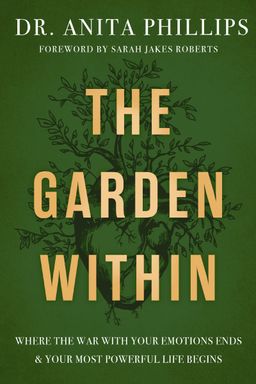
The Garden Within cover

The Garden Within

by Anita Phillips

The Garden Within (2023) by Anita Phillips redefines emotions as allies in our journey of self-discovery. Blending psychology and faith, the book guides readers to nurture their hearts as gardens, fostering emotional resilience and spiritual strength. Embrace vulnerability, understand the mind-body connection, and unlock your most powerful life.

The Garden Within: Ending the War with Your Emotions

Have you ever felt that your emotions are your enemy—something to suppress, conquer, or overcome before you can truly be spiritual or successful? In The Garden Within: Where the War with Your Emotions Ends and Your Most Powerful Life Begins, trauma therapist and minister Dr. Anita Phillips reframes one of the most misunderstood parts of human experience: our feelings. She argues that your emotions are not a weakness to subdue but sacred signals planted in the soil of your heart, meant to help you flourish. Where culture and even religion have often told us that strength means emotional control or disconnection, Phillips insists that healing—and power—begin when we stop fighting our hearts and start tending to them.

Drawing from psychology, neurobiology, and Scripture, Dr. Phillips introduces a vivid metaphor: your heart is a garden. It is not a battlefield, even if it feels like one. Every emotion, from joy to grief to anger, is a seed that can grow into something fruitful when nurtured. Just as the Creator planted a garden for humanity and later a spiritual garden within us, emotional health and spiritual strength grow together when we care for that inner terrain. Phillips blends scientific insight with theology to illustrate that the physical, mental, and spiritual dimensions of life interlock, and that true spiritual power comes from emotional wholeness, not denial.

From Battle to Cultivation

Throughout the book, Phillips challenges the reader to make a paradigm shift—from battling their emotions to cultivating them. She recalls traveling with Sarah Jakes Roberts’s Woman Evolve tour, where thousands of women shouted words like “fear,” “anxiety,” and “grief” as enemies to overthrow, yet Phillips tells them the secret: You don’t need to overthrow your emotions—you need to overthrow the lies you’ve believed about them. The soil of your heart was designed for growth, not combat. Every feeling points toward healing and connection with self, God, and others.

This shift requires unlearning centuries of cultural conditioning, beginning with philosophy. Early thinkers like Plato and later Stoic theologians prized the mind and denigrated emotion as irrational—ideas that still define Western religion and psychology today. Phillips contends that Jesus rejected this false hierarchy. He felt deeply—He wept at Lazarus’s tomb, agonized in Gethsemane, and angered when injustice filled the temple. Feeling, Phillips says, isn’t failing; Christ’s emotions preceded miracles. This divine model shows that emotion can catalyze spiritual power when expressed in truth.

The Garden Metaphor

The central metaphor of the garden unfolds layer by layer. In her neuroscience class, Phillips noticed that neurons—the cells of the brain—look like seedlings. Both are living conduits of communication. Plants exchange chemical signals through soil; neurons send neurotransmitters through synapses. She realized that the Creator modeled the internal human world on the natural world: the mind is a living garden within the body. Scripture’s repeated garden imagery—from Eden to Gethsemane to Revelation’s Garden City—reveals that spiritual flourishing mirrors ecological thriving. When the heart’s soil is good, the whole system flourishes.

This garden has distinct zones. The relationship zone represents connection and emotional intimacy; the purpose zone reflects productivity and contribution; the legacy zone is where long-term love and impact grow. Each zone must be nourished by faith (air), hope (water), and love (nutrients)—the three essential elements of emotional well-being. When these flows are blocked by shame, perfectionism, or unresolved pain, the soil hardens and nothing can take root. Healing the heart restores vitality to every part of life.

Integrated Healing

The book progresses from spiritual cultivation (“Soil Power”) to psychological integration (“Deeply Rooted”) and physical embodiment (“The Embodied Garden”). Phillips demonstrates that emotional wellness transforms all dimensions of existence: spiritual faith, mental clarity, and bodily health. She unites theology and neuroscience to reveal that emotion precedes thought, that physical sensations express emotional states, and that our nervous system—the vagus nerve—functions like a “tree of life” rooted in the heart and reaching the brain. This biological garden connects prayer, breath, and bodily awareness to divine communion and personal healing.

Why It Matters

Phillips’s message matters because emotional disconnection is both a spiritual and societal epidemic. Many Christians have inherited a theology that treats pain or anger as evidence of weak faith. Many secular individuals manage emotions with medication or avoidance. Both approaches ignore the truth that emotions are central to human design. This book bridges faith and psychology, calling readers to rediscover emotional life as sacred ground. As Christine Caine described it, The Garden Within offers “a biblical model of well-being.” It invites readers to realize that the Creator’s first command—be fruitful—applies to the garden within the heart.

By the end, you learn that your most powerful life isn’t conquered through suppression but cultivated through compassion. Healing means stewarding your emotional soil, balancing faith and feeling, and tending the garden daily through mindfulness, relational connection, and divine love. Phillips concludes that the war with your emotions can end—because you were never created for battle. You were created for growth.


The Soil of the Heart

When Dr. Anita Phillips teaches about emotional health, she begins with a simple truth: the heart is not symbolic—it is literal. In Scripture, the heart is the center of thought, will, emotion, and spirit. Proverbs 4:23 declares that “from it flow the springs of life.” Phillips interprets this as divine biology—the heart is the soil of your life, the place where spiritual seeds are planted and emotional growth begins.

Faith, Air, and Flow

Phillips uses faith as oxygen. Faith opens the heart by making space for possibility. A seed cannot grow without air. Likewise, spiritual belief cannot thrive without openness to hope. Many people mistakenly think faith is an emotion—optimism or cheerfulness—but Phillips reminds readers that faith is breath, the life-infusing connection between God’s spirit and our own. It circulates through our emotional soil like oxygen through fertile ground. When our faith stagnates—often through fear or doubt—the inner garden suffocates.

Feelings as Water

In the parable of the sower, Jesus distinguishes dry, stony, thorny, and good ground. Phillips connects water to emotion: a well-watered heart is emotionally open, responsive, and healing. Tears, sweat, and even saliva—each physiologically linked to emotion—represent water flowing through our emotional lives. Just as water enables germination, feelings awaken belief. Hope, she says, is what “possibility feels like.” When hope flows, faith and love circulate too. Your tears, far from weakness, are water nurturing growth.

Blocking emotional flow creates spiritual drought. Phillips cites Maria’s story—a grieving mother who suppressed her sorrow after losing a child in a house fire. Her façade of strength made others comfortable but kept her garden desolate. Therapy helped her let the water flow again through tears of grief, which allowed spiritual renewal. She realized that feeling pain didn’t undermine faith—it released healing. “Pain denied is pain multiplied,” Phillips writes. Emotional expression is sacred hydration.

Love as Nutrients

Every garden needs nutrients, and Phillips identifies love as the essential nutrient. Faith breathes, hope waters, and love nourishes. Without love, the soil loses vitality. She invokes 1 Corinthians 13:13: “Three things will last forever—faith, hope, and love—and the greatest of these is love.” Love replenishes the ground by fostering intimacy and compassion. Love flows through relationships, service, and self-care. It is not sentimental but vital to sustaining emotional fertility.

Phillips explains that cultivating love means seeing one’s heart as beloved ground. Many of us overwork spiritually while neglecting self-compassion. Love restores balance by connecting self-care to divine care. When you speak kindly to yourself, nurture friendships, and welcome God’s presence through prayer, you fertilize the inner garden. Love is the nutrient that turns effort into abundance.

“Your heart is a sacred seedbed. Emotional healing is sacred work.” —Dr. Anita Phillips

Ultimately, Phillips urges readers to stop treating emotion as an obstacle to holiness. The Creator designed human spirituality within biological reality. Your heart’s soil contains divine chemistry—faith as breath, feelings as water, love as nutrients. When you tend this soil, your emotions and spirit grow together, becoming good ground for your most powerful life.


Emotions as Seeds and Signals

If the heart is soil, emotions are seeds. Phillips invites you to stop labeling them “bad” or “good” and start seeing them as messages that reveal what needs tending. Emotions germinate truth. Joy announces flourishing; sadness signals loss; anger demands boundaries; fear alerts vulnerability. Each emotion, she writes, “is a tool given by God to excavate the soil of your heart.”

Three Painful Emotions: Sadness, Anger, Fear

Through biblical metaphors and scientific explanation, Phillips explores sadness, anger, and fear as “ground zero” emotions from which every other feeling grows. In sadness, the soil becomes clay—heavy, waterlogged, and suffocating. The cure is drainage: tears that release pressure and make space for hope. In anger, the soil turns sandy—hot and dry, unable to hold moisture or nutrients. Release, not repression, restores flow. And in fear, thorny weeds choke love from the soil, until reassurance and tenderness restore order.

Phillips reframes these emotions biologically and spiritually. She likens sadness to loss of air, anger to loss of water, fear to loss of nutrients. Each corresponds to impaired faith, hope, or love. Healing emotion requires restoring that element through spiritual and physical practice. Crying, breathing prayer, setting boundaries, and receiving physical affection all become gardening acts that heal the soil.

Jesus and Emotional Expression

Phillips shows that even divine love expresses emotion. Jesus wept; He felt anger and anguish; He openly asked why God had forsaken Him. His emotional honesty birthed miracles. “After Jesus wept, He raised Lazarus. After He flipped tables, healing followed. After He endured Gethsemane, redemption began.” Through the lens of neuroscience and faith, Phillips reveals the pattern: when emotions flow honestly, spiritual power flows freely.

The Body Remembers

Trauma interrupts emotional flow. Drawing on her sister Valerie’s struggle with schizophrenia and addiction, Phillips shows how unhealed pain can shape a lifetime of disconnection. She explains, through stories and science, that emotional memory lives not just in the mind but in the body. The nervous system—the “tree in the temple”—stores emotional history in muscle tension, heart rhythms, and gut feedback. Healing requires bodily participation through breath, movement, and touch. This “embodied gardening” transforms stored pain into growth.

In essence, emotions are not enemies but indicators. They are divine sensors planted to reveal when your soil needs air (faith), water (hope), or nutrients (love). Ignoring them leads to drought; embracing them cultivates flourishing.


Cultivating Good Ground

Phillips devotes much of the book to answering one question: how do you create good ground in your heart? Her answer unfolds like gardening advice—practical, spiritual, embodied. Good ground is fertile emotional soil where faith, hope, and love flow freely, allowing relationships, purpose, and legacy to thrive. She encourages readers to examine which life “zones” are flourishing and which feel barren.

Relationships, Purpose, Legacy

Phillips identifies three vital life zones mirrored in creation’s first plants. Grass symbolizes relationships, herbs symbolize purpose, and fruit trees symbolize legacy. Healthy relationships are rooted in connection—grass blades intertwined for mutual support. Purpose serves others like herbs providing nourishment. Legacy bears fruit for future generations. These zones form the ecology of a powerful life.

When any zone suffers—a broken friendship, lost direction, or unfulfilled calling—the soil’s fertility declines. The remedy, Phillips says, is not striving but tending. Nourish relationships through empathy and touch; nurture purpose through generosity; fertilize legacy through love that outlasts fear. “A truly powerful life isn’t conquered,” she writes. “It’s cultivated.”

Faith, Hope, Love as Soil Chemistry

Phillips treats spiritual virtues as soil science. Faith oxygenates growth through belief in unseen possibilities. Hope hydrates perseverance through expectation for good outcomes. Love nourishes relationships through compassion. Neglecting any element destabilizes the ground. A faith drought suffocates; hope evaporation cracks the soil; lovelessness depletes nutrients. Restoration involves practices such as prayerful breathing (faith), gratitude journaling (hope), and acts of service (love). When balanced, these make emotional well-being sustainable.

From Accountability to Nurture

Phillips uses powerful anecdotes to illustrate this shift. Her colleague Casey, obsessed with productivity goals, learned that his power did not come from accountability charts but from cultivating emotional wholeness—being connected with himself, God, and others. Phillips helped him reorganize his goals not as tasks but as zones of the garden: relationships, purpose, and legacy. Once he tended his heart rather than his calendar, growth came naturally. Goal lists became soil maps.

Through stories like Casey’s, Phillips shows that emotional health is not just personal but relational ecology. Everyone’s healing enriches the collective garden. Good ground is contagious.


The Heart-Mind Connection

A central revelation in the book is that thinking begins with feeling. Phillips bridges neuroscience and Scripture to overturn the assumption that emotions follow thoughts. Just as the soil precedes the plant, the heart precedes the mind. In wisdom literature, “heart” comes before “mind” more than forty times—because emotion grounds cognition. Modern neuroscience agrees: emotional signals from the body drive attention, perception, and decision-making long before rational thought joins in.

The Garden System

Phillips compares your inner world to an ecosystem. The heart is soil, the mind is plant, and behavior is fruit. The tree grows from emotional nutrients. When the soil dries, the plant withers—the mental equivalent of despair or anxiety. Renewing the mind, she explains, is not a purely cognitive process but a full transplant: uprooting false beliefs and planting new ones in nourished heart-soil. Change hurts because change disturbs the ground. But that disruption is part of growth.

Jesus, Paul, and Embodied Emotion

Phillips references Jesus’ emotions in Gethsemane and Paul’s struggles in Romans 7 to show that emotions are embodied experiences. Paul’s “thorn in the flesh,” she argues later, may have been anxiety—a bodily expression of fear. Both figures faced internal battle that could not be solved by intellect alone. Instead, surrender, love, and physical presence with God restored peace. “Healed hearts can quiet troubled minds,” Phillips writes, turning theology into neuroscience.

Emotion Shapes Cognition

Modern research confirms Phillips’s biblical claim. As physicist Leonard Mlodinow has shown (in Emotional), emotions guide rational thought, not the other way around. Phillips integrates such findings with Scripture to argue that heart-work is mental health work. By tending emotional soil, you improve cognitive clarity, creativity, and decision-making. The mind is not a chariot controlling emotions (as Plato imagined) but fruit nourished by them.

For readers, this idea reframes spirituality and psychology alike: you can’t think your way out of feeling—but you can feel your way into peace.


The Embodied Garden and the Tree of Life

Phillips culminates her metaphor by linking biology and spirituality through what she calls “the tree in the temple.” This tree represents the vagus nerve—the body’s longest nerve running from brain to heart to gut. Its structure resembles a tree: roots in the belly, trunk through the chest, branches to the face. It connects physical sensations, emotions, and spiritual states. When we breathe, sing, cry, or love, this tree carries signals between heart and brain, regulating calm and vitality. Phillips calls it the Tree of Life within you.

Feeling Is Bodily

She explains, with insight from neuroscience and Scripture, that emotion is not mental “stinking thinking”—it begins in the body. Fear accelerates heartbeat; sadness constricts the chest; joy expands breathing; anger tightens muscles. Jesus experienced this fully: sweating blood in Gethsemane under extreme emotional agony. Phillips rejects dualism between body and spirit, emphasizing that God designed emotional life to be embodied. Healing means returning to that unity.

Somatic Practices

Practical chapters teach how to “walk the garden”: breathing exercises, gentle movement, sensory awareness, and interoception (noticing internal sensations). Each restores vagal tone—the health of the tree. Singing, hugging, dancing, and prayer activate this system, calming anxiety and healing trauma. Phillips blends faith and science seamlessly, suggesting that worship itself is vagus nerve therapy. The heart is the holy of holies; self-care becomes sacred ritual.

Ending the War

In the final chapters, Phillips unites everything under the Hebrew concept of shalom—not mere peace but flourishing harmony with God, self, others, and nature. Emotional wholeness isn’t the absence of pain but integration of feeling and faith. Drawing on Augustine’s idea of the “book of nature,” she affirms that creation itself teaches divine wisdom. The garden within, like Eden, is God’s signature on your soul.

You end this journey realizing that tending your embodied garden is not self-help—it’s sacred stewardship. You were made to be fruitful, not faultless. The Creator’s fingerprints are in your emotions, your neurons, and your tears. Healing the heart is how you return from war to peace.

Dig Deeper

Get personalized prompts to apply these lessons to your life and deepen your understanding.

Go Deeper

Get the Full Experience

Download Insight Books for AI-powered reflections, quizzes, and more.