
Idea 1
The Gap and the Gain: Measuring Happiness Backward
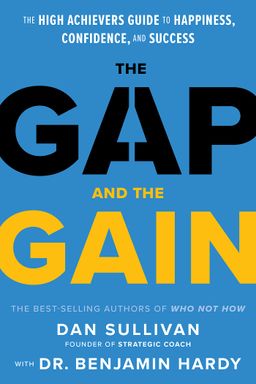
How often do you feel frustrated that you're not yet where you want to be—financially, professionally, or personally? In The Gap and The Gain, Dan Sullivan and Dr. Benjamin Hardy argue that this chronic dissatisfaction stems from a simple but devastating mistake: measuring your progress against an ideal instead of your starting point. This trap, called the GAP, keeps high achievers perpetually unhappy no matter how much they accomplish. The antidote, Sullivan contends, is shifting into the GAIN—a mindset of appreciation, gratitude, and backward measurement that turns every experience into progress.
This book is both a psychological guide and a philosophical reframing of success. Sullivan developed the core concept from decades of working with thousands of entrepreneurs in his Strategic Coach program. Hardy, a psychologist, expands it through research on mindset, motivation, and well-being. Together, they show that the difference between unhappiness and fulfillment isn’t achievement—it’s perspective.
The Cultural Trap: How “Pursuit” Creates Unhappiness
The book opens with a bold claim: America’s founding ideal of “Life, Liberty, and the pursuit of Happiness” doomed its citizens to chase a mirage. As Hardy points out, you don't pursue something you already have. Jefferson’s idea of happiness as future-oriented became the blueprint for the Western mindset—one that treats joy as something perpetually around the corner. The result? Achievement feels hollow because happiness is postponed until the next milestone. Sullivan discovered that this same pattern haunted entrepreneurs who were “successful but never satisfied”—always feeling they should be further ahead. The GAP, he realized, isn’t about what you lack externally. It’s about the distance between your current reality and your imagined ideal.
The GAP Defined: Measuring Against Ideals
Being in the GAP means measuring yourself, your progress, or your worth against something that can’t be reached. The “ideal,” Sullivan explains, is like a horizon in the desert—no matter how far you walk, it moves further away. Whether you’re comparing your business to someone else’s or your body to an unrealistic image, the result is psychological scarcity. You see what’s missing, not what’s gained. The story of Edward, a wealthy investor who chased higher portfolio goals from $5 million to $17 million but never felt secure, illustrates this futility. Happiness tied to “there” will always erase contentment “here.”
The GAIN: Measuring Backward for Confidence and Joy
The GAIN is the radical alternative: measuring progress backward from where you started. As Sullivan first drew on his coaching flipchart—labeling Start at the bottom, Achieved in the middle, and Ideal at the top—he saw that satisfaction comes when people measure from Start to Achieved, not Achieved to Ideal. When you focus on the gains you’ve made, confidence replaces anxiety. Hardy’s psychological perspective confirms that backward measurement activates gratitude and optimism—the emotional pillars of resilience. Research shows that people who recount progress (such as in gratitude journaling) experience greater motivation and long-term success than those pursuing unattainable perfection (notably echoed in Martin Seligman’s positive psychology).
From Scarcity to Enough: Happiness as the Starting Point
One of the most powerful ideas in this book is that happiness isn’t the end goal—it’s the starting point. High performers often believe confidence and joy come after achievement. Sullivan and Hardy reverse that logic: joy and gratitude initiate the very growth and creativity that lead to success. The Olympic speed skater Dan Jansen exemplifies this shift. After years of heartbreak, he decided before his final race to focus on gratitude—for his coaches, family, and love of skating—rather than the need to win. He skated freely, smiling all the way, and broke the world record. He didn’t escape the GAP by winning gold—he won gold because he escaped the GAP.
Why It Matters
The implications of this reframing are immense. Measuring backward doesn’t just make you happier; it rewires your perception of reality. Hardy connects this to psychological resilience, showing that framing experiences as “gains” rather than “gaps” correlates with better mental health, physical well-being, and even longer life spans. When you live in the GAIN, achievements become evidence of your progress, not reminders of what’s missing. You stop chasing happiness and start expanding it. In essence, the GAP is internal disconnection—the sense that you lack something to be whole. The GAIN reconnects you to yourself and turns every experience into growth. You become free—not because circumstances change, but because your measurement does.
Over the rest of the book, Sullivan and Hardy explore how to escape the GAP and train your brain to live permanently in the GAIN. They apply this lens to passion and motivation, self-determination, health, hope, daily habits, and even trauma. You learn why goals must be measured backward, how gratitude rewires the mind, and how every setback can transform into gain through deliberate reflection. This concept feels deceptively simple, but its power lies in its application: measure backward, practice gratitude, and you’ll discover happiness was never ahead of you—it was always here.