
Idea 1
The Human Future Beyond Earth
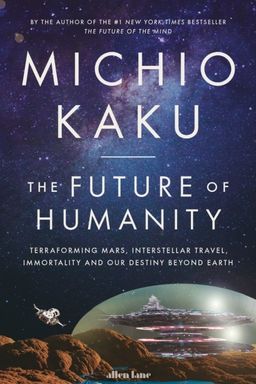
Why must humanity move beyond Earth? Michio Kaku begins his sweeping exploration by reminding you that extinction has been the norm for most species in Earth's history. Asteroids, volcanoes, climate shifts, and self-inflicted threats—such as nuclear war or engineered pandemics—expose civilization's fragility. The Toba supereruption 75,000 years ago may have reduced humans to a few thousand survivors. That ancient near-annihilation becomes Kaku’s metaphor for today: you need a backup world if you hope to protect the experiment of civilization.
Existential Risk and Survival Logic
Kaku’s central claim is practical, not romantic: space colonization is an insurance policy. Carl Sagan once told him, “We need an insurance policy for humanity,” meaning a multiplanetary existence. Self-inflicted disasters—nuclear arms, global warming, genetic engineering gone awry—loom on decadal horizons. Geological and astronomical risks—asteroid impacts, supervolcanoes, and eventually the Sun’s red-giant death—operate on longer timescales, yet the conclusion is identical: Earth alone is too vulnerable for permanent habitation.
From Dreamers to Engineers
To escape gravity’s grip, dreamers became mathematicians. Konstantin Tsiolkovsky’s 1903 rocket equation revealed that escaping Earth’s pull requires exponential amounts of fuel. Robert Goddard's liquid-fuel rockets transformed theory into hardware, enduring public ridicule before vindication through Apollo. Wernher von Braun’s wartime V-2 rockets proved large-scale propulsion possible, and despite their dark origins, they set the stage for Saturn V and the Moon landing. These pioneers built the foundations of the space age, showing that moral dilemmas often accompany technological leaps.
The New Frontier: Economics, Private Industry, and Survival
Kaku argues that the next great migration will not be driven solely by governments but by economics and private innovation. The Moon emerges as the first step: rich in water ice, oxygen-bearing soils, and potential fusion fuel (helium‑3). NASA’s Orion and Space Launch System project work hand in hand with corporate pioneers like Elon Musk’s SpaceX and Jeff Bezos’s Blue Origin to make reusable, cheaper launch systems practical. The Moon becomes a refueling and manufacturing hub—a “gas station” and learning ground for missions to Mars and beyond.
A Pragmatic Vision for the Cosmos
This book’s throughline is clear: humanity’s survival depends on transcending planetary limits, guided by physics, biology, and imagination. You’ll traverse the Moon and Mars, learn how robots and AI will construct extraterrestrial bases, and see why new propulsion ideas—ion engines, solar sails, or even warp drives—could stretch civilization across star systems. Alongside engineering, the narrative challenges existential complacency: expanding into space is not optional extravagance but evolutionary necessity. The story is both scientific and moral—a call for humanity to mature into a Type I civilization that safeguards life by reaching for the stars.