
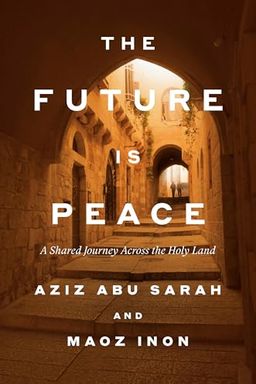
The Future Is Peace cover

The Future Is Peace

by Aziz Abu Sarah And Maoz Inon

A Palestinian and an Israeli share reflections from the journey they took together over the course of a week.

From Fear to Friendship Across Faiths

When was the last time a stranger became your teacher—or even your friend? In Strangers, Neighbors, Friends, Kelly James Clark, Aziz Abu Sarah, and Nancy Fuchs Kreimer argue that Judaism, Christianity, and Islam already contain the spiritual tools we need to turn fear into neighborliness and neighborliness into friendship. They contend that the real battle today isn’t between religions but within them: between fear-fueled, pride-driven distortions and the quieter, harder work of compassionate, humble love. Their thesis is deceptively simple: if you take each tradition at its best—its deepest texts, its boldest exemplars, its most honest self-critique—you discover that the future is peace, and the path there is paved with encounter, humility, and shared action.

This book intertwines three voices—a Palestinian Muslim peacemaker (Abu Sarah), an American Christian philosopher (Clark), and a Reconstructionist rabbi and educator (Fuchs Kreimer). Each contributes memoir, theology, and practical wisdom. You’ll meet bereaved parents who refuse revenge, imams and rabbis shouldering each other’s burdens, and communities that practice a “conspiracy of decency.” You’ll also learn how to read hard scriptures in context, why rituals like prayer, fasting, and Sabbath can decenter ego, and how small acts—like a shared meal or a careful renaming—can reshape a life.

What the authors are really arguing

The authors insist that religions are not monoliths. Like inkblots, scriptures reflect the heart of the reader: fear looks for enemies; humility looks for neighbors. They show that each Abrahamic faith commands costly compassion toward the stranger (Lev. 19; Matt. 25; Qur’an 4:36), yet each tradition has also been misused to bless prejudice or violence. The cure, they say, is not less religion but better religion—practiced with self-suspicion, neighbor-love, and a bias for peace.

How the book works

Aziz Abu Sarah begins with a searing story—his brother Tayseer, tortured to death in an Israeli prison when Aziz was nine. He traces his journey from revenge to reconciliation through risky encounters: learning Hebrew in an ulpan, visiting Yad Vashem, working with former warlords in Afghanistan, and co-leading Parents Circle with Israeli friends who also lost children. His chapters show, in concrete steps, how crossing “enemy lines” can unfreeze a heart.

Kelly James Clark looks inward at the habits that block love: pride in our group, snap judgments, toxic naming, and a hunger to be “great.” He retells Jesus’ parables—the Good Samaritan, the laborers in the vineyard, the Pharisee and the tax collector—to argue that Christians must become neighborly before asking “who is my neighbor.” He also takes on scripture-twisting (on all sides), media distortions, and the temptation to ally faith with national power.

Nancy Fuchs Kreimer models Jewish midrash—creative, responsible rereading—to expand moral imagination. She reconsiders Sarah and Hagar, Joseph and Zuleikha, and Abraham and Isaac (through Levinas) to show how new stories can heal old wounds. She also chronicles practical projects—women’s retreats, the Interfaith Walk for Peace, and the Sisterhood of Salaam Shalom—where people practice courageous listening, ritual hospitality, and hopeful public witness.

Why this matters now

We live amid competing “clash of civilizations” stories—and their mirror images. The authors unmask how these narratives flatten people, weaponize pain, and justify harm. They counter with data (mosque attendance correlates with less radicalization), reframed texts (Qur’an 9 read in context demands peace-seeking), and stubborn facts (99% of Danish Jews survived the Holocaust due to nationwide solidarity; not a single US refugee from a Muslim-majority country has carried out a fatal terror attack on US soil since vetting began). Their point: fear sells, but it doesn’t tell the truth about our neighbors—or our own scriptures.

Key Idea

“Friendship transforms a stranger into a relative.” The book’s wager is that friendship is not just a feeling; it’s a practice you can choose. When you choose it—over and over—theologies evolve, habits soften, and enemies shrink into neighbors.

In the pages ahead, you’ll see how one man’s grief turned into cross-border courage; how humility disarms our biases; how rituals train mercy; why “women and Islam” is more complex—and hopeful—than headlines; how communities can shelter refugees with moral clarity; and how truth grows when you seek others’ stories. By the end, you’ll have a map for small, doable acts that scale: rename your “other,” share a table, read hard texts in context, take a walk across town, and build your own “conspiracy of decency.” (For parallels, see Miroslav Volf’s Exclusion and Embrace on boundary-crossing love, and Jonathan Sacks’s The Dignity of Difference on faith-rooted pluralism.)


Crossing Enemy Lines Heals the Heart

Aziz Abu Sarah’s early life makes forgiveness sound impossible. At nine, he watched his brother Tayseer—a gentle 19-year-old—return from an Israeli prison with shattered organs; he died after surgery from injuries consistent with torture. Aziz’s grief hardened into a mission for revenge. By sixteen he led Fatah youth, edited pamphlets, and learned to navigate checkpoints where guards joked one day and beat you the next. Rocks, tear gas, and onions in schoolbags were his normal.

The risk that changed everything

Aziz did the unthinkable: he enrolled in an Israeli ulpan to learn Hebrew—the “language of the enemy.” He entered terrified, swore he wouldn’t make friends, and sat stone-faced. Then the teacher greeted him warmly in Arabic. Classmates asked about his favorite music (he loved Johnny Cash) and debated instant coffee versus Arabic coffee. These tiny human bridges scrambled his categories. He began to see people, not positions.

The real turning point came at Yad Vashem, Israel’s Holocaust memorial. Feeling conspicuous as the only Palestinian in the building, Aziz found his anxiety replaced by horror: how had humans descended to this? He faced a hard truth—acknowledging Jewish suffering doesn’t deny Palestinian pain. He decided to forgive—not because the perpetrator apologized but because he refused to let his brother’s killers own the rest of his life. “I would be a forgiver,” he writes, echoing the Prophet’s mercy (Qur’an 9:128).

Choosing hard friendships

Aziz doubled down on discomfort. He worked in an ultra-Orthodox neighborhood and studied at an evangelical Bible college. He co-led Parents Circle-Families Forum with his Israeli friend Rami, whose 13-year-old daughter Smadar was killed by a Palestinian suicide bomber. Together they visited classrooms—Palestinian and Israeli—where they were called traitors, told their loved ones “deserved it,” and asked to justify the unjustifiable. Instead of arguing policy, they asked piercing questions: “How does killing young girls bring you freedom?” Over time, students’ anger cracked; some wanted a different kind of victory.

Afghanistan: the price of peace

Working with George Mason University, Aziz helped build a Muslim leadership network in Kabul to counter Taliban recruitment. He met Burhanuddin Rabbani—the former warlord turned peacemaker—who quoted Qur’an 8:61: “If they incline to peace, then incline to it [also].” Rabbani invited Aziz to negotiations with the Taliban because “God made us peoples and tribes that we may know one another” (49:13). Weeks later, Rabbani was assassinated by a bomber hiding explosives in his turban—an act that violated every norm of hospitality and Qur’anic law. Aziz was devastated but not derailed; he concluded that mending discord outranks even prayer and almsgiving in Islam’s moral architecture.

Key Idea

Encounter is not a debate tactic; it’s a heart-school. The practice is simple, not easy: step into the other’s story, humanize their pain, and let that shared humanity set your political compass.

Practical steps you can borrow

  • Learn your neighbor’s language. Aziz’s Hebrew opened doors and softened caricatures. Even basic phrases signal respect.
  • Visit sacred memory sites you’ve avoided. Yad Vashem broke Aziz’s zero-sum empathy; you can do your version locally.
  • Work where you’re “the other.” Jobs or classes in communities unlike yours accelerate unlearning.

(Context: Similar journeys appear in Desmond Tutu’s No Future Without Forgiveness and in Daryl Davis’s stories of befriending KKK members; the mechanics—proximity, curiosity, dignity—are remarkably consistent.) Aziz’s story won’t naïvely promise safety; it promises transformation. Your “enemy” becomes the friend whose safety you now check on after a bombing—because love has redrawn your map.


Humility Beats Pride Every Time

Kelly James Clark argues that the biggest obstacle to peacemaking isn’t someone else’s ideology; it’s your pride—your need to be right, superior, or safe. Pride shrinks your world to “people like me” and then baptizes that shrinkage as moral clarity. Jesus takes a sledgehammer to that edifice with stories that feel custom-built for our feeds and timelines.

From “Who is my neighbor?” to “Am I neighborly?”

In the Good Samaritan, the legal expert asks for boundaries; Jesus changes the question. Neighborliness isn’t about their category; it’s about your compassion. Clark illustrates this with a blizzard-night rescue: he invites a homeless addict into his home, terrified and inconvenienced, then arranges rehab and a bus ticket. The lesson lands: you don’t vet a person’s tribe before you practice mercy.

Grace > fairness

We cry “That’s not fair!” when latecomers get full pay (the workers in the vineyard). Jesus reframes the economy: God’s kingdom runs on grace, not merit. Clark points out that if you picture heaven and aren’t surprised by who gets in, you’ve domesticated grace. This matters for interfaith life: if you start from superiority, you’ll treat whole peoples as inferiors in need of fixing.

The addiction to greatness

Jesus predicts his own suffering; the disciples argue about who’s greatest. That’s us. When our status is threatened, we invent “useful fictions” to prop up ego (“my car isn’t fancy, but I care about the environment”). Scale that up, and you get national and religious chauvinism (“Islam is bad, Christianity is good”). Clark shares actual Facebook comments equating “Muslim” with “demonic death cult”—a spiritual diagnosis masquerading as analysis. The antidote? Choose the child’s posture: depend on God for worth; share the table with those who don’t boost your brand.

The violence of names

As a first-grader, Clark bullied “Bobby Adams”—twisting his name into “Adam Bomb.” He still carries the shame. Names shape the soul; “Muslim = terrorist” is a secular slur with sacred damage. He notes Glenn Beck’s false claim that “10% of Muslims are terrorists” (the reality is orders of magnitude lower). Films like Aladdin reinforce lazy archetypes (barbaric ear-choppers vs. light-skinned heroes). Followers of Jesus, Clark insists, should learn to call people by their true name: friend, not foe; icon of God, not enemy of God.

Snap judgments and empathy gaps

Our brains sort “in-group good / out-group bad” in milliseconds. We “are Brussels” after an attack but barely notice Baghdad, Aden, or Lahore. Neuroscience confirms lower empathic response to other-race pain. That’s not a verdict; it’s a training plan. Love is learned person by person. Clark suggests: swallow fear, start one relationship, and let love drive out fear (1 John 4:18). John Lewis models this: trained in nonviolence, he loved enemies who fractured his skull on the Edmund Pettus Bridge, later receiving a police chief’s apology with tears.

Key Idea

Humility is not self-loathing; it’s other-honoring. It shifts the focus from your goodness to the good you can do for the person in front of you—especially when they unsettle you.

(Context: This mirrors C. S. Lewis’s definition of humility—“not thinking less of yourself but thinking of yourself less”—and aligns with social-psychology findings on contact theory.) Practical move: Next time your feed tempts you to generalize (“they”), replace the noun with a name. Then act accordingly.


Reading Hard Texts In Context

“Is Islam violent?” a man demands after Aziz presents. The authors don’t dodge the question; they widen it. Every tradition has “texts of terror” and readers who wrench them from context. The remedy is the same for Bible and Qur’an: read the whole paragraph, the social setting, the genre, and the canon’s overall thrust toward mercy.

Qur’an 9:5 doesn’t license murder

Critics cite “slay the idolaters wherever you find them.” But Qur’an 9 opens with a broken treaty among warring tribes. Verse 9:7 commands: “As long as they are upright toward you, be upright toward them.” Verse 9:6 grants protection and safe passage to defectors. Verse 9:13 asks, “Would you not fight a people who broke their oaths… and began the attack upon you?” In short, defensive war under strict limits—not a blank check for aggression. (Compare to OT commands in 1 Samuel 15, which Christians routinely contextualize.)

The real rules of jihad

Classical Islamic law bans killing women, children, elders, noncombatants, and even fruit trees; it forbids mutilation and burning bodies. Abu Bakr’s guidance reads like modern IHL. Yes, scholars made tragic exceptions under existential threat (Mongol invasions), and extremists like ISIS exploit those edge cases to justify atrocities. But the normative arc is restraint and mercy. Most recruits to violent groups, research shows, are “woefully ignorant of Islam” (Lydia Wilson; MI5 behavioral study). Mosque participation correlates with lower radicalization, not higher (Duke University study).

Suicide bombings are anti-Islamic

When a Palestinian teen calls suicide attacks “resistance,” Aziz listens first. Then he teaches: the Prophet forbids killing noncombatants and fellow Muslims (Qur’an 4:93), and commands proportionality (2:190). Loopholes constructed in wartime don’t overturn clear norms. He doesn’t just argue; he builds alternatives—Parents Circle, multi-narrative tours, and leadership networks that convert grievance into civic courage.

ISIS isn’t Islam

Aziz tells the story of Hasan, a Syrian teen nearly beheaded by ISIS for a tattoo and a shirt pattern. ISIS murders Muslims more than anyone else, destroys Sufi, Shia, Christian, and ancient sites to erase pluralism, and finances terror by looting antiquities. None of this fits the Qur’an’s insistence on diversity (49:13), non-compulsion (2:256), or justice (5:8). Calling ISIS “Islamic” is like calling the KKK “Christianity”—it smears millions with the crimes of a few. (Note: Naomi Shihab Nye’s poem “To Any Would-Be Terrorists” gently makes this same point.)

Key Idea

Context is not a dodge; it’s faithfulness. When you read a hard verse within its story, rules of engagement emerge: seek peace first, defend only as last resort, protect the innocent, honor defection, and forgive quickly.

(Context: Karen Armstrong’s Fields of Blood and John Esposito’s work echo this reading; scripture becomes violent mostly in the hands of fearful readers allied with power.) Your takeaway: apply the same generous hermeneutic to your neighbor’s text that you want them to apply to yours.


Rituals That Unself the Self

You don’t think your way into compassion; you practice your way there. The book shows how embodied rituals—prayer, fasting, and Sabbath—shrink the ego and make space for mercy. These aren’t empty routines; they are daily “un-selfings” (to borrow C. S. Lewis’s term) that train your heart to say, “I am not God.”

Prayer: five daily resets

Eight-year-old Aziz tried to “hack” prayer at Jerusalem’s Al-Aqsa: if a prayer there equals 500 elsewhere, why not pray 12 times a year and call it done? His teacher laughed kindly and reframed prayer as relationship, not a punch card. Wudu (ablutions) as spiritual hygiene; prostration as ego training. Aziz concludes that those who truly bow before God resist playing god with others’ lives. That’s why bombings in mosques, churches, and synagogues reveal not piety but idolatry of the self.

Fasting: empathy with a timer

Ramadan made Aziz a big-hearted six-year-old who learned to tell the truth to his mom—and, more importantly, to feel with the hungry. Iftar is family joy, yes, but it also funds generosity: British Muslims gave ~£100 million during Ramadan 2016. The fast isn’t merely about abstaining from food; it’s about abstaining from false talk and fighting. It is hunger that sharpens mercy’s edge.

Sabbath: remembering you’re not the Maker

Rabbi Fuchs Kreimer learned to “make Shabbos” in places where it seemed impossible—like in Germany with her Holocaust-survivor teacher, Reb Zalman. When no ritual objects were handy, he blessed a German child and crafted Havdalah with grapes, a match, and a garden herb. The heart of it all? Hesed—lovingkindness—expressed in embodied attention. Later, hosting Shabbat, she covers two loaves to recall “manna between dew,” training gratitude and a Rawlsian awareness: much of what we have is manna, not merit.

Borrowing across traditions

Clark, a Protestant raised to distrust ritual, learns from Muslims kneeling: reciting “There is no God but You” decentered him five times a day. Fuchs Kreimer, skeptical of memorization, was moved by Muslim children reciting Qur’an with joy; she reclaimed Jewish embodied practice she’d sidelined. The point is not syncretism; it’s mutual sharpening. Rituals become shared gyms for the heart.

Key Idea

Rituals don’t earn God’s love; they tutor yours. They bend your posture—and, over time, your reflexes—toward mercy.

(Context: James K. A. Smith’s “you are what you love” thesis fits here; habits form hearts.) Try this: schedule one embodied act this week—kneel, fast till midafternoon, or shut your devices for a mini-Sabbath—and notice how it changes your patience toward a difficult person.


Beyond Stereotypes: Women and Islam

“Why do Muslim men oppress women?” an American tour group asks in Oman. The guide who answers—with authority and a smile—is a woman in a headscarf, teaching inside a mosque. The scene scrambles assumptions. Aziz uses it to show how easy stories flatten complex realities—and how scriptural illiteracy, not Islam, often drives injustice.

What the Qur’an actually says

The Qur’an affirms men and women created from one nafs (4:1), declares “no compulsion in religion” (2:256), and commands kindness and justice for all (5:8; 60:8–9). Headscarves are a cultural practice, not a Qur’anic mandate. Verses like 4:34 require careful reading: daraba can mean “leave” or “separate,” not only “strike.” A liberation-forward hermeneutic aligns with the Qur’an’s trajectory: protect the vulnerable in patriarchal settings and aim for equality. When men weaponize texts to control women, it’s cultural patriarchy draped in piety.

Stories that humanize

Aziz’s heroes start at home. His illiterate mother—widowed young, separated from siblings, working farms—insisted on education for her kids and taught him to reject victimhood. His sisters charted bold paths: one taught Bedouin men and women; another was among the first in the family to attend college and translate professionally. No one forced headscarves; choices were honored. These women formed Aziz’s moral spine more than any cleric.

The data you don’t hear

Eight Muslim women have led countries. In Iran and Oman, a higher percentage of women study STEM than in the US. Maryam Mirzakhani, an Iranian, became the first woman to win the Fields Medal (2014). No one denies the reality of honor killings or forced coverings in some contexts; the point is to refuse a single story. (See Chimamanda Adichie’s “The Danger of a Single Story.”)

Shared learning across faiths

Nancy Fuchs Kreimer leads retreats for Muslim and Jewish women; they are not kumbaya. Race, class, and politics surface sharply—especially around the figures of Sarah and Hagar. Yet poetry (Mohja Kahf’s Hagar Poems), zikr (Sufi chant), and honest storytelling create space where both women can name pain and imagine a reunion where “we don’t rush to glib forgiveness” and still “dismantle the house of fear.”

Key Idea

Stereotypes hide both sins and strengths. If you condemn abuses without hearing women’s own voices, you repeat the silencing you claim to resist.

(Context: Leila Ahmed’s Women and Gender in Islam and Amina Wadud’s Qur’an and Woman offer rich, insider readings.) Action: replace “women in Islam” with “women of Islam”—then listen to a few, by name, in your city.


Welcoming Refugees, Rescuing Ourselves

“What’s the worst that can happen? I die? Dying and going to heaven is better than life in this hell.” That’s Arwa, a Syrian child who comforts her older sister Amneh during airstrikes. Stranger fear spikes in times like these, but the Abrahamic mandate is blunt: love the stranger as yourself (Lev. 19), invite the stranger in (Matt. 25), and prefer the refugee over yourself even in privation (Qur’an 59:9).

History’s receipts: Muslims protecting Jews

When Nazis demanded Jewish lists, Muslim-majority Albania refused; it issued false papers, hid families, and saw its Jewish population increase tenfold. In Paris, Imam Si Kaddour Benghabrit forged Muslim IDs and sheltered Jews in the Great Mosque’s tunnels. These stories puncture lazy binaries. Hospitality isn’t Western or Eastern; it’s human—and commanded.

The numbers cut through fear

From 1975–2015, the US admitted 3.2 million refugees. Exactly zero admitted from Muslim-majority countries committed a fatal terror attack in the US under modern vetting. Refugees flee terror; they don’t import it. They want what you want: school, work, a bed where planes do not terrify children into hiding under it.

A shared future, not charity

Aziz co-founded Project Amal ou Salam (“Hope and Peace”) with his Christian colleague Nousha Kabawat, a Syrian who builds trauma-informed schools for refugee children across the region. In one camp workshop, kids built a hospital, a mosque—and initially refused a church because “Christians are infidels.” When they learned that their beloved teacher Nousha was Christian, they made crosses from craft sticks and handed them to her in apology. Compassion + proximity rewires identity.

“Our students”: widening the word “our”

Imam Yahya Hendi told a room of rabbis, after a shooting in Jerusalem, that “a gunman killed our students.” For a beat, the room froze. Then the penny dropped: he meant “our” in the future we long for—where Jewish and Muslim children are all “ours.” This is not rhetorical flourish; it’s a moral muscle you can train.

Key Idea

Hospitality doesn’t just rescue the stranger; it rescues you—from fear, from smallness, from a shrunken “us.”

(Context: Christine Pohl’s Making Room traces Christian hospitality; Islamic jurists codified refugee rights centuries ago.) Your move: support a resettlement agency, host an iftar/Seder for refugees, or join an interfaith “circles of welcome.” Let your table teach your heart what your head already knows.


Grow Bigger Stories (Midrash & Levinas)

Nancy Fuchs Kreimer shows how new readings—rooted in tradition—can heal. Jews call this midrash: “seeking out” the white fire between the black letters. The aim isn’t to erase hard texts but to wrestle them toward life-giving truth in our time.

Sarah and Hagar: from rivals to relatives

As a girl, Nancy loved Sarah; as a feminist, she recoiled from Sarah’s treatment of Hagar. Classical sources are mixed—some even redeem Hagar as “Keturah,” Abraham’s later wife. Today’s midrashim imagine the women calling each other by name across the desert. Mohja Kahf’s poem “All Good” envisions a family reunion where no one “rushes into glib forgiveness,” yet, after real wailing, “everyone can recognize in the eyes of every other the flickering light of the Divine.”

Joseph and Zuleikha: another angle

In Genesis, Potiphar’s wife is a plot device; in the Qur’an and later Muslim poetry, she becomes Zuleikha—complex, confessing, and even a mystical symbol of the soul’s longing. Jewish communities in Iran illustrated Jami’s Yusuf and Zuleikha in Judeo-Persian. Hearing the Muslim telling helped Nancy see what her tradition hadn’t spotlighted—and, in turn, helped her ask better questions of her own text. Moral: multiple stories reveal multiple truths.

The Binding of Isaac: passing the real test

Kierkegaard celebrates Abraham’s obedience; Soloveitchik says the “sacrifice” happened in his heart. Levinas shifts the spotlight: the true test is whether Abraham can hear the angel and put down the knife when he sees the face of the Other—his son. That’s the eternal moral: great causes (even “God’s will”) must yield to the concrete face in front of you.

Truth, shattered and shared

A rabbinic story pictures God casting Truth to the ground so humanity could be created; Truth shattered and now each of us holds a shard. That’s why Israelis and Palestinians mirror each other’s laments; both demand—and deserve—hearing. Groups like Parents Circle (bereaved families from both sides) embody this by telling grief-stories in public and insisting, “We don’t want you here”—i.e., we don’t want new members added by more death.

Key Idea

Grow a bigger story by borrowing each other’s lenses. You don’t lose your truth; you discover its limits—and its neighbors.

(Context: Miroslav Volf and Amos Oz make similar pleas for “narrative hospitality.”) Try this: invite a friend of another faith to co-read one shared story (Hagar, Abraham, Joseph). Ask: What did your teachers emphasize? What did we miss?


Everyday Practices of Peace

Big summits matter. But the most durable peacemaking is ordinary, local, and repeatable. The authors offer a toolkit you can start using this week—habits that nudge your circle from stranger to neighbor to friend.

Practice courageous hospitality

Clark literally brought a stranger home in a blizzard; you can start with a porch, coffee, or communal meal. Nancy’s Interfaith Walk for Peace (mosque → synagogue → church) turns streets into classrooms. Aziz’s MEJDI Tours pair Israeli and Palestinian guides; two narratives walk the same path. Hospitality scales: Sisterhood of Salaam Shalom grew from one phone call (Sheryl Olitsky to Atiya Aftab) to 150+ women’s circles nationwide.

Reframe your language

Drop “they.” Use names. Resist smear terms. Remember Clark’s lesson: words can be sticks and stones. Replace “women in Islam” with “Fatima and Aisha.” Replace “Jews” or “Christians” with “Rivka” and “John,” then proceed.

Read before you react

Hard verse trending? Read the whole chapter. Ask a practitioner how they understand it. Apply to your own texts first. (Pro tip from Clark’s Bible class: identify genre, audience, and whether a text is the rule or an exception.)

Let rituals train your reflexes

Kneel. Fast. Keep a mini-Sabbath. Bless your dinner bread like “manna between dew,” then ask who around you lacks daily bread—and what you can do about it. Rituals turn compassion into muscle memory.

Confess your own side’s sins

Clark models contrition for Christianity’s alliances with power (from Crusades to Iraq). He quotes Frank Schaeffer’s repentance after Dr. Tiller’s murder. Nancy wrestles with Jewish communal pain and privilege, even rethinking standard prayers about Israel in light of Palestinian suffering. Confession isn’t self-hate; it’s credibility.

Build a “conspiracy of decency”

Emmy Werner’s phrase describes Denmark’s WWII rescue: bishops protested, students ran warnings, doctors hid families, fishermen ferried them to Sweden. Why so effective? Decency was distributed. Your town can do this—faith leaders, schools, and neighbors agreeing: “First a human—then a Christian/Jew/Muslim.”

Key Idea

Peace isn’t a feeling; it’s a stack of small, repeatable actions—hospitality, reframing, study, ritual, confession—done together over time.

(Context: John Paul Lederach calls this “moral imagination” in everyday systems.) Choose one practice this week, tell one friend, repeat next week. That’s how strangers become neighbors—and neighbors, friends.

Dig Deeper

Get personalized prompts to apply these lessons to your life and deepen your understanding.

Go Deeper

Get the Full Experience

Download Insight Books for AI-powered reflections, quizzes, and more.